


Are you choosing subcontractor websites based on who looks biggest, or on who reduces your tax, payroll, and admin risk?
For most UK subcontractors, that's the key question. Finding work matters, but getting paid correctly, staying on top of CIS, and avoiding messy IR35 problems matter more. The UK construction sector is large enough that this isn't a niche issue either. It employed about 2.37 million people in 2023, represented roughly 5.5% of total UK employment, and construction output has accounted for around 6% of UK GDP in recent years, which helps explain why online sourcing and payroll support platforms have become such an important part of the market, according to this construction subcontractor metrics overview.
Before picking a provider, look at three things first. Service model, compliance focus, and pricing transparency. If you're inside IR35, or you don't want the hassle of running payroll and tax administration yourself, a compliant umbrella company is often the simplest low-risk option.
This guide gets straight to the point. These are 10 subcontractor websites worth considering if your priority is UK payroll support, CIS handling, cleaner admin, and fewer surprises. If lead generation is also part of your plan, Silva Marketing helps contractors get leads.
1. Umbrella Company
Need a way to compare umbrella providers without spending hours decoding payslips, margins, and IR35 wording?
Umbrella Company is one of the better starting points for that job. It acts as a UK comparison portal for contractors, freelancers, and payroll professionals who need to match a worker's contract type, pay rate, and tax position with a suitable umbrella setup. For subcontractors, that matters because the wrong choice creates problems fast. Poor onboarding, unclear deductions, late payments, and weak compliance checks all add cost and stress.
What makes this site useful is the decision framework behind it. Many directories stop at a list of names. Umbrella Company goes further by helping users compare providers on the points that directly affect day-to-day outcomes: IR35 fit, payment handling, likely admin workload, and how clearly costs are shown before you commit.
Why it stands out
The process is straightforward. You enter your details, review suitable providers, and check estimated take-home pay before making a decision. That is far more practical than scrolling through generic rankings with no indication of how weekly margins, holiday pay treatment, or payroll timing affect what reaches your bank account.
If you need to get clear on the tax framework first, the site also has a useful guide explaining what the Construction Industry Scheme is.
Practical rule: A good payroll partner does more than process payments. They spot when your process is drifting into risk.
That point gets missed too often. A comparison site is not only about finding the cheapest option. It should help you filter out providers that make compliance sound simple but stay vague on deductions, employment status, or payment schedules. For UK subcontractors, that is usually where trouble starts.
Best fit and trade-offs
Umbrella Company is a strong fit for:
- Inside IR35 contractors who want PAYE handled through a suitable umbrella provider
- Workers moving between short contracts who need fast onboarding and dependable payment cycles
- Subcontractors who want less admin instead of running limited company payroll and tax tasks themselves
- Payroll teams and recruiters who need to shortlist providers quickly
There is still a trade-off. Umbrella Company helps you compare the market, but it does not remove the need to check each provider's exact fee structure, payslip method, and terms. A low advertised margin can still turn expensive if the provider is unclear about holiday pay, insurance costs, or payment timing.
It also does not replace legal or tax advice where status is uncertain. What it does well is narrow the field to providers that are easier to assess on compliance, reliability, admin burden, and cost clarity. For many subcontractors, that is the right first step.
2. PayCIS
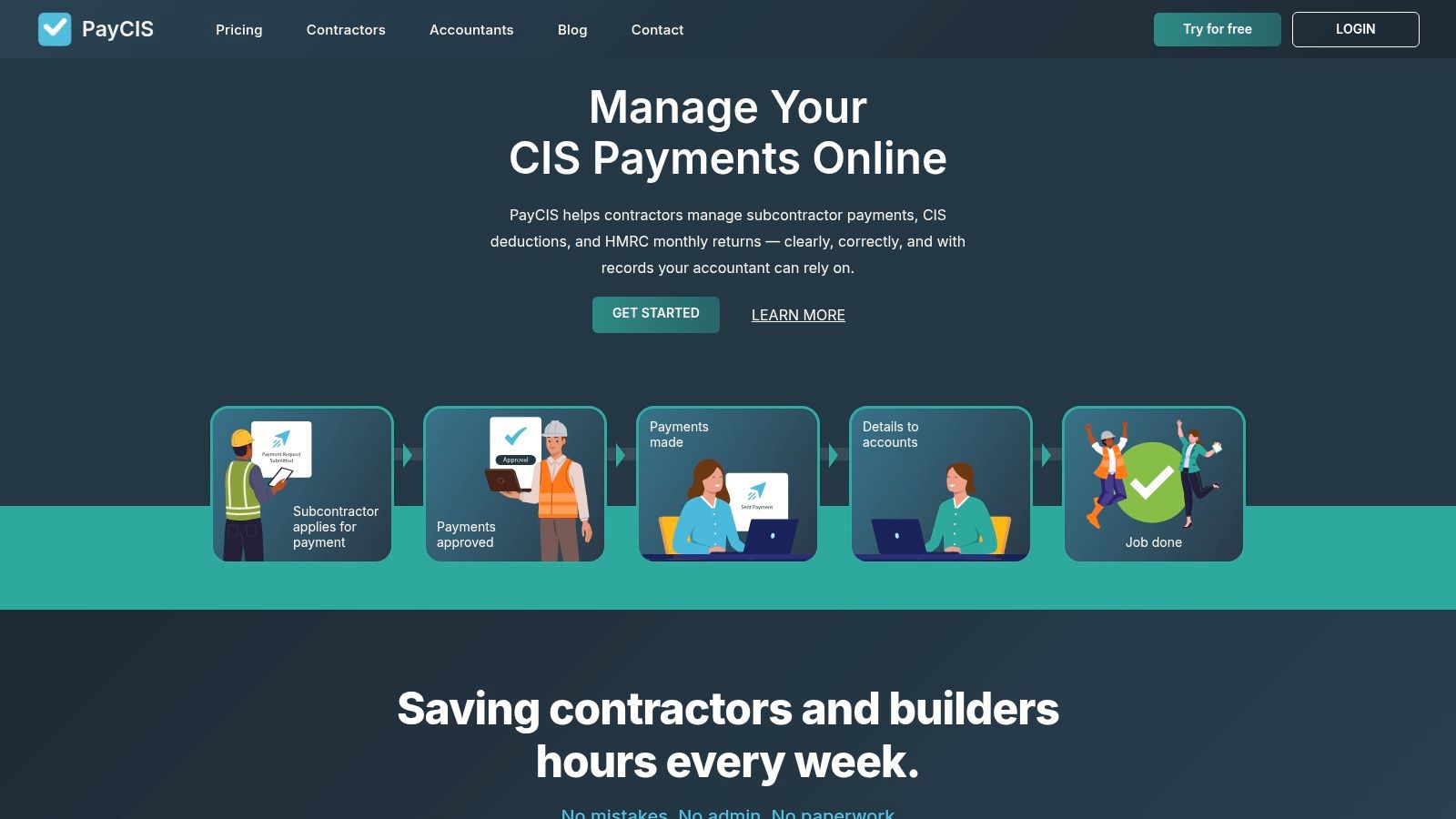
PayCIS is for firms that want to keep CIS in-house instead of handing everything to an external bureau.
That's a sensible route when you want direct control over subcontractor verification, deductions, and monthly return preparation, but don't want to build the workflow from spreadsheets and memory. PayCIS is positioned as a purpose-built CIS tool rather than a generic payroll add-on, and that usually makes a difference in day-to-day use.
Here's the platform view:
Where it works well
The practical appeal is its focused workflow. CIS verification, deduction handling, and return preparation sit in one place, which is better than trying to force general payroll software into a construction-specific process.
If you need a quick refresher on the framework behind all of this, Umbrella Company has a useful explainer on what the Construction Industry Scheme is.
- Best for control: You keep the process internal instead of relying on a bureau turnaround.
- Best for accountants and office teams: Digital remittance records are easier to reconcile later.
- Best for CIS-heavy setups: It suits businesses where subcontractor payments are frequent enough to justify dedicated software.
The trade-off is visibility. Public pricing isn't clearly listed, and the site gives limited detail before you engage. That isn't unusual in payroll software, but it does slow down comparison.
The strongest DIY CIS tools save admin only if your team already has someone who owns the process.
If nobody in your office is going to stay on top of verifications, remittances, and deadlines, software alone won't solve the problem.
3. DTM Payroll
DTM Payroll takes the opposite approach to PayCIS. Instead of helping you run CIS yourself, it offers a managed bureau service for PAYE and CIS.
That makes it a better fit for subcontractors and small construction firms who don't want payroll sitting on an admin manager's desk every Friday afternoon. The service is built around regular pay runs, RTI submissions, pension handling, and digital payslips.
Best use case
DTM Payroll is strongest when consistency matters more than flexibility. If you've got a steady flow of workers, recurring pay cycles, and no appetite for fixing payroll errors yourself, a bureau model can be the cleaner option.
Its positioning around fixed monthly fees and no hidden charges is useful, even though exact pricing isn't published online. Onboarding speed and a named payroll contact also matter in practice, because payroll problems are rarely solved by generic ticket systems.
If you're comparing bureau payroll against umbrella arrangements, this guide to which payroll solution gives the highest take-home pay helps frame the right questions.
- Works well for regular payroll cycles: Weekly, fortnightly, and monthly structures are supported.
- Reduces deadline risk: RTI and routine compliance work sit with the provider.
- Less ideal for very small setups: If you only pay a handful of CIS workers occasionally, a full bureau may be more than you need.
One useful benchmark from the verified data is that 65% of UK subcontractors use ERP and project management tools to streamline operations, based on the cited AXA XL 2026 construction tech adoption study in the data provided. That lines up with what we see in practice. The more repeatable your operations become, the more value you get from outsourced payroll systems that fit into a wider workflow.
4. Centurion Payroll Services
Centurion Payroll Services is a straightforward option for businesses that want hands-on support, not just software access.
Its CIS payroll offering focuses on onboarding, subcontractor verification, deduction handling, remittances, and HMRC submissions. It also references joint-employment handling where appropriate, which makes it more specialised than a standard payroll processor.
The real advantage
Centurion's strongest selling point is personalised service. For many subcontractors, especially those dealing with mixed worker categories or changing site teams, a named contact is more useful than a polished dashboard.
That matters because UK construction compliance has had a long administrative tail. The modern form of CIS has been in place since the early 1970s, with major reforms over time, and the broader compliance framework pushed firms towards more formal record-keeping and digital discovery tools, as noted in this subcontractor bidding and CIS background article.
A good payroll partner doesn't just process payments. They spot when your process is drifting into risk.
The downside is familiar. Pricing isn't public, and the website only gives an overview. You'll need a call to understand how the service handles edge cases, onboarding timelines, and communication standards.
Centurion is a better fit if you want support with judgement calls and administration. It's less attractive if your priority is self-service software with detailed public documentation.
5. Serenity Payroll
Serenity Payroll is a specialist CIS payroll provider with a construction-led feel. If your payroll rhythm is weekly, site headcount moves around, and you need someone who understands subcontractor-heavy operations, it's a sensible name to shortlist.
The service covers CIS onboarding, verification, payslip handling, and HMRC submissions. It's built around the kind of work pattern many general payroll firms struggle with, where crews change quickly and payment accuracy needs to hold up under pressure.

What makes it practical
Serenity looks most useful when volume changes week to week. That's where specialist providers tend to outperform broader bureaus, because they're already set up for fluctuating labour numbers and short payroll windows.
Another practical point is compliance visibility. Verified benchmark data says websites with secure IR35 compliance guides and sector-specific support sections see a 35% higher conversion rate than those without, which reflects how much buyers now value sector-specific guidance in regulated services. Serenity's niche construction focus fits that expectation.
A few clear takeaways:
- Good for weekly construction payroll: It appears designed for regular CIS movement.
- Better than generic payroll for site-led businesses: The construction angle is front and centre.
- Harder to compare on price: Like many providers in this category, you'll need to enquire.
If you want a provider that feels close to the realities of site payroll rather than office payroll, Serenity is one of the more relevant subcontractor websites on this list.
6. PhoenixCIS
PhoenixCIS is one of the simpler offerings here, and that simplicity is part of the appeal.
Some subcontractor websites overload the buyer with broad outsourcing claims. PhoenixCIS is easier to read. It frames itself around compliant processing, reliability, and a clear CIS lifecycle that covers verification, deductions, remittances, payslips, and monthly returns.

Who should consider it
This is a good pick for firms that are relatively new to CIS outsourcing and don't want to decode vague sales language. If your current process is messy, manual, or inconsistent, a provider that keeps the service model obvious is often the best first move.
One broader point from the verified data is especially relevant here. 92% of contractors rate their site as highly effective for securing contracts, and platforms optimised for fast results can bring client sign-up time to under 60 seconds. In practical terms, subcontractor websites need to feel fast and credible now. Slow, unclear, hard-to-use payroll sites lose trust quickly.
PhoenixCIS does have limitations:
- Pricing isn't shown publicly
- Integration detail is limited
- You'll still need procurement checks before committing
That said, if you want a CIS-first provider with a simple message and straightforward service framing, PhoenixCIS earns a place on the shortlist.
7. Magic Connect
Magic Connect takes a slightly different route by pairing CIS payroll with a worker-facing app and benefits package.
That won't matter to every subcontractor. If all you want is deduction handling and remittance statements, the extras may feel unnecessary. But for agencies or contractors trying to retain workers, a pay portal plus benefits can have practical value.
Where the extras help
Magic Connect includes CIS payroll processing, returns, remittances, and a portal for pay visibility. It also promotes worker benefits such as discounts, wellbeing support, and access to services that sit outside core payroll.
That kind of packaging works best when labour retention is part of the problem. If your workforce moves often, a better worker experience can help reduce avoidable churn, even if payroll itself is broadly similar to competing services.
If two providers handle CIS equally well, choose the one workers will actually find easier to deal with every week.
One wider trend from the verified data supports this shift. A 2025 UK Landbase B2B Technology Adoption Report found that 30% of UK subcontractors now use AI implementation rates exceeding 40% on their sites, enabling real-time personalisation and ROI tracking for B2B buyers. You don't need AI for its own sake, but the message is clear. Buyers increasingly expect payroll and contractor-facing platforms to be easier, more responsive, and more personalized.
Magic Connect is strongest when payroll is part of a wider worker management strategy. It's weaker if your only goal is the cheapest bare-bones CIS processing.
8. SHMS Contracting
SHMS Contracting sits closer to compliance-led subcontractor support than pure payroll processing.
That makes it useful for organisations that care about insurance, liability modelling, and CIS administration in the same conversation. Its offer includes CIS management, HMRC submissions, record keeping, and insurance elements for registered subcontractors.
Why compliance-led buyers may prefer it
SHMS stands out because it gives you more than payment processing. The liability calculator and supporting resources suggest a business that understands subcontractor risk in practical terms, not just payroll terms.
That broader stance matters because one of the biggest content gaps in this market is verification. The verified data notes that a major underserved angle in UK searches for subcontractor websites is how subcontractors are verified and matched to the right compliance route, not just how they find work. There's no comparable neutral central UK public directory in the provided results, unlike certain US public tools referenced in this subcontracting resources page from the US Army Corps of Engineers. In plain English, buyers often have to do more due diligence themselves.
If you're still actively sourcing work as well as tightening compliance, Umbrella Company also has a page on jobs for subcontractors.
SHMS is a strong fit when you want payroll, compliance support, and risk awareness under one roof. It's less suitable if you only need a lightweight payroll bureau with no extras.
9. Forest Payroll
Forest Payroll is aimed at businesses that want software and managed service in one place.
That can be a good middle ground. Pure software can leave too much work with your internal team, while a pure bureau can feel opaque if you want more direct operational control. Forest Payroll appears to sit between those two models with onboarding, CIS calculations, HMRC submissions, BACS payments, remittances, year-end support, and time and attendance functionality.
Best fit
Forest Payroll is most appealing when workforce numbers shift across projects and payroll accuracy depends on cleaner inputs from site activity. Time and attendance tools can reduce disputes before they hit payroll, which is often more valuable than another layer of reporting afterwards.
From the verified data, 9% of UK subcontractors automate 1 to 3 processes via their websites, with CRM and bidding or estimating software identified as common tools in the cited Construction Dive 2026 report. That figure shows where many businesses still are. Partial automation, not full transformation. Forest Payroll fits that practical stage well.
- Useful for rotating subcontractor bases: It appears built for project-by-project movement.
- Helpful if payroll errors start with bad time capture: Time and attendance support matters.
- Needs due diligence: Integration depth and pricing detail are limited publicly.
For firms growing out of spreadsheets but not ready for a heavy enterprise stack, Forest Payroll looks like a credible bridge option.
10. Voloconst
Voloconst is a portal-led CIS payroll option focused on automation.
Its pitch is clear. Use the platform to handle registration, verification, deductions, RTI reporting, and year-end statements through a secure online environment. For contractors who want software-led efficiency with some managed support behind it, that setup can be attractive.
The procurement view
Voloconst is one of those subcontractor websites where the feature set makes sense quickly. You can see the CIS-specific workflow without digging through unrelated payroll language, and that's always a good sign.
Still, this is a platform to assess carefully during procurement. The site makes marketing claims about scale and accuracy, and those should be validated in the usual way through demos, references, and service detail.
One final benchmark from the verified data is useful here. Websites with integrated AI workflows see a 22% increase in client engagement compared with static sites. The lesson isn't that every payroll provider needs AI. It's that responsive, functional, workflow-driven platforms are outperforming brochure-style websites. Voloconst's portal-led model is aligned with that shift.
What works well:
- Clear CIS-specific automation
- Portal-led administration
- Suitable for firms that want process efficiency first
What doesn't:
- No public pricing
- You'll need to verify operational claims yourself
- Managed support detail is lighter than some bureau-led competitors
Top 10 Subcontractor Website Comparison
| Service | Target audience | Key strengths / USPs | Pricing & onboarding | Limitations |
|---|---|---|---|---|
| Umbrella Company | Contractors, freelancers, payroll pros, IR35 cases | Role & sector matching, IR35 guidance, built‑in take‑home calculator, fast free comparisons | Free comparison service; provider fees vary; setup ~1 minute | UK‑focused; not a substitute for personalised tax/legal advice; fees vary by provider |
| PayCIS | SMEs and contractors keeping CIS in‑house | Purpose‑built CIS workflow, reduces errors, digital remittances & returns | Pricing on request; demo required; web app (JS) | No public pricing; limited info without sales engagement |
| DTM Payroll | SMEs & construction firms wanting outsourced payroll | PAYE & CIS bureau, fixed‑fee positioning, RTI on/ before payday, dedicated manager | Quote‑based fees; onboarding often within 48 hours | Fees not published; bureau may be overkill for very small teams |
| Centurion Payroll Services | Businesses needing personalised account management | Named account manager, strong compliance focus, joint‑employment option | Quote required; details via call | No published pricing; website is overview‑level |
| Serenity Payroll | Construction contractors with weekly pay needs | CIS specialist, weekly payroll support, scales for fluctuating headcount | Pricing on enquiry; supports weekly runs and named support | Pricing not published; newer brand with limited public references |
| PhoenixCIS | Newcomers to CIS or firms seeking simple compliance | Straightforward CIS lifecycle support, transparent remittances, UK phone support | Fees not disclosed; contact sales | Pricing opaque; limited integration technical detail |
| Magic Connect (CIS payroll) | Agencies & contractors wanting payroll + retention benefits | CIS payroll + worker benefits app, pay portal, public liability inclusion | Margin/fees on contact; benefits bundled option | Fees not transparent; benefits may be unnecessary for pure payroll needs |
| SHMS Contracting | Organisations prioritising compliance & liability modelling | CIS management, liability calculator, public liability & accident insurance | Enquiry‑based pricing; compliance resources available | Not pure payroll‑only; broader labour‑supply model may exceed some needs |
| Forest Payroll | Firms wanting software + managed payroll services | Time & attendance, BACS payments, secure portal, scalable managed service | Limited public pricing; service + software model | Newer brand; limited public integration/pricing detail, due diligence advised |
| Voloconst | Firms seeking portal‑led CIS automation | Automated verification, RTI & year‑end, secure contractor portal, claims large scale | Pricing via sales; managed support available | Marketing claims should be validated; no public pricing |
Making Your Choice: Compliance and Simplicity Are Key
The best subcontractor websites don't just help you process payments. They help you avoid preventable mistakes.
That means checking whether a platform is built for UK construction realities, not just payroll in general. CIS handling, clear remittances, reliable submissions, support for fluctuating site labour, and sensible communication all matter more than polished marketing. If a provider looks impressive but leaves you unclear on deductions, onboarding, or responsibilities, it probably isn't the right fit.
There's also a basic decision to make early. Do you want software, managed service, or an umbrella solution?
- Choose software if you want control in-house and already have someone who can manage CIS properly.
- Choose a bureau or managed payroll service if regular pay runs are creating admin pressure and you need operational consistency.
- Choose an umbrella company if you're working inside IR35, moving between assignments, or want the lowest-friction route for PAYE compliance.
For many subcontractors, especially individuals working on inside IR35 contracts, simplicity is the deciding factor. Running a limited company, managing tax responsibilities, and keeping payroll compliant can be done, but it often takes more time and creates more risk than people expect. A compliant umbrella company removes much of that burden by handling tax and National Insurance deductions through PAYE and giving you a more straightforward payroll experience.
That's why Umbrella Company is such a useful first stop. Instead of forcing you to chase providers one by one, it helps you compare suitable umbrella companies based on your role, pay rate, and IR35 position. That shortens the path to a workable decision and reduces the odds of choosing a provider that looks fine on the surface but doesn't fit your contract setup.
There's also a wider website lesson here. Buyers increasingly expect speed, mobile usability, clear compliance information, and less friction. If you're a subcontractor improving your own digital presence, Exclusive Addons' website enhancement tips are a useful reminder that user experience affects trust long before anyone picks up the phone.
The safest choice is usually the one that makes your obligations clearer, not more complicated. Start with compliance. Check payment reliability. Then compare the actual admin burden and cost structure.
If you want a faster, lower-risk way to find a suitable payroll partner, Umbrella Company is a smart place to begin. You can compare trusted providers based on your contract type, pay rate, and IR35 status, then choose an option that fits how you work.


