


A Statement of Work (SOW) is the blueprint for your entire project. It is the master document that spells out exactly what you will deliver, how you will do it, by when, and for how much. Think of it as the foundational agreement between you and your client that gets everyone on the same page from day one. This guide will explain what a Statement of Work is and how you can use it to protect your business.
What Is a Statement of Work and Why Does It Matter

An SOW is a formal, legally binding document that maps out every critical aspect of your engagement. Its main job is to remove ambiguity before it can cause problems. By clearly defining project goals, deliverables, timelines, and payment terms in one place, it prevents misunderstandings down the road.
For contractors in the UK, a solid SOW is more than just good business sense. It is a vital tool for proving your professional status and navigating the tricky waters of IR35. Getting this right protects you, protects your client, and sets the stage for a successful project.
The Strategic Importance for UK Contractors
A well-crafted statement of work is your best defence against scope creep, a common problem where a project slowly grows beyond what you originally agreed to. Without a clear SOW, a client might casually ask for "just one more tweak" or an extra feature, assuming it is all part of the original fee. Your SOW puts a firm pin in that.
More importantly, it frames your working relationship correctly. It proves you are an independent business contracted to deliver a specific service, not a disguised employee. This distinction is absolutely critical when it comes to your IR35 status, a topic we will be covering in more detail. For some excellent background on how this works when bidding for contracts, this guide on What Is a Statement of Work is a great starting point.
By defining exactly what success looks like and how it will be measured, an SOW builds immediate trust. It signals to your client that you are an organised, professional, and reliable business partner focused on delivering outcomes, not just logging hours.
Core Benefits of a Strong SOW
A thorough SOW is not just paperwork; it is an investment that pays off throughout the project. It secures your work and reinforces your professional standing.
Here is a quick summary of what each component does for you:
Quick Guide to SOW Core Components
| Component | Its Purpose for You |
|---|---|
| Project Objectives | Defines the "why" of the project, keeping everyone focused on the end goal. |
| Scope of Work | Clearly lists what is included and, crucially, what is not included. |
| Deliverables & Milestones | Breaks the project into tangible outputs, which often trigger your payments. |
| Timeline & Schedule | Sets realistic deadlines and manages client expectations from the start. |
| Payment Terms | Guarantees you get paid on time for the work you complete. |
| Acceptance Criteria | Defines how and when your work is officially considered "done." |
These elements work together to create a safety net for your business.
A few key advantages really stand out:
- Clarity and Alignment: It ensures you and the client have a shared vision, which is the best way to avoid costly arguments later.
- Risk Mitigation: If a dispute arises, the SOW is your single source of truth, detailing exactly what was agreed upon.
- Financial Protection: It ties your payments directly to completed work or milestones. This is fundamental to managing your cash flow. We cover this in more detail in our guide to contracting in business.
- Professionalism and Credibility: Nothing says "I know what I am doing" like a detailed, professional SOW. It immediately boosts your client’s confidence in you.
This guide will walk you through exactly how to build a statement of work that protects your interests and sets you up for success.
The Building Blocks of a Bulletproof SOW

To draft an SOW that actually protects your business, you need to think beyond a simple to-do list. It is a bit like building a solid wall; each brick must be laid correctly and in the right place, or the whole thing will be unstable. A truly bulletproof SOW is made up of several distinct parts that lock together to form a solid foundation for your project.
Let's move past the high-level view and get into the practical details of each building block. Understanding what each part does is the key to writing a document that stops disputes before they start, manages expectations, and ultimately, ensures you get paid for your hard work.
Defining Clear Project Objectives
Before you even think about tasks or deliverables, you must nail down the ‘why’. What is the whole point of this project? The objectives section lays out the business purpose and the specific, measurable goals the project is meant to hit. This is your North Star for the entire engagement.
It must answer the big questions:
- What problem are you actually solving for the client?
- What does a successful outcome look like in concrete terms?
- How will this work benefit the client's organisation?
An objective is not just "build a new website." A proper objective is "to develop a new e-commerce website that increases online sales by 20% within six months of launch." That level of clarity gets everyone pulling in the same direction.
Detailing the Scope of Work
This is probably the most important section for preventing the dreaded ‘scope creep’. The scope of work details every single activity, task, and process needed to hit the project objectives. You have to be incredibly specific, leaving no grey areas for misunderstanding.
Just as importantly, it must also define what is not included. Clearly stating exclusions is one of the most powerful things you can do to protect your time. For example, if you are designing a logo, you might add: "This scope does not include creating a full brand style guide, business card designs, or social media assets."
Because the SOW is so crucial for defining what is in and out, knowing how to put together a strong project scope template is a skill that feeds directly into creating a better SOW. It helps you list every activity with precision.
A well-defined scope acts as a fence around your project. It keeps the agreed work in and any unpaid "extras" out, ensuring that any new requests are handled through a formal change process.
Listing Specific Deliverables
Deliverables are the tangible things you will actually produce. While the scope describes the work you will do (the ‘how’), deliverables describe the results you will hand over (the ‘what’). It is standard practice to tie your payment schedule to these deliverables, which is vital for maintaining a healthy cash flow.
Each deliverable needs a clear description. For instance:
- Initial Design Mock-up: A high-fidelity, non-interactive visual of the website homepage, delivered as a PDF file for review.
- Monthly Performance Report: A report covering key marketing metrics, including site traffic, conversion rates, and campaign ROI, delivered by the 5th working day of each month.
- User Training Manual: A complete guide for the client's internal team on using the new software’s back-end system.
Setting the Schedule, Milestones, and Payments
A realistic project schedule is all about managing client expectations and giving everyone a clear roadmap. It needs a start date, an end date, and key milestones in between. Milestones are major checkpoints that signal a big phase of work is complete, and they usually line up with a specific deliverable.
Your payment schedule should be directly linked to hitting these milestones. This structure means you get paid for your work as you progress, rather than having to wait until the very end of a lengthy project.
Example Milestone and Payment Structure:
| Milestone | Deliverable | Payment Due |
|---|---|---|
| Project Kick-off | SOW Signed | 25% Upfront Deposit |
| Design Approval | Approved Homepage Mock-up | 25% of Project Fee |
| Development Complete | Beta Version of Website | 25% of Project Fee |
| Project Go-Live | Public Launch of Website | 25% Final Balance |
Outlining Acceptance Criteria and Reporting
How will you both agree that a deliverable is finished? Acceptance criteria are the pre-agreed conditions that must be met for a deliverable to be officially signed off. This takes all the guesswork and subjectivity out of it, giving you a clear checklist for getting approval.
For a website design, the criteria might include something like: "The design must be fully responsive, displaying correctly on the latest versions of Chrome, Firefox, and Safari."
Finally, reporting requirements set the rules for how you will communicate progress. This could be weekly update emails, fortnightly calls, or formal monthly reports. Agreeing on this upfront ensures the client feels looped in and confident as the project moves forward.
Using Your SOW to Demonstrate Outside IR35 Status
For contractors in the UK, getting your IR35 status right is always front of mind. A properly drafted statement of work is one of the best bits of evidence you can have to show you are operating ‘outside IR35’. It is your proof that the relationship is a genuine business-to-business one, not a case of ‘disguised employment’.
The trick is to use the SOW to address the key tests HMRC uses for employment status. A vague SOW can leave you exposed to an inside IR35 determination, but a precise one builds a solid wall of defence for your independent status.
Defining a Specific Project to Counter MOO
One of the big tests for being outside IR35 is a lack of Mutuality of Obligation (MOO). In simple terms, this means your client is not obliged to keep offering you work when the project ends, and you are not obliged to take it. Your SOW is the ideal place to draw this line in the sand.
Instead of describing your work like an ongoing role, the SOW must focus on a specific, finite project. It needs a clear beginning, a defined end, and a tangible result. This shows you have been brought in to get a particular job done, not just to fill a seat.
Here are a few ways to frame it:
- "This statement of work covers the complete and final scope for the 'Website Redesign Project', starting on [Start Date] and ending upon final client acceptance, which is estimated to be on or around [End Date]."
- "Once all deliverables listed in this document have been successfully delivered and signed off, this engagement will be considered complete."
- "There is no obligation for the client to offer, nor for the contractor to accept, any work beyond the scope defined in this SOW."
Articulating a Clear Right of Substitution
A real business can send someone else to do the work, and so can you. This is known as the Right of Substitution, and it is a massive indicator of being outside IR35. Clients can be a bit wary of this, but you can write it into the SOW in a way that gives them confidence.
Your SOW needs a clause that explicitly gives you the right to send a substitute. It proves the client is paying for a service to be delivered, not for you personally.
The Right of Substitution cannot just be a theoretical clause you never intend to use; it has to be genuine. Your SOW should make it clear that any substitute would be suitably qualified and, crucially, that you would pay them yourself.
A solid substitution clause might read:
"The contractor reserves the right to provide a qualified substitute to carry out the services in this statement of work. The contractor guarantees any substitute will have the necessary skills to meet the project's requirements and will be remunerated solely by the contractor."
Using Deliverables to Demonstrate Independence
How your work is structured matters just as much as what you do. An SOW that centres on project-based deliverables rather than a set number of hours or days helps prove you are not working like an employee. The focus shifts from your time to your results.
Tying your payments to hitting these milestones strengthens that business-to-business feel even more. You are getting paid for achieving specific outcomes, not just for showing up.
To get a deeper understanding of the rules and how they affect you, our guide on IR35 for contractors is packed with valuable insights.
While a strong SOW is your best friend for outside IR35 work, you also need a plan for any contracts that are deemed 'inside IR35'. For those, a compliant umbrella company offers a safe, straightforward way to handle your tax and NI, giving you peace of mind no matter what your IR35 status is.
How a Statement of Work Operates with an Umbrella Company
When you are a contractor using an umbrella company, it can feel like you are juggling two different agreements. You have the statement of work (SOW) with your client, and you have an employment contract with the umbrella company. It is vital to understand how these two documents fit together.
Think of your SOW as the project’s blueprint; it tells the client what you will deliver and when. Your umbrella company, on the other hand, acts as your payroll and HR department, handling the specifics of how you get paid correctly and compliantly. They are separate but linked parts of your contracting life.
The Flow of Information and Payment
The process might seem complicated, but it is more straightforward than you would think. The payment terms you define in your SOW are what kickstart the entire payment chain.
When you complete a milestone or reach a payment date, you will submit an invoice or timesheet to your client for approval. Once they sign it off, the funds are transferred to your umbrella company. This is where their role as your employer begins. They do not simply pass the money to you; they process it as employment income.
This means they handle all the necessary deductions:
- Calculating and deducting the correct PAYE (Pay As You Earn) tax.
- Deducting both Employee’s and Employer’s National Insurance contributions.
- Accounting for any pension contributions and their own margin.
- Providing you with a detailed payslip that breaks down all these deductions.
The final amount that lands in your bank account is your net pay, with all your tax and NI obligations taken care of. It removes a huge administrative headache, freeing you up to focus on the work outlined in your SOW.
Your SOW as a Compliance Tool in the Supply Chain
As regulations evolve, a well-drafted SOW is becoming more critical than ever. A clear statement of work helps define the entire supply chain, from the end client, through the agency and umbrella company, right down to you. This clarity is essential for assigning liability correctly.
This diagram shows how key elements in your SOW, like defined deliverables, the right of substitution, and a clear project scope, serve as strong evidence for your IR35 status.
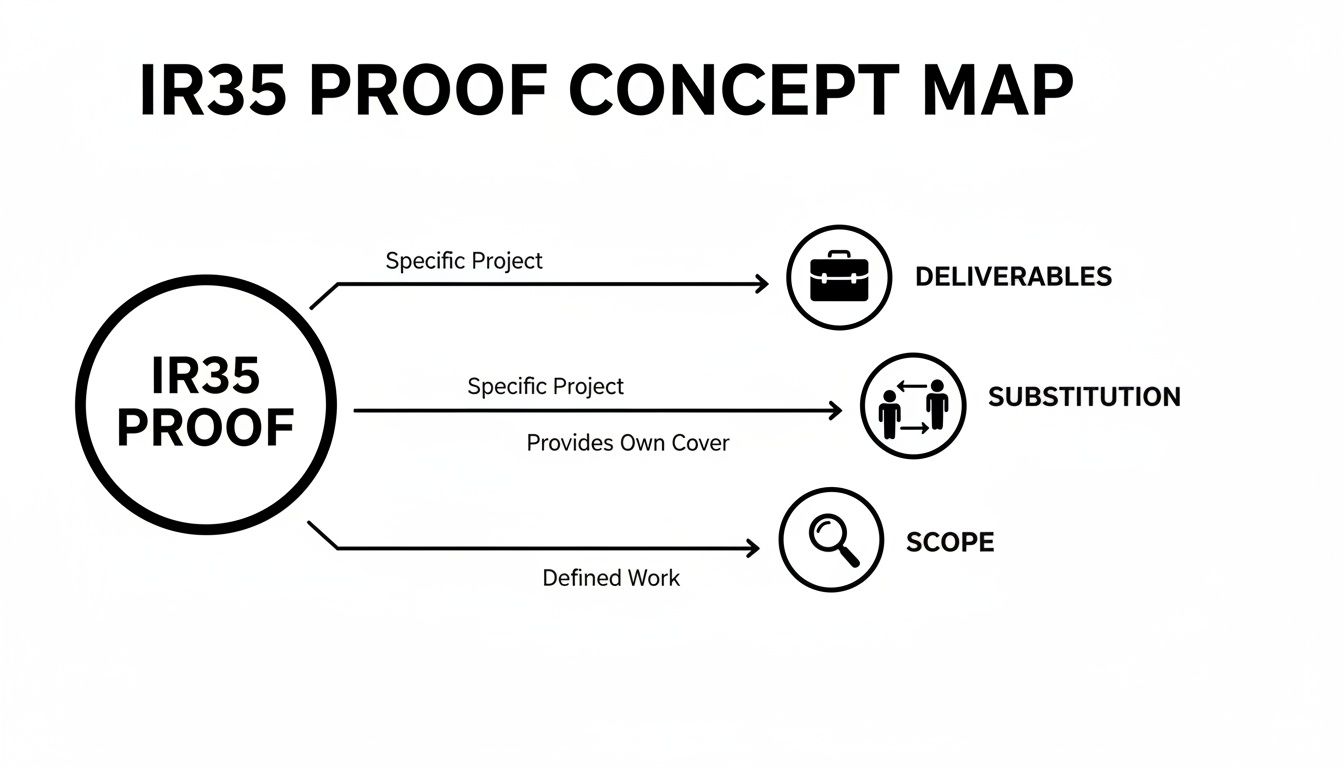
By spelling these things out, your SOW helps prove you are in a genuine business-to-business relationship, which is a cornerstone of IR35 compliance.
For the 1.6 million contractors in the UK who use umbrella companies, a solid SOW is an essential tool. Forthcoming regulatory changes in 2026 will transfer PAYE liability to agencies, with end clients next in line. These changes are expected to help recover £2.8 billion by 2029-30 by targeting non-compliant schemes, which were responsible for an estimated £500 million in lost tax in 2022-2023 alone.
A well-defined SOW acts as a protective shield. It clearly shows you are engaged for a specific service, not as a disguised employee, which helps protect the entire supply chain from tax compliance risks.
Partnering with Compliant Umbrella Companies
Your SOW protects you on the project side; a compliant umbrella company protects you on the tax and employment side. The two go hand-in-hand.
A trustworthy umbrella provider understands the importance of a clear SOW and will never suggest bending the rules or getting involved in tax avoidance schemes. At UmbrellaCompany.com, we connect contractors with fully accredited and compliant partners who value transparency. You can learn more in our guide to choosing an umbrella company for freelancers.
Ultimately, the SOW sets the commercial terms with your client, and the umbrella company makes sure your earnings are processed in full compliance with HMRC rules. When you get both right, you gain professional protection and peace of mind.
Common SOW Pitfalls and How to Avoid Them
A well-written Statement of Work can be a contractor’s best friend. But a bad one? That can quickly become your worst nightmare, leading to disputes, unpaid invoices, and a soured client relationship.
We have seen countless contractors stumble into the same predictable traps. Learning to spot these pitfalls before you sign is one of the most valuable skills you can develop. Here is what to watch out for.
The Trap of Vague Language and Scope Creep
The most dangerous pitfall is an SOW filled with vague, woolly language. Phrases like "assist with marketing efforts" or "provide general IT support" are recipes for disaster. They leave far too much open to interpretation, which often leads to an ever-expanding list of tasks you never agreed to.
This is how scope creep begins. The project slowly bleeds beyond its original boundaries, but the fee stays the same. Before you know it, you are working more for less, your effective day rate plummets, and burnout is not far behind.
Example Scenario:
A developer signs an SOW to deliver "website improvements." The client then demands a complete checkout redesign, a new blog, and a third-party inventory integration, all for the original fee. Because "improvements" was never defined, the developer has a weak foundation for pushing back.
Unrealistic Timelines and Milestones
Clients, bless them, are often wildly optimistic about project timelines. Signing an SOW that reflects their optimism rather than reality puts you under immense pressure from day one. It sets you up to fail, especially if your payments are tied to hitting those impossible milestones.
Your job is to be the voice of professional realism. Break the project into smaller, manageable tasks and estimate the time for each. Always add a sensible buffer for the things that inevitably go wrong: unexpected bugs, rounds of feedback, or client delays.
A few tips to manage expectations:
- Be Assertive: Do not be afraid to politely explain what is realistically achievable within a given timeframe. Back it up with a logical breakdown of the work.
- Define Dependencies: Clearly state which of your tasks rely on the client. If they are late providing feedback, content, or system access, the timeline shifts. Make sure the SOW says so.
- Use Phased Deadlines: Ditch the single, high-stakes deadline at the end. Set multiple, smaller deadlines for each milestone. This keeps the project moving and flags any potential delays nice and early.
Ambiguous Payment Terms
Another classic mistake is leaving any ambiguity around your payment terms. Your SOW must be crystal clear about when and how you get paid. Without this, you risk facing serious cash flow problems while you chase overdue invoices.
Your SOW absolutely must specify:
- The total project fee or the agreed hourly/daily rate.
- A clear payment schedule linked to specific dates or milestones.
- The invoicing process (who to send them to and when).
- The payment terms (e.g., “Payable within 14 days of invoice receipt”).
By tying payments directly to the completion of specific, agreed-upon deliverables, you create a clear, enforceable contract. This transforms the payment process from a hopeful expectation into a contractual obligation, protecting your income.
No Formal Acceptance Criteria
Finally, a huge red flag is an SOW with no formal acceptance criteria. This is the part that defines, in black and white, what "done" looks like. Without it, a client can keep refusing to sign off on your work based on subjective feelings or a last-minute whim, trapping you in a cycle of endless, unpaid revisions.
Your acceptance criteria should be a simple, objective checklist. Once every item on that list is ticked, the deliverable is officially complete. For example: "The user login feature is complete when a registered user can successfully log in, access their dashboard, and log out using the latest versions of Chrome and Safari." There is no room for debate, ensuring you get your work signed off and your invoice paid.
Your Statement of Work Template and Checklist

The best way to get comfortable with creating SOWs is to start drafting them. To give you a head start, we have put together a Statement of Work template built specifically for UK contractors. Think of it as a solid foundation for your next project.
This is not just a blank form. It is a structured document that already includes all the critical components we have covered. You can take this framework and adapt it to the specifics of any engagement, whether you are in IT, creative services, or business consulting.
Your Final Review Checklist
Before you ever send a statement of work to a client, it is essential to give it one last review. This final check helps you catch any small omissions or ambiguities that could grow into much bigger problems down the line.
Running through these questions ensures your SOW is clear, comprehensive, and ready for your client to sign.
- Objectives: Have I spelled out the project’s main goal and what a successful outcome looks like?
- Scope: Is the work to be done specific? Just as importantly, have I clearly listed what is not included?
- Deliverables: Are all outputs tangible and described without ambiguity?
- Timeline: Is the schedule realistic? Does it have clear milestones and firm deadlines?
- Payment: Does the payment schedule match the milestones, and are all terms (e.g., 'payable within 14 days') clearly stated?
- Acceptance Criteria: Have I defined the objective measures for how and when the work will be approved as complete?
- IR35: Does the language used reinforce my status as an independent business (e.g., referring to project-based work, deliverables, and the right of substitution)?
A well-written SOW is the bedrock of a professional relationship. It protects your income and stops scope creep and payment disputes before they even have a chance to start.
By using a template and a checklist, you turn a potentially complex document into a straightforward process. You will be able to produce a professional statement of work for every project, creating clarity and security for yourself and your client. For other useful tools, take a look at our freelance contract template for UK contractors.
Frequently Asked Questions About Statements of Work
As a contractor, getting the statement of work right is one of the most important parts of running your business well. To make sure everything we have covered has really sunk in, here are some quick answers to the questions we hear most often from contractors like you.
What Is the Difference Between an SOW and a Contract?
This is a common point of confusion, but the distinction is actually quite straightforward.
Think of a main contract, like a Master Services Agreement (MSA), as the big-picture legal framework. It governs your entire relationship with a client, setting out the long-term rules on things like confidentiality, liability, and how payments will be handled for any work you do together.
A statement of work, on the other hand, is all about a single project. It slots in underneath that main agreement. For every new project you take on with that client, you will have a new SOW that details the specific scope, deliverables, timeline, and cost for that piece of work only. The SOW is for the nitty-gritty details of a project; the main contract is the legal foundation for the whole relationship.
Can an SOW Be Changed After It Is Signed?
Yes, absolutely. Projects evolve, and it is normal for clients to request changes or additions along the way. The key is that it has to be done through a formal, agreed process, which is where a change order or amendment comes in.
This is not something you agree to over a quick chat or in an email chain. A change order is a proper document outlining the new request, how it affects the project timeline and budget, and any other necessary adjustments.
Both you and the client have to sign this new document before the extra work begins. This formal process is your safety net. It makes sure that:
- You get paid for any work that was not in the original scope.
- Expectations stay clear for both you and the client.
- The project timeline is officially updated to reflect the new reality.
Sticking to this process protects you from scope creep and guarantees you are paid fairly for every bit of work you do.
Who Should Write the Statement of Work?
Drafting the SOW can be a joint effort, but as the contractor, you must have the final say. Often, the client or a recruitment agency will put together an initial draft based on what they think the project needs.
Your job is to go through that document with a fine-tooth comb. You are the expert they have hired, so you are the one best placed to judge if the scope is realistic, the timeline is achievable, and the deliverables are crystal clear. Do not be afraid to question and refine it.
Never sign an SOW you have not thoroughly reviewed and agreed with. It is your main tool for protecting your business, managing what the client expects, and making sure you get paid for your expertise. Always ensure the final version is an accurate reflection of the project as you understand it.
By taking ownership of the final SOW, you set the tone for a professional, business-to-business relationship from day one.
At UmbrellaCompany.com, we specialise in helping contractors navigate the world of contracting with confidence. Our comparison tool makes it easy to find a trusted, accredited umbrella company that understands your needs. Get started in just one minute and find the right umbrella company for you.


