


Let's clear up one of the biggest myths from the start. The specific rules known as off-payroll working, or IR35, do not technically apply to sole traders. This is because the legislation was written specifically to tackle contractors who operate through their own limited company, often called a Personal Service Company (PSC).
But that doesn't mean you're in the clear. The core principles IR35 is built on (the same tests HMRC uses to determine a worker's real employment status for tax) are absolutely relevant to sole traders. If your relationship with a client looks and feels like an employer-employee one, HMRC can still reclassify you, leading to significant financial consequences.
This guide explains what sole traders need to know about employment status rules, the financial risks of getting it wrong, and how to operate compliantly.
Does IR35 Really Apply to Sole Traders?
While you might be outside the direct legislative reach of IR35, you are still subject to employment status checks from HMRC. The criteria they use for these checks are virtually identical to those used in an IR35 assessment. In simple terms, HMRC wants to ensure you're not a 'disguised employee' avoiding the correct income tax and National Insurance.
This is a very important distinction to understand. The official IR35 rules are designed for situations where there's an intermediary, like a contractor's limited company, between the worker and the end client. As a sole trader, you contract directly, so there is no intermediary. However, if HMRC investigates your contract and decides your working practices are the same as an employee's, the result is practically the same: a different, less favourable tax treatment is applied.
The Core Issue Is Employment Status
Regardless of your business structure, HMRC's main concern is the same: is the relationship between you and your client one of genuine self-employment, or is it simply employment in disguise? To make this clearer, it helps to see how these rules affect you versus a contractor working through a limited company.
The key takeaway is simple: while the name 'IR35' might not apply to your sole trader business, the risk of being reclassified as an employee for tax purposes certainly does. Focusing on your true employment status is essential.
How Employment Status Rules Impact Different Business Structures
To clarify the differences, here’s a quick comparison showing how the principles behind IR35 affect sole traders and limited company contractors.
| Factor | Sole Trader Impact | Limited Company (PSC) Impact |
|---|---|---|
| Legislation Applied | Standard employment status rules. | The official Off-Payroll Working (IR35) rules. |
| Tax Liability | If you're reclassified, the client is responsible for any back taxes and penalties. | The 'fee-payer' (which could be the client or an agency) is responsible for deducting tax at source. |
| Financial Consequence | The client would have to pay any owed tax, but your engagement could be terminated or moved onto their payroll. | Your income is processed through PAYE, which can significantly reduce your take-home pay. |
| Assessment Process | HMRC can conduct a status review at any time. | The end-client is legally required to perform a Status Determination Statement (SDS). |
Understanding these distinctions is the first step toward making sure your business operates on the right side of the line. For a deeper dive into the legislation itself, you can learn more about what IR35 is in our detailed guide.
Understanding Your True Employment Status
To keep your business on the right side of HMRC, you need to see your client relationships exactly as they do. The tax authority uses a few key tests to determine whether a working arrangement is genuinely self-employed or if it’s just employment in disguise. These aren't just tick-box exercises; they examine the reality of how you work day-to-day.
Understanding these principles is your best defence against being wrongly classified. The three main ones are Control, the Right of Substitution, and Mutuality of Obligation (MOO). Getting these right shows you're a proper business, not a 'disguised employee'.
The Test of Control
This is all about how much say your client has over how, when, and where you do your work. If they're setting your hours, making you work from their office, and managing your tasks like any other permanent staff member, that’s a big red flag for HMRC. It looks and feels like employment.
A genuinely self-employed contractor, on the other hand, agrees on the final deliverables and deadlines but keeps full control over the process. Think of a freelance graphic designer: they will agree on a project brief and a due date, but it's up to them when and where they actually create the designs.
The Right of Substitution
This is a classic cornerstone of being self-employed. The right of substitution asks a simple question: can you send someone else with the right skills to do the work instead of you? Crucially, this cannot be a token clause in a contract. It has to be a genuine, unrestricted right, meaning your client cannot just say no without a very good reason.
If your client insists that only you can do the job, it strongly points towards a contract for personal service, a hallmark of employment. But if you can, at your own cost, bring in a replacement, you’re acting much more like a business supplying a service. You can get a better handle on these details in our simple guide to IR35 for dummies.
Mutuality of Obligation
Mutuality of Obligation (MOO) looks at whether the client is obliged to keep offering you work and if you are obliged to accept it. In a standard employment contract, this obligation is always there. The employer provides the work, and the employee is expected to do it.
For a sole trader, this obligation should not exist beyond the project you're currently working on. Once that contract is finished, neither you nor the client should expect more work to automatically follow. If your client just rolls you onto the next project and you are expected to accept, it starts to look like an ongoing, employment-style relationship.
At the end of the day, figuring out your status is about looking at the whole picture of how you work. No single factor decides it, but together, they paint a very clear picture for HMRC.
This decision tree gives you a great visual on how these factors can point you towards or away from an employment-like relationship.
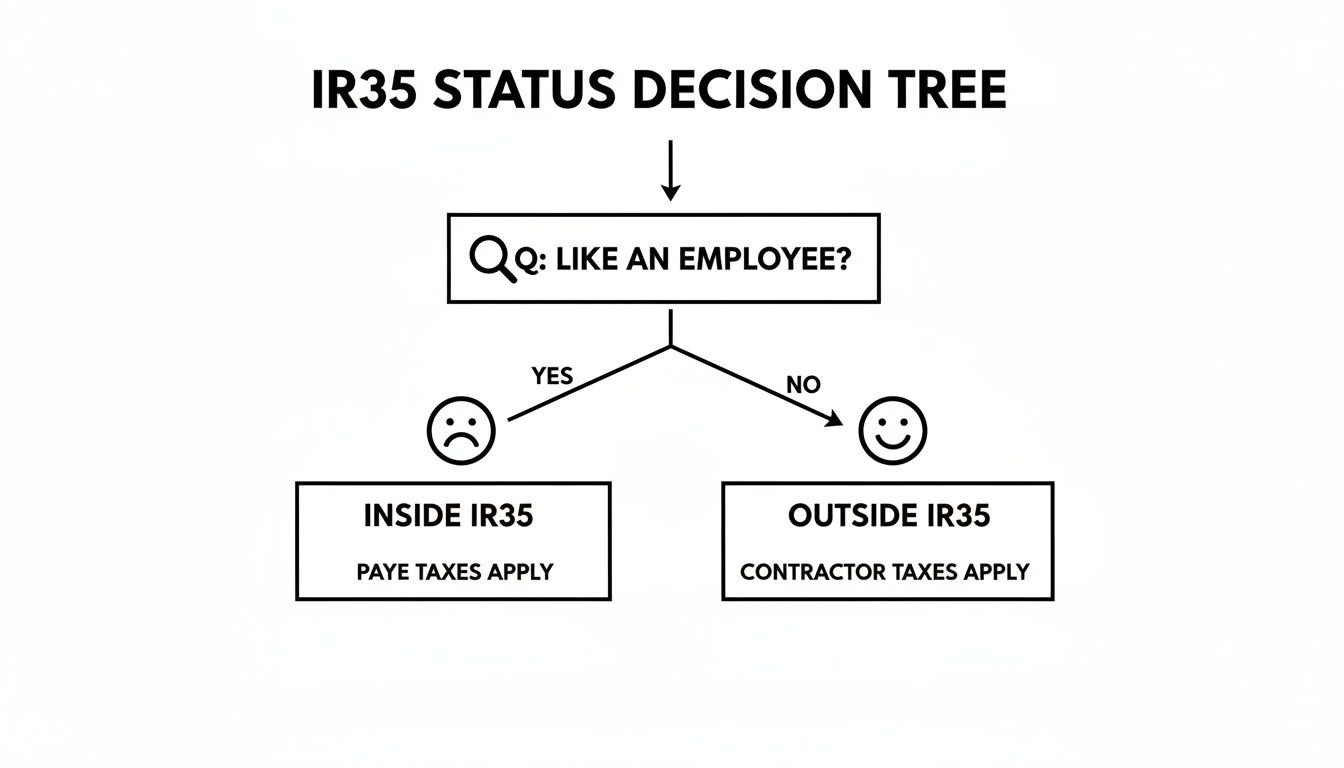
As the flowchart shows, the more your working arrangement mirrors that of a regular employee, the greater the risk you will be treated as one for tax purposes.
The Financial Hit of an 'Inside IR35' Status
When HMRC decides your working arrangement looks more like 'disguised employment' than a genuine business-to-business contract, the conversation quickly turns to your bank balance. The consequences are very real, and they completely change how you get paid.
Suddenly, your client is legally required to treat you as an employee for tax purposes. This means they must deduct Income Tax and both employee's and employer's National Insurance Contributions (NICs) straight from your invoices via their payroll. You will no longer see the gross value you billed for; instead, you get a net payment, just like any other permanent member of staff.

This shift can take a serious chunk out of your earnings. For sole traders caught by the rules, it is not uncommon to see take-home pay shrink by as much as 25%. That is a huge drop, all thanks to the heavier tax burden. HMRC's own figures from past investigations show just how much they stand to gain, highlighting the high financial stakes for contractors.
A Practical Example of Reduced Take-Home Pay
To see what this means in pounds and pence, let’s walk through a quick example. Imagine you're a sole trader and you’ve just invoiced a client £3,000 for a month's work.
- As a genuine sole trader: You would receive the full £3,000. It is then up to you to put money aside to cover your Income Tax and Class 2 and Class 4 National Insurance when you file your annual Self Assessment.
- If deemed 'inside IR35': Your client processes that £3,000 through their PAYE system. Before a penny hits your account, they deduct tax and NICs. Your actual take-home pay could be closer to £2,100, depending on your specific tax code.
That is a £900 difference in your monthly cash flow. It is a massive reduction that hammers home why getting your employment status right is not just about red tape, it is about protecting the financial health of your business.
The immediate drop in income can be a real shock and makes budgeting a whole lot harder. Understanding these numbers is the first step. Proactive compliance is not just about following rules; it is about safeguarding your earnings.
To get a clearer idea of what these deductions could look like for you, use our inside IR35 calculator. Seeing how your own pay could be affected is a powerful motivator to make informed choices about your contracts and business setup.
Choosing the Right Business Structure for Your Contracts
If you are getting worried about your employment status or have landed a contract that looks like it is ‘inside IR35’, you have some strategic thinking to do. Moving away from a sole trader setup is not just about paperwork; it is about giving yourself clarity and ensuring you are compliant. It is about operating in the smartest way for your career.
The golden rule is to match your business structure to the kind of work you do. There is no one-size-fits-all answer here. A setup that is perfect for a short, one-off project clearly outside the rules will likely be a poor fit for a long-term role that looks a lot like permanent employment.
Working with an Umbrella Company
For contractors whose work firmly falls ‘inside IR35’, joining an umbrella company is often the simplest, most straightforward solution. It’s a completely hassle-free way to operate. When you work with us at UmbrellaCompany.com, we become your official employer, which instantly removes any doubt about your employment status.
This structure just makes life easier. We take care of all your PAYE tax and National Insurance deductions, getting it right every time. It means you can get on with your work, knowing that the compliance side of things is completely handled.
The main benefits of taking the umbrella route include:
- Full Compliance: You completely eliminate the risk of HMRC misclassifying you for tax.
- Simplicity: Forget about managing company accounts or wrestling with complex tax returns.
- Employment Rights: You get access to statutory benefits you would not otherwise have, like sick pay and holiday pay.
Operating as a Limited Company
On the other hand, setting up your own limited company (often called a Personal Service Company or PSC) is a fantastic option for contractors who are confident their work is genuinely ‘outside IR35’. This structure means you are operating as a separate legal entity from yourself, which offers much greater control and can be more tax-efficient.
Running your own limited company often allows you to pay yourself a mix of a modest salary and dividends. For many, this is a much more tax-efficient way to take home your earnings. However, this route comes with a bigger administrative load. You will be responsible for managing company accounts and making sure you are compliant with all the rules.
Choosing the right structure is a strategic decision. An umbrella company offers security for 'inside IR35' roles, while a limited company provides tax efficiency for those operating firmly 'outside IR35'.
Recent trends show how much the contracting world has changed. Since the reforms in 2021, self-employment has dropped to levels not seen since mid-2015. ONS data shows that the number of sole traders has fallen by 11% since 2019, while the number of new companies being registered has risen. It is a clear sign that contractors are moving towards more formal, compliant ways of working.
How to Protect Your Business and Stay Compliant
Demonstrating that you are genuinely self-employed is about more than the words in your contract. It is all in your day-to-day actions. The best way to guard against any questions from HMRC about your employment status is to proactively operate like a proper business.
This means building a solid foundation that clearly distinguishes you from an employee. Getting a professional contract review is a sensible first step, but HMRC will always look at the bigger picture: your actual working practices. If the reality of your role does not line up with the contract, the paper it is written on will not shield you.

Building Your Case for Self-Employment
To really strengthen your position, you need to focus on the practical things that demonstrate an "independent business". Known as 'in-business' factors, they provide powerful, real-world evidence of your status.
Here is an actionable checklist to help you solidify your self-employed standing:
- Maintain a Business Presence: Run a professional business website. Use a dedicated business email address. Have your own branded letterheads and invoices. These all show you are actively marketing your services to the wider world, not just one client.
- Work with Multiple Clients: Having a diverse client base is one of the most compelling signs of self-employment. It proves you are not financially reliant on a single company, which is a classic hallmark of being an employee.
- Use Your Own Equipment: Whenever you can, use your own laptop, software licences, and tools to get the job done. Relying on equipment provided by the client can blur the lines and suggest a level of control that looks a lot like employment.
- Invest in Your Business: Taking out business insurance, like professional indemnity cover, is a clear sign you are accepting the financial risks that come with running a business.
- Market Your Services: Actively looking for new work, networking, and advertising your skills are all things employees simply do not do.
By consistently acting like a business, you create a clear and compelling picture of genuine self-employment. This approach is not about ticking boxes; it is about embedding professional independence into everything you do.
Keeping on top of regulatory changes is also vital. For example, from 6 April 2026, new financial thresholds will mean more end-clients are classified as 'small' businesses, making them exempt from the off-payroll working rules. This is a positive move for sole traders and builds on earlier reforms that saw a drop in self-employment from 5 million in early 2020 to 4.39 million by the third quarter of 2023. You can explore more insights about these changes to see how they might affect your business.
Your Top IR35 Questions Answered
When you're trying to get to grips with employment status rules, it is natural for questions to pop up. Let's tackle some of the most common queries we hear from sole traders who are figuring out where they stand. The goal here is simple: clear, direct answers so you can work with confidence.
Can I Use HMRC's CEST Tool as a Sole Trader?
Yes, you certainly can. While the Check Employment Status for Tax (CEST) tool was built with the off-payroll working rules for limited companies in mind, its logic still applies. The core principles it tests (like control, personal service, and substitution) are the very same ones HMRC uses to determine a sole trader's employment status.
Think of the CEST tool as a useful temperature check. It can give you a solid indication of how HMRC might view your contract, but it is important to know its results are not legally binding. Use it as a guide, but always alongside professional advice, not as the final word.
What Happens if My Client Says I’m Inside IR35?
If your client has determined that your contract falls ‘inside IR35’, the law requires them to treat you as an employee for tax purposes. This is a crucial point. It means they must deduct Income Tax and National Insurance Contributions (NICs) through their PAYE payroll system before you get paid.
This is exactly why many contractors in this situation choose to work through an umbrella company. It neatly formalises the employment relationship, ensuring everything is compliant and above board. This takes the administrative burden and any potential risk away from both you and your client, offering a clean, straightforward path forward.
Does Having Multiple Clients Make Me Safe from IR35?
Working with several clients at once is a very strong signal that you are genuinely in business for yourself, but it is not a magic bullet. HMRC looks at each of your client contracts individually, assessing them on their own merits.
If one of your projects has all the hallmarks of employment, it could still be classed as ‘inside IR35’, no matter how many other clients you are working with. It is vital to assess the specific terms and day-to-day reality of each client relationship to make sure you're compliant across the board.
Remember, one 'inside IR35' contract does not automatically taint your other client work. However, each engagement must be able to stand on its own as a genuine business-to-business relationship.
Is It Better to Be a Sole Trader or Use an Umbrella Company?
Honestly, the best route depends entirely on your contracts. If your work is clearly ‘outside IR35’ and you value simplicity with minimal administration, being a sole trader can be a brilliant and cost-effective way to operate.
However, for any contract that has been deemed ‘inside IR35’, an umbrella company is the most compliant and hassle-free solution. It effectively removes the risk and headache by making you an employee for that specific engagement, guaranteeing all taxes are calculated and paid correctly from the start.
Navigating the rules around employment status can be challenging, but you don't have to do it alone. At UmbrellaCompany.com, we specialise in helping contractors find compliant and reliable umbrella solutions tailored to their needs. We make it easy to compare trusted, accredited providers so you can focus on your work with complete peace of mind. Find the right umbrella company for you today.


