


The first time you go freelance, tax can feel bigger than the work itself. You start with one contract, one invoice, one login to HMRC, then suddenly you’re trying to decode Self Assessment, National Insurance, VAT, IR35, payroll, expenses, and software rules that seem to change just when you think you’ve got comfortable.
That feeling is normal. The struggle isn't typically due to poor money management. It's because UK small business taxes sit across different systems, and the rules change depending on how you work.
A sole trader doesn’t pay tax in the same way as a limited company. A contractor inside IR35 doesn’t take home pay in the same way as someone working outside it. And from April 2026, some self-employed people will also need to deal with Making Tax Digital for income tax using compatible software.
If you want a calmer way to think about all this, start with one question. What type of work arrangement do I have? Once that’s clear, the tax picture gets much easier.
Your Guide to Navigating UK Small Business Taxes
Small business taxes in the UK aren’t just one bill from HMRC. They’re a set of rules that attach to your income, your business structure, your payroll setup, and sometimes your turnover.
That’s why two freelancers earning similar amounts can end up with very different admin and very different take-home pay.
Why new freelancers get confused
Most confusion comes from mixing up three separate ideas:
- Your legal structure: sole trader, partnership, or limited company
- Your tax method: Self Assessment, Corporation Tax, PAYE, or VAT
- Your working status: especially whether a contract falls inside or outside IR35
If those get blurred together, everything feels messy.
Practical rule: Tax gets simpler when you separate the questions. First identify the structure, then the taxes that apply, then the deadlines.
What matters in practice
When we explain small business taxes to new freelancers, we usually strip it back to a few practical points:
- How money reaches you: through drawings, salary, dividends, or payroll
- Who reports it to HMRC: you, your company, or an employer or umbrella
- Which records you need to keep: invoices, receipts, bank records, and payroll documents
- What changes as you grow: VAT, software requirements, and possibly a different structure
That’s the roadmap. Once you understand those moving parts, tax stops being a fog of acronyms and starts looking like a routine you can manage.
The Core UK Small Business Taxes You Need to Know
Before comparing structures, it helps to know the main taxes by name and purpose.
Sorting post on the kitchen table helps categorize taxes: one pile is tax on you personally, another is tax on a company’s profit, another is tax you collect and pass on, and another applies when you pay people through payroll.
Income Tax
Income Tax is the tax on your personal earnings.
If you’re a sole trader, your business profit feeds into your personal tax position. For 2023/24, the basic rate is 20% on income from £12,571 to £50,270, and the higher rate is 40% from £50,271 to £125,140, according to the verified HMRC figures in the brief.
This is why sole traders often say, “I pay tax through Self Assessment.” Self Assessment is the reporting system. Income Tax is the actual tax.
A practical way to think about it is simple. If the money is your profit as an individual, HMRC wants to assess it through your personal return.
National Insurance Contributions
National Insurance Contributions, usually shortened to NICs, often confuse people because they come in different classes depending on how you work.
For sole traders, the key one is usually Class 4 NICs. For 2023/24, verified data shows this applies at 6% on profits between £12,570 and £50,270, and 2% above that.
A clear real-world example from the verified data helps. A self-employed person with £40,000 profit would pay about £1,368 in Class 4 NICs alone, alongside their Income Tax.
That matters because many new freelancers only budget for “tax” and forget NICs are a separate part of the bill.
If you’re self-employed, don’t treat National Insurance as a footnote. It changes your real take-home pay.
Corporation Tax
Corporation Tax applies to limited companies, not to sole traders.
From 1 April 2023, the UK moved away from a flat rate. Verified data states that companies with profits of £50,000 or less pay the small profits rate of 19%, while companies with profits above £250,000 pay 25%. Profits between those levels can qualify for marginal relief.
That tiered system matters because many freelancers assume “limited company tax is 25% now”. That isn’t the full picture. For smaller companies, the small profits rate may still apply.
The brief also notes that over 90% of UK limited companies qualified for the lower 19% rate based on 2022/23 HMRC data, and that around 1.5 million UK limited companies were affected by the structure.
If you want a separate explainer on thresholds and registration points, this guide on the VAT registration threshold in the UK is a useful companion.
VAT
VAT works differently from Income Tax or Corporation Tax. It isn’t mainly a tax on your profit. It’s a tax you may need to charge on your sales and then account for to HMRC.
That’s why VAT can catch people off guard. You might feel as though the money “came in”, but part of it may not really be yours to keep.
Later in this guide, we’ll look at Making Tax Digital because VAT and digital filing often overlap in day-to-day bookkeeping.
For a quick visual explanation of how these tax pieces fit together, this video gives a helpful overview.
PAYE and CIS
PAYE, or Pay As You Earn, is the payroll system used when someone is paid as an employee. Tax and employee NICs are deducted before pay reaches the worker.
Contractors often meet PAYE through umbrella companies, especially when working inside IR35.
CIS, the Construction Industry Scheme, is a separate withholding system for parts of the construction sector. It doesn’t apply to everyone, but if you work in construction-related contracting, it can affect how payments are made and how tax is settled later.
A simple glossary
Here’s the short version:
- Income Tax: tax on personal earnings
- NICs: National Insurance, calculated differently depending on status
- Corporation Tax: tax on limited company profit
- VAT: tax collected on certain sales
- PAYE: payroll deduction system for employees
- CIS: construction sector withholding system
Once those labels are clear, the next question becomes much easier. Which of them applies to you?
How Your Business Structure Defines Your Tax Obligations
Your structure is where small business taxes stop being theoretical and start affecting your bank balance.
A freelancer can do the same piece of client work as a sole trader, through a partnership, or through a limited company, but the tax route changes with the structure. So does the admin, the legal risk, and the way HMRC expects records to be kept.
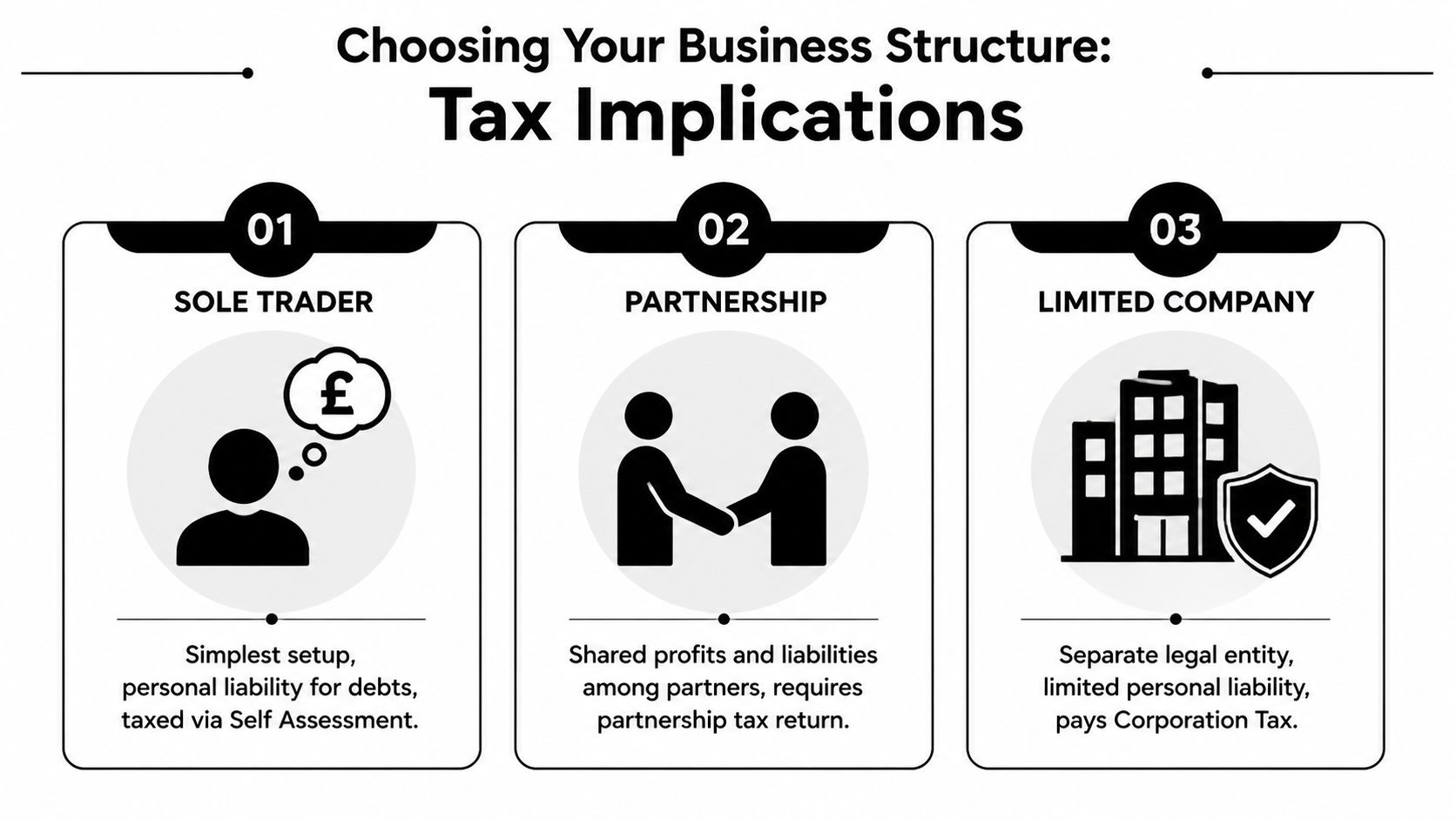
If you’re still deciding, this overview of types of business structure can help frame the options.
Sole trader
A sole trader setup is the simplest starting point for many freelancers.
There’s no separate legal person sitting between you and the business. In plain English, that means the profits are yours, the tax is yours, and the responsibility is yours too. You report business income and allowable expenses, then pay tax through Self Assessment.
The verified data gives a useful example. A self-employed plumber with £40,000 profit pays £5,513 in Income Tax plus £1,368 in Class 4 NICs, totalling £6,881.
That example is helpful because it shows something many people miss. The sole trader route is simple to run, but simplicity doesn’t mean the tax bill is small.
Partnership
A partnership sits somewhere in the middle.
It still isn’t the same as a limited company, but the profits and responsibilities are shared between partners. The partnership submits its own return, and each partner is then taxed personally on their share.
This structure can work well where two or more people run a business together, but it needs good records and a clear agreement between the people involved. Tax problems in partnerships often start as communication problems, not maths problems.
Limited company
A limited company is a separate legal entity. That changes both the tax treatment and the legal position.
The company pays Corporation Tax on its taxable profits. Under the verified rules from 1 April 2023, profits of £50,000 or less are taxed at 19%, while profits above £250,000 are taxed at 25%, with marginal relief between those bands.
That difference can matter a lot when compared with personal tax. The verified data includes a simple illustration: a company with £100,000 taxable profit would pay £19,000 at 19%, compared with £25,000 at the main rate.
A limited company can improve flexibility, but it also creates a second layer of admin. You’re no longer just earning money. You’re running an entity that has its own tax life.
Side-by-side comparison
| Feature | Sole Trader | Limited Company |
|---|---|---|
| Legal status | You and the business are the same | The company is separate from you |
| Main tax route | Self Assessment on business profits | Corporation Tax on company profits |
| NIC position | Class 4 NICs apply to profits | Payroll NICs may apply if salary is taken |
| Admin level | Lower | Higher |
| Personal liability | Personal responsibility for business debts | Liability is generally limited to the company |
Where people often get this wrong
The common mistake is choosing a structure based only on what someone in a forum said was “most tax efficient”.
That’s too narrow. You also need to weigh:
- Admin appetite: some people want simplicity above all else
- Client expectations: some contracts are easier to manage through a company or umbrella arrangement
- Risk tolerance: legal separation matters to some businesses more than others
- IR35 exposure: contractors can’t judge structure properly without looking at status rules too
A practical decision test
If you’re unsure which route fits, ask yourself:
Am I working alone and keeping things simple?
Sole trader may feel more manageable.Am I building something bigger than my own day rate?
A limited company may offer the structure you need.Am I working in contracting where status rules can override the neat theory?
Then IR35 may matter more than your preferred setup.
That last point is where many contractor tax conversations become more complicated. You can set up a limited company, but if a role falls inside IR35, the tax reality may look much closer to employment than business ownership.
The Contractor's Dilemma IR35 and Umbrella Companies
IR35 is where small business taxes stop being a planning exercise and start becoming a live commercial issue.
For contractors, the question usually isn’t just “What structure do I want?” It’s “How will this contract be taxed?” Those are not always the same thing.
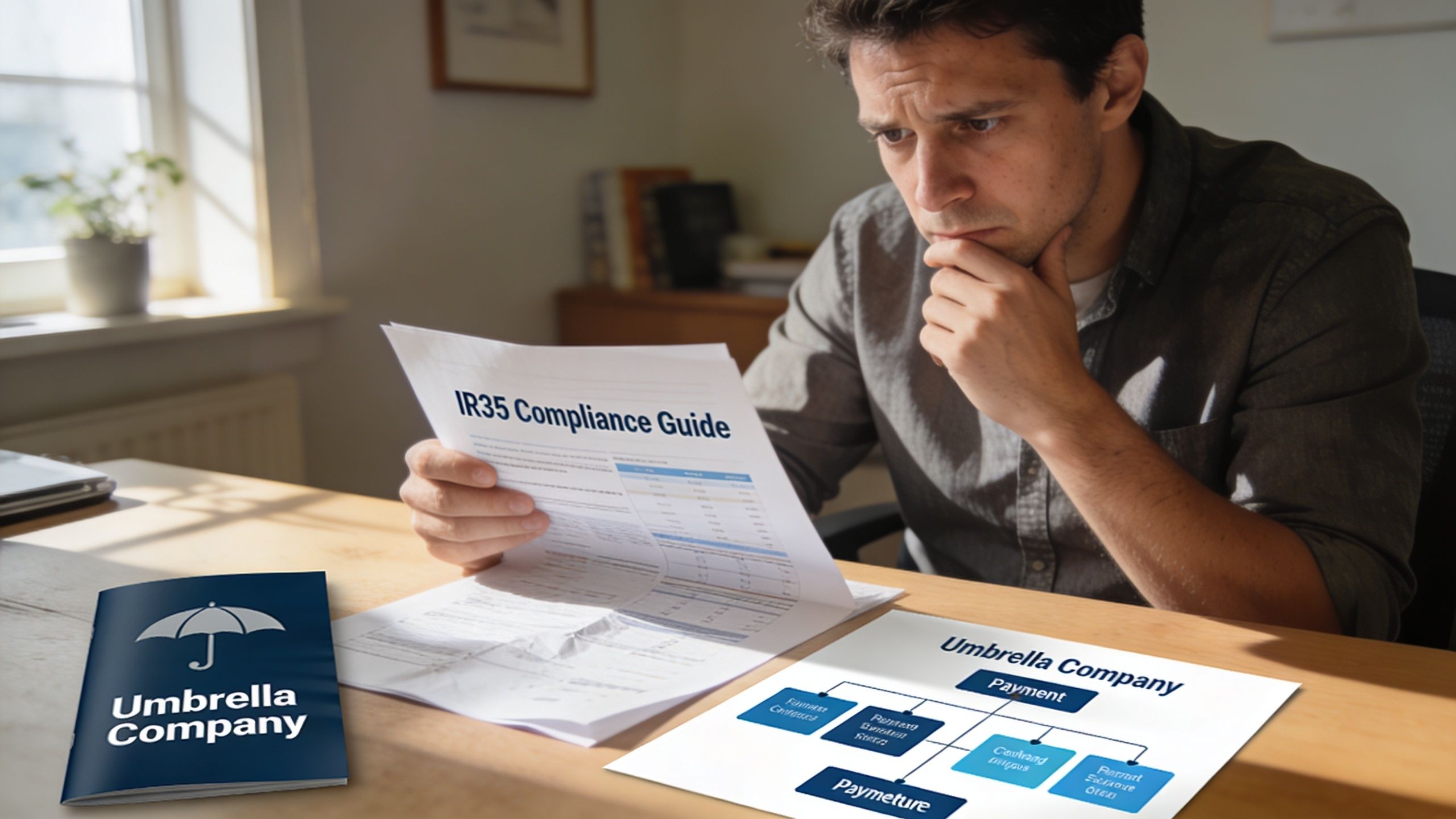
What inside IR35 really means
Under the verified data, UK off-payroll working rules apply in the private sector from April 2021 for relevant contracts over £56,000 annually. Where a contractor is treated as being inside IR35, HMRC taxes that work like employment income.
That means PAYE Income Tax and National Insurance apply in a way that feels very different from the classic limited company model.
The verified data states that this can create a 25% to 35% effective tax increase for affected contractors compared with outside-IR35 self-employment, and HMRC reported £1.2 billion in additional IR35 compliance revenue for 2022/23 from 1.3 million reviewed contracts.
Why take-home pay changes so sharply
The practical issue is simple. Inside IR35, you don’t just look at your contract value and assume most of it will land in your company.
For a contractor on a £60,000 contract inside IR35, the verified data says using an umbrella company results in take-home pay of approximately £38,000 after PAYE and both employee and employer National Insurance deductions.
That’s the number that often makes contractors pause, because it reveals the impact more clearly than abstract status advice ever can.
Inside IR35 doesn’t just change a label. It changes how the money flows and how much reaches you.
Why umbrella companies enter the picture
When a contract is inside IR35, many contractors use an umbrella company because it offers a compliant route through payroll.
The umbrella employs the contractor, processes PAYE, handles submissions to HMRC, and issues payslips. The verified data says umbrella companies handle real-time PAYE submissions through FPS, and that this reduces contractor admin burden by 80% according to the benchmark stated in the brief.
That convenience is real. So is the need for caution.
The same verified material warns that hidden costs and confusion around umbrella arrangements remain a problem. It notes that some comparisons overlook margin and compliance detail, and that many contractors feel misadvised about costs.
If you want a fuller explanation of the mechanics, this guide on IR35 and umbrella companies helps unpack the relationship.
What to check before choosing an umbrella
Not all umbrellas are equal. A sensible review should look at more than the headline promise of “easy payroll”.
Focus on the practical checks:
- Payslip clarity: you should be able to see what has been deducted and why
- Transparent margin: fees should be easy to identify
- Tax compliance: avoid arrangements that sound too clever or unusually generous
- Support quality: someone should be able to explain deductions in plain English
- Employment rights: understand holiday pay, pension treatment, and contract terms
The real dilemma for contractors
A lot of articles make this sound like a moral choice between independence and employment. It usually isn’t.
It’s a compliance and cash-flow choice. If a role is inside IR35, the contractor’s job is to handle it in the cleanest practical way. If a role is outside IR35, the planning options may be broader. But the key is getting the status right first, not trying to force a preferred tax answer onto the wrong contract.
That’s why contractors often need more than tax theory. They need a working arrangement that matches the contract in front of them.
Maximising Your Income Allowable Expenses and Tax Savings
Once you know which taxes apply, the next step is making sure you only pay what you owe.
The phrase to remember is wholly and exclusively for business purposes. That’s the basic test behind allowable expenses. If a cost is solely for the business, it may reduce taxable profit. If it’s personal, or mixed without a clear business element, it usually won’t.
The easiest way to think about expenses
Ask one practical question before you spend the money.
Would I have bought this if I weren’t doing the work?
If the answer is no, you may have a business expense. If the answer is yes because it’s really personal, be careful.
Keep the note at the moment you spend. “Client travel to site”, “software for invoicing”, and “professional indemnity insurance” are far better records than trying to remember six months later.
Common expense areas freelancers should review
The exact list depends on your structure and the nature of your work, but these categories are often relevant.
- Equipment and office costs: laptops, monitors, stationery, printer supplies, and other work essentials
- Software and subscriptions: bookkeeping tools, design software, cloud storage, video meeting tools, and trade platforms
- Professional services: accountancy fees, legal advice, and certain business banking costs
- Travel for work: journeys to temporary workplaces, parking linked to business travel, and mileage where the rules allow it
- Training and subscriptions: courses or memberships connected to your current trade or profession
- Insurance: policies taken out for the business, such as professional cover
Different structures, different results
A sole trader claims allowable expenses to reduce business profit before Income Tax and NICs are worked out.
A limited company records business costs inside the company accounts, which can reduce the company’s taxable profit before Corporation Tax is calculated.
That sounds similar, but the paperwork and treatment can differ in practice. This is why good bookkeeping matters. A legitimate expense only helps if it is recorded clearly enough to support the claim.
A few caution points
Some of the biggest mistakes happen in familiar grey areas:
- Home costs: working from home doesn’t mean every household bill becomes a tax deduction
- Clothing: everyday clothes usually don’t become allowable just because you wore them to work
- Meals: routine personal food costs are not automatically business expenses
- Mixed use items: if a purchase has both personal and business use, take care before claiming the full amount
Tax saving is mostly record-keeping
People often look for advanced tricks. In reality, many tax savings come from simple habits done properly.
Try this routine:
- Use a separate business account where possible
- Save receipts immediately, ideally in cloud software or a receipt app
- Add a note explaining the business purpose
- Review expenses monthly, not at year end
- Ask before claiming anything doubtful, rather than correcting it later
For limited company owners, pension contributions made through the company can also be part of wider tax planning, but the details depend on your setup and should be checked carefully.
The main point is reassuring. Tax efficiency does not mean doing anything aggressive. It usually means claiming what is legitimately available and keeping evidence tidy enough to stand up if HMRC ever asks.
Staying Compliant Deadlines, Records and Making Tax Digital
Most tax stress doesn’t come from the tax itself. It comes from scrambling for figures late, missing a filing date, or realising your records are too messy to trust.
Compliance is less dramatic than planning, but it’s what protects you.
Good records make tax cheaper to manage
Clean records save time, reduce errors, and make it easier to spot missing invoices or overlooked expenses.
At a minimum, keep:
- Sales records: invoices issued and money received
- Expense evidence: receipts, bills, and subscription records
- Bank information: statements that match your business activity
- Payroll paperwork: if anyone is paid through PAYE
- Tax correspondence: letters, notices, and filing confirmations
If you still receive statements or receipts in awkward formats, tools that convert records into spreadsheets can reduce manual entry. Something like the Elyx AI Excel add-in can be useful when you’re trying to turn PDF bank statements into cleaner working data before filing or reconciling.
Deadlines matter more than most people think
Missing a date creates problems quickly. Even when the tax position itself is straightforward, late filing or late payment can trigger avoidable hassle.
For self-employed people who need a refresher on timing, this guide to the self-employed tax return deadline is a practical starting point.
A simple diary habit helps:
- Set a monthly bookkeeping day
- Review your tax reserve regularly
- Check HMRC notices as they arrive
- Don’t wait until January to understand the year
Making Tax Digital is becoming part of normal practice
One of the biggest admin changes ahead is Making Tax Digital for income tax.
The verified data states that from April 2026, small businesses with turnover above £50,000 must use compatible software for quarterly updates. The same verified material says the FSB estimates an average of £1,200 in extra admin and software costs in the first year for affected businesses.
That figure matters because it changes the conversation. Digital tax reporting is no longer just a bookkeeping preference. For some businesses, it becomes part of the compliance cost of trading.
The easiest time to move to digital records is before you’re forced to. If you wait until the rules bite, every software choice feels rushed.
What to do now
If April 2026 is likely to affect you, get ahead of it.
- Check your turnover level: know whether you are likely to fall within the new requirement
- Choose software early: Xero and similar tools can reduce panic later, but only if you start using them properly
- Create a filing routine: quarterly reporting is easier when bookkeeping happens all year
- Reduce manual processes: the fewer spreadsheets and loose PDFs you rely on, the better
- Get help with setup: a short conversation with an accountant can save a lot of correction work later
For many freelancers, the biggest win is psychological. Once your records are current and your software is set up, tax stops arriving as an annual ambush.
Your Next Steps to Tax Confidence
Tax confidence rarely appears all at once. It builds when you understand how the pieces fit.
For most freelancers and contractors, the useful sequence is straightforward. Learn the main taxes. Match them to your business structure. Check whether IR35 changes the picture. Claim genuine allowable expenses. Keep records in order before deadlines become urgent.
That’s the difference between feeling chased by HMRC and feeling in control of your business.
If you also want broader practical guidance beyond tax, marketing, and operations, resources like this Complete 2026 guide for small businesses can be handy as part of your wider planning. Tax works best when it’s part of an organised business, not a last-minute clean-up job.
For contractors in particular, one message matters most. A “good” tax setup is not always the one with the most appealing theory. It’s the one that matches your actual contract, your compliance position, and the amount of admin you’re realistically willing to manage.
If IR35, payroll deductions, and umbrella arrangements still feel heavier than they should, that doesn’t mean you’ve failed. It usually means you need a clearer route and a setup that fits the reality of the work.
If you’re comparing compliant options for contract work, Umbrella Company helps you review trusted umbrella providers and find a setup that suits your role, rate, and IR35 position.


