


Thinking about going it alone as a contractor? The sole trader route is often the simplest and quickest way to get your business off the ground, and for good reason: it's the most popular setup for UK freelancers. This guide explains what you will learn about becoming a sole trader in the UK.
At its core, being a sole trader means you are the business. You own it, you control it, and you keep all the profits after tax. The flip side is that you are also personally on the hook for any debts. The main thing you have to do legally is let HMRC know you are now self-employed.
Your First Steps to Becoming a Sole Trader
Deciding to work for yourself is a massive step, and choosing to be a sole trader strips away a lot of the usual business admin. You call all the shots, from which clients you work with to the hours you keep. It is perfect for freelancers, consultants, and contractors who want to focus on their work, not on endless paperwork.

The crucial thing to get your head around is that, in the eyes of the law, there is no distinction between you and your business. They are one and the same. This is great when it comes to profits, but it does mean you are personally liable if things go wrong.
It is an incredibly common way to work. Sole traders make up a huge part of the UK's business landscape, accounting for 56% of all private sector businesses. You are in good company.
What Being a Sole Trader Really Means
Let’s cut through the jargon. Setting up as a sole trader is really just about creating a professional extension of yourself. It is less about jumping through complex legal hoops and more about getting your responsibilities to HMRC in order.
To give you a clearer picture, here is a quick summary of the key responsibilities you will be taking on.
Key Responsibilities of a UK Sole Trader
| Responsibility | What It Means for You |
|---|---|
| HMRC Registration | You must register for Self Assessment and Class 2 National Insurance with HMRC as soon as you start trading. |
| Annual Self Assessment | Every year, you have to complete a tax return detailing your income and expenses to calculate the tax you owe. |
| Tax & National Insurance | You are responsible for paying your own Income Tax and both Class 2 and Class 4 National Insurance contributions. |
| Record Keeping | You need to keep accurate records of all your sales and business expenses. This is essential for your tax return. |
| Personal Liability | Since you and the business are not legally separate, you are personally responsible for any business debts. |
| Following Naming Rules | Your business name cannot be offensive, the same as an existing trademark, or include 'Limited', 'Ltd', 'LLP', or 'PLC'. |
| VAT Registration (If Req.) | If your turnover exceeds the VAT threshold (currently £90,000), you must register for and charge VAT on your services. |
This table is not meant to be exhaustive, but it covers the main pillars of what it means to operate as a sole trader day-to-day. Get these right, and you are well on your way.
Building Your Contracting Career with Confidence
Our goal at UmbrellaCompany.com is to give you the practical knowledge you need to start your contracting career on the right foot. Understanding these fundamentals from the outset helps you sidestep common mistakes and build a sustainable business.
For a wider perspective on the contracting world, have a look at our complete guide on how to become a contractor in the UK.
In the sections that follow, we will walk you through the practical steps, from choosing a name and registering with HMRC to managing your finances and understanding your tax obligations. Let's get started.
How to Register Your Business with HMRC
Getting registered with HMRC is one of those first big steps into the world of self-employment. Do not worry, it sounds more intimidating than it actually is. We are going to walk you through the whole process, from figuring out when you actually need to register to getting that all-important tax number from HMRC.
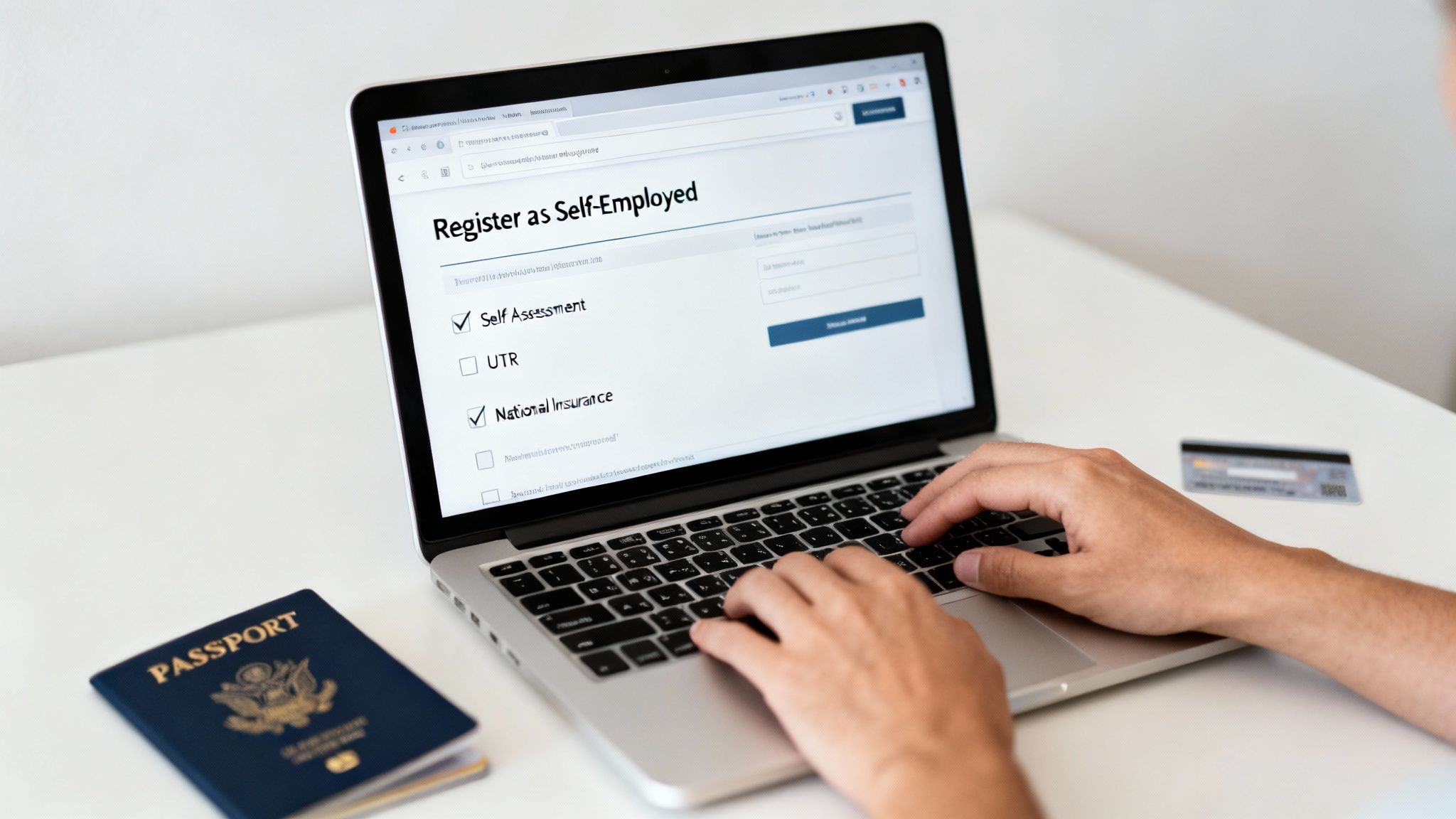
Think of this as a practical guide to getting it done right. We will look at the online portal, the information you will need, and what all the official jargon means. By the end, you will be set up, compliant, and ready to avoid any unwanted surprises from the taxman.
When Does Registration Become Necessary?
First things first, before you dive into the HMRC website, let's make sure you actually need to register. It all hinges on your gross income from your business activities within a single tax year, which runs from 6th April to 5th April.
Thanks to the trading allowance, if you earn £1,000 or less from self-employment in a tax year, you do not have to tell HMRC or register for Self Assessment. This is a great little perk for those just dipping their toes in the water or running a small side project.
But the moment your gross income tips over that £1,000 mark, the rules change. At that point, registration becomes a legal requirement, officially kicking off your journey as a sole trader in the eyes of HMRC. For a more detailed look at different situations, our guide explains exactly when to register as self-employed.
Your Registration Checklist
A little bit of prep makes the online process a whole lot smoother. You will be registering through the Government Gateway portal, which is HMRC’s secure online hub for all things tax.
Here is a quick list of what you will need to hand:
- Your full name and date of birth
- Your UK address
- Your National Insurance number (you can usually find this on old payslips, your P60, or letters about tax and benefits)
- The date you started trading
- Your business name and address
- A brief description of your business (e.g., IT consultant, graphic designer, freelance writer)
Once you have got these details, you are ready to head over to the HMRC website. The process involves setting up a Government Gateway account if you do not have one already, then adding the 'Self Assessment' service to your profile.
Understanding Key HMRC Terms
Once you are registered, you will start seeing some specific terminology crop up. Getting to grips with these is key to managing your tax affairs without any headaches.
- Self Assessment: This is simply the system HMRC uses to collect Income Tax from the self-employed. It is on you to report your income and expenses each year by filling out a Self Assessment tax return.
- Unique Taxpayer Reference (UTR): This is a 10-digit number that HMRC will post to you a couple of weeks after you register. It is your unique ID for everything to do with Self Assessment. You will need it to file your tax return, so keep it somewhere safe.
- Government Gateway: This is your secure online account for all government services, including HMRC. You will use it to file your returns, see how much tax you owe, and make payments.
Key Takeaway: Your Unique Taxpayer Reference (UTR) is your lifeline to the Self Assessment system. Once that letter with your UTR lands on your doormat, you are officially in the system and can manage everything online.
Choosing Your Business Name
As a sole trader, you have a choice: trade under your own name or pick a business name. While you do not have to register the name with Companies House like a limited company does, there are still a few rules to follow.
Your chosen name cannot:
- Be offensive or include sensitive words.
- Be the same as, or sound too much like, an existing trademark. It is always a good idea to do a quick search on the Intellectual Property Office website first.
- Suggest a connection to government or local authorities unless you have been given permission.
- Include words like ‘Limited’, ‘Ltd’, ‘LLP’, or ‘PLC’. These are legally reserved for other types of business structures.
For example, if a web developer called Jane Smith starts freelancing, she could simply operate as "Jane Smith". Or, she could go for something like "JS Web Creations" to build more of a brand.
Critical Registration Deadlines
If you take one thing away from this section, let it be the deadlines. Missing them can lead to automatic penalties from HMRC, and nobody wants that.
You must register for Self Assessment by the 5th of October in your business's second tax year.
Let’s break that down with an example. Say you start your sole trader business on 1st December 2024:
- Your first tax year of trading is 2024/25, which ends on 5th April 2025.
- Your second tax year is 2025/26, which starts the next day, on 6th April 2025.
- This means your deadline to register is 5th October 2025.
Honestly, one of the best things you can do is stick that date in your calendar the day you start trading. It keeps you compliant from the get-go and helps you avoid that last-minute panic or a dreaded brown envelope from HMRC.
Managing Your Finances and Tax Obligations
Getting your finances sorted from day one is one of the smartest things you can do as a new sole trader. It is not just about keeping HMRC happy; good financial habits give you a crystal-clear picture of your business's health, helping you make better decisions as you grow.
Let's walk through the practical side of managing your money. We will cover everything from getting a business bank account and keeping on top of your records to understanding your tax bill and getting ready for Self Assessment.

Should You Open a Business Bank Account?
Legally, you do not have to open a separate business bank account. Because you and your business are a single legal entity, you can technically run everything through your personal account. But honestly, we would strongly advise against it.
Mixing personal and business cash is a recipe for a bookkeeping nightmare. It makes it incredibly difficult to track your income, spot allowable expenses, and get a true feel for how your business is actually performing.
A dedicated business account just makes life easier:
- Clear Record Keeping: It creates a clean, undeniable trail of all your business income and spending, which makes filling out your Self Assessment tax return far simpler.
- Professionalism: Paying suppliers and getting paid by clients from a proper business account looks far more professional and builds trust.
- Easier Financial Management: You can see your business's cash flow at a glance, helping you budget and plan for quiet periods or big investments.
- Avoiding Trouble: Many personal bank accounts have terms and conditions that actually forbid you from using them for business purposes.
Keeping Accurate Financial Records
Meticulous record-keeping is completely non-negotiable when you are a sole trader. HMRC requires you to keep detailed records to prove your figures on your tax return if they ever decide to investigate.
You must keep records of:
- All sales and income: This means copies of every single invoice you send out.
- All your business expenses: Hold on to every receipt, whether it is for a train ticket to a client meeting or a subscription to some industry software.
- Bank statements: From your business account and any personal accounts you have had to use for business transactions.
- VAT records (if applicable): If you are VAT registered, you have extra record-keeping duties to follow.
HMRC rules state you have to keep your records for at least five years after the 31st January submission deadline for that tax year. So, for the 2024/25 tax year (deadline 31st January 2026), you would need to keep your records until at least the end of January 2031.
Pro Tip: Do not just stuff receipts in a shoebox. Get into the habit of using a simple spreadsheet or accounting software from the very beginning. Snapping a quick photo of a receipt on your phone and logging it straight away can save you days of stress down the line.
Understanding Your Tax Obligations
As a sole trader, you are responsible for paying Income Tax and National Insurance on your business profits. This is all sorted through your annual Self Assessment tax return. It is this straightforward system that keeps the sole trader route a popular choice for UK contractors, with 4.39 million self-employed individuals currently navigating it.
Your profit is simply your total business income minus your allowable business expenses. Here are the taxes you will be paying.
Income Tax
You pay Income Tax on any profits you make above your Personal Allowance. The tax bands and rates are the same as for employees, but they apply to your profits, not a fixed salary.
National Insurance Contributions
Sole traders usually pay two types of National Insurance:
- Class 2 NICs: A flat weekly rate you pay if your profits are over a certain threshold.
- Class 4 NICs: A percentage of your profits paid on anything you earn above a higher threshold.
The good news is that both are calculated and paid automatically through your Self Assessment return, so you do not need to handle them separately.
Preparing for Your Self Assessment Tax Return
The UK tax year runs from 6th April to 5th April. Once it ends, you have several months to get your return filed and pay what you owe. Hitting these deadlines is crucial.
Key Self Assessment dates to remember:
- 5th October: The cut-off for registering for Self Assessment if you are newly self-employed.
- 31st October (midnight): The deadline if you are still filing a paper tax return.
- 31st January (midnight): The main event, the deadline for filing your online tax return and paying your bill.
For the 2024/25 tax year, for example, your online filing and payment deadline would be 31st January 2026. Missing these dates means automatic penalties from HMRC, so do not get caught out. To stay on top of it all, have a read of our in-depth guide covering the self-employed tax return deadline.
One of the biggest mistakes new sole traders make is not putting money aside for tax. A great rule of thumb is to siphon off 25-30% of every payment you receive into a separate savings account. This simple habit means you will have the cash ready and waiting when the tax bill lands, avoiding any nasty surprises.
Getting to Grips with VAT, Expenses, and Insurance
Once you are officially registered, the real work begins. Now it is time to get a handle on the day-to-day financial details that keep your business running smoothly and, crucially, keep you on the right side of HMRC. This means understanding VAT, knowing which expenses you can claim, and getting the right insurance.
These are not just boxes to tick. Mastering these areas is fundamental to operating a professional, resilient business. Get them right, and you will manage your cash flow effectively, lower your tax bill, and protect yourself from nasty financial surprises.
Do I Need to Register for VAT?
Value Added Tax (VAT) is a tax that VAT-registered businesses add to the price of most goods and services they sell in the UK. As a sole trader, you are legally required to register for VAT if your VAT-taxable turnover crosses the current threshold within any rolling 12-month period.
But the decision is not always that simple. You can also choose to register for VAT voluntarily, even if your turnover is well below the official threshold.
Why would you do that? Well, if your clients are mostly VAT-registered businesses themselves, they can simply reclaim the VAT you charge them. It makes you look like a more established business and puts you on a level playing field. The downside is the extra admin, as you will need to submit regular VAT returns to HMRC. We break down the numbers and help you decide in our guide to the UK VAT registration threshold.
Claiming Every Allowable Business Expense
This is one of the biggest perks of being a sole trader. You can deduct allowable business expenses from your income before you calculate how much tax you owe. This directly reduces your taxable profit, which means a smaller bill for both Income Tax and National Insurance.
An allowable expense is any cost incurred "wholly and exclusively" for your business. The key is to keep meticulous records. HMRC can, and does, ask for proof, so a folder of receipts or a simple spreadsheet is your best friend.
So, what can you typically claim? For most contractors and freelancers, the list includes:
- Office Costs: Think stationery, your business mobile bill, and postage. If you work from home, you can claim a proportion of your household bills like heating and electricity.
- Travel Costs: This covers fuel for your car, train tickets, parking, and hotel stays for business trips. Just remember, your regular commute to a permanent workplace does not count.
- Professional Subscriptions: Your membership fees for professional bodies or subscriptions to industry magazines are usually fair game.
- Software and Equipment: The cost of that new laptop, your project management software, or specialist tools needed for the job can all be claimed.
- Marketing and Advertising: Costs for building your website, running online ads, or attending networking events are also allowable.
Key Insight: Start thinking like a business owner from day one. Every single pound you spend on a legitimate business expense is a pound you will not pay tax on. Diligent record-keeping is not just admin, it directly boosts your bottom line.
Why Business Insurance is Non-Negotiable
As a sole trader, the buck stops with you. You are personally liable for your business, which makes insurance an absolutely critical safety net. Without it, a client dispute, an accident, or a simple mistake could put your personal finances, including your home, at serious risk.
It is not always a legal requirement, but many clients will flat-out refuse to sign a contract unless you have adequate cover. It shows you are a professional and protects everyone involved.
The Two Essential Policies for Sole Traders
For most contractors, it boils down to two main types of cover:
- Public Liability Insurance: This has your back if a member of the public is injured or their property gets damaged because of your work. Imagine you are a contractor on-site and you accidentally spill coffee on a client's expensive server; this insurance would cover the cost.
- Professional Indemnity Insurance: This protects you from claims of negligence or bad advice. If you are an IT contractor and a bug in your code causes a major financial loss for your client, this insurance would cover the legal fees and any compensation.
Going it alone as a sole trader has become a smart move for countless UK freelancers. It is no surprise that the UK is now home to 5.5 million private-sector businesses, a figure that has shot up 59% since 2000. You can dig into these trends in the Office for National Statistics' latest business population estimates. Getting the right insurance is a key part of building a professional and long-lasting business in this thriving environment.
Choosing the Right Structure for Your Contracting Work
While going the sole trader route is a perfectly valid and popular starting point, it is just one of the ways you can operate as a contractor in the UK. Each option (sole trader, limited company, or umbrella company) strikes a different balance between admin, tax efficiency, and your personal liability. Getting your head around these differences is the key to picking the right path for your career goals and personal situation.
The choice you make now will ripple through everything from how you handle your money and pay tax to the legal protection you have if things go wrong. Let's break down the three main options on the table.
Sole Trader Simplicity and Risk
As we have covered, setting up as a sole trader is by far the most straightforward option. It is quick, the accounting is relatively simple, and you are in complete control. Legally, you and the business are one and the same, meaning all the profits (after tax) are yours to keep.
But that simplicity comes with a hefty catch: unlimited personal liability. If your business runs into debt or faces legal trouble, your personal assets, like your house, could be on the line. This structure really suits contractors in lower-risk fields or those just dipping their toes in the water who want to keep paperwork to a minimum.
The Limited Company Advantage
Forming a limited company creates a completely separate legal entity from you, the individual. This is its biggest selling point, as it gives you limited liability. In simple terms, your personal finances are shielded from any business debts.
A limited company can also be more tax-efficient. You can pay yourself a mix of a small salary and dividends, which often works out better than taking all your earnings as straight income. However, this structure demands a lot more from you.
You will have to:
- Register your company with Companies House.
- File annual accounts and a confirmation statement every year.
- Manage Corporation Tax, PAYE on your salary, and all the dividend paperwork.
Because of this extra admin, most directors wisely choose to hire an accountant, which is an added running cost to factor in.
The Umbrella Company Alternative
For many contractors, especially if you are working on a contract that falls inside IR35, an umbrella company is the hassle-free choice. Instead of running your own business, you effectively become an employee of the umbrella company. They take care of all your invoicing, tax, and National Insurance contributions in exchange for a fee, known as their margin.
This flowchart gives a clear view of one of the key administrative hurdles you might face as your business grows: registering for VAT.
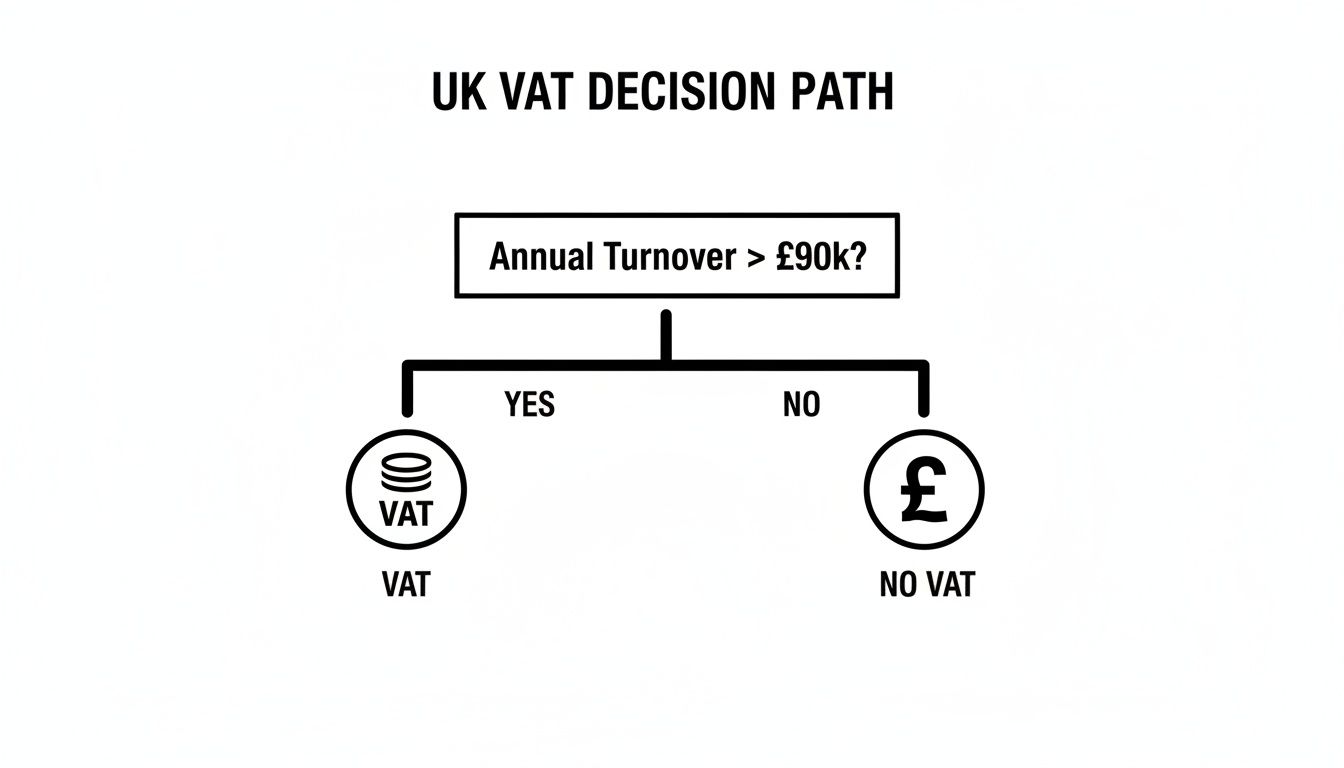
As you can see, once your annual turnover hits the £90,000 threshold, VAT registration is not optional, it is a legal requirement.
Working through an umbrella means you get paid just like a regular employee, with all your taxes sorted before the money hits your bank. It provides a record of continuous employment, gives you access to statutory benefits like holiday and sick pay, and takes the headache of IR35 compliance completely off your plate.
Comparing Business Structures for UK Contractors
To help you visualise the trade-offs, here is a straightforward comparison of the three main structures.
| Feature | Sole Trader | Limited Company | Umbrella Company |
|---|---|---|---|
| Setup & Admin | Very simple and minimal. Register with HMRC for Self Assessment. | More complex. Register with Companies House and HMRC, file annual accounts. | Easiest of all. Just sign up, provide your details, and you are ready to go. |
| Liability | Unlimited. Your personal assets are at risk from business debts. | Limited. Your personal finances are legally separate and protected. | No personal liability. You are an employee of the umbrella company. |
| Tax Efficiency | All profits taxed as personal income. Can be less efficient at higher earnings. | Potentially most tax-efficient, using a salary/dividend mix. More planning options. | Less tax-efficient. All income is processed through PAYE, like a standard employee. |
| Control | Full control over the business and all its finances. | Full control as a director and shareholder. | No control. You are an employee following their processes. |
| IR35 | Less common for roles affected by IR35, but compliance is your responsibility. | Your responsibility to determine IR35 status. Complex if inside IR35. | The simplest solution for inside-IR35 contracts. They handle all compliance. |
| Best For | New contractors, lower-risk work, and those wanting maximum simplicity. | Contractors earning higher rates, seeking liability protection, and operating outside IR35. | Contractors on inside-IR35 roles, those who want zero admin, or short-term contractors. |
Ultimately, picking the right structure from day one can save you a world of time and stress down the line.
Our Perspective: There is no single "best" option; it all comes down to your individual circumstances. A sole trader setup is fantastic for its simplicity in low-risk ventures. A limited company is the go-to for tax planning and liability protection. And an umbrella company is the perfect fit for contractors who value guaranteed compliance and minimal admin, particularly for inside-IR35 roles.
Your Sole Trader Questions Answered
Starting out on your own always throws up a few questions. To help you get going with confidence, here are some clear, straightforward answers to the queries we hear most often from new contractors and freelancers.
Can I Be Employed and a Sole Trader at the Same Time?
Yes, you absolutely can. It is actually very common for people to test the waters with a new business idea or earn a bit extra on the side while keeping the security of their main PAYE job.
The key thing is to declare all your sole trader income on your annual Self Assessment tax return. HMRC will then look at your combined earnings from your job and your business to work out your total tax bill. Your employer handles the tax on your salary as normal, but you are responsible for paying the tax and National Insurance on your self-employed profits.
What Happens if I Miss the Registration Deadline?
The big date for your diary is the 5th of October in your business's second tax year. So, if you start trading anytime between 6th April 2024 and 5th April 2025, you have until 5th October 2025 to let HMRC know.
Missing this deadline can land you with penalties. If you suddenly realise the date has passed, the best thing to do is get in touch with HMRC straight away. Being upfront, explaining the situation, and getting registered quickly can often help you avoid bigger fines down the line. Do not bury your head in the sand!
Top Tip: The 5th of October deadline is fixed. As soon as you start trading, pop a reminder in your calendar for the following year. It is a simple step that will save you a lot of stress and potential penalties.
Do I Need a Separate Business Bank Account?
Legally, no. As a sole trader, the law sees you and your business as one and the same, so a separate account is not mandatory. That said, we at UmbrellaCompany.com strongly recommend you open one.
Having a dedicated business account just makes sense for a few reasons:
- Easier Finances: It keeps your business income and spending separate, which makes filling out your tax return a whole lot simpler.
- Clean Records: It creates a clear paper trail for all your business transactions. This is incredibly useful if HMRC ever decides to take a closer look.
- Looking Professional: Sending invoices from a proper business account just looks more credible and helps build trust with your clients.
It is also worth noting that most personal bank accounts have terms and conditions that specifically forbid you from using them for business purposes. You could find yourself in breach of your bank's rules, which is a headache you can do without.
Getting these initial steps right is a huge part of setting up as a sole trader successfully. If the admin feels overwhelming, or if you are taking on contracts that fall inside IR35, UmbrellaCompany.com can help. We make it easy to compare compliant and trusted umbrella companies in just a few minutes. Find the perfect one for your contracting career at https://umbrellacompany.com.


