


You've probably searched for self employment allowance because you want one plain answer to a simple question. If you're freelancing, between contracts, moving out of employment, or wondering whether an umbrella company changes what you can claim, the UK system can feel like it uses similar words for completely different things.
That confusion is normal. In practice, people often use “self employment allowance” as a catch-all phrase for several separate UK rules and support schemes. Some relate to tax, some relate to benefits, and some only apply if you're trading on your own account. If you're working through an umbrella company, the position changes again because you're treated as an employee for tax purposes.
We see this misunderstanding all the time at UmbrellaCompany.com. The practical question usually isn't “Is there one allowance called that?” It's “What applies to my earnings, my tax, and my cash flow right now?”
Introduction What Is the Self Employment Allowance?
There isn't one single, official UK payment called the self employment allowance. That's the first point to get clear.
People usually mean one of these:
- The Trading Allowance, which is a tax rule for small amounts of trading income
- Universal Credit support for self-employed people, which can help if your income is low
- Historic pandemic support such as SEISS, which was a separate scheme and is not the same as a standing allowance
- General start-up or unemployment-to-business support, which has older policy roots
The reason this matters is scale. Self-employment isn't a niche corner of the labour market. About 4.95 million people were registered as self-employed in the UK in July to September 2019, and the first government self-employment support scheme later reached roughly 2.7 million people at its peak, showing how central support for freelancers, sole traders, and contractors became during periods of disruption, according to GoSimpleTax's summary of UK self-employment statistics.
The simplest way to think about it
Treat the phrase self employment allowance like a label people use when they're not yet sure which rule they need.
If your concern is tax on small side income, you may be thinking about the Trading Allowance.
If your concern is help with living costs while business income is weak or irregular, you may be thinking about Universal Credit.
If your concern is pandemic-era grants, you're probably thinking of SEISS.
If you're still deciding whether you count as self-employed at all, our guide on when to register as self-employed can help you sort out the starting point.
Practical rule: Before you look for an “allowance”, identify your status first. Sole trader, limited company contractor, and umbrella employee all sit under different tax and benefit rules.
Why contractors get tripped up
Contractors often move between models. You might work directly for clients one month, then accept an inside IR35 role through an umbrella company the next. The words stay similar, but the rules don't.
That's why broad internet advice often feels slippery. It talks about “self-employed people” in general, while your real question is narrower. You want to know what hits your payslip, what you need to report, and what support you can access without creating a tax mess later.
Trading Allowance vs Employment Allowance Untangling the Terms
Two terms cause most of the confusion. They sound related, but they do very different jobs.
The Trading Allowance is the one many freelancers mean when they say “self employment allowance”. The Employment Allowance is something else entirely. It's aimed at eligible employers reducing their National Insurance bill, not at sole traders trying to lower personal tax.
Why these terms get mixed up
Part of the confusion comes from the wider history of self-employment support. Programmes based on the Self-Employment Assistance (SEA) model were designed to let unemployed people keep benefit support while building a business, instead of being forced straight back into wage-search activity. A key feature was removing the usual job-search requirement while support continued, as described in the U.S. Department of Labor's study of Self-Employment Assistance. That policy logic helps explain why people still use one broad phrase for very different forms of support.
UK allowances for contractors at a glance
| Allowance Type | Who It Is For | What It Does | Key Detail |
|---|---|---|---|
| Trading Allowance | People with small amounts of trading or casual self-employed income | Lets you use a tax exemption on qualifying trading income instead of claiming actual expenses in some cases | Often relevant to freelancers and side hustles |
| Employment Allowance | Eligible employers | Reduces the employer's National Insurance liability | Not a personal allowance for sole traders |
| Universal Credit support for self-employed people | People on means-tested support with low or irregular self-employed income | Assesses earnings for benefit purposes | Separate from tax allowances |
| Historic SEISS | Eligible self-employed people during the pandemic period | Provided income support grants under a temporary scheme | Not a permanent ongoing allowance |
What matters if you're a freelancer
If you're trading in your own name, the Trading Allowance is the term to look into first.
If you run payroll for staff through a business structure, the Employment Allowance may matter to the business, but it isn't the same thing as a personal tax break. A sole trader searching for help with their own earnings can usually ignore this term unless they also have employer responsibilities.
The easiest test is this. Ask, “Am I trying to reduce my own taxable freelance income, or am I running employer payroll?” If it's the first one, Employment Allowance usually isn't the answer.
Where PAYE changes the picture
A lot of contractors read about allowances when what they really need is a clean understanding of payroll status.
If you're paid through PAYE, tax and National Insurance are handled differently from direct self-employment. Our plain-English guide to how PAYE works for contractors shows why that distinction matters before you rely on advice aimed at sole traders.
A quick warning on similar-sounding language
Words like “allowance”, “support”, “relief”, and “benefit” often get used interchangeably online. They shouldn't be.
Use this mental shortcut:
- Allowance often points to a tax rule
- Support often points to a temporary scheme or practical help
- Benefit often points to Universal Credit or another welfare payment
- Payroll relief often applies at employer level, not personal level
That small distinction can save a lot of wasted time.
How to Get Support When You Are Self Employed
If your income has dropped and you need practical support now, the main route you need to understand is Universal Credit.
For self-employed claimants, one of the most important technical features is the 12-month start-up period before the Minimum Income Floor (MIF) normally applies. During that period, support is based on your actual profits rather than assumed full-time minimum wage earnings, as noted in the guidance on the start-up period and MIF.
Here's a visual summary of the process:
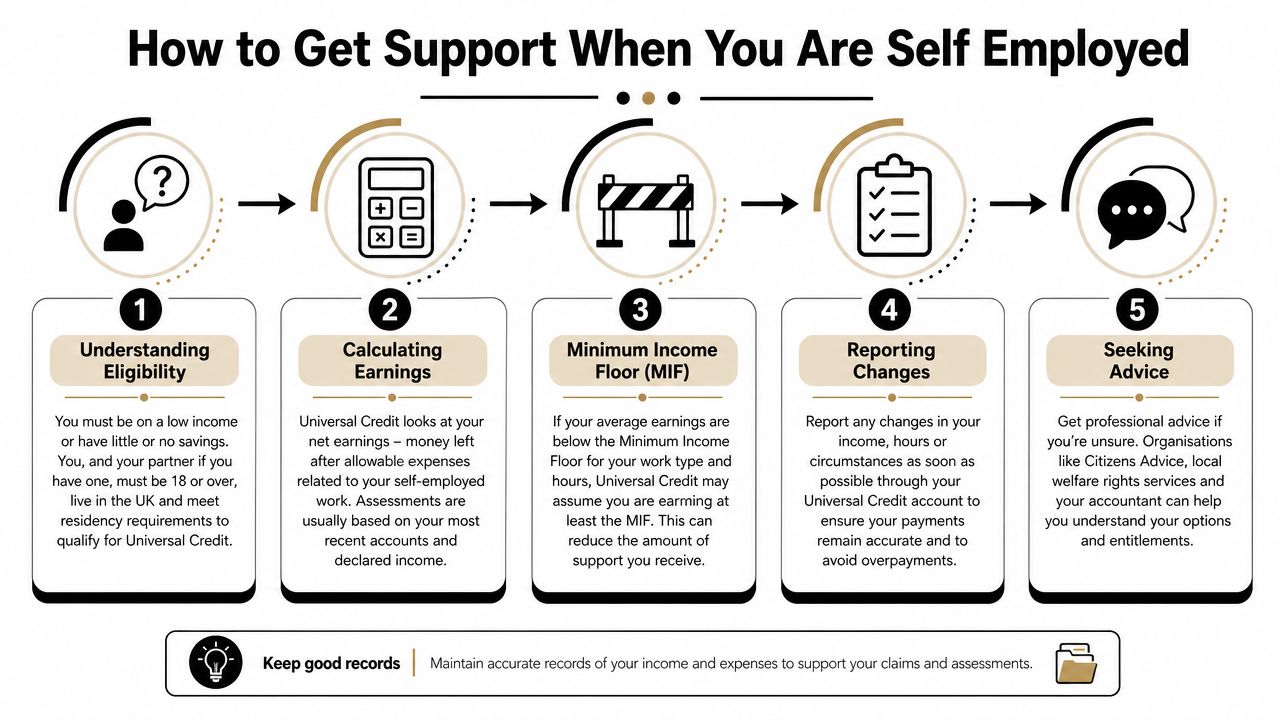
How Universal Credit usually works for self-employed people
Think of Universal Credit like a monthly snapshot.
Each month, you report what your business brought in and what allowable business costs you paid out. That creates a profit figure for the assessment period. During the start-up period, that figure usually matters most. After that, the MIF can change the result because the system may assume a higher level of earnings than you made.
The five practical steps
Check whether you are self-employed
The DWP usually looks for real trading activity, not just a plan on paper. Keep invoices, contracts, bank records, and evidence that you're actively seeking or doing work.Track income and expenses monthly
Universal Credit works month by month. That means timing matters. A late client payment can affect one assessment period even if the work was done earlier.Understand the start-up period
New businesses can get breathing space because actual profits are used before the MIF normally starts to bite.Prepare for the MIF
Once the start-up period ends, assumed earnings may reduce your award even when your real income is uneven.Get advice before income jumps or contracts change
Contractors often have irregular payment patterns. A short review with an adviser can stop an avoidable reporting mistake.
A written contract also helps prove that your work is genuine and commercial. If you're freelancing directly for clients, RedactAI's freelance contract guide is a useful starting point for understanding what should be written down.
Keep your records as if someone will ask you to explain every pound next month. With self-employed Universal Credit claims, that isn't being over-cautious. It's normal practice.
This walkthrough gives a useful overview of the claim process and common sticking points:
Where people usually go wrong
The biggest misunderstanding is thinking profit works like turnover. It doesn't.
If you invoice a client, that doesn't automatically mean all of that money counts as spendable income in the same way wages would. You need clean records showing what you earned, what you spent for the business, and when each item falls into the assessment period.
Another common problem is assuming support stays stable while income swings around. Self-employed support rarely feels smooth when your cash flow isn't smooth. That's why contractors need to treat bookkeeping as part of earning, not as an afterthought.
Real World Calculations and Examples
Rules make more sense when you can see them in everyday contractor situations. These examples stay deliberately simple, because most confusion starts with the basics.

Example one, small freelance income
A graphic designer takes on a few logo jobs alongside part-time work. Over a tax year, the designer brings in a modest amount from freelance work and wants to know whether the so-called self employment allowance applies.
The practical decision often looks like this:
Option one, use the Trading Allowance
This can suit someone with low trading income and very little business spending.Option two, claim actual expenses instead
This can suit someone whose software, equipment, subscriptions, or other costs are high enough that actual expense claims are more useful.
Here's a simple version of the thought process using the scenario from the brief:
- Turnover is £800
- Business costs are low
- The freelancer wants the least admin
In that kind of situation, using the Trading Allowance may be the cleaner route because the income is small and the record-keeping burden may be lighter. If the same freelancer had larger genuine expenses, they'd need to compare which method leaves them in the better position.
Example two, uneven income on Universal Credit
Now take a contractor with irregular monthly earnings.
One month brings a strong invoice payment. The next month is quiet because the client project ended and a new contract hasn't started yet. In such situations, the Minimum Income Floor can feel harsh after the start-up period ends, because benefit calculations may stop following the natural rhythm of your real income.
A plain-English version looks like this:
Month A
Good client payment arrives. Reported profit is relatively high.Month B
Very little comes in. The contractor still has bills to pay.After the start-up period
The MIF may mean Universal Credit is assessed using assumed earnings rather than that low Month B profit.
A freelancer can feel busy, genuine, and still receive less support than expected once assumed earnings apply. That isn't always a reporting error. Sometimes it's the rule itself.
How to model your own position
Don't try to guess from memory. Build a simple monthly worksheet.
Include:
- Money in from invoices received in the assessment period
- Money out for business costs paid in that period
- Notes on one-off items, such as equipment or delayed customer payments
- Status changes, such as moving onto an umbrella assignment or ending direct trading
If you want to see how payroll treatment changes take-home pay once you move away from direct self-employment, a contractor payroll calculator for take-home pay is a useful comparison tool.
The habit that saves the most stress
Keep records monthly, not annually.
Annual tax thinking works badly when benefits are assessed in shorter cycles and contract income lands unevenly. Good contractors don't just ask, “What did I earn this year?” They also ask, “How will this payment look in the month it lands?”
Umbrella Companies IR35 and Your Allowances
A contractor's tax position changes sharply when they move under an umbrella company.
If you work through an umbrella, you're generally treated as an employee for tax purposes. That means the self-employed rules you might have been reading about, including the Trading Allowance logic and self-employed style income reporting, usually stop being the main framework for that assignment.
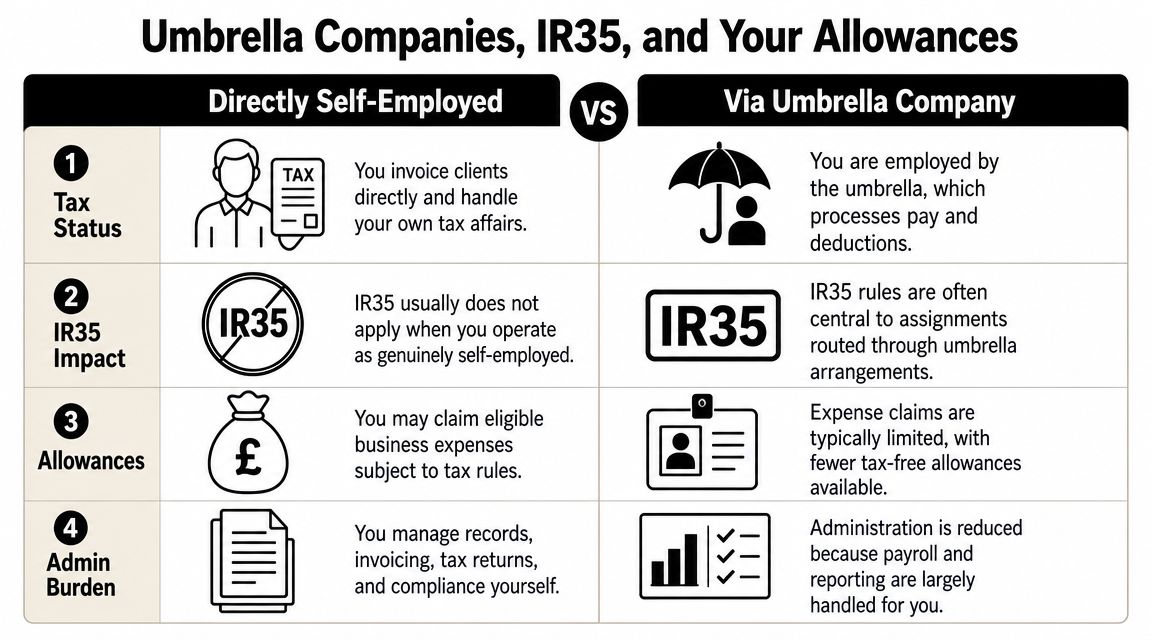
Why this matters for inside IR35 work
Inside IR35 roles are designed to be taxed more like employment. In practice, using an umbrella company means PAYE is applied before you're paid, so tax and National Insurance are handled through payroll rather than through self-employed tax reporting for that contract.
That changes the allowances question completely.
If you're an umbrella employee, you usually focus on:
- Your payslip and deductions
- PAYE treatment
- Employment rights linked to umbrella employment
- Assignment rate versus take-home pay
You usually don't focus on self-employed tax allowances for that income, because that income isn't being treated as sole trader income.
A simple comparison
Think of direct self-employment as running your own till. You record the sales, track the costs, and work out the tax position.
Think of umbrella work as being put on an employer payroll for the contract. The tax machinery runs through payslips instead.
That doesn't mean one model is always better. It means they solve different problems.
Where Umbrella Company fits
If you're comparing umbrella options for an inside IR35 contract, Umbrella Company's IR35 guide explains how the off-payroll rules affect the way contractors are paid and why payroll status matters.
If your contract income is processed through an umbrella payslip, stop applying sole trader rules to that same income. That's one of the most common causes of confusion.
The practical upside
For many contractors, umbrella employment removes a large chunk of admin.
You don't need to build your tax approach around self-employed treatment for that assignment. Instead, the focus shifts to understanding the assignment rate, reading the payslip properly, and checking that the umbrella is operating compliant payroll.
Frequently Asked Questions
Can I still use the phrase self employment allowance if I mean the Trading Allowance
You can, but it's better not to. The phrase is common, but it's imprecise.
If you mean a tax rule for small amounts of freelance income, say Trading Allowance. If you mean means-tested support because income is low, say Universal Credit. That one change makes advice much easier to follow.
What if I earn more than the Trading Allowance
Once income rises beyond the small-income scenario, the simple shortcut usually stops being enough on its own.
At that stage, you need to look carefully at proper income reporting and whether claiming actual business expenses gives a better result than relying on a simplified allowance approach. The right answer depends on how you work and what genuine costs you incur.
I'm disabled and my freelance income goes up and down. Will I lose my benefits
This is one of the biggest gaps in mainstream guidance.
Support materials often don't answer the fundamental question clearly enough: “Will I lose my benefits if my freelance income is irregular?” That's especially important for disabled claimants dealing with means-tested support, work-related conditions, or partial capacity for work. Guidance highlighted in the SEED policy curriculum on self-employment and entrepreneurship support shows why benefits counselling and structured support matter when self-employment interacts with income-related benefits.
In UK practice, the key points are usually:
- Universal Credit can change with income fluctuations
- Access to Work may be relevant depending on your work needs
- Good reporting matters even more when health affects work patterns
- Irregular income doesn't automatically mean you've done anything wrong, but it can change how support is assessed
If this is your situation, don't rely on general freelancer advice. Get UK-specific guidance on your exact mix of benefits and work arrangements.
Do I need detailed records if my self-employed income is only occasional
Yes. Keep the records anyway.
Use invoices, payment confirmations, and a simple expenses log. Even small side income can become confusing later if you switch between self-employment, unemployment support, and umbrella assignments.
What if I move from self-employment to an umbrella company mid-year
Treat that as a status change, not just an admin update.
Your directly earned freelance income and your umbrella PAYE income don't sit under the same tax treatment. Keep them clearly separated in your records so you don't blur self-employed rules with employment income.
If you're weighing up whether to stay self-employed or move into PAYE for an inside IR35 contract, Umbrella Company lets contractors compare umbrella companies and understand how payroll treatment changes their day-to-day admin, deductions, and take-home pay.


