


If you're self-employed, pension saving often sits in the same mental pile as bookkeeping, tax returns, and chasing invoices. Important, but easy to postpone.
That’s understandable. No employer enrols you into a scheme, no payroll team nudges you, and no matching contribution appears automatically in the background. You have to decide to do it, set it up, and keep it going.
That’s exactly why self employed pension contributions feel confusing at first. The rules are manageable once you separate them into a few simple ideas: what type of pension you can use, how much you can pay in, how tax relief works, and what changes if you contract through an umbrella company.
An Introduction to Pensions for the Self-Employed
Many freelancers reach the same point. Work is going well, invoices are being paid, and then a bigger question lands. “What am I doing about retirement?”
For employed staff, workplace pensions do a lot of the heavy lifting. For the self-employed, that safety net usually isn’t there. The gap is clear. According to the Department for Work and Pensions workplace pension participation data, only 20% of self-employed people were actively saving into a pension in 2021/22, compared with 81% of eligible employees.
That doesn’t mean pensions are harder for self-employed people. It means you need a clearer process.
A good pension plan gives you more than a retirement pot. It gives structure. It helps you turn irregular income into long-term security, and it can make your tax position more efficient at the same time.
Retirement planning usually becomes easier once you stop treating it as a huge life decision and start treating it as a regular business habit.
The practical questions often raised are usually these:
- What kind of pension can I open
- How much can I contribute
- What tax relief do I get
- How do contributions work if I’m inside IR35
- What do I need to put on my Self Assessment return
Those are the points that matter in day-to-day life. If you understand them, pensions stop feeling vague and start feeling workable.
What Are Self-Employed Pension Contributions
A pension contribution is money you put aside for later life into a tax-efficient pension wrapper.
If you’re employed, this often happens through a workplace scheme. If you’re self-employed, you usually make the decision and the contribution yourself. In other words, you act as the person earning the money and the person arranging the pension.

Paying your future self
The simplest way to think about self employed pension contributions is this: you’re paying your future self first.
You earn money now, and instead of leaving all of it in your current account, you direct some of it into a pension so it can grow over time. That money is normally invested, rather than just sitting in cash, and the government gives tax relief to encourage you to save.
This is why pensions can be much more effective than trying to save for retirement in an ordinary savings account.
Why self-employed people need a deliberate plan
The main difference between workplace pensions and self-employed pensions isn’t the end goal. It’s the setup.
With a workplace pension, your employer handles much of the administration. With self-employment:
- You choose the provider
- You decide how often to contribute
- You monitor whether the amount still suits your income
- You claim any extra tax relief you’re entitled to
That extra responsibility can feel annoying, but it also gives you control. You can raise, lower, pause, or restart contributions as your contracts change.
What pension contributions actually do
A pension contribution usually does three things at once:
- Builds long-term savings, so your retirement doesn’t depend only on the State Pension
- Creates tax advantages, which makes each contribution more efficient than ordinary saving
- Adds discipline, especially if you automate payments when income lands
Practical rule: if you wait until freelance income feels perfectly predictable, you may never start. A modest regular contribution often beats a perfect plan that never gets opened.
A lot of confusion comes from the word “pension” itself. People assume it means a complicated product or a fixed commitment. In reality, it’s a tax-efficient container for retirement savings. The important part is choosing the right version for the way you work.
Your Main Pension Options as a Contractor
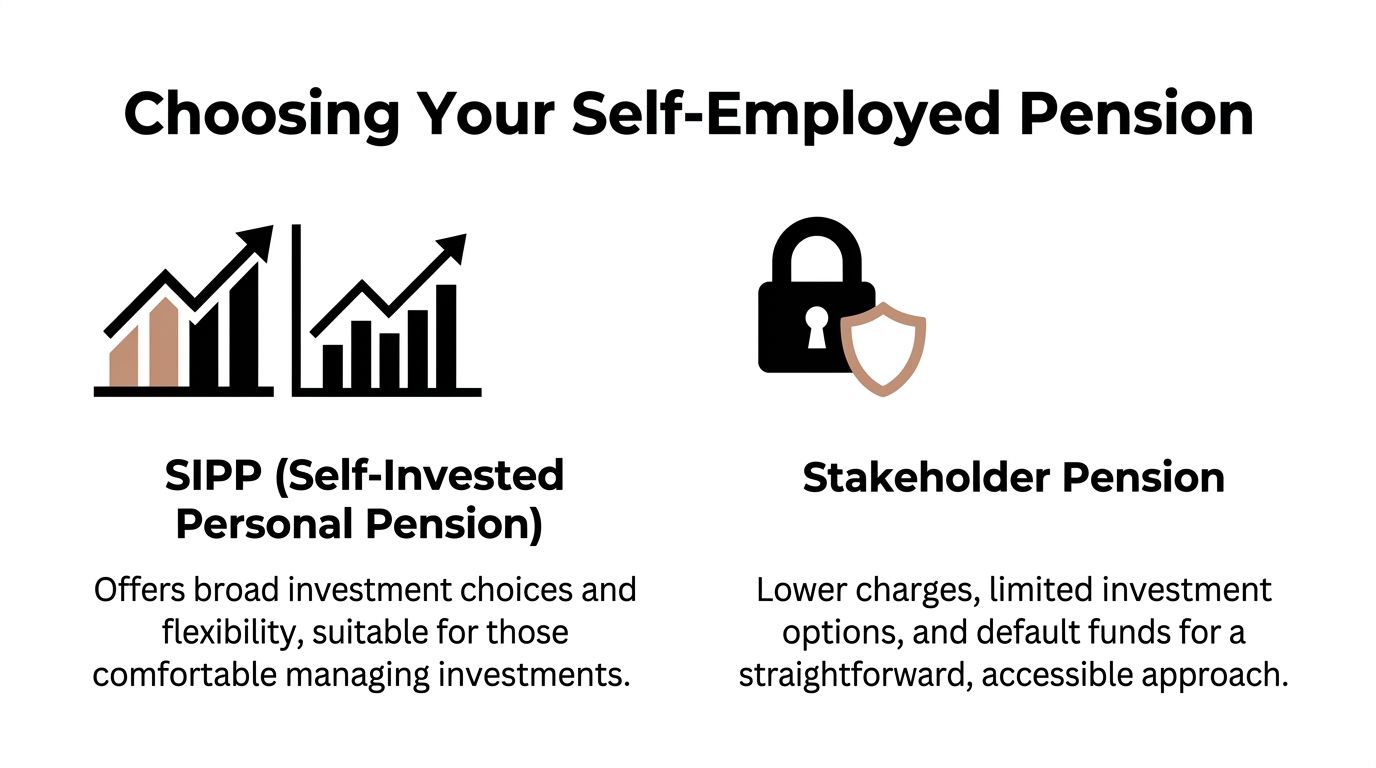
Most contractors and freelancers start by choosing between a personal pension and a Self-Invested Personal Pension (SIPP).
Both can work well. Both are private pensions. Both can receive tax-relieved contributions. The main difference is how much control you want and how involved you’re willing to be.
Personal pensions
A personal pension is usually the simpler route.
You pick a provider, choose from a more limited menu of funds, and let the provider handle most of the investment framework. This suits people who want a straightforward arrangement without spending much time on investment decisions.
It often works well if:
- You want a clean, easy setup
- You’d rather use default or guided fund choices
- You don’t want to manage lots of moving parts
- You prefer administration to stay minimal
For many first-time pension savers, that simplicity is a strength, not a compromise.
SIPPs
A SIPP gives you more investment choice and more control.
That wider choice can be useful if you already understand investing, work with an adviser, or want to build your own approach. But extra flexibility also means more decisions. If you don’t want to review funds, platforms, and risk levels, a SIPP can become a source of delay.
A SIPP may suit you if:
- You want broad investment options
- You’re comfortable selecting and reviewing investments
- You want more control over how your pension is run
- You don’t mind a more involved setup
Comparison of Personal Pensions vs. SIPPs for Contractors
| Feature | Personal Pension | Self-Invested Personal Pension (SIPP) |
|---|---|---|
| Investment choice | Usually narrower and guided | Usually broader and more flexible |
| Ease of use | Generally simpler | Often better for confident investors |
| Administration | Lower effort | More hands-on |
| Default options | Common | Available, but platform-led |
| Best fit | Contractors who want simplicity | Contractors who want control |
Which one is right for most contractors
The best choice usually depends on your behaviour, not your income.
If you’re the type of person who likes simplicity and gets decision fatigue from financial products, a personal pension can be ideal. If you already manage investments elsewhere and want your pension to fit into that wider strategy, a SIPP can be a strong fit.
A useful test is to ask yourself one question: Will more choice help me act, or will it make me put this off?
That answer matters more than people think.
What about stakeholder pensions
Some contractors also come across stakeholder pensions. These are designed to be accessible and straightforward, often with capped charges and simpler fund choices.
That can be attractive if you want a basic pension without much complexity. A SIPP, by contrast, is usually aimed at people who want flexibility. If you're comparing how your overall setup affects tax, payroll, and pension decisions, it also helps to review your wider type of business structure, because the right pension route often depends on how you’re working.
The best pension is usually the one you’ll actually fund consistently, review occasionally, and understand well enough to keep.
Understanding Pension Contribution Rules and Limits
This is the part that often puts people off, but the core rule is simpler than it sounds.
For UK self-employed individuals, the annual pension contribution limit for tax relief is the lower of 100% of your earnings or £60,000 for 2026/27, and you can also use the carry forward rule for unused allowances from the previous three tax years, as explained in HMRC’s guidance on the annual allowance for private pensions.
The two limits people mix up
There are really two checks happening at once.
First, there is the annual allowance. That is the general cap for tax-relieved contributions in a tax year.
Second, there is the earnings limit. For most self-employed people, tax relief is linked to relevant earnings, so you normally can’t just ignore what you earned that year.
People often get confused. They hear the annual allowance and assume they can always contribute up to that figure. In practice, your earnings still matter.
Carry forward for uneven income
Carry forward is especially useful for freelancers and contractors because income often moves around from year to year.
If you had lower contributions in earlier tax years and then have a strong year, carry forward can let you use some of that unused allowance. That can be powerful when:
- You finish a profitable contract
- You clear company reserves into personal planning
- You want to catch up after years of under-saving
- Your income jumps after a quiet period
The rule that often gets missed is that carry forward doesn’t let you ignore your current earnings position. You still need to check how the earnings rule applies to you.
A plain-English example
Suppose a contractor had modest pension contributions for several years while building their client base.
Then they land a much better contract and want to make a larger pension payment. Carry forward may allow them to use unused allowance from earlier years, which can make that larger contribution more tax-efficient than they expected.
That’s why many self-employed people review pensions near the end of the tax year, once income is clearer.
Carry forward is often most useful when income is lumpy. It gives you a way to use strong years more intelligently instead of treating every tax year in isolation.
The tapered annual allowance
High earners may also need to watch the tapered annual allowance.
The broad point is simple. If your income is high enough, your annual allowance can reduce. That makes the planning more technical, particularly for contractors with very strong years, multiple income sources, or complex remuneration arrangements.
If that might apply to you, it’s worth getting personal advice before making a large contribution.
A working habit that helps
For most freelancers, a sensible routine is:
- Estimate annual earnings
- Check how much has already gone into pensions this tax year
- Review any unused allowance from earlier years
- Decide whether to contribute monthly, as a lump sum, or both
That keeps things practical. You don’t need to master pension legislation. You just need a repeatable decision process.
How Pension Tax Relief Works and How to Claim It
Tax relief is the reason pensions are so attractive for many self-employed people.
You’re not just saving money. You’re saving it inside a structure that gets government support. That changes the effective cost of contributing.

Relief at source
The most common method is called relief at source.
This means you pay a net contribution into your pension provider, and the provider claims basic-rate tax relief and adds it to your pension pot. The standard example is the one worth remembering:
- You pay in £80
- Tax relief adds £20
- Your pension receives £100
That happens automatically with many personal pensions and SIPPs.
What the real cost looks like
According to MoneyHelper’s guidance on pension tax relief, a £100 pension contribution costs a basic-rate taxpayer £80, a higher-rate taxpayer £60, and an additional-rate taxpayer £55.
That’s the part many contractors miss. Higher-rate and additional-rate taxpayers may be entitled to more relief than the pension provider adds automatically.
Claiming extra relief through Self Assessment
If you pay higher-rate or additional-rate tax, you usually claim the extra relief through your Self Assessment tax return.
That means you should keep clear records of:
- What you paid personally into the pension
- Whether the figure shown is the net amount or the gross amount
- Which tax band applied to you for the year
- Any provider statements confirming contributions
For self-employed people, this matters because the contribution can affect your wider tax calculation. If you’d like to understand related planning ideas around take-home pay, this guide on how to reduce PAYE tax as a contractor is a useful companion read.
Why pensions can be more efficient than ordinary investing
Tax relief gives an immediate uplift, but there’s another reason pensions matter in wider planning.
MoneyHelper also notes that pensions are typically exempt from Inheritance Tax. For some contractors, especially those building long-term family wealth as well as retirement income, that makes pensions useful beyond the narrow idea of “saving for old age”.
A pension contribution can reduce the real cost of saving while increasing the amount invested. Few other options give that combination as cleanly.
Common mistakes
People usually go wrong in one of four places:
- Mixing up net and gross contributions
- Forgetting to claim extra relief through Self Assessment
- Assuming all pension schemes work the same way
- Not keeping annual contribution records
That’s why good admin matters. A pension isn’t only an investment decision. It’s also a paperwork decision.
Pensions for Contractors Inside IR35 and Umbrella Companies
If you work inside IR35 through an umbrella company, pensions can feel especially murky.
You may look at your payslip, see PAYE deductions, and assume you’ve lost the flexibility that self-employed people usually have. In practice, there is often still a very efficient route available.
Why umbrella arrangements change the mechanics
Inside IR35, your income is generally processed in a way that feels much more like employment. That changes how pension contributions are handled.
Instead of making all contributions personally from net pay, many contractors can arrange pension saving through the umbrella payroll itself. The key mechanism here is often salary sacrifice.
According to the FCSA’s explanation of working through an umbrella company, contractors using a compliant umbrella company can often make pension contributions via salary sacrifice, so the money comes from gross earnings before taxes are calculated, giving relief on both Income Tax and National Insurance.
Why salary sacrifice can be powerful
That structure matters because it changes the order of events.
With an ordinary personal contribution, money usually reaches your bank account first and then goes into the pension. With salary sacrifice, the contribution is arranged before tax is calculated through payroll.
For contractors inside IR35, that can make pension saving one of the cleanest planning tools available.
What to check with an umbrella company
Not every arrangement is equal. Ask direct questions.
- Is salary sacrifice available
- Which pension schemes can receive contributions
- How do I opt in or change the amount
- When does the payroll change take effect
- How will the contribution appear on payslips
If you’re comparing providers, this overview of an umbrella company for freelancers can help you think through the wider support you may need, not just pension handling.
Compliance matters
This is one area where cutting corners can create bigger problems later.
Use a compliant umbrella company and be cautious of any arrangement that sounds like a tax loophole rather than a normal payroll pension process. Contractors should understand what is happening to their gross pay, how deductions are calculated, and what pension records they will receive.
If a provider can’t explain your pension process clearly on one payslip, that’s a warning sign.
A simple way to think about it
For umbrella contractors, pension planning is less about choosing between dozens of strategies and more about making sure payroll and pension contributions are aligned properly.
If your umbrella supports salary sacrifice and explains it well, you may have a very efficient route to build retirement savings even while working inside IR35.
Practical Steps to Set Up and Make Contributions
Many individuals don’t need more pension theory. They need a manageable starting point.
A good setup should be easy to run in a busy month and easy to review in a strong earning month.
Choose the provider first
Start by comparing pension providers on practical points, not marketing language.
Look at:
- Fees, including platform charges and fund charges
- Investment options, especially whether you want guided funds or wider control
- Ease of use, including app access and contribution changes
- Support, particularly if you may need documents for tax returns
If your work setup also involves payroll decisions, it helps to understand related administration such as setting up a PAYE scheme, because pension contributions often sit alongside wider earnings reporting.
Open the account and gather the basics
Most providers will ask for standard identity details, National Insurance information, bank details, and your contribution preferences.
Keep copies of:
- Opening confirmation
- Contribution receipts
- Annual statements
- Tax year summaries if the provider issues them
This is the sort of paperwork that saves time when Self Assessment season arrives.
Decide how you’ll contribute
There are two common patterns.
Monthly contributions suit people who want discipline. They turn pensions into a routine bill, like software or insurance.
Ad hoc lump sums suit people whose income moves around a lot. Many freelancers prefer this when contract income is uneven.
Some people use both. They make a modest monthly payment, then add more after a strong quarter or near the tax year end.
Keep one eye on the admin
This short explainer is useful if you want a visual overview before making changes to your setup.
Record contributions properly for Self Assessment
A common point of confusion is where pension contributions go on the tax return.
For personal contributions, record them in the pension contributions area of Self Assessment using the correct grossed-up figure where required. The exact boxes and wording can change over time, so check the current HMRC filing guidance or use software that prompts you clearly.
What matters most is consistency.
- Don’t guess whether a figure is gross or net
- Don’t wait until filing week to collect provider statements
- Don’t assume your accountant can fix missing records without evidence
A clean folder for pension documents is often enough to avoid most problems.
Your Path to a Secure Freelance Retirement
Self employed pension contributions don’t need to be perfect to be worthwhile. They need to be started, understood, and reviewed.
If you remember the main points, you’re already in a strong position. Choose a pension type that matches how involved you want to be. Use tax relief properly. Watch the contribution rules if your income changes. If you work inside IR35 through an umbrella company, check whether salary sacrifice is available and how it operates in payroll.
For a broader view of owner-led retirement planning, Retirement Planning for Business Owners is a useful extra read.
The biggest mistake is usually delay. A clear, boring, repeatable pension habit is often far better than waiting for the perfect moment.
If you’re comparing umbrella companies and want one that supports compliant payroll and pension arrangements, Umbrella Company can help you review your options and choose a provider that fits the way you work.


