


If you're a contractor, you've probably had this experience. Your income is strong, your contract is solid, and your bank account shows regular money coming in, yet a lender still treats your application like a puzzle.
That's where a self employed mortgage broker earns their place. Not by doing magic, but by presenting your income in a way underwriters can work with. For contractors, especially those dealing with IR35, umbrella payroll, day rates, dividends, or uneven monthly drawings, the mortgage process is less about whether you can afford the loan and more about whether you can prove it cleanly.
A good outcome usually comes down to three things. First, how your income is structured. Second, how your documents tell the story. Third, whether the broker handling your case understands contractor lending properly, not just standard employed applications.
Why Getting a Mortgage Is Different for Contractors
Lenders like simplicity. A borrower on a straightforward PAYE salary fits neatly into an automated system. The payslips are regular, the employer is obvious, and the underwriter can usually verify income quickly.
Contractors rarely look that tidy on paper.

Why lenders struggle with contractor income
A contractor might be paid through a limited company, an umbrella company, sole trader accounts, or a mix of methods over time. Some draw a low salary and take dividends. Others work on a day rate that looks very healthy in practice but doesn't appear in the way a lender's default model expects.
That creates friction in affordability assessments. The lender isn't only asking, "What do you earn?" They are also asking:
- How stable is it
- How easy is it to verify
- Will this income continue
- Does the paperwork match the explanation
If those answers aren't obvious from the documents, the case slows down or gets declined.
The UK issue isn't the same as generic self-employed advice
A lot of online guidance still borrows from overseas content. That's one reason contractors get confused. As noted in this market context on loan brokers, some global broker data can be misleading, because the UK market is shaped by flexible working and IR35, which creates a stronger need for advisers who understand contractor income properly.
That matters because a UK contractor isn't just "self-employed" in a broad sense. They may be:
- Inside IR35 and paid via umbrella PAYE
- Outside IR35 through a limited company
- Moving between contract structures
- Showing income differently for tax and mortgage purposes
Those are not small details. They affect what a lender will accept, how they calculate affordability, and how much explanation the file needs.
Contractors usually don't have an income problem. They have a presentation problem.
What underwriters are really looking for
Underwriters want a clean story. If your documents show consistency, continuity of work, sensible account conduct, and a structure they understand, the case becomes easier.
A weak application often has one of these problems:
- Mismatched dates between contracts, payslips, bank statements, and accounts
- Unclear income trail, especially where personal and business finances overlap
- Tax-efficient drawings that reduce visible income too far
- Contract changes that create avoidable questions
If you're unsure how your setup looks on paper, it helps to review how to structure your contractor income in the UK before you apply. The mortgage market rewards clarity.
Preparing Your Income Evidence for Lenders
Most contractor mortgage problems start long before submission. They start when the paperwork doesn't line up.
A lender can only assess what they can verify. If your income is genuine but the evidence is patchy, delayed, or inconsistent, that can damage an otherwise good case.

The core documents most lenders ask for
The exact list varies by lender and trading structure, but most contractor cases involve a version of the following:
- SA302s and tax year overviews, where relevant, to confirm declared income and tax position
- Business accounts, ideally finalised and easy to read
- Personal bank statements, showing income credits and day-to-day conduct
- Business bank statements, where income runs through a company account
- Current contract or assignment schedule, to show rate, term, and continuity
- Identification and proof of address
- Latest payslips, if you're working through an umbrella company
- Accountant reference, where a lender wants confirmation of sustainable earnings
Each document does a different job. Accounts show trading history. Bank statements show conduct. Contracts show forward visibility. Payslips show a format many lenders understand immediately.
What often goes wrong
The most common issue isn't missing paperwork. It's paperwork that tells conflicting stories.
Examples include:
- A contract says one rate, but bank credits don't reflect it clearly
- Dividend income appears in accounts, but the lender needs more explanation
- Large transfers appear with no clear source
- Dates on statements don't cover the lender's requested period
- SA302 figures don't match what the borrower thinks they earn
This is why preparation matters. You want every part of the file to support the same income narrative.
Practical rule: Before submission, put your contract dates, invoices, payslips, and bank credits into one timeline. If you can't follow it quickly, the lender won't either.
A good check-in point is your tax admin. If filings are behind or disorganised, fix that first. Keeping on top of self-assessment deadlines in the UK reduces last-minute document stress.
Why umbrella payslips can strengthen a case
For contractors inside IR35, mortgage affordability can become awkward. Deemed salary calculations and non-standard deductions can make income harder for lenders to interpret. According to this mortgage underwriting discussion, 28% of UK contractors inside IR35 face difficulties with mortgage approvals due to deemed salary calculations, and using a compliant umbrella company can improve lender confidence by 15% to 20% in affordability ratios because it creates a PAYE-style income trail.
That doesn't mean umbrella use is automatically better in every case. It does mean lenders often find it easier to understand.
A compliant umbrella setup can help because it provides:
- Regular payslips
- P60s
- A visible employer relationship
- Clear tax deductions through PAYE
- A simpler income trail on personal statements
For some borrowers, that's the difference between an underwriter making a quick decision and raising repeated queries.
Later in the process, it also helps to understand the paperwork from the umbrella side. This explainer may help if you want a visual overview before speaking to a broker.
Presenting your file properly
A strong file doesn't just contain documents. It anticipates questions.
Use this simple approach:
Lead with the clearest evidence
If umbrella payslips best reflect your current income, make them prominent.Support with context
Add your current contract and a short explanation if you've moved between structures.Keep accounts clean
Avoid mixing personal and business spending where possible.Explain unusual items early
One large deposit with no note can create more trouble than a modest income fluctuation.Check consistency across names, dates, and addresses
Small discrepancies cause delays far more often than people expect.
How to Choose a Specialist Self Employed Mortgage Broker
Not every broker who says they handle self-employed applicants is effective for contractors. That's the first filter.
A specialist self employed mortgage broker should know how to place a day-rate contractor, an umbrella employee inside IR35, and a limited company director with fluctuating drawings. If they only work comfortably with simple salary-and-bonus cases, you'll feel it quickly in the questions they ask.
What a specialist should understand immediately
You shouldn't need to educate your broker on your own income structure. A good contractor broker already knows the pressure points, including contract gaps, retained profit questions, umbrella payslips, and how lenders view company directors who minimise salary for tax reasons.
They should also be able to talk sensibly about the economics of broking. According to this comparison of employed and self-employed mortgage adviser models, self-employed brokers in the UK can retain 100% of commissions, employed advisers often retain 50% to 75%, self-employed advisers earn on average 30% to 50% more, and operational costs typically sit at 10% to 15% of earnings. The same source notes that 85% of mortgage advisers charge broker fees, with an average fee of £500 per case, though fees can range from £0 to £1,400 depending on complexity.
Those numbers matter because they remind you to ask direct questions about fees, commission, and service scope. A broker can be excellent and still be expensive. That's fine, provided the value is clear.
Questions worth asking before you commit
Don't ask broad questions like "Do you help contractors?" Ask things that test real experience.
- How do you assess day-rate income for lender selection
- Which lenders on your panel accept umbrella income comfortably
- How do you handle cases where current earnings are stronger than the latest accounts
- What do you need from my accountant
- Do you charge a broker fee, and if so, when is it payable
- How often will you update me once the case is submitted
- Have you handled clients moving between inside and outside IR35 structures
The answers tell you a lot. A specialist gives specific, calm replies. A generalist tends to stay vague.
If a broker spends more time selling themselves than discussing how lenders read your income, keep looking.
What good broker value looks like
A broker's real value isn't just access to products. It's packaging.
Research based on 2023 HMDA data, reported in this industry article on broker outcomes, found that consumers working with independent mortgage brokers save an average of £10,662 to £13,432 per loan over the life of the mortgage compared with nonbank retail lenders. The article also describes broker-led transactions as faster, smoother, and more personalised.
For contractor cases, that value often shows up in quieter ways:
- They stop you applying to the wrong lender first.
- They prevent avoidable document issues.
- They know when to push for manual review.
- They can explain your structure in terms underwriters accept.
If your circumstances cross borders as well as contracts, specialist reading helps there too. Borrowers with overseas income or residency questions may find Invexa for self-employed expat mortgages useful as a supplementary perspective on how complex self-employed cases are assessed.
Signs you've found the right broker
A strong broker usually does three things early:
| What they do | Why it matters |
|---|---|
| They ask for documents before making promises | It shows they're placing the case on evidence, not guesswork |
| They explain lender fit, not just rates | A low rate is irrelevant if the lender won't accept your income |
| They talk through weaknesses openly | Honest case strategy beats false reassurance |
If you want to sense-check your own numbers before that first meeting, your records and drawings should already be in order. Clean bookkeeping gives any specialist a better starting point, and contractor accounting guidance can help tighten that side first.
The Mortgage Application Process Timeline
For most contractors, the process feels stressful because the lender goes quiet at the exact moment you want certainty. The timeline is more manageable when you know what each stage is trying to achieve.
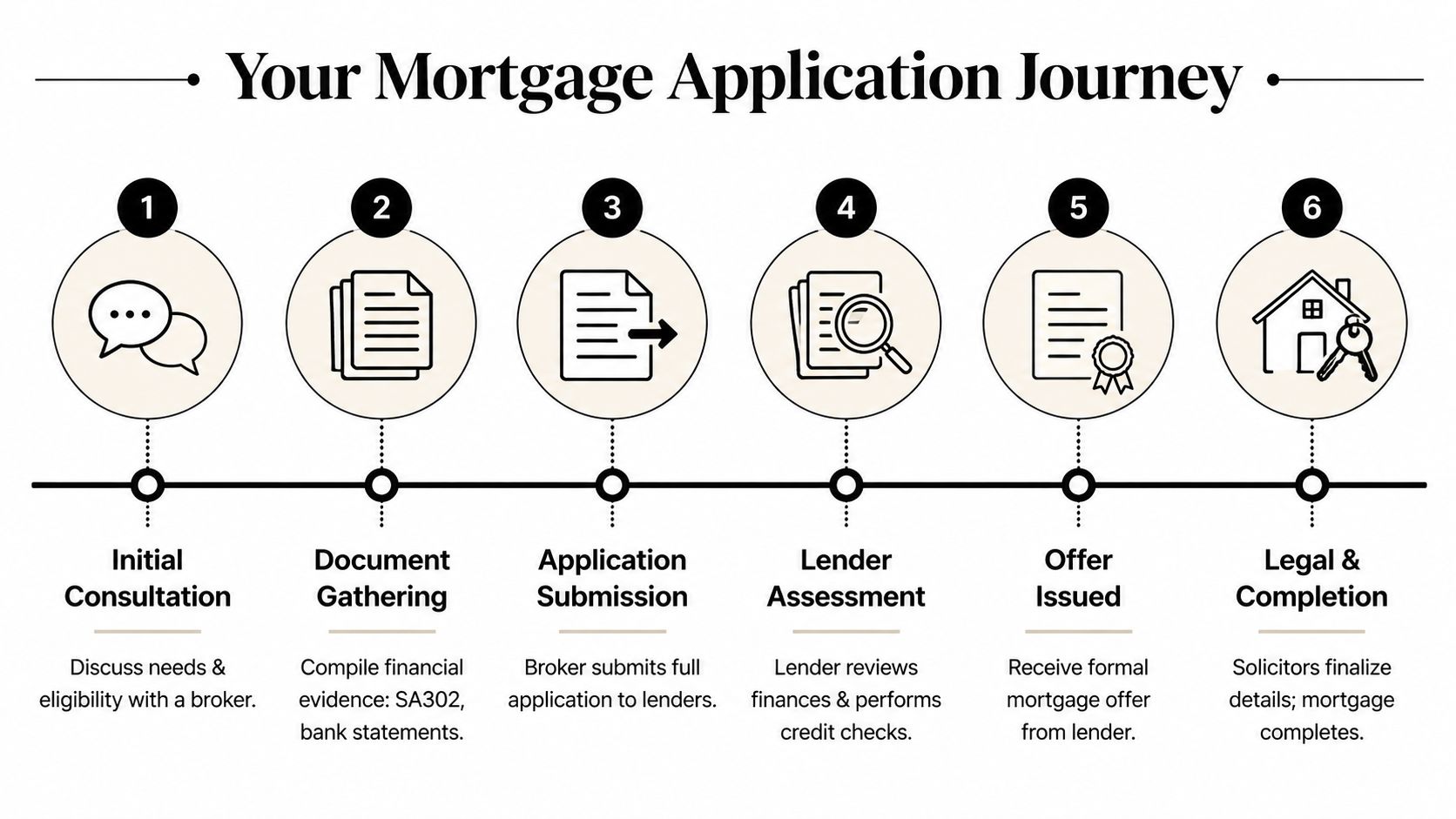
Initial consultation and fact-find
The first proper conversation is where a broker tests the shape of the case. They review your income structure, contract position, deposit, credit profile, property plans, and any complications such as recent company changes.
This stage is also where weak points should surface. If the broker doesn't ask detailed questions here, problems tend to appear later when time matters more.
A useful first meeting usually covers:
- How you're paid now
- How long you've been contracting
- Whether there are gaps between roles
- What documents exist already
- Whether your deposit is seasoned and traceable
Agreement in principle and lender choice
Once the broker is satisfied with the basics, they usually target an agreement in principle. That is not a final offer, but it can show whether the lender is broadly comfortable with the headline case.
At this stage, lender selection matters more than speed. For a contractor, the wrong lender can waste weeks.
Good brokers don't submit first and explain later. They match the lender to the income structure before the full application goes in.
Full application and document submission
The core of the workload resides here. The broker sends the application, supporting documents, and any explanations needed to make the file coherent.
The cleaner the file, the easier the lender's first review tends to be. A messy submission invites queries, and each query adds time.
Typical items in this pack include:
| Stage item | What happens |
|---|---|
| Income evidence | Payslips, accounts, tax documents, contract papers |
| Bank statements | The lender checks credits, commitments, and conduct |
| ID and address proof | Standard compliance checks |
| Deposit evidence | The lender confirms source and traceability |
Underwriting and valuation
Underwriting is where the lender pressure-tests the file. They may ask for clarifications, updated statements, or a better explanation of how income is calculated. This is normal.
The property valuation runs alongside or shortly after this. The lender wants to confirm the property is acceptable security for the loan.
This stage often feels slow because several parties are involved:
- The broker, answering lender questions
- The underwriter, reviewing risk
- The valuer, assessing the property
- You, supplying anything missing
- Sometimes your accountant, confirming income detail
Offer, legal work, and completion
Once underwriting is satisfied and the valuation is fine, the lender issues the formal mortgage offer. After that, the legal side takes over.
Your solicitor handles searches, title checks, enquiries, mortgage conditions, and the final exchange and completion process. The lender remains involved, but the pace is often driven by legal work and the chain.
A realistic way to think about the process is in milestones rather than fixed dates:
- Broker confirms case fit
- Lender indicates initial acceptance
- Full file is submitted
- Underwriter signs off
- Offer arrives
- Solicitors complete the purchase
Contractors do best when they treat the process like project management. Respond quickly, keep every document current, and don't assume silence means a problem. Sometimes it just means the file is waiting its turn.
Advanced Tips for Strengthening Your Application
Once the basics are in place, small adjustments can materially improve a contractor case. Specialist strategy is particularly important, especially if your income doesn't look flattering on older tax documents.

Consider alternative income verification
For some borrowers, traditional proofs are the wrong lens. The issue isn't affordability. It's that older SA302s don't reflect current contract earnings well enough.
According to this guide on non-traditional income borrowing, an emerging trend for 2026 is the use of bank statement mortgages from specialist UK lenders, using 12 to 24 months of statements to evidence income. The same source says these products saw a 22% surge in availability in early 2026.
That won't suit everyone. Rates and criteria can differ from standard products, and specialist underwriting can be stricter in other ways. But for contractors with variable commissions, seasonal receipts, or accounts that understate current affordability, this can be a practical route.
Improve the parts you control
You can't control every underwriting decision, but you can control how much avoidable risk sits in your file.
Focus on these areas:
Credit hygiene
Keep utilisation sensible, avoid missed payments, and check your report before you apply. For a plain-English breakdown of what influences credit files, Nanak Accountants on credit score determinants is a useful supplementary read.Deposit strength
A larger deposit can make the case easier, especially if the income side is more complex than usual.Account conduct
Lenders read statements closely. Gambling transactions, returned payments, and unarranged overdraft use create friction fast.Accountant support
A mortgage-friendly accountant can prepare references and explain company income in a way that underwriters can follow.
A contractor application gets stronger when every supporting detail says the same thing. Stable income, controlled commitments, and no surprises.
Use the right blend of evidence
Some of the strongest cases combine more than one type of proof. For example, a borrower may have umbrella payslips that show regular PAYE income, plus bank statements that reflect broader earning consistency over time.
That blended approach can help where one document set is technically accurate but incomplete in context. The key is not to overwhelm the lender. Use enough evidence to clarify the case, not so much that it becomes chaotic.
Common Mortgage Mistakes Contractors Must Avoid
Contractors often assume the hard part is proving income. In reality, plenty of applications fail because the borrower changes something at the wrong time.
A case can be strong at the start and weaker three weeks later if your financial behaviour shifts while the lender is still reviewing it.
Changing structure mid-application
Switching from limited company to umbrella, changing accountants, moving contracts, or altering how you draw income can all create fresh questions. Even if the change makes sense commercially, it can delay underwriting or force the lender to reassess the whole case.
If a structural change is unavoidable, tell your broker before it happens. Silence causes more damage than the change itself.
Taking on new credit
That car finance agreement, buy-now-pay-later plan, or large credit card purchase may look manageable to you. To a lender, it's a fresh monthly commitment arriving at the worst possible moment.
Avoid the following until completion if you can:
- New finance agreements
- Large credit card balances
- Store finance promotions
- Guarantor commitments for someone else
Letting the bank statements become messy
Underwriters don't only look for income. They look for behaviour. If your statements suddenly show bounced payments, unexplained cash deposits, or irregular transfers between accounts, expect questions.
This is especially important for contractors because the file already asks the lender to do more interpretation than a simple PAYE case.
Keep your statements boring while the mortgage is live. Boring statements get approved more easily than dramatic ones.
Assuming preparation only means saving a deposit
Deposit matters, but so does how the lender reads the rest of your profile. If you're still building funds for a purchase, broad budgeting guidance like Econumo's guide to buying a home can help frame the bigger picture around affordability, costs, and planning.
Ignoring IR35 positioning
One recurring mistake is not understanding how your current status affects the lender's view of income. Some borrowers assume tax structure and mortgage structure are separate conversations. They aren't.
If your contract status is likely to shift, make sure you understand the implications of being inside or outside IR35 before the application starts. A lender can work with complexity. They struggle with inconsistency.
Rushing the first application
Submitting quickly to "see what happens" is usually poor strategy for contractors. A weak first application wastes time and can create avoidable headaches if you then need to repackage the case elsewhere.
The better approach is simple. Slow down before submission, not after a decline.
Your Mortgage Application Checklist and Next Steps
Contractor mortgages are rarely impossible. They just reward preparation more heavily than standard employed cases.
The strongest applications tend to share the same features. The income story is clear. The documents are consistent. The broker understands contractor lending properly. The borrower avoids unnecessary financial changes while the case is live.
Use this checklist before you apply.
Contractor's Mortgage Preparation Checklist
| Task Category | Action Item | Status |
|---|---|---|
| Income evidence | Gather current contract, payslips, accounts, and relevant tax documents | ☐ |
| Income evidence | Check that names, dates, and addresses match across documents | ☐ |
| Income evidence | Review bank statements for unexplained large deposits or problem transactions | ☐ |
| Tax admin | Make sure filings are up to date and easy to verify | ☐ |
| Deposit | Confirm the source of deposit funds is traceable | ☐ |
| Credit profile | Check your credit report and correct any errors | ☐ |
| Credit profile | Avoid taking new credit before completion | ☐ |
| Broker selection | Ask how the broker handles contractor, umbrella, and IR35 cases | ☐ |
| Broker selection | Confirm all fees and when they become payable | ☐ |
| Accountant support | Make sure your accountant can provide references quickly if needed | ☐ |
| Application timing | Avoid changing payment structure or contract setup mid-application | ☐ |
| Final review | Read the full submission summary before it goes to the lender | ☐ |
What to do next
If you're applying soon, start with your evidence pack. That gives you the fastest read on whether the case is ready or whether it needs tidying first.
If your income runs through an umbrella company, don't assume that's a weakness. In many contractor cases, clean PAYE records and regular payslips can make the application easier to explain. If you're outside IR35 or using a limited company, the same principle applies. The structure itself isn't the problem. The presentation is.
A capable self employed mortgage broker should be able to look at your documents and tell you three things quickly:
- Which lenders are realistic
- What the underwriter will question
- What to fix before submission
That kind of clarity saves time, protects your credit profile, and gives you a far better chance of moving from enquiry to offer without unnecessary stress.
If you're comparing umbrella options and want a cleaner PAYE paper trail for future lending, Umbrella Company helps contractors review compliant providers and find support that fits their role, rate, and IR35 position. A well-structured income setup won't guarantee a mortgage, but it can make your application far easier to evidence.


