


You’ve finished a contract, checked your bank account, and then the tax question lands. What can I claim? That’s usually the point where self employed deductions start to feel confusing, especially if you’re juggling freelance work, short-term contracts, and questions about IR35.
Most guides stay far too general. They tell you that business expenses reduce tax, but they don’t explain the specific sticking points UK contractors face. The biggest one is simple. Your deductions depend on how you work. A sole trader can usually claim far more than someone working through an umbrella company inside IR35.
That’s why this guide matters. In the UK, 5.5 million self-employed people filed Self Assessment tax returns in the 2020/21 tax year, collectively claiming over £47 billion in expenses, an average of around £8,545 per person, according to HMRC Self Assessment tax statistics. Those figures show how important it is to understand the rules properly.
Your Guide to UK Self Employed Deductions
If you’re newly self-employed, the first thing to know is that deductions are not loopholes. They’re part of the normal tax system. HMRC lets you deduct certain costs of running your business before working out the profit you pay tax on.

That sounds straightforward, but confusion usually starts when contractors ask things like:
- Can I claim for working from home
- What if I use my phone for both business and personal calls
- Does mileage count
- Can I still claim expenses if I’m paid through an umbrella
- Should I use the trading allowance instead
Those are sensible questions. The answers depend on a few basic rules, and once you understand them, the whole subject becomes much easier to manage.
The key idea behind deductions
A deduction reduces your taxable profit, not your turnover. So if you invoice a client and then spend money that was needed for the work, HMRC generally taxes the profit left after allowable costs.
For many people, this is also the point where they realise they need to decide whether they’re properly set up. If you’re still unsure about the basics, our guide on when to register as self employed is a useful place to start.
Practical rule: If the cost exists because you run your business, it may be deductible. If it’s mainly personal, it usually isn’t.
Where contractors usually get caught out
New freelancers often assume all work-related spending is deductible. It isn’t. HMRC uses a strict test, and it becomes even stricter if you’re treated as an employee for tax purposes under IR35.
That’s why it helps to break the topic into manageable parts:
- what counts as an allowable expense
- how to keep records HMRC will accept
- how deductions are entered on your tax return
- how the rules change if you’re inside IR35 or using an umbrella company
Once you can separate those four areas, self employed deductions stop feeling like guesswork and start becoming a normal part of running your finances well.
Understanding Allowable Business Expenses
The main HMRC rule is that an expense must be wholly and exclusively for business. That phrase matters because it decides what you can and can’t deduct.
In plain English, it means the cost must exist for your business, not for your private life. If you buy something purely for work, the position is usually clear. If the item has both business and personal use, you usually need to split it fairly and only claim the business part.
What wholly and exclusively really means
A simple example helps.
If you buy printer paper for client work, that’s normally a business expense. If you buy a normal winter coat because you wear it to meetings, that isn’t usually allowable, because you’d still need clothing in everyday life. The fact that you wore it for work doesn’t turn it into a business cost.
Mixed-use costs are where many people go wrong. A mobile phone bill, broadband package, or car expense often includes both private and business use. In those cases, you don’t usually claim the full amount unless the full amount is for business use only.
If you have to explain an expense with “I use it a bit for work as well”, pause and check whether only part of it is claimable.
Allowable vs disallowable expenses at a glance
| Expense Category | Generally Allowable (Examples) | Generally Disallowable (Examples) |
|---|---|---|
| Travel | Business travel to temporary workplaces, business mileage, parking for business journeys | Ordinary commuting, private travel, family travel |
| Home working | Business use of home costs, including simplified flat-rate claims where eligible | General household costs with no business apportionment |
| Professional costs | Accountancy fees, trade subscriptions, professional indemnity insurance, training that maintains existing skills | Costs of training for a completely new trade |
| Office and admin | Stationery, printer ink, software subscriptions, domain names, hosting | Personal shopping, non-business subscriptions |
| Phone and internet | Business proportion of phone and internet costs | Private calls, personal streaming or home use |
| Meals and entertainment | Certain subsistence costs where HMRC rules allow them | Client entertaining and social hospitality |
| Clothing | Protective clothing or specialist uniforms | Everyday clothes, even if worn for work |
| Equipment | Business equipment used in the trade, such as laptops and monitors | Personal gadgets with no clear business use |
If you want a broader practical overview of claiming business expenses, that guide is useful for building the general habit of sorting receipts and matching costs to business activity. For UK tax, though, always apply HMRC’s own rules.
Simplified expenses
HMRC also allows simplified expenses in some areas. These are flat-rate methods that can save time because you don’t need to work out every small household or vehicle cost individually.
Examples include:
- Working from home, where simplified home office costs can apply if you work enough hours from home during the month
- Business mileage, where you use HMRC’s mileage rate instead of tracking fuel, servicing, and depreciation separately
- Living at your business premises, for people whose work and home overlap in a specific way
For contractors who work from a home office, this often removes a lot of stress. Instead of trying to split every utility bill with absolute precision, you may be able to use HMRC’s simpler method where it fits. Our detailed guide to working from home tax deductions covers that area in more depth.
Common examples contractors often claim
For a typical sole trader contractor, allowable costs often include:
- Mileage and travel costs for business journeys
- Software and cloud tools such as Microsoft 365, Adobe Creative Cloud, Xero, FreeAgent, or project management tools used for client work
- Professional fees like accountancy, insurance, and certain memberships
- Office consumables such as notebooks, postage, printer supplies, and cables
- Business banking charges on a dedicated account
The important part isn’t whether the expense sounds “business-like”. It’s whether you can show why your business needed it.
Keeping Accurate Records for HMRC
Good records make tax easier, but they also protect you if HMRC ever asks questions. A missing receipt doesn’t always mean a claim is wrong, but weak records make it much harder to prove your position.
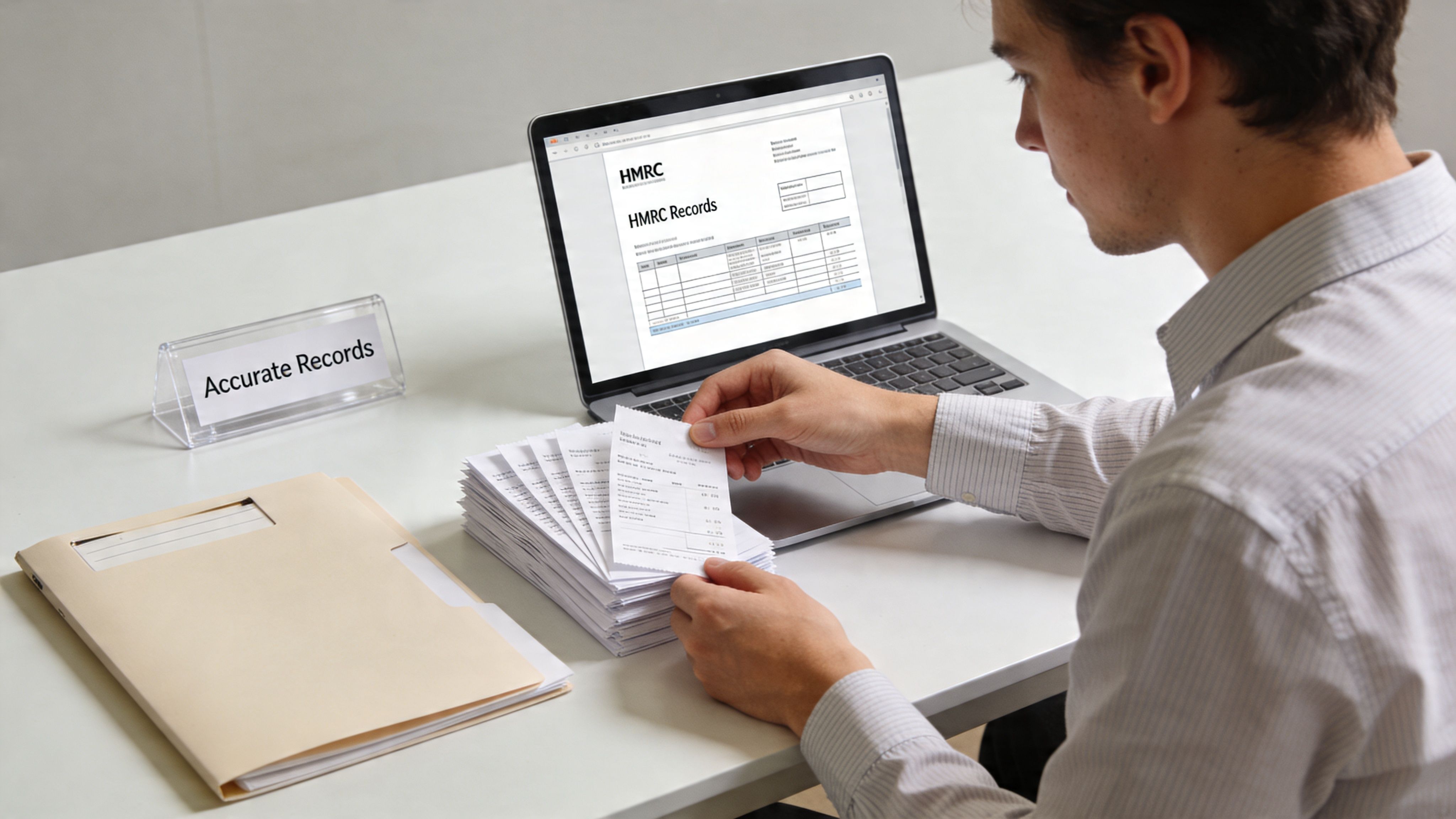
The best approach is simple. Keep evidence as you go, not months later when you’re trying to remember what a card payment was for.
What records you should keep
Most contractors should retain:
- Sales invoices you issued to clients
- Purchase receipts for business spending
- Bank statements for your business account
- Mileage logs showing date, journey, purpose, and distance
- Bills and contracts for software, insurance, and subscriptions
- Notes on apportionment where a cost is split between personal and business use
Digital copies are usually much easier to manage than paper files. A scanned receipt in a cloud folder is far more useful than a faded slip stuffed in a wallet.
A lot of contractors now use OCR tools to capture receipts quickly. If you’re comparing options, this roundup of best OCR software for invoices can help you see what different systems do well.
How long to keep records
For Self Assessment, you generally need to keep records for the required HMRC retention period after the relevant submission deadline. In practice, that means your paperwork needs to be stored for years, not weeks.
That’s why a repeatable system matters. A spreadsheet can work. So can accounting software. The best choice is the one you’ll keep updated.
Good habit: Take the receipt, label it, store it, and move on. Small routines stop year-end panic.
If you invoice clients directly, choosing the right tools early saves time later. Our guide to best invoicing software for contractors can help if you’re still deciding what setup fits your workflow.
Making Tax Digital is changing the routine
The record-keeping standard is becoming more important because Making Tax Digital for Income Tax Self Assessment becomes mandatory from April 2026 for sole traders with turnover over £30,000, with quarterly digital expense reporting required, and an ICAEW poll in January 2026 found that 40% of the 4.3 million self-employed individuals were still unaware of the change, according to ICAEW guidance on Making Tax Digital.
That matters because MTD rewards people who keep records in real time. If you leave everything until January, quarterly reporting becomes much harder to manage.
A short explainer can help if this is all new to you:
A simple system that works
You don’t need a complex finance department. Most newly self-employed contractors do well with this routine:
- Use one account for business income and costs, even if it’s not legally required.
- Upload receipts weekly, not at year end.
- Tag each expense clearly, such as travel, software, insurance, or home office.
- Write a note for unusual costs, especially if the business purpose isn’t obvious.
- Review monthly, so errors are fixed while they’re still easy to trace.
Record-keeping isn’t admin for admin’s sake. It’s what makes legitimate deductions defendable.
Calculating and Claiming Your Deductions
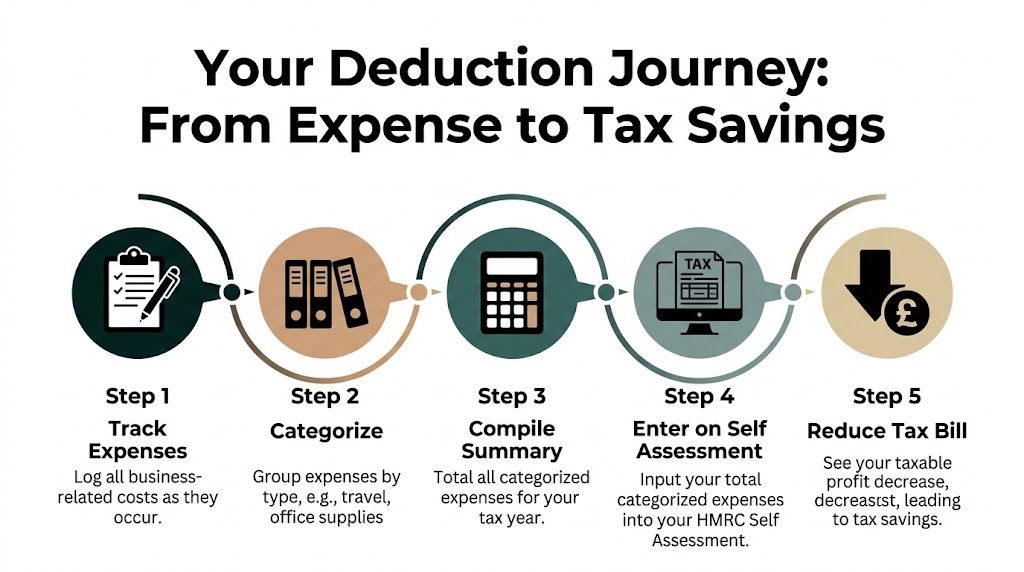
Once your records are organised, the next step is turning them into the figure HMRC uses for taxation. That figure is your taxable profit.
The principle is simple. Start with your business income, subtract allowable business expenses, and the amount left is the profit used for tax calculations.
The basic calculation
For a sole trader, the process usually looks like this:
Add up your turnover
This is all business income received or invoiced for the tax year, depending on your accounting method.Total your allowable expenses
Include only costs that meet HMRC rules.Subtract expenses from income
The result is your business profit.Use that profit on your Self Assessment return
HMRC then works out income tax and National Insurance based on the relevant rules.
For the 2025/26 tax year, Class 4 National Insurance Contributions are 6% on profits between £12,570 and £50,270, and that main rate cut from 9% is expected to save the average self-employed worker around £400 annually, according to the Autumn Statement 2023 personal tax factsheet. That’s one reason accurate profit figures matter so much. Every allowable deduction changes the figure those calculations start from.
Cash basis and traditional accounting
Contractors often get confused here because there are two common ways to prepare accounts.
Cash basis
Under the cash basis, you generally record income when money comes in and expenses when money goes out. Many smaller businesses like this because it follows the bank account and feels intuitive.
Traditional accounting
Under traditional accounting, often called accrual accounting, you match income and costs to the period they relate to, even if payment happens later. This can give a more complete business picture, but it usually needs more careful bookkeeping.
For many new sole traders, cash basis feels easier. But if your affairs are more complex, traditional accounting may suit you better. The right choice depends on how your business operates.
Your tax return gets easier when your bookkeeping method matches the way you actually work.
A simple worked example
Suppose a freelance contractor has:
- Income from clients
- Allowable travel costs
- Software subscriptions
- Professional insurance
- Business-use home working costs
They total those allowable expenses and deduct them from their income. The remaining balance is the taxable profit reported through Self Assessment.
That’s the key point. You are not deducting expenses from the tax itself. You are deducting them from the business income before tax is worked out.
When the trading allowance may suit you
The £1,000 trading allowance, introduced in April 2017, gives some people a much simpler route. If your gross trading income is low enough, you may choose the allowance instead of claiming actual expenses.
This can make sense where:
- your allowable expenses are small
- you only have occasional side income
- keeping full expense records would be more effort than the claim is worth
If your actual business costs are higher than the allowance, itemising expenses may be better. But if your costs are modest, the allowance can keep things tidy and reduce admin.
What to enter on the return
When you complete Self Assessment, your records should already give you the totals you need. That’s why categorising expenses through the year helps so much. You’re not trying to rebuild your accounts from memory.
A clean system usually means:
- income is already totalled
- expenses are grouped logically
- mixed-use items have notes showing how you split them
- you can explain any unusual claim if HMRC asks
Claiming deductions isn’t about being aggressive. It’s about being accurate.
Deductions in Action Worked Examples
Rules make more sense when you can see how they apply to ordinary contractor life. Here are two realistic examples that show the thought process behind self employed deductions.
Example one, an IT contractor working from home
Daniel is a self-employed IT contractor. He works mainly from a dedicated room at home and invoices clients directly as a sole trader.
During the year, he buys a laptop for client delivery work, pays for cloud software, renews his professional insurance, and uses the simplified home working method because he works substantial time from home. He also attends a technical course that updates skills he already uses in his current trade.
Daniel’s thinking should look like this:
Laptop
This is business equipment used for his trade. He treats it as a business cost under the relevant tax treatment for equipment rather than confusing it with ordinary stationery.Software subscriptions
Costs for tools such as GitHub, Microsoft 365, or specialist development platforms are typically part of running the business if they’re used for client work.Home working
Because he works from home regularly, he uses HMRC’s simplified method rather than trying to apportion every utility bill.Professional development
The course updates his current technical skills. That’s very different from paying for training that would move him into a completely new career.
What doesn’t Daniel claim? He doesn’t try to claim ordinary food at home, normal clothing, or the whole household broadband bill without a reasonable business split.
A good expense claim tells a clear business story. HMRC should be able to see why the cost exists.
Example two, a freelance marketing consultant on the move
Aisha is a freelance marketing consultant. She spends much of her week travelling to client sites, working from a co-working space on some days, and handling calls on her mobile.
Her typical claims may include:
- Business mileage for journeys to client meetings and temporary workplaces
- Co-working fees because the desk space is used for the business
- Phone costs, but only the business element if the contract is mixed-use
- Design and scheduling software used to deliver client campaigns
- Printing and admin costs for pitch documents and project material
Aisha needs to be careful in two places.
First, she must separate business mileage from private journeys. Driving to meet a client is not the same as general personal travel.
Second, she can’t turn social spending into a deduction just because a client was present. Taking a client out for entertainment is not the same as an allowable running cost.
Why these examples matter
Daniel and Aisha both run genuine businesses, but their deductions are different because their working patterns are different. That’s normal.
The point isn’t to copy someone else’s claim list. It’s to look at your own work and ask:
- What did I need to spend to do this work
- Was the cost business-only or mixed-use
- Do I have evidence
- Would this still exist if I weren’t running the business
If the answer is clear, the deduction usually is too.
How Deductions Work Inside IR35 and Umbrella Companies
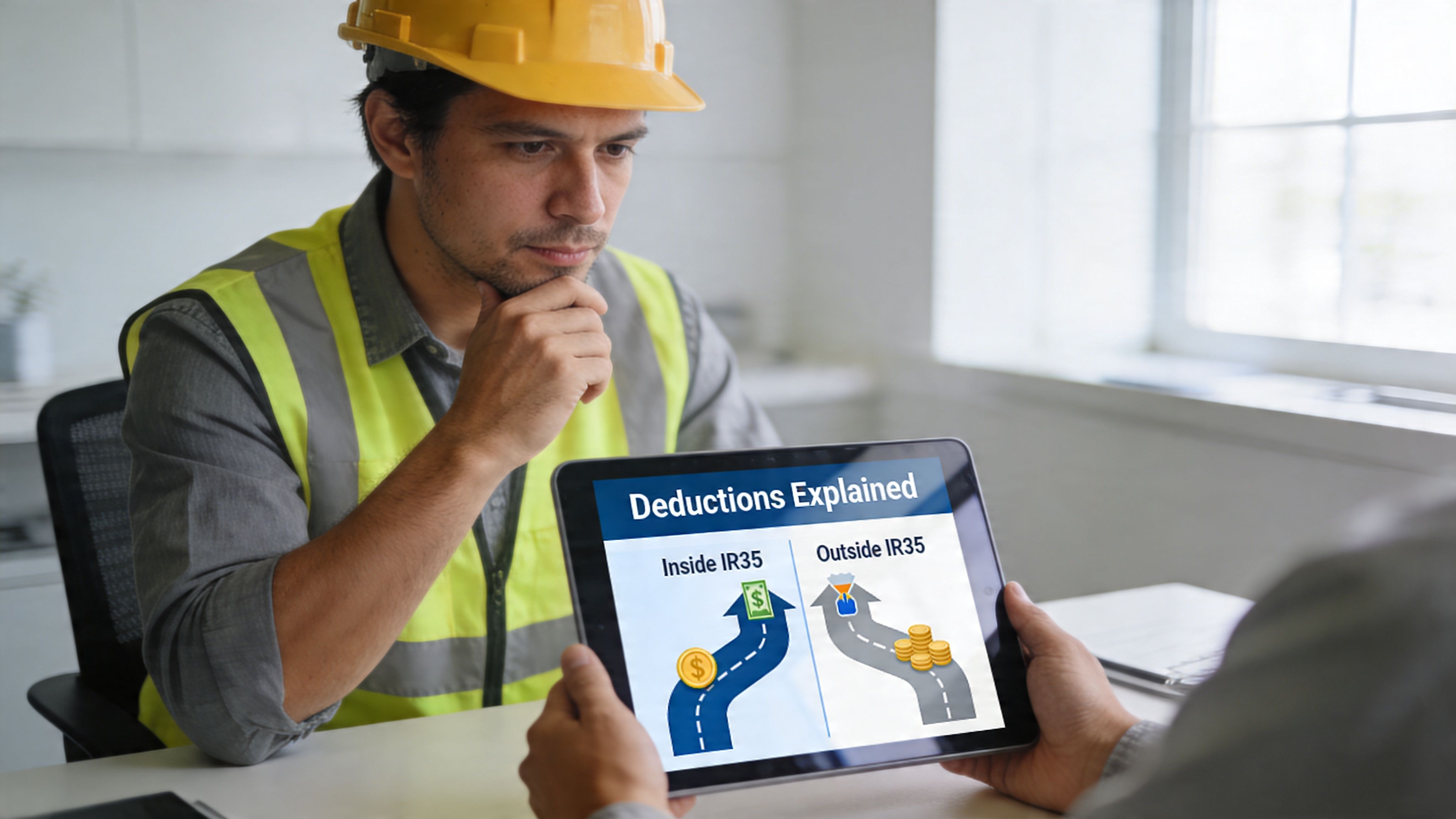
This is the part many contractors find most frustrating. If you’re inside IR35 and working through an umbrella company, the rules change sharply.
The reason is straightforward. For tax purposes, you are treated much more like an employee than a self-employed sole trader. That means the broad range of business deductions many freelancers expect isn’t available in the same way.
Why the rules change inside IR35
For contractors deemed inside IR35, deductions are generally limited to those an employee could claim. HMRC’s 2023 data shows that 68% of IR35 investigations involved disallowed deductions, averaging £4,200 per case, because contractors improperly claimed non-travel expenses such as home office costs, according to HMRC guidance on the Check Employment Status for Tax tool and related IR35 rules.
That figure tells you where the risk sits. Contractors often continue thinking like sole traders when HMRC is taxing them like employees.
Sole trader compared with umbrella employee
The simplest way to understand it is side by side.
| Working arrangement | Typical deduction position |
|---|---|
| Sole trader outside IR35 | Broader range of allowable business expenses may be available, subject to HMRC rules |
| Umbrella employee inside IR35 | Deductions are much more restricted, broadly limited to what an employee could claim |
What a sole trader may claim that an umbrella worker usually can’t
A sole trader may often be able to claim, where justified:
- Business-use home office costs
- Accountancy fees for the business
- Software subscriptions paid personally for the trade
- Professional insurance
- Office consumables and certain equipment
- A business proportion of phone and internet costs
An umbrella worker inside IR35 will usually find those claims blocked at the personal tax level because those are not standard employee deductions.
This catches people out most often with:
- home office claims
- equipment bought personally
- general overheads
- subscriptions not handled through payroll arrangements
- everyday mileage assumptions carried over from sole trader work
If you’re unsure how umbrella working changes your position, our overview of an umbrella company for freelancers explains the structure in plain English.
What may still be available through an umbrella
The list is narrower, but not empty.
Depending on the setup and the specific facts, umbrella contractors may still have access to certain tax-efficient arrangements that fit employment rules better than normal expense claims. The most important example is usually pension contributions made through payroll.
Pension contributions
For many inside IR35 contractors, pension contributions are one of the few major compliant ways to reduce taxable pay. Instead of trying to claim broad self-employed expenses that no longer apply, you focus on a deduction route that fits the payroll model.
That matters because umbrella working usually means PAYE applies before the money reaches you as take-home pay. If pension contributions are made through an appropriate payroll arrangement, they can reduce the pay that tax and National Insurance are worked out on.
The practical attraction is clear:
- It stays within employment-style tax rules
- It helps retirement planning
- It can improve net efficiency compared with taking all pay as immediate salary
Common confusion points
Contractors moving from limited company or sole trader work into an umbrella often ask the same questions.
Can I still claim for working from home
Usually not in the broad sole trader sense, because you’re no longer deducting costs as a self-employed business owner.
Can I claim my laptop or tools
Not usually as a personal tax deduction because you need them for work. The employment tax treatment is far tighter.
What about travel
This depends heavily on the assignment and the employee-style rules that apply. It is not safe to assume travel is claimable just because it was allowable in your previous setup.
Inside IR35, the safest mindset is this. Stop asking “what could a business claim?” and start asking “what could an employee claim?”
The real takeaway for contractors
Self employed deductions and umbrella deductions are not the same subject. That’s the nuance many generic articles miss.
If you’re self-employed, HMRC usually lets you deduct the costs of running the business. If you’re inside IR35 and paid through an umbrella, the tax system no longer sees you in that same way. Trying to use sole trader logic in an umbrella arrangement is one of the fastest ways to create a tax problem.
Common Deduction Mistakes to Avoid
Most deduction mistakes come from good intentions and weak understanding, not dishonesty. A quick checklist can save a lot of trouble.
Claiming mixed-use costs in full
If a phone, car, or broadband package is partly personal, only claim the business portion and keep a note of how you worked it out.Misunderstanding wholly and exclusively
A cost isn’t allowable just because it helps you work. Ordinary clothing and private meals are common examples.Trying to claim client entertainment
Taking a client out socially may help relationships, but that doesn’t usually make it deductible.Keeping poor records
If you can’t show what you bought, when you bought it, and why it was for business, your claim is much harder to defend.Confusing equipment with everyday expenses
A laptop is not the same as printer paper. Larger asset purchases may need different tax treatment from normal running costs.Using sole trader rules inside an umbrella arrangement
This is a frequent contractor mistake. Once you’re taxed as an employee, many familiar self-employed claims disappear.Forgetting to review claims before filing
A final sense-check often catches weak or duplicate entries before they become an HMRC issue.
Conclusion Maximise Your Contractor Take-Home Pay
Getting self employed deductions right comes down to three things. Know what HMRC allows, keep evidence as you go, and make sure your tax position matches how you work.
For sole traders, that usually means claiming genuine business costs carefully and consistently. For contractors inside IR35 or using an umbrella company, it means recognising that the rules are much narrower and planning around what is still compliant, especially where pension arrangements are available.
You don’t need to claim aggressively to improve your tax position. You need to claim accurately.
If your contracts are shifting, or you’re weighing up umbrella options, take time to check your status before you assume an expense is deductible. That one habit prevents a lot of expensive mistakes.
If you’re comparing options for your next contract, Umbrella Company helps contractors and freelancers find compliant umbrella companies that fit their pay rate, sector, and IR35 position.


