


Understanding Self Assessment can feel complicated, but it all comes down to knowing a few key dates. If you keep these deadlines on your radar, the whole process becomes much less stressful. This guide will walk you through the essential UK Self Assessment deadlines, explain what they mean for you, and show you how to stay organised.
The most important date for every contractor is midnight on 31 January. This is the final deadline for filing your online tax return and paying HMRC what you owe. Missing it results in an immediate penalty.
Your No-Nonsense Guide to UK Self Assessment Deadlines
Let's break down the entire tax year so you know exactly what is due and when. This is particularly important if you are juggling different income streams or getting to grips with how your umbrella company arrangement fits into your tax affairs under IR35.
Think of this as your roadmap to staying on good terms with HMRC. We will provide a clear, straightforward timeline to help you manage your finances like a professional and avoid those costly fines.
Key Self Assessment Dates at a Glance
To give you a bird's-eye view, here is a quick summary of the most important dates in the UK tax calendar. We recommend adding these to your diary now.
| Deadline | What You Need to Do |
|---|---|
| 5 October | Tell HMRC you need to file a tax return. This is for anyone new to self-employment or with new, untaxed income. |
| 31 October | Post your paper tax return (if you are not filing online). It is an early deadline, so do not get caught out. |
| 30 December | File online if you want HMRC to collect any underpaid tax through your PAYE tax code. This is an option, not a must. |
| 31 January | The main event: File your online tax return and pay your tax bill in full. |
| 31 July | Pay your second 'Payment on Account', which is an advance payment towards your next tax bill. |
There you have it, the core dates that shape the Self Assessment year. Knowing what is coming up is the first step to a smooth and penalty-free tax season.
Getting to Grips with the Annual Tax Return Timeline
The UK tax year is not the same as the calendar year, which often catches people out. It runs from 6 April to 5 April. Think of this as the official window for your financial life that HMRC cares about. Understanding this cycle is the first step to making Self Assessment much less stressful. If you treat each deadline as a milestone, you will stay organised and avoid that last-minute panic.
This simple infographic breaks down the three main dates you absolutely need to know.
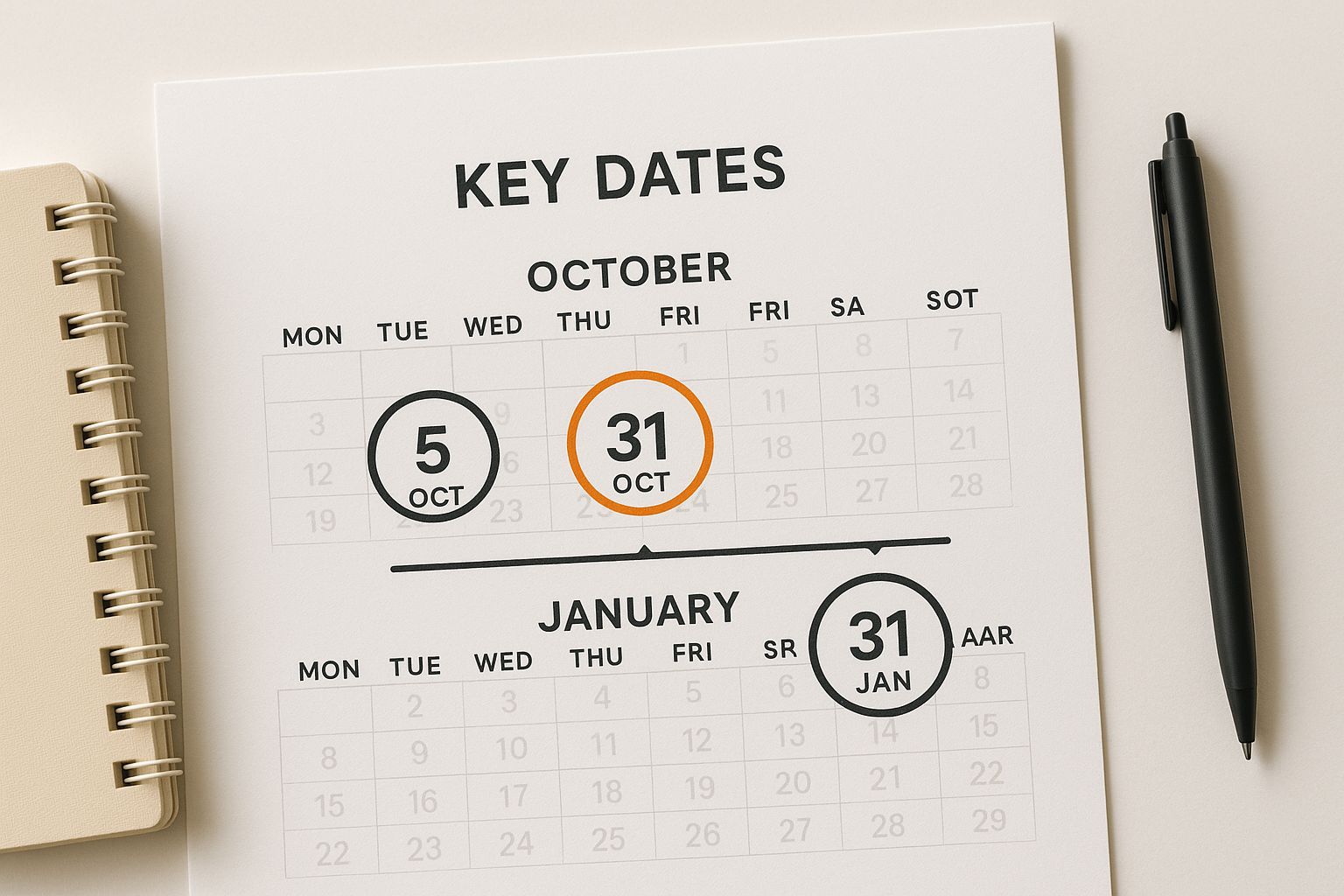
As you can see, the main activity starts in the autumn and builds up to the deadline at the end of January, giving you a clear runway to get everything sorted.
Your Chronological Walkthrough
The Self Assessment journey has a few key dates you cannot afford to miss if you want to stay compliant. The process begins after the tax year ends on 5 April, with your first major deadline hitting in the autumn. This structure is designed to help you plan everything properly.
Here is a breakdown of the main deadlines to circle in your calendar:
5 October: Registration Deadline
This is your first port of call. If this is your first year contracting, you have started renting out a property, or you have any other income that has not been taxed at source, you must tell HMRC and register for Self Assessment by this date.31 October: Paper Filing Deadline
For those who prefer to file by post, this is your cutoff. Be warned, though: the vast majority of people now file online simply because it is easier and you get more time. If you do go the paper route, your return has to be in HMRC's hands by this date, not just in the postbox.31 January: Online Filing and Payment Deadline
This is the big one, the most important date in the Self Assessment calendar. Your online tax return must be submitted, and any tax you owe must be paid to HMRC by midnight. If you miss it, you will face an immediate penalty.
Most people find filing online is far less hassle than paper returns. You get an instant confirmation that HMRC has received it, which gives you valuable peace of mind. And if you are working inside IR35, your umbrella company will be handling the tax on your main contract income through payroll, which simplifies things greatly.
To make sure you do not lose track, you could even use a countdown days calculator to keep these critical dates front and centre.
Demystifying Payments on Account

The term ‘Payments on Account’ is one of those classic bits of HMRC jargon that sounds far more complicated than it is. It is a good idea to understand them, because they catch many people out.
Think of them as HMRC’s way of getting you to pay your tax bill in instalments. It is essentially a prepayment towards your next Self Assessment bill, designed to help you spread the cost and avoid a single, large payment in January.
You will usually have to make Payments on Account if your last tax bill was over £1,000 and less than 80% of it was already paid at source (for example, through PAYE). This often applies to contractors and freelancers whose income does not come from standard payroll.
Key Payment on Account Deadlines
Getting these dates wrong is one of the easiest ways to land yourself with interest charges from HMRC, so we recommend adding them to your calendar now. They are always the same, falling exactly six months apart.
- First Payment: This is due by midnight on 31 January. It is paid alongside any balancing payment you owe for the previous tax year.
- Second Payment: The mid-year instalment is due by midnight on 31 July.
Each payment is simply 50% of your previous year's tax bill. If it turns out your income was higher this year, you just settle the difference with a ‘balancing payment’ by the next January deadline.
For example, say your tax bill for the 2023-24 tax year was £4,000. For the upcoming 2024-25 tax year, your first Payment on Account of £2,000 would be due on 31 January 2025. The second £2,000 payment would then be due on 31 July 2025.
Keeping on top of these self assessment deadlines UK is vital for managing your cash flow. It means you can put money aside and not have any nasty surprises when the payment dates arrive.
The Real Cost of Missing a Deadline
Let's be blunt: overlooking a self-assessment deadline is a costly mistake. HMRC's penalty system is automatic and unforgiving, and the charges can accumulate much faster than you might think, taking a serious bite out of your earnings.
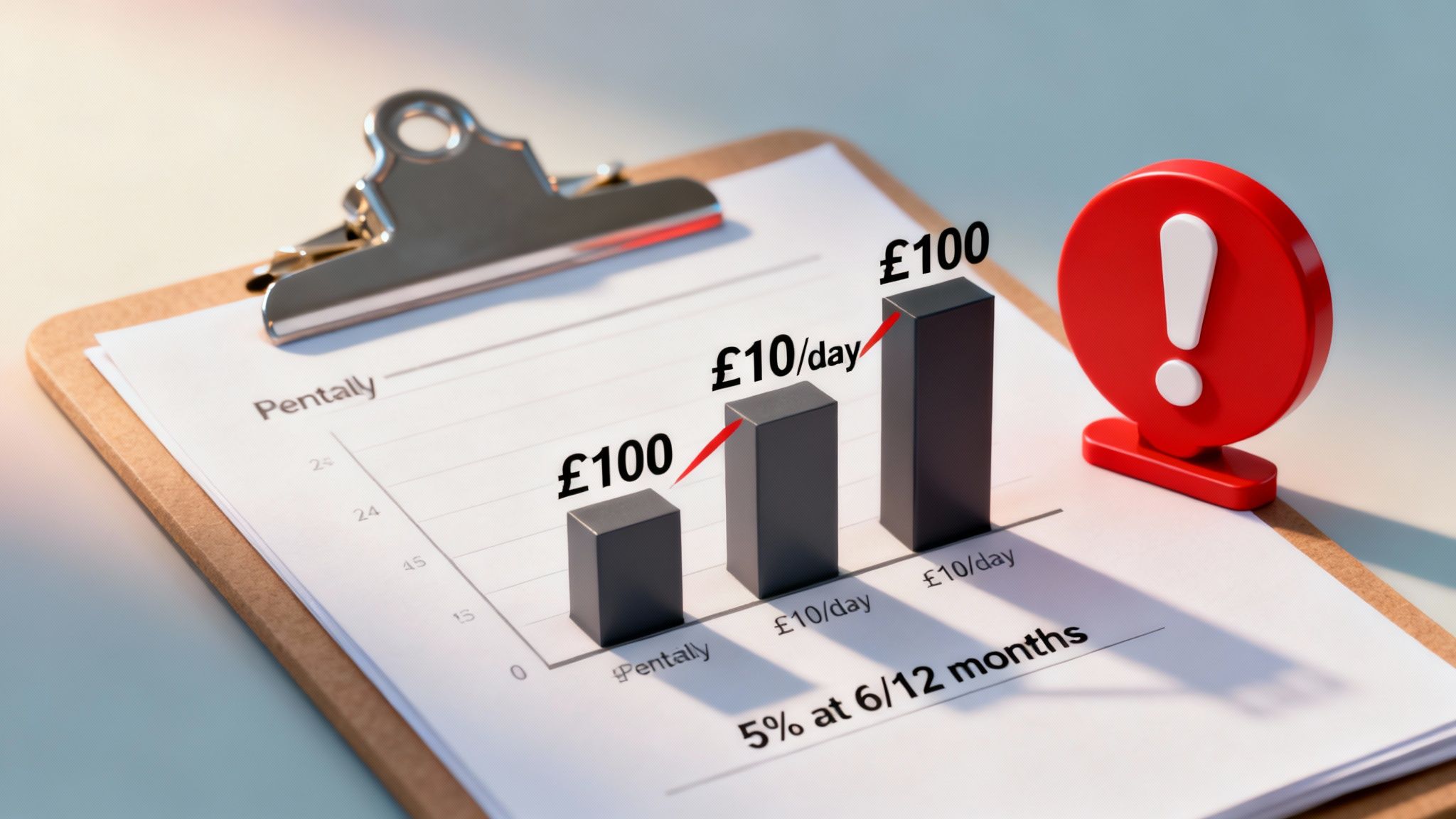
The clock starts ticking the second the deadline passes. If you file your return just one day late, you will be hit with an immediate £100 penalty. This is not tied to what you owe; it applies even if you have no tax to pay or you have already paid everything. It is purely a fine for late paperwork.
That initial £100 is just the beginning. If you let it slide, the financial headache gets a lot worse.
How Late Filing Penalties Escalate
HMRC's penalty structure is designed to get your attention, with fines increasing the longer you delay. It is a straightforward system where doing nothing costs you more each day.
Here is how the penalty timeline unfolds:
- After 3 months: A daily penalty of £10 per day kicks in. This runs for up to 90 days, adding a potential £900 on top of your initial fine.
- After 6 months: You will face another penalty of either £300 or 5% of the tax you owe, whichever is higher.
- After 12 months: The same penalty is applied again: £300 or 5% of your tax bill, whichever is greater. In the most serious cases, this can climb to 100% of the tax due.
In addition to these penalties, HMRC charges interest on any unpaid tax, which accrues from the payment deadline until the day you finally clear the bill. This makes it vital to know your self-employed tax return deadline.
It is a surprisingly common trap. Every year, over one million taxpayers miss the 31 January deadline and get hit with these automatic penalties. Our goal is to make sure you are not one of them and help you avoid these preventable costs.
Do Umbrella Contractors Need to File a Tax Return?
It is a common (and often costly) misconception that working through an umbrella company means you can forget about Self Assessment. While it is true that we handle your PAYE tax and National Insurance contributions on your contract earnings, you might still have a legal duty to file a return with HMRC.
Think of it this way: Self Assessment is not just for the self-employed. It is HMRC’s way of gathering tax on any income that has not already been taxed at source. So, if your only income for the entire tax year comes from your umbrella assignments, you probably will not need to file. But that is rarely the full picture for most contractors.
When You Still Need to File
You absolutely must complete a Self Assessment return if you have other sources of income. This is how you stay compliant and ensure you are paying the right amount of tax on all your earnings for the year, not just your contract pay.
Some of the most common scenarios we see include:
- Running a side business: Any profits from a freelance project or weekend work must be declared.
- Rental income: If you are a landlord and rent out a property, that income needs to be reported.
- Significant savings or investment income: Untaxed interest from savings or dividends from shares will often mean you need to file.
- High earnings: If your total income from all sources goes over £100,000 in a tax year, filing a return is mandatory.
This has become even more relevant since the IR35 reforms, which pushed many contractors who previously used a limited company towards umbrella employment. It is crucial to understand how IR35 applies when working through an umbrella company to manage your tax affairs correctly.
Staying compliant means looking at your entire financial picture. Your umbrella income is handled, but HMRC needs to know about everything else. Ignoring this can lead to penalties, even if it is an honest mistake. Always check if your circumstances require you to file.
How to Prepare for a Stress-Free Tax Season
The secret to a stress-free tax season is preparation. If you treat your tax return as something you work on throughout the year, rather than a frantic last-minute scramble, you can file with confidence long before any self assessment deadlines UK appear.
Getting organised early is not just about avoiding stress. It gives you the headspace to spot potential tax reliefs and make sure your records are watertight. Suddenly, tax season becomes a simple administrative task instead of a major headache. The best place to start is by getting all your paperwork in one place.
Your Document Checklist
To begin, you will need to gather a few key documents. Whether you prefer a physical folder or a digital one on your desktop, having everything to hand makes a world of difference.
Here is what you should round up:
- Your P60s and P45s from any employment during the tax year.
- Bank statements for both your personal and business accounts.
- Any dividend vouchers or details of income from investments.
- A complete record of your business expenses, along with the receipts to back them up.
If you are running a business, a big part of tax preparation is solid financial management. That includes things like opening a UK business bank account. For more tailored advice, our guide on https://umbrellacompany.com/accounting-for-contractors/ is also a great resource.
Filing online has become the go-to method for millions. For the 2023-24 tax year, more than 11.5 million people filed on time, and a massive 97.36% of them did it online. It is a clear sign that going digital is the most efficient way to get it done and avoid any penalties.
Your Self Assessment Questions, Answered
Getting to grips with Self Assessment can feel like you are trying to solve a puzzle. To help you piece it all together, here are a few of the most common questions we hear from contractors.
Can I Get a Penalty Cancelled for a Late Return?
It is possible, but only under specific circumstances. HMRC might cancel a penalty if you have what they call a ‘reasonable excuse’ for missing the deadline.
This is not for everyday slip-ups. We are talking about serious, unexpected events like a sudden illness that puts you in hospital, the death of a partner, or a major, documented failure of HMRC’s online systems right before the deadline. Forgetting the date or just being too busy with work, unfortunately, will not be accepted. If this happens, you need to file your return and appeal as soon as you can, providing evidence to support your case.
I’m Paid Through PAYE. Do I Still Need to Bother with Self Assessment?
For most people, no. If your only income is from your job and your tax is handled through PAYE, you are usually not required to file a return.
However, for many contractors and high earners, it is a different story. You must file a return if your income goes over £100,000 a year. You will also need to file if you have other untaxed income streams, like earnings from a rental property, significant investment income, or a side business.
How Can I Reduce My Payments on Account?
If you know your earnings are going to be lower in the coming tax year, you do not have to overpay and wait for a refund. You can formally ask HMRC to reduce your Payments on Account.
You can do this either through your online tax account or by filling out form SA303. A word of caution: be realistic with your forecast. If you reduce your payments too much and end up underpaying your tax bill for the year, HMRC will charge you interest on the shortfall.
Feeling like you are drowning in tax admin? You do not have to navigate it all on your own. At UmbrellaCompany.com, we connect contractors with compliant and reliable umbrella solutions that take the headache out of your finances. Find the right umbrella company for you today.


