


As a UK contractor, one of the first big decisions you will face is how to pay yourself. It boils down to a choice between salary and dividends, and getting the balance right is key to running a tax-efficient limited company.
The fundamental difference? A salary is a regular, fixed payment that is subject to both Income Tax and National Insurance Contributions (NICs). In contrast, dividends are a share of the company's profits paid out to shareholders after Corporation Tax has been settled. The big appeal of dividends is they are not subject to NICs.
Salary vs Dividends: Understanding Your Core Options

If you operate through your own limited company, getting to grips with salary versus dividends is the bedrock of a smart payment strategy. HMRC treats these two methods of taking money out of your business very differently, and each comes with its own set of rules, benefits, and paperwork.
Think of a salary as what you get for being an employee of your own company. It is processed through the standard Pay As You Earn (PAYE) system, just like any traditional job. This means Income Tax and both employee's and employer's National Insurance are deducted before the money hits your personal account.
Dividends, on the other hand, are a reward for being a shareholder. They are drawn from the company’s leftover profits, crucially, only after the business has paid its Corporation Tax bill. While you still pay a specific dividend tax on this income, the absence of NICs makes it so attractive.
Key Differences at a Glance
To make this crystal clear, let's put them side-by-side. This table breaks down the essential distinctions that will shape how you manage your earnings.
| Feature | Salary (PAYE) | Dividends |
|---|---|---|
| Source of Funds | Paid before Corporation Tax is calculated. | Paid from post-tax company profits. |
| Tax Treatment | An allowable business expense, reducing your Corporation Tax. | Not a business expense; paid after Corporation Tax is settled. |
| National Insurance | Subject to both Employee's and Employer's NICs. | Not subject to any National Insurance Contributions. |
| Tax Liability | Taxed via PAYE at your standard Income Tax rates. | Taxed at specific, and often lower, dividend tax rates. |
| Profit Requirement | Can be paid even if the company makes a loss. | Can only be paid if the company has sufficient retained profit. |
| Administrative Process | Requires running a compliant payroll (RTI submissions). | Requires board meeting minutes and issuing a dividend voucher. |
Why This Choice Matters for Contractors
Your decision on the salary vs. dividends mix directly shapes your take-home pay, your company's tax bill, and the amount of admin you must do. For most limited company directors, the sweet spot is a small salary combined with larger dividend payments.
This typically means taking a salary just high enough to qualify for the State Pension but low enough to incur minimal (or no) tax and NI. We then draw the rest of the income as dividends.
This combined approach lets you build up your National Insurance record for state benefits while extracting the bulk of your earnings in the most tax-efficient way possible.
But there is a big caveat. This strategy only works if your contract is genuinely 'outside IR35'. If your work is deemed to be 'inside IR35', these tax advantages disappear, and using an umbrella company often becomes the most straightforward and compliant option.
You can learn more about the practical steps in our detailed guide on how to pay yourself dividends.
A Practical Breakdown of Tax and NICs

To get tax efficiency right in your limited company, you first have to grasp how HMRC treats a salary versus a dividend. These are not just minor accounting details; the differences have a direct impact on your company's profit, your personal tax bill, and what you actually take home at the end of the day.
When you draw a salary, it is a straightforward allowable business expense. This means the total cost of that salary, including any Employer’s National Insurance Contributions (NICs), is deducted from your company's income before you calculate Corporation Tax. It is a simple way to lower your company’s taxable profit.
The catch is that this salary is then hit by both Income Tax and NICs through the PAYE system. Not only do you pay Employee's NICs, but your company gets a bill for Employer's NICs too, which can add a hefty chunk to your costs. For a closer look at this, you can read our guide on what employer National Insurance contributions are.
The Dividend Advantage: No National Insurance
Dividends work completely differently. They are paid out from your company’s post-tax profits. In other words, your company has already settled its Corporation Tax bill before any money can be distributed to you as a shareholder.
So, where is the benefit? The big one is that dividends are not subject to National Insurance Contributions. This single factor is the main reason why a low-salary, high-dividend strategy has been the go-to model for limited company directors for years.
You still pay personal tax on any dividends you receive, but the rates are lower than standard Income Tax rates. It is a structure that lets you pull profits from your business much more efficiently than just taking a large salary.
Salary vs Dividends at a Glance
To lay it all out clearly, this table gives a side-by-side comparison of how salary and dividends stack up.
| Feature | Salary (PAYE) | Dividends |
|---|---|---|
| Corporation Tax Impact | Reduces company profit before Corporation Tax is paid. | Paid from company profit after Corporation Tax is settled. |
| National Insurance | Subject to both Employee's and Employer's NICs. | Completely exempt from all NICs. |
| Personal Tax Liability | Taxed at standard Income Tax rates (20%, 40%, 45%). | Taxed at lower dividend tax rates (8.75%, 33.75%, 39.35%). |
| Tax-Free Allowance | Covered by the standard Personal Allowance (£12,570). | Has a separate, smaller Dividend Allowance (£500 for 2024/25). |
| Payment Basis | Can be paid regardless of company profitability. | Can only be legally paid if the company has sufficient retained profits. |
The tax difference explains why dividend income is so common among the UK's highest earners. When you look at the top 1%, research from the Institute for Fiscal Studies shows that partnership and dividend income make up over a quarter of their total earnings. Even after factoring in Corporation Tax, dividends often carry a lower overall tax burden than a salary.
The core takeaway is simple: salaries reduce your Corporation Tax bill but attract high rates of tax and NICs. Dividends are paid from taxed profits but save you entirely on National Insurance, which is often the biggest saving.
This is not just a minor point of interest; it's the central pillar of tax planning for contractors. Getting the balance right means you can legally and compliantly keep more of the money you earn, but it takes careful management and a solid understanding of the rules.
How IR35 Redefines Your Payment Strategy
For any contractor running their own limited company, IR35 (or the off-payroll working rules) is the single biggest factor in how you can pay yourself. These rules are designed to figure out if you are a genuine business or what HMRC calls a ‘deemed employee’ for tax purposes.
That distinction completely changes the salary vs dividends conversation. If your contract is judged to be 'outside IR35', you are free to use the classic, tax-efficient structure of a low salary topped up with dividends.
But if your contract is deemed 'inside IR35', the financial landscape flips on its head. The client or agency paying you is legally required to treat all your earnings as if you were a regular employee.
The Impact of an Inside IR35 Determination
When a contract falls inside IR35, the tax advantages of your limited company essentially vanish for that specific piece of work. All the income you generate from that client has to be processed through a payroll system, exactly like a standard employee.
This means the full amount gets hit with PAYE Income Tax, plus both Employee's and Employer's National Insurance Contributions (NICs). The crucial outcome here is that there is no company profit left over from that contract to draw down as tax-friendly dividends.
The responsibility for making this call and deducting the right tax now sits with your end client (for most public and private sector organisations). This has understandably made many of them risk-averse, often insisting that contractors work through an umbrella company for any role they deem to be inside IR35.
Why Dividends Are Not an Option Inside IR35
The logic behind an inside IR35 determination is that your working relationship mirrors that of an employee. Because of this, HMRC insists that your entire fee for that contract is taxed just like a salary.
- No Profit, No Dividend: Since all your fees are treated as employment income, there is simply no profit sitting in your limited company from that job.
- Compliance Risk: Trying to re-route this money and pay it out as a dividend is not just a bad idea – it is a serious breach of tax law that comes with hefty penalties.
This is a black-and-white area of the legislation. For any work classified as inside IR35, the salary versus dividend debate becomes moot. The dividend option is completely off the table, and the focus has to switch to ensuring you are 100% compliant.
The Umbrella Company Solution for IR35 Compliance
When a contract lands inside IR35, using a compliant umbrella company is often the most straightforward and secure way to get paid. At UmbrellaCompany.com, we offer a simple solution that keeps you fully compliant and takes the administrative burden off your shoulders.
When you join us, you become our employee for the duration of the contract. We handle the invoicing, receive the funds from your client, process all the required tax and NIC deductions via our PAYE system, and pay you a net salary.
This approach brings several clear benefits for inside IR35 contracts:
- Guaranteed Compliance: We manage all PAYE and National Insurance deductions correctly, making sure you meet every single one of your HMRC obligations.
- Administrative Simplicity: Forget about wrestling with complex payroll calculations or worrying about an HMRC investigation into your limited company for that particular contract.
- Continuity of Employment: Working on multiple contracts through us builds a continuous employment history, which can be a huge help for things like mortgage or loan applications.
- Statutory Rights: As our employee, you get access to statutory rights like holiday pay, sick pay, and a workplace pension scheme.
Getting your head around the off-payroll working rules is crucial. You can dive deeper into the topic in our complete guide to IR35 for contractors. For any contractor taking on an inside IR35 role, partnering with a trusted umbrella company is the safest and most reliable way to handle your tax.
Comparing Real-World Take-Home Pay Scenarios

Theory is one thing, but seeing the actual numbers in black and white is what really counts. The difference in your net pay when operating outside IR35 versus inside can be huge.
To bring this to life, we have worked through two scenarios. Both are based on a contractor earning a day rate of £400, working five days a week for 46 weeks of the year. This gives them a total contract value of £92,000.
Let's break down exactly what that means for your bank account.
Scenario 1: Outside IR35 via a Limited Company
In this situation, our contractor’s work is confirmed as being 'outside IR35'. This gives them the freedom to structure their pay for maximum tax efficiency, using the classic low-salary, high-dividend model that most limited company directors favour.
They opt to pay themselves a small salary, setting it at the Secondary Threshold for National Insurance Contributions (£9,100 per annum). This is a smart move, it ensures they qualify for state benefits without triggering any employee or employer NICs. The rest of the company's profits are then drawn as dividends.
Here is a simplified breakdown of the numbers for the 2024/25 tax year:
- Total Invoice Value: £92,000
- Director's Salary: £9,100 (this is a business expense that reduces the profit)
- Company Profit Before Tax: £82,900 (£92,000 – £9,100)
- Corporation Tax Due (at 19% on the first £50k, 25% thereafter): £17,725
- Profit Available for Dividends: £65,175 (£82,900 – £17,725)
Now, we need to look at the contractor's personal tax on this income:
- Salary Income: £9,100 (which is comfortably within the £12,570 Personal Allowance)
- Dividend Income: £65,175
- Dividend Tax Due: The first £500 is tax-free. The rest of the dividends push the contractor into the higher rate tax band, leading to a personal dividend tax bill of roughly £15,088.
After all the tax is settled, the contractor’s estimated net take-home pay comes out at £60,287. It's a powerful demonstration of the salary vs dividends strategy when you're genuinely operating outside IR35.
Scenario 2: Inside IR35 via an Umbrella Company
Now, let's take the same contractor on the same £400 day rate. This time, however, their contract is determined to be 'inside IR35'. This means they cannot use their limited company for this particular job and must be paid as an employee for tax purposes.
They decide to work through UmbrellaCompany.com for a compliant, no-fuss solution. We become their employer, handling all payments through PAYE. All their income is treated as salary, so the dividend option is off the table completely.
The calculation now looks quite different, factoring in our margin and the full force of PAYE deductions:
- Total Invoice Value: £92,000
- Gross Pay (after our margin, Employer's NICs, and Apprenticeship Levy): Approximately £77,500
- Deductions from Gross Pay:
- Income Tax: Approximately £18,630
- Employee's NICs: Approximately £4,188
- Total Deductions: £22,818
In this scenario, the contractor's estimated net take-home pay is £54,682. This figure also includes their accrued holiday pay.
When you put them side-by-side, the outside IR35 route delivers £5,605 more in annual take-home pay for the exact same work. This really highlights the significant financial incentive for contractors to operate outside the off-payroll working rules whenever it is genuinely appropriate.
Understanding the Financial Impact
While your IR35 status often dictates the structure you must use, the financial difference is plain to see. The killer advantage of the limited company route is the saving on National Insurance, which is completely avoided on dividend payments.
This tax difference has always influenced how business owners take money out of their companies. In fact, you can see how responsive people are whenever tax policy changes. Just before a dividend tax hike in 2016, a mere 100 high-earning individuals collectively pulled enough in dividends to slash their future tax bill by an estimated £100 million. It shows just how much these strategies matter.
If you want a personalised estimate based on your specific contract rate, give our easy-to-use limited company take-home calculator a try. It can give you a much more detailed projection to help you plan your finances more effectively.
Tax efficiency is the big shiny object in the salary vs. dividends debate, but fixating on it alone can be a mistake. Your personal situation, how you feel about risk, and where you are headed financially all play a massive part in making the right call. A decision driven purely by the numbers might ignore what actually matters in your day-to-day life.
Think about it: do you need a steady, predictable income? A regular salary gives you that rock-solid stability, which is gold when you have big financial commitments. Dividends, on the other hand, depend entirely on how well your company is doing, and that can be a real rollercoaster.
Income Stability and Predictability
One of the biggest non-tax differences here is reliability. A PAYE salary lands in your bank account every month like clockwork. This kind of consistency is exactly what mortgage lenders and credit providers want to see. It shows a stable financial history and makes getting approved for loans a whole lot easier.
Dividends are a different beast entirely. You can only legally pay them out if your limited company has enough profit left after tax. If you hit a quiet patch or a tough financial quarter, you might not be able to draw the income you were counting on. That can create some serious cash flow headaches for you personally.
While dividends can look great from a tax perspective, a regular PAYE salary provides the financial stability and proof of income you will need for life's biggest purchases, like getting a mortgage on a new home.
It is also worth noting the huge gap that has opened up between dividend payments and wage growth in the UK. Between 2000 and 2019, nominal dividends shot up almost fourfold from £48 billion to £191 billion, while real wages for most workers barely moved. You can dig into more of these insights on the differences between wages and dividends over at Common Wealth.
Administrative Responsibilities
The sheer amount of paperwork involved is another huge factor. Running a limited company and paying yourself through dividends comes with a significant administrative load. You are personally on the hook for a whole range of duties, including:
- Filing annual accounts and a confirmation statement with Companies House.
- Submitting a company tax return (CT600) to HMRC.
- Keeping on top of Corporation Tax and dividend tax payments.
- Holding formal board meetings (even if it is just you!) to declare dividends and keeping official minutes.
This all requires serious organisation and can eat up a lot of your time. Working through an umbrella company, in contrast, just wipes all that off your plate. As your employer, we handle all the payroll, tax calculations, and HMRC submissions for you. It frees you up to just focus on your contract work, without the admin stress.
Access to Employment Rights
A major perk of using an umbrella company is that you get proper statutory employment rights. These are not things you automatically get as a director of your own limited company; you have to arrange and fund them yourself.
As an employee of UmbrellaCompany.com, you are entitled to:
- Statutory Sick Pay (SSP) if you are too ill to work.
- Statutory Holiday Pay, so you can take paid time off.
- A workplace pension scheme with employer contributions.
- A continuous record of employment, which is a big help for credit applications.
These rights provide a safety net and a sense of security that limited company directors often miss out on. It is what makes the umbrella route a really compelling option for contractors who value simplicity and peace of mind.
Choosing Your Best Path Forward
Deciding between running your own limited company with a smart salary/dividend mix, or just using a straightforward umbrella company, all comes down to you. Your personal circumstances, where you are in your career, and critically, your contract's IR35 status, will point you in the right direction.
There is no single "best" answer, only the one that fits your finances, your appetite for admin, and your long-term plans. To make it easier, let's break down when each option makes the most sense.
When an Umbrella Company Is Your Best Option
For a lot of contractors, especially if you're just starting out or working on certain projects, an umbrella company is the perfect blend of simplicity and security. At UmbrellaCompany.com, we find this is the best fit if you:
- Are working on a contract that has been deemed 'inside IR35'. This is the big one. For these jobs, an umbrella company is really the only sensible and compliant way to get paid.
- Are new to contracting and want to test the waters before committing to setting up a limited company.
- Work on short-term contracts where the hassle of running a limited company just is not worth the potential tax savings.
- Simply want to avoid the paperwork that comes with being a company director. Think filing accounts, running payroll, and handling Corporation Tax.
If your priorities are staying compliant, keeping things simple, and getting access to employment rights like sick pay and holiday pay, our umbrella service is designed for you.
For any contract that is inside IR35, the decision is pretty clear-cut. An umbrella company is not just the easiest choice; it is the most compliant and financially responsible one, taking all the risk of IR35 off your shoulders.
When a Limited Company Makes More Sense
Operating through your own limited company can definitely be more tax-efficient, but it is only a good idea in specific situations. This path is generally for seasoned contractors who:
- Have contracts that are clearly and demonstrably 'outside IR35'. You need to be confident in this status and ready to prove it if HMRC comes knocking.
- Are established in your career, with long-term or high-value projects that make the extra admin worthwhile.
- Are comfortable with the legal duties of a company director, which means managing the books, filing official documents, and hitting every tax deadline.
This route gives you more control and potentially more in your pocket, but it comes with real legal and financial responsibilities.
Still not sure which way to go? Our friendly team is always here to give you clear, practical advice based on your situation. We can help you navigate the whole salary vs dividends debate and make sure you choose the path that best supports your contracting career.
Your Contractor Pay Questions Answered
Choosing between a salary and dividends always throws up a few questions. To help you get your head around it, we have answered some of the most common queries from UK contractors, giving you quick, clear guidance on the bits that often cause confusion.
This decision tree gives you a visual on how your IR35 status really dictates your payment options.
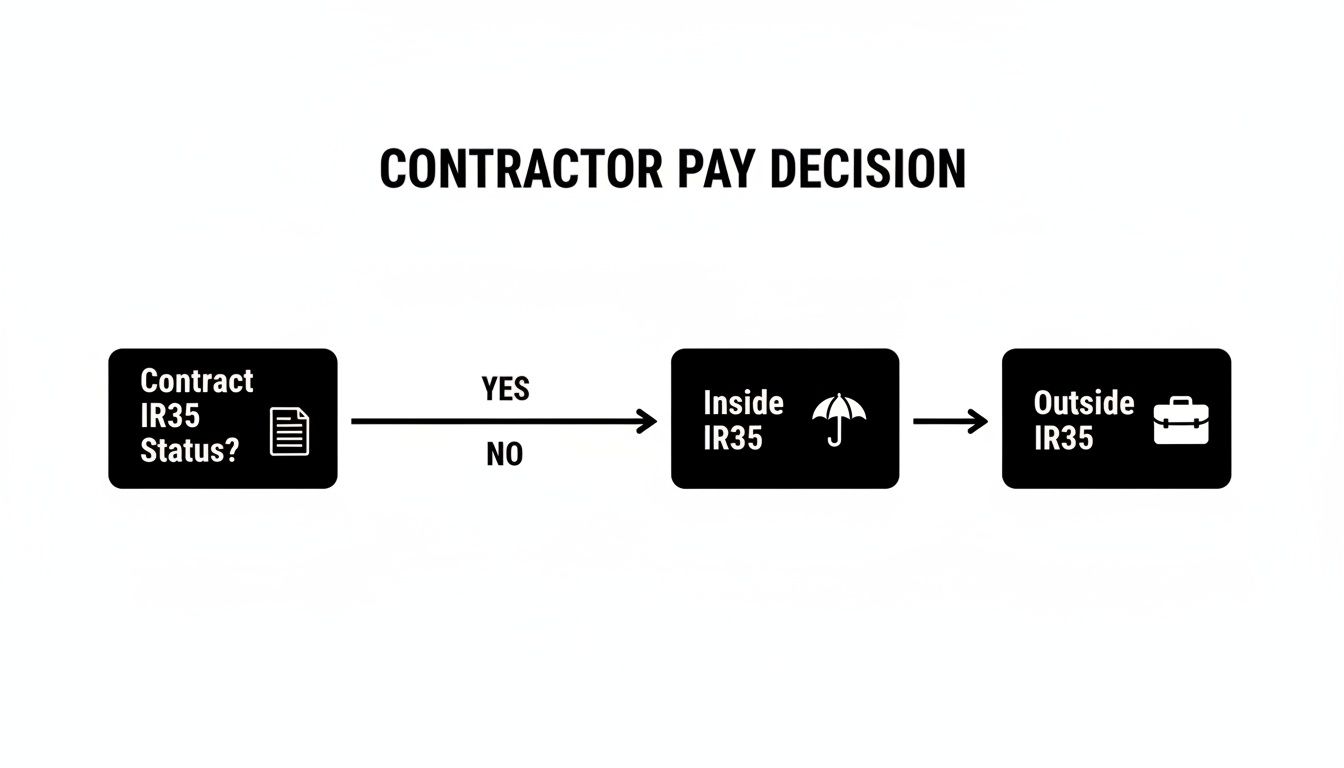
As you can see, your contract's IR35 status is the first and most important hurdle. It determines whether you can even access dividend payments or if you will need to use a payroll solution like an umbrella company.
Can I Pay Myself Only in Dividends?
In a word, no. You cannot pay yourself entirely through dividends. Because you are a director actively working in your own limited company, you are also an employee in the eyes of HMRC.
This means you are expected to take a reasonable salary for the work you do, which must be processed through PAYE. Paying a small, compliant salary is not just good practice; it is a necessary part of running a limited company.
How Much Salary Should I Take Before Dividends?
The go-to strategy for most contractors working outside IR35 is to pay themselves a small salary, usually pegged to the National Insurance Secondary Threshold. For the 2024/25 tax year, this figure is £9,100.
Setting your salary at this level is smart. It is just enough to count as a qualifying year for your State Pension but low enough that you will not trigger any employee's or employer's National Insurance Contributions.
The sweet spot for your salary is an amount that protects your National Insurance record for future state benefits while keeping your immediate tax and NICs liability as low as possible. This leaves the maximum amount of profit in the company, ready to be distributed as tax-efficient dividends.
Do I Need an Accountant to Manage Salary and Dividends?
While you could technically manage your limited company accounts yourself, it is something we would strongly advise against. Using a qualified contractor accountant is the far better option.
They will make sure you hit every HMRC deadline, calculate your Corporation Tax correctly, issue the proper dividend paperwork, and run your payroll without a hitch. An accountant’s expertise can save you a huge amount of time, stress, and the risk of hefty penalties for getting things wrong. Honestly, their fee is an investment that pays for itself.
Figuring out the complexities of contractor pay can be a real headache. At UmbrellaCompany.com, we make it simple. We help you compare and choose a compliant umbrella company that is a perfect fit for you, ensuring you get paid on time and with total peace of mind. Find your ideal provider with us today.


