


A salary and dividend tax calculator is an essential tool for any UK contractor. It quickly shows you how different ways of paying yourself can change what you take home after tax. It’s all about finding that sweet spot between a director's salary and shareholder dividends to make your limited company as tax-efficient as possible.
How To Structure Your Contractor Pay For Maximum Efficiency
Working out how to pay yourself from your limited company is one of the biggest financial decisions you'll face as a contractor. Getting the blend of salary and dividends right has a direct impact on your take-home pay, so a little know-how goes a long way. This guide is here to cut through the jargon and give you a clear, practical framework to follow.
We’ll walk through the main factors that affect your earnings, like Corporation Tax, PAYE, and National Insurance. Once you see how they all fit together, you can start structuring your pay in a way that’s both smart and compliant. Here at UmbrellaCompany.com, our goal is to give you the confidence to make choices that let you keep more of your hard-earned cash.
Key Considerations For Your Pay Structure
Before diving into the numbers, it helps to understand the main levers you can pull. Your strategy will essentially be a balancing act between these different taxes and allowances:
- Minimising National Insurance: This is a big one. Dividends aren't subject to National Insurance Contributions (NICs), which makes them a far more attractive option for taking profits out of the company compared to a large salary.
- Using Your Tax-Free Allowances: You get a Personal Allowance for your income and a separate Dividend Allowance. Using both of these smartly is key to reducing your overall tax bill.
- Reducing Corporation Tax: A director's salary is a legitimate business expense. This means it reduces your company's taxable profit, which in turn lowers the amount of Corporation Tax it has to pay.
Our guide on how to structure your contractor income in the UK dives into these strategies in more detail.
Salary vs Dividends: What’s the Difference?
To get the most out of any tax calculator, you first need to get your head around the two main ways you can pay yourself from your limited company: salary and dividends. They’re two completely different routes for money to travel from your business account to your personal one, and each has its own set of tax rules.
Think of your director's salary as just another business running cost, like your office rent or software subscriptions. It gets paid before your company calculates its final profit. The big advantage here is that your salary is deducted from the company's income, which lowers the profit it has to pay Corporation Tax on. The catch? That salary is processed through PAYE and gets hit with both Income Tax and National Insurance Contributions (NICs).
How Are Dividends Different?
On the other hand, dividends aren't a business expense. They are a way of sharing out the company's profits after it has paid its tax bill. So, your company first figures out its profit, settles up with HMRC for Corporation Tax, and only then can it distribute what’s left to shareholders as dividends.
The real benefit of this structure is that dividends are not subject to National Insurance. This single detail is why the classic small-salary, large-dividend strategy is so tax-efficient for contractors. By keeping your salary low and taking the rest of your income in dividends, you can dramatically reduce your overall NICs bill. For a more detailed look, check out our article comparing salary versus dividends.
Here’s the key takeaway: a salary reduces your company's pre-tax profit, while dividends are paid from profit that’s already been taxed. Nailing this distinction is central to getting your take-home pay right.
Before we dive deeper, let's quickly summarise the main points of comparison.
Salary vs Dividends: A Quick Comparison
| Feature | Salary | Dividends |
|---|---|---|
| When It's Paid | Before Corporation Tax is calculated | After Corporation Tax is paid |
| Tax Status | A tax-deductible business expense | A distribution of post-tax profit |
| National Insurance | Subject to both Employee's and Employer's NICs | Not subject to National Insurance |
| Personal Tax | Taxed via PAYE at Income Tax rates | Taxed at lower dividend tax rates |
| Who Can Receive It | Directors and employees | Shareholders only |
| Flexibility | Paid regularly (e.g., monthly) | Can be paid when sufficient profit exists |
As you can see, the biggest win for dividends is avoiding National Insurance, but it's not a completely tax-free ride.
The Tax on Dividends
While you dodge National Insurance, dividends are still subject to their own form of income tax, fittingly called dividend tax. The good news is that the rates are lower than standard income tax, which is another reason they're so popular with company directors.
For the current tax year, the dividend tax rates are:
- 8.75% for basic-rate taxpayers
- 33.75% for higher-rate taxpayers
- 39.35% for additional-rate taxpayers
It's worth remembering that things haven't always been this way. Before 2016, there was a complex tax credit system, but that was swapped for a dividend allowance and the rates you see above. That allowance started at a generous £5,000 back in 2016 but has since been reduced to just £500 for the current tax year, making smart tax planning more vital than ever.
Right, let's break down the numbers. Knowing the theory is one thing, but seeing how your earnings move from a client invoice to your personal bank account is where the real confidence comes from.
We’re going to walk through the exact mechanics behind any good salary and dividend tax calculator. This isn't magic; it's a step-by-step process of deducting costs and taxes to figure out what you actually get to keep. Once you get the hang of it, you can run the numbers yourself and avoid any nasty surprises from HMRC.
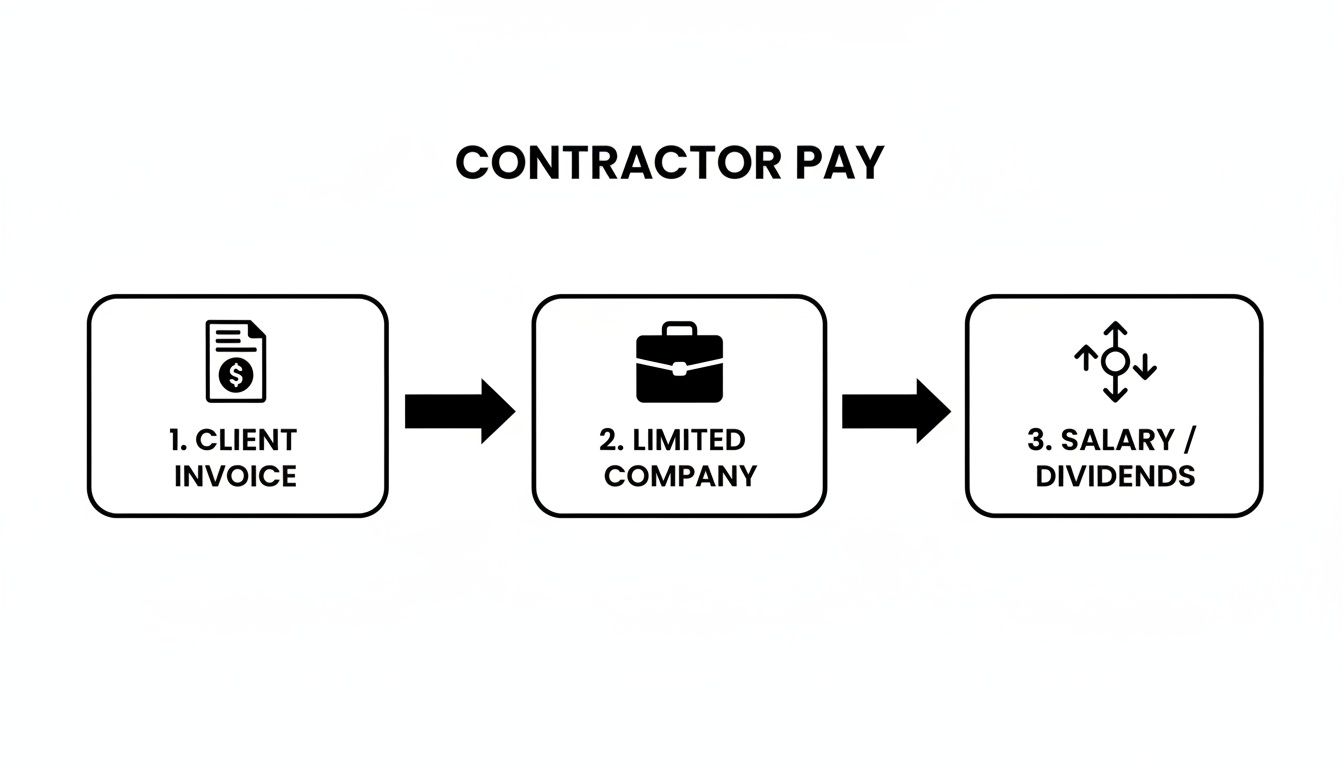
This diagram shows the basic journey of your money. It starts with the client, flows into your limited company, and then you decide how to draw it out as either a salary or dividends, each with its own tax rules.
Let's get into it.
Step 1: Start With Your Company Profit
First, we need your company's profit before you've paid yourself anything. This is simply your total contract revenue minus all your allowable business expenses (think software, insurance, your accountant's fees, etc.).
For this example, let's say your company has made a profit of £60,000 before paying you, the director.
Step 2: Deduct Your Director's Salary
Now, you pay yourself a salary. The most common tax-efficient strategy for contractors is to pay a salary up to the National Insurance Primary Threshold. For the 2024/25 tax year, this figure is £12,570.
Why this specific amount? It's a sweet spot.
- It’s a tax-deductible expense for your company, which immediately lowers your Corporation Tax bill.
- It sits neatly inside your personal tax-free allowance, meaning you pay zero Income Tax on it.
- Crucially, it’s high enough to count as a qualifying year for your State Pension, but low enough that neither you nor your company pays any National Insurance.
So, let's deduct that from the company's profit:
£60,000 (Initial Profit) – £12,570 (Salary) = £47,430 (Remaining Profit)
Step 3: Calculate Corporation Tax
Next, your limited company has to pay Corporation Tax on the profit that's left. The main rate is 25%, but for companies with profits of £50,000 or less, a 'small profits rate' of 19% applies.
Our remaining profit of £47,430 falls into this lower bracket, so we'll use the 19% rate:
£47,430 x 19% = £9,011.70 (Corporation Tax due)
This tax is paid from the company's profits, leaving the final pot of cash available for you to take as dividends.
£47,430 (Profit Before Tax) – £9,011.70 (Corporation Tax) = £38,418.30 (Profit Available for Dividends)
This £38,418.30 is the maximum you can now pay yourself in dividends.
Step 4: Work Out Your Personal Tax
Finally, we need to calculate the personal tax you owe on everything you've taken out of the company, both the salary and the dividends.
Salary Income: Your £12,570 salary is completely covered by your £12,570 Personal Allowance. So, the tax on this part is £0. Simple.
Dividend Income: You've got £38,418.30 in dividends to deal with.
- The first £500 is tax-free, thanks to the Dividend Allowance. This leaves £37,918.30 that is taxable.
- Your total income for the year is £50,988.30 (£12,570 salary + £38,418.30 dividends). This just tips you over the higher-rate tax threshold, which starts at £50,271.
- The chunk of your dividends that falls into the basic-rate band (£50,270 – £12,570 = £37,700) is taxed at 8.75%.
- The small remaining bit that's in the higher-rate band (£37,918.30 – £37,700 = £218.30) gets taxed at 33.75%.
Your total dividend tax bill is (£37,700 x 8.75%) + (£218.30 x 33.75%), which comes to £3,372.56. This is your only personal tax liability for the year.
And there you have it. That’s how you can accurately map out your take-home pay. If you want a quicker way to play around with different contract rates and expenses, our limited company take-home calculator can model various scenarios for you in seconds.
Putting Theory Into Practice: Real-World Contractor Scenarios

Theory is one thing, but seeing how the numbers stack up is where it all starts to click. Let’s walk through three common profit levels for UK contractors: £60,000, £90,000, and £150,000.
In each case, we’ll use the classic, tax-efficient strategy: a small salary set at the National Insurance threshold, with the rest of the profit taken as dividends.
Think of your company’s profit as a large cake. Before you can enjoy it, you need to slice it up. A small piece goes to your salary, a bigger slice goes to HMRC for Corporation Tax, and the remainder is yours to take as dividends.
How We've Broken It Down
To keep things crystal clear and easy to compare, all three examples follow the exact same steps. You'll see how small shifts in profit can have a big knock-on effect on your final take-home pay.
Scenario 1: £60,000 Company Profit
This is a pretty standard starting point for many contractors. With £60,000 in profit, we begin by paying you a salary of £12,570. This is the optimal number that lets you build up your State Pension entitlement without paying a penny in National Insurance Contributions (NICs) or income tax.
That salary comes straight off the profit, leaving £47,430 in the company. This amount is subject to Corporation Tax, which at 19% comes to £9,011.70.
What’s left is £38,418.30, all of which you can draw as dividends. After using your £500 tax-free dividend allowance, you'll pay £3,372.56 in personal dividend tax.
The final result? Your total take-home pay is £47,615.74.
Scenario 2: £90,000 Company Profit
Now let's scale things up. At £90,000 in profit, the salary strategy stays the same. We still take just £12,570 to keep things efficient.
The remaining profit of £77,430 is now high enough to be taxed at the main Corporation Tax rate of 25%. The bill from HMRC comes to £19,357.50, leaving £58,072.50 available for dividends.
This is where your personal tax bands come into play. Your dividend income pushes you well into the higher-rate tax bracket, resulting in a personal tax bill of £10,003.28.
Even with the higher tax rates, your net take-home pay climbs to £60,639.22. This example shows how crossing into the main rate of Corporation Tax and the higher-rate dividend tax band starts to change the picture.
Scenario 3: £150,000 Company Profit
For high-earning contractors, the numbers get even more interesting. With a £150,000 profit, we again stick with the £12,570 salary.
The remaining £137,430 is taxed at 25%, meaning a Corporation Tax payment of £34,357.50. This leaves a hefty £103,072.50 for you to distribute as dividends.
Because such a large chunk of this dividend income falls into the higher-rate tax band (33.75%), the personal tax bill is substantial: £25,189.30. At this level, many contractors start looking at pension contributions to bring their taxable income down.
After all is said and done, your final take-home pay is £90,453.20.
It’s easy to forget how much things have changed. Imagine you were a contractor earning £50,000 a few years ago. In the 2015/16 tax year, you could take dividends completely tax-free up to the higher-rate threshold.
Fast forward to today, and the tax-free dividend allowance has been reduced from £5,000 to just £500. As a result, a higher-rate taxpayer taking £30,000 in dividends will pay £3,046 more in tax this year than they would have in 2015. It's a stark reminder of why smart planning matters, as highlighted in analysis from AJ Bell.
Take-Home Pay Projections Across Different Profit Levels
Here's a side-by-side look at how the numbers from our three scenarios compare. This table neatly summarises the total tax paid and your final net income at each profit level, based on the tax-efficient strategy we've outlined.
| Company Profit | Corporation Tax | Personal Tax (Salary + Dividend) | Total Tax Paid | Final Net Take-Home Pay |
|---|---|---|---|---|
| £60,000 | £9,011.70 | £3,372.56 | £12,384.26 | £47,615.74 |
| £90,000 | £19,357.50 | £10,003.28 | £29,360.78 | £60,639.22 |
| £150,000 | £34,357.50 | £25,189.30 | £59,546.80 | £90,453.20 |
As you can see, while your total tax bill increases with your profits, your net income grows significantly at each stage. It's also worth noting these are simplified examples for the 2024/25 tax year; your personal circumstances, such as pension contributions, could change the final figures.
Key Takeaways From the Scenarios
- Higher Profits, Higher Taxes: As your company becomes more profitable, it moves into higher Corporation Tax brackets. Your planning needs to account for this.
- The Optimal Salary: Keeping your salary at the National Insurance Primary Threshold is a cornerstone of this strategy. It secures your State Pension credits without costing you or your company a penny in NICs.
- Dividend Planning is Crucial: Dividends are still a fantastic way to extract profit, but with the allowance so low, every pound counts. A significant portion of your dividends will likely be taxed at the higher rate of 33.75% once you're earning more.
- Use a Calculator: Don't rely on guesswork. Using a dedicated salary and dividend tax calculator lets you model different scenarios in seconds to find the sweet spot for your own business.
Think of a contractor named Alex, who started out earning £60,000 and grew her business to £150,000 over five years. These examples map out that journey and show exactly how her tax situation would have evolved.
Ready to see what your own numbers look like? Go ahead and plug them into our salary and dividend tax calculator.
How IR35 Changes Your Tax Plan
The tax-efficient salary and dividend model we've walked through is a fantastic strategy for contractors working 'outside IR35'. It's the cornerstone of maximising your take-home pay.
However, if your contract gets flagged as 'inside IR35', the whole game changes. The flexibility you had over how you draw your income essentially disappears.
When a contract falls inside IR35, HMRC considers your relationship with the client to be 'disguised employment'. This means your earnings can't be treated as company profit to be paid out in dividends. Instead, every penny has to be processed as if you were a permanent employee, completely changing how you're taxed.
The Real Impact On Your Take-Home Pay
The single biggest change for an inside IR35 contract is that dividends are completely off the table. All your earnings from that project must go through a payroll system, just like a regular salary.
This has two major consequences for your bank balance.
First, your entire income is hit with PAYE Income Tax at the standard rates. Second, both Employee's and Employer's National Insurance Contributions (NICs) have to be paid on those earnings. Losing the NIC-free dividend route often leads to a noticeable drop in your net pay compared to an outside IR35 engagement.
Why An Umbrella Company Is The Go-To Solution
This is exactly where an umbrella company steps in as the standard, compliant way to handle inside IR35 work. When you join an umbrella, you effectively become their employee for that specific contract. The whole structure is designed to manage the payroll headache that an inside IR35 determination creates.
The umbrella company becomes your official employer, handling all the tax deductions for you. Here’s a simple breakdown of how it works:
- The umbrella company sends invoices to your client or agency for the work you've done.
- They receive the payment, which is treated as your gross salary.
- They deduct all the necessary taxes, including PAYE Income Tax and both employee's and employer's National Insurance.
- What’s left is paid directly to you as your net salary, and you get a clear payslip showing every single deduction.
By using an umbrella company for inside IR35 contracts, you get total peace of mind. You know you're paying the right amount of tax and National Insurance, keeping you fully compliant with HMRC's rules without any of the administrative hassle.
Why Your IR35 Status Is Everything
It’s not an exaggeration to say that your IR35 status is one of the most critical factors affecting your finances as a contractor. It dictates the entire structure of your pay and your final tax bill.
Whether a contract is deemed 'inside' or 'outside' can mean a difference of thousands of pounds in your pocket over the course of a year.
Understanding this distinction is absolutely vital for planning your finances. While a salary and dividend tax calculator is the perfect tool for mapping out your income on outside IR35 projects, the sums for inside IR35 work follow the much simpler (but often less rewarding) PAYE model.
For a deeper dive into the rules, you can learn more about IR35 for contractors in our detailed guide. Here at UmbrellaCompany.com, we specialise in providing clear, compliant solutions for all contractors, whatever their IR35 status.
Choosing The Right Path For Your Contracting Career
Deciding how to run your contracting business is like plotting a journey. A few key choices set your course, affecting everything from your net income to the administration on your desk. As you now know, the starting point for this path is your IR35 status.
Your two main options are operating through your own limited company or working via an umbrella company. Each route fits different circumstances and carries distinct benefits and obligations. Below, we’ll recap the essentials so you can choose confidently.
The Limited Company Route For Outside IR35
If your contracts clearly sit outside IR35, setting up a limited company and adopting the salary-dividend model often delivers the greatest tax efficiency. You pay yourself a modest salary and draw the rest as dividends, reducing both income tax and National Insurance Contributions.
- Tax Efficiency: A low salary plus dividends equals lighter NIC bills.
- Financial Control: You decide when and how much profit to extract.
- Director Responsibilities: You’ll manage company accounts, file annual returns, and ensure compliance.
A salary and dividend tax calculator is invaluable here. It lets you explore different scenarios and confirm your take-home pay before you make any moves.
The Umbrella Company Route For Inside IR35
When your contract is ruled inside IR35, an umbrella company removes the guesswork. You become an employee of the umbrella, with all PAYE tax and NIC handled on your behalf.
Using an umbrella company for inside IR35 work provides complete peace of mind. It ensures all necessary PAYE tax and National Insurance are correctly deducted and paid to HMRC, protecting you from compliance risks while giving you statutory employment rights.
There’s no need to juggle company accounts or file Corporation Tax returns. Simply submit your timesheets, and your umbrella employer takes care of payroll, issues clear payslips, and guarantees you’re paid on time.
At UmbrellaCompany.com, we guide you through these vital decisions. Whether you’re hunting for an FCSA-accredited umbrella provider or seeking expert advice, we’re here to support your contracting journey every step of the way.
Frequently Asked Questions
When you're running your own limited company, figuring out the best way to pay yourself can feel like a minefield. Below, we've tackled some of the most common questions contractors ask us about balancing salary, dividends, and taxes.
What Is The Most Tax-Efficient Salary For A Contractor?
For most limited company directors, the sweet spot is taking a salary up to the National Insurance Primary Threshold. For the 2024/25 tax year, that figure is £12,570.
Why this specific number? It’s a smart, strategic move for a few reasons:
- It’s a deductible expense, so it lowers your company's Corporation Tax bill.
- It sits neatly inside your Personal Allowance, meaning you pay zero income tax on it.
- Crucially, it’s high enough to count as a qualifying year for your State Pension but just low enough that you don’t pay any employee's National Insurance Contributions (NICs).
This approach lets you build up your State Pension entitlement for the future without it costing you a penny, while keeping the maximum amount of profit in the business to take out as dividends.
When And How Can I Pay Myself Dividends?
You can pay yourself dividends whenever you like, with one very important condition: your company must have enough retained profits to cover the payment. It is illegal to pay a dividend if the company cannot afford it from its post-tax profits.
To keep everything above board with HMRC, there's a simple process to follow. First, you need to hold a board meeting to officially declare the dividend (even if you're the only director). You just need to document this decision in your company's minutes.
Then, for every dividend you pay out, you must issue a dividend voucher to each shareholder. This is just a slip of paper (digital or physical) that details:
- The company name and number
- The shareholder's name
- The payment date
- The total dividend amount
Many contractors get into a rhythm of paying themselves dividends monthly or quarterly. It’s a great way to create a steady, predictable income stream.
How Do The Personal And Dividend Allowances Work Together?
Think of your Personal Allowance and Dividend Allowance as two separate tax-free pots. They work together but are used for different types of income.
Your Personal Allowance (£12,570 for 2024/25) is your main tax-free allowance, and your salary will almost always use this up first. The Dividend Allowance (£500 for 2024/25) is a much smaller, specific allowance that only applies to your dividend income.
For example, if you pay yourself a salary of £12,570, that's your entire Personal Allowance used. When you then start taking dividends, the first £500 is completely tax-free because of the Dividend Allowance. Any dividends you take beyond that £500 will then be taxed at the appropriate rate for your income band.
What Happens If I Use Dividends For An Inside IR35 Contract?
Simply put, you cannot. Trying to pay yourself via dividends for work that has been classified as inside IR35 is a serious breach of HMRC rules and is considered tax avoidance.
When a contract is inside IR35, all the money you earn from it must be treated as if it were a salary from a regular job. This means it must go through a payroll system and is subject to full PAYE tax, plus both Employee's and Employer's National Insurance. The option to take tax-efficient dividends is completely off the table.
If HMRC investigates and finds you’ve been paying yourself dividends for inside IR35 work, the consequences can be severe. You could be hit with a bill for all the underpaid tax and NICs, plus interest and potentially heavy financial penalties. This is why using a compliant umbrella company is the only correct and risk-free way to handle inside IR35 contracts.
At UmbrellaCompany.com, we specialise in helping contractors find the right compliant solution for their circumstances. Whether you need to compare FCSA-accredited umbrella companies for an inside IR35 role or want guidance on running your limited company, we provide the tools and support you need. Find your perfect match in minutes at https://umbrellacompany.com.


