


When you agree a day rate or a contract value, it is easy to get a little ahead of yourself. But that headline figure is not what will actually land in your bank account. The number that truly matters is your salary after tax, your real take-home pay once all the deductions have been made.
We understand that if you are new to contracting in the UK, it can feel like you need a degree in accounting just to figure out your payslip. This guide will break down everything you need to know about your salary after tax, explaining the key deductions and how your take-home pay is calculated when working through an umbrella company.
What Salary After Tax Means for UK Contractors

Simply put, your 'salary after tax' is the net amount you get to keep after HMRC and other statutory bodies have taken their share. You will hear it called net pay or take-home pay. This is the practical, spendable income you use for your mortgage, bills, and everything else. It is the number that really counts for your budget.
Here at UmbrellaCompany.com, we believe every contractor deserves to feel confident and clear about their earnings. This guide is designed to give you exactly that. We will break down everything you need to know about your pay, from the standard taxes to the specifics of working through an umbrella company.
Why Gross Pay Is Just the Starting Point
Think of your gross pay, whether it is an annual figure or a day rate, as the top-line number before the reality of UK tax rules kicks in. It is the big, impressive figure on the contract, but the journey from that gross amount to your net pay involves a few crucial steps.
We promise to demystify your payslip by explaining the essential deductions you will see, including:
- Income Tax: The main tax on your earnings, calculated using different tax bands.
- National Insurance Contributions (NICs): Your contribution towards state benefits like the NHS and your State Pension.
- Other Deductions: Things like student loan repayments and pension contributions can also reduce your take-home pay.
Setting Realistic Expectations
By the end of this guide, you will see exactly how your gross contract value is processed to determine your net pay. This will put you in a much better position to manage your finances with control and confidence, allowing you to plan effectively and set realistic financial goals.
Understanding these calculations ensures there are no surprises on payday. It empowers you to compare contract offers accurately and choose the best path for your contracting career.
Understanding the Key Deductions from Your Gross Pay
When you agree on a contract rate, that headline figure is your gross pay. It is the starting point, but it is not the amount that will land in your bank account. To get to your actual take-home pay, or salary after tax UK, a few things have to be deducted first.
Think of your gross pay as the whole pie. Before you get your slice, a few mandatory pieces are taken out for things like tax and social security. Let's break down exactly what these are so you can see where your money goes and forecast your net pay with more confidence.
UK Income Tax: The Biggest Slice
For most people, the largest chunk taken out is Income Tax. This is how the government funds essential public services, everything from the NHS to schools and road maintenance. It is not a flat fee; it is a progressive system. The more you earn, the higher the percentage of tax you pay on the portion of your earnings that falls into higher bands.
For the 2024/25 tax year in England, Wales, and Northern Ireland, the system is built around these bands:
- Personal Allowance: You can earn up to £12,570 a year completely tax-free.
- Basic Rate: On earnings from £12,571 up to £50,270, you will pay 20% tax.
- Higher Rate: For the portion of your earnings between £50,271 and £125,140, the rate jumps to 40%.
- Additional Rate: Anything you earn over £125,140 is taxed at 45%.
It is worth noting that Scotland has its own tax bands and rates, which are different. Also, your tax-free Personal Allowance starts to shrink once you earn over £100,000, reducing by £1 for every £2 you earn above that threshold. This whole structure is the backbone of the UK's Pay As You Earn (PAYE) system. If you want a more detailed look at the mechanics, our guide explains how PAYE works.
National Insurance Contributions: Your Social Security
Next up is National Insurance Contributions (NICs). This is another type of tax, but the money is specifically earmarked for state benefits like the State Pension, Jobseeker's Allowance, and funding for the NHS.
As an employee of an umbrella company, you will pay Class 1 NICs. This is calculated based on what you earn each pay period. For 2024/25, the rates are:
- 0% on what you earn up to £242 per week (£1,048 per month).
- 8% on earnings between £242.01 and £967 per week (£1,048.01 to £4,189 per month).
- 2% on any earnings over £967 per week (£4,189 per month).
Paying these contributions is what builds up your entitlement to state support later down the line.
Other Common Deductions
Income Tax and National Insurance are the two big ones, but a couple of other deductions might appear on your payslip.
Two other common deductions you will probably come across are:
- Student Loan Repayments: If you have an outstanding student loan, your repayments are taken automatically once you earn over a set threshold. The exact threshold and rate depend on which student loan "Plan" you are on.
- Workplace Pension Contributions: Auto-enrolment rules mean your umbrella company has to sign you up for a workplace pension. A percentage of your salary goes into your pension pot automatically, topped up by a contribution from your employer (the umbrella) and tax relief. You can choose to opt out, but it is a very effective way to save for retirement.
How Umbrella Companies Calculate Your Pay
When you work through an umbrella company, your payslip might look a little different from a standard one. That is because there are a few extra moving parts, but do not worry. It is all designed to make sure you are paid correctly and compliantly, while still getting the perks of being an employee.
Let's walk through how the money travels from the client who hired you, all the way to your bank account.
The first thing to get your head around is the assignment rate. This is the full amount your end client or agency pays us for the work you do. It is always a higher figure than your personal gross pay because it is designed to cover all the costs of employing you. We take care of sorting all this out for you, which is a key part of what we do. You can get a more detailed look in our guide on how an umbrella company works.
Understanding the Umbrella Deductions
Once we receive the assignment rate from your client, we must deduct the costs of employment before we calculate your personal gross pay. This is not about you losing money; it is about making sure all the right funds go to the right places to keep everything above board with HMRC. These are the same costs any UK employer has to cover.
The main employment costs we handle are:
- Employer’s National Insurance Contributions (NICs): This is a mandatory tax for all UK employers. It is calculated at 13.8% on any earnings above the secondary threshold.
- Apprenticeship Levy: A UK tax paid by larger employers to fund apprenticeship schemes, set at 0.5% of the annual pay bill for employers with a bill over £3 million.
- Our Margin: This is the small, fixed fee we charge for our service each time you are paid. It covers all the admin, from processing your payroll to providing you with continuous employment support.
This diagram breaks down the journey from the total contract value to what you actually take home.
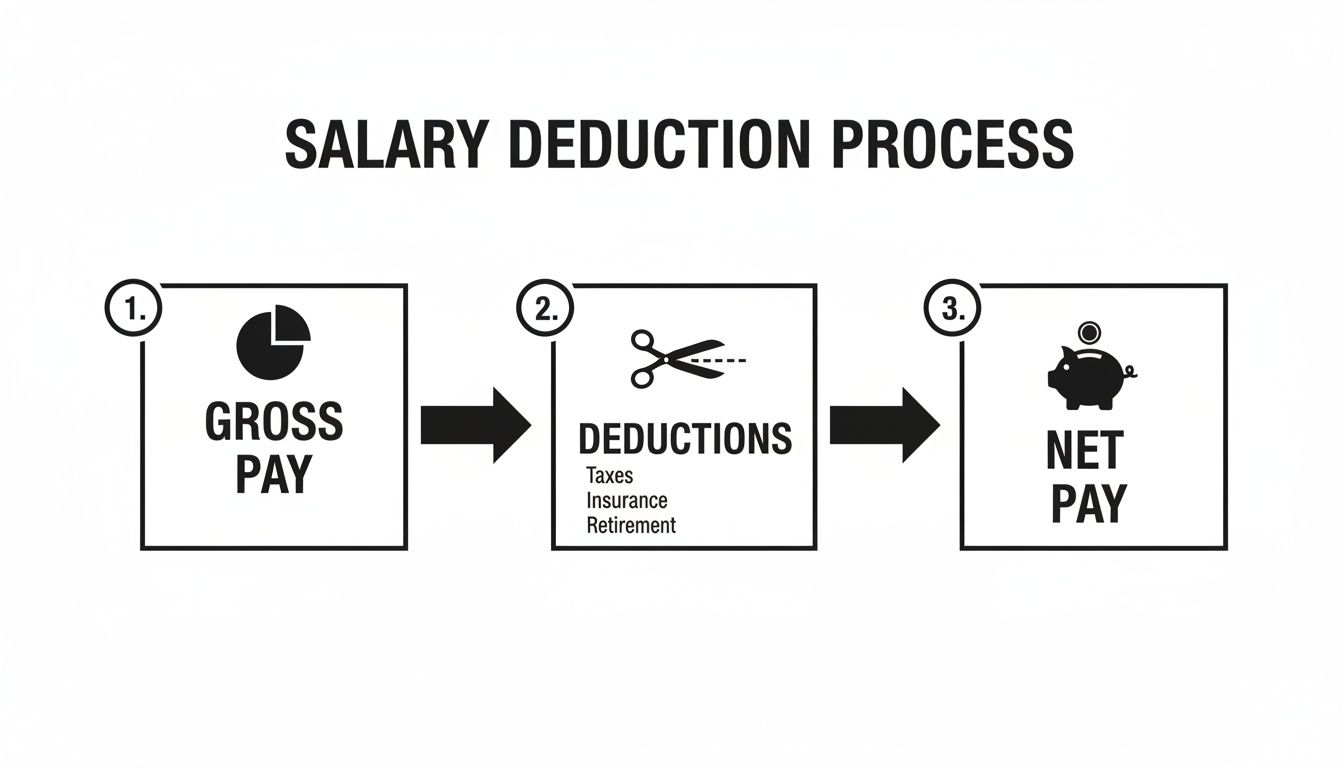
As you can see, these deductions are just a standard part of the payroll process, turning your gross earnings into your final take-home salary.
From Gross Pay to Net Pay
After those employment costs are sorted, the money left over becomes your gross pay. This is the figure that shows up on your payslip and is the amount your personal taxes will be calculated from.
From your gross pay, we then make all the usual statutory deductions we have already covered:
- Income Tax: Worked out using your tax code against the UK's tax bands.
- Employee’s National Insurance: Your own contribution to state benefits.
- Student Loan Repayments: If you have one, this is deducted based on your plan.
- Pension Contributions: Your contribution to the workplace pension scheme.
What is left after all that is your net pay, your salary after tax UK. This is the final amount that we transfer straight into your bank account. It is a clear, compliant process that ensures all your tax obligations are met, giving you peace of mind to focus on what you do best.
Example Take-Home Pay Calculations for UK Contractors
Now it is time to crunch the numbers. Theory is one thing, but seeing how it all plays out with real figures is where it gets interesting.
To give you a practical feel for what your take-home pay might look like, we have put together a few step-by-step examples. This is where we go from a gross contract rate to the actual cash that hits your bank account.

We will walk through three common day rates we see for UK contractors: £300, £500, and £750. This will show you exactly how all those deductions we have talked about apply in the real world.
For these examples, we are making a few assumptions: you are working five days a week for 48 weeks a year, your umbrella company charges a typical £25 weekly margin, and you are on a standard 1257L tax code for the 2024/25 tax year. Just remember, these are illustrations. Your final pay could vary depending on your personal circumstances.
Example 1: The Contractor on £300 Per Day
Let’s kick things off with a contractor on a £300 day rate. This is a common starting point for many skilled professionals new to contracting.
First, we work out the gross value of the contract for the week.
- Gross Contract Value: 5 days x £300 = £1,500
From this amount, the umbrella company first covers the employment costs, their margin, Employer's National Insurance, and the Apprenticeship Levy. What is left after that is your gross pay for tax purposes.
Then, your personal deductions come off that gross pay:
- Income Tax (PAYE): Calculated using the standard tax bands.
- Employee's National Insurance: Deducted at the appropriate rate.
- Pension Contributions: Your standard auto-enrolment slice is taken out.
After all that, a contractor on a £300 day rate can expect a weekly take-home pay of around £875. That works out to a monthly net income of roughly £3,790.
Example 2: The Contractor on £500 Per Day
Now for a more seasoned contractor, earning £500 a day. The process is exactly the same, but the bigger numbers mean you start to feel the effects of higher tax bands.
- Gross Contract Value: 5 days x £500 = £2,500
Again, we subtract the employment costs from this weekly figure to find the gross taxable pay. Since the earnings are higher, the amount paid in Employer’s NI also goes up significantly.
Next, the personal deductions are applied. A significant chunk of this contractor's earnings will now fall into the 40% Higher Rate tax band, which makes a real dent in the final amount. Employee's NI and pension contributions are also calculated on this much larger gross pay figure.
For this contractor, the estimated weekly net pay is approximately £1,340, giving them a monthly take-home of around £5,800.
Example 3: The Contractor on £750 Per Day
Finally, let’s look at a senior or specialist contractor earning £750 per day. At this level, the tax implications become even more significant.
- Gross Contract Value: 5 days x £750 = £3,750
The employment costs are deducted from this substantial weekly sum. The remaining amount, your gross pay, will put you well over the £100,000 annual threshold where your tax-free Personal Allowance starts to shrink. This has a huge impact, as more of your income gets pushed into the higher tax brackets.
Here’s how the personal deductions stack up:
- Income Tax (PAYE): A large portion is now taxed at the 40% Higher Rate.
- Employee's National Insurance: Contributions are made all the way up to the Upper Earnings Limit.
- Pension Contributions: Calculated as a percentage of their very healthy gross pay.
For a contractor on £750 a day, the estimated weekly net pay is around £1,870. This gives them an estimated monthly take-home of about £8,100.
Estimated Take-Home Pay for UK Contractors
To make it even clearer, here is a table that summarises these examples and gives you a quick snapshot of what you might expect to earn.
| Day Rate | Gross Weekly Contract Value | Estimated Weekly Take-Home Pay | Estimated Monthly Take-Home Pay |
|---|---|---|---|
| £300 | £1,500 | ~£875 | ~£3,790 |
| £500 | £2,500 | ~£1,340 | ~£5,800 |
| £750 | £3,750 | ~£1,870 | ~£8,100 |
These examples should give you a solid benchmark for how a day rate translates into net earnings. They highlight why it is so important to factor in all the deductions when you are figuring out your finances.
How IR35 Status Affects Your Take-Home Pay
If you are a contractor in the UK, you cannot escape talk of IR35. It is a piece of tax legislation that has a massive impact on how you get paid and, ultimately, your salary after tax. Understanding your contract's IR35 status is not just a good idea, it is essential.
Put simply, IR35 is HMRC's way of determining if a contractor is a genuine, independent business or a 'disguised employee' who should be paying tax like one. If your contract is deemed 'inside IR35', it means HMRC sees your working relationship as being no different from a permanent employee's.
Why Umbrella Companies Are Key for Inside IR35 Roles
For any contract that falls inside IR35, working through a compliant umbrella company is the most straightforward and safest way to get paid. We effectively become your employer, processing all your payments through the standard PAYE (Pay As You Earn) system.
This setup guarantees that all the right taxes are deducted before the money hits your bank account, keeping you completely compliant with HMRC. It takes the administrative headache and the risk of miscalculating your tax off your shoulders.
What you get with this model is:
- Full tax and National Insurance compliance, all managed for you.
- Statutory employment rights, like holiday pay and sick pay.
- A continuous employment record, which is a big help when you need to apply for a mortgage or a loan.
The Difference Between Inside and Outside IR35
On the flip side, if your contract is assessed as 'outside IR35', it signals a true business-to-business relationship. Contractors working this way usually operate through their own limited company, often called a Personal Service Company (PSC).
Working outside IR35 can be more tax-efficient, but it comes with a much heavier administrative burden and a lot more risk. You are responsible for everything: managing the company's finances, filing accounts, and proving to HMRC your IR35 status is correct.
For many contractors, the simplicity and security an umbrella company offers for inside IR35 work just makes sense. It is the hassle-free way to contract compliantly. To get to grips with the rules, have a look at our detailed guide on what IR35 means for contractors.
Tools and Tips for Getting Your Numbers Right
Now that we have untangled the different deductions, it is time to apply that knowledge to your own contract. Getting a confident estimate of your salary after tax in the UK is essential for good financial planning. Thankfully, there are some great tools and simple tips to help you get a clear picture of what you will actually take home.
This section provides the practical advice and resources to forecast your earnings accurately. We will show you how to get from a headline day rate to a realistic net pay figure, so there are no surprises when that first payment lands.
Using an Online Payroll Calculator
One of the quickest ways to get a reliable estimate is to use a tool built for the job. These calculators are designed to do all the heavy lifting, running your numbers through the latest tax and National Insurance rates.
To make things easy, we have built our own. You can get a clear projection of your earnings by using our online payroll calculator for take-home pay. Just input your contract details, and it will give you a detailed breakdown.
Here is a glimpse of how our Umbrella Company Comparison Portal simplifies this, letting you see different providers and their pay illustrations all in one place.
The portal gives you a clear, side-by-side view of your potential earnings, which makes it much easier to pick a compliant and transparent partner for your contracting career.
What You Will Need for an Accurate Estimate
To get the most accurate projection, whether you are using a calculator or looking at an illustration, you need a few key pieces of information. The more detail you can provide, the closer the estimate will be to your actual net pay.
Before you start, try to have these details to hand:
- Your Contract Day Rate: The gross figure you have agreed with your agency or client.
- Your Tax Code: If you know it (for most people, it is 1257L), it helps with the Income Tax calculation.
- Pension Contributions: Are you planning to contribute? If so, have an idea of how much.
- Student Loan Plan: Make sure you know which repayment plan you are on (e.g., Plan 1, Plan 2).
- Working Days: The number of days you expect to work each week or month.
Always demand full transparency from any potential umbrella company. A reputable provider will give you a clear illustration showing every single deduction, their margin, Employer's NI, and everything else. If a take-home pay figure looks too good to be true, it almost certainly is.
Benchmarking Your Earnings
It can also be useful to see where your earnings sit compared to national averages. For context, average UK earnings on Statista provide a helpful benchmark. A contractor’s day rate might look like it leads to a huge annual salary, but that can be misleading once all the employment costs and deductions are factored in.
Checking your net projection against national figures helps you sense-check whether an illustration is realistic. Finally, always check that any umbrella company you are considering is accredited by a professional body like the FCSA or Professional Passport. This is your best guarantee that they play by the rules and your pay will be handled properly.
Your Contractor Pay Questions Answered
Understanding contractor pay can feel a bit daunting, especially when you are just starting out. There are a few key terms and concepts that often cause confusion. To help clear things up, here are some straight answers to the questions we hear most often.
Is My Day Rate the Same as My Salary?
Not quite, and this is probably the most crucial thing to grasp. Think of your day rate as the total, raw figure the client agrees to pay for your time and expertise. Your actual salary after tax is what lands in your bank account after all the necessary deductions are made.
Your day rate is the starting point. From there, employment costs (like Employer's National Insurance) are handled first. What is left is your gross pay, which is the figure your personal taxes are calculated on.
What Is an Assignment Rate?
You will often hear the term assignment rate. This is the total amount your agency or client pays to your umbrella company for the work you do. It is set higher than your take-home pay on purpose because it has to cover all the costs of being an employee.
This rate includes funds for:
- Employer’s National Insurance Contributions (13.8%)
- The Apprenticeship Levy (0.5%)
- The umbrella company’s margin (their fee for processing your pay)
- Holiday pay that is put aside for you
After these costs are settled, the remaining amount becomes your gross salary, which is then taxed as normal through PAYE.
Why Do I Have to Pay Employer’s National Insurance?
This is a common point of confusion. When you work through an umbrella company, you become their employee, which gives you the benefit of continuous employment rights. By law, every UK employer has to pay Employer's NICs for their staff.
The assignment rate is structured to include these funds from the outset, so it is all above board with HMRC. The umbrella company is not taking an extra cut; they are simply managing this mandatory payment on your behalf. It is a standard cost of employment that is factored into the rate the client pays.
How Can I Get an Accurate Pay Calculation?
The best way to see what you will actually take home is to use a properly detailed pay calculator. A vague estimate will not help you budget, so for a truly accurate picture of your salary after tax, you will need a few bits of information:
- Your contract day rate.
- How many days you work each week.
- Your tax code (it is usually 1257L if you have one job).
- Details of any student loan or pension contributions you make.
Input these details into a good calculator, and you will get a realistic breakdown of your net pay. Always look for a calculation that is completely transparent and shows you exactly where every penny is going.
At UmbrellaCompany.com, we are here to give you the clarity and tools you need to feel confident about your contractor pay. We believe in total transparency, and our comparison service connects you with trusted, accredited umbrella companies that share our values. We want to empower you to make informed decisions for a successful contracting career.


