


Thinking about going it alone and running your business from home? It's a fantastic move for many contractors, but it's not just about swapping your office chair for the sofa. This guide explains what you need to know.
To do it right in the UK, you will need to understand the legal structure, how to register with HMRC, and what your tax obligations are, especially with IR35 always looming. It is a balancing act between the freedom you gain and the professional duties you take on.
The Reality of Running a Business from Home

The idea of starting a home-based business has moved from a niche dream to a mainstream career path. Millions of UK contractors and freelancers now build solid careers from their own homes, driven by the desire for more control and a better work-life balance.
Forget the stock photos of people working from a beach. The reality of successfully running a business from home is about putting in place the structures to build a resilient, scalable career that gives you a genuine alternative to traditional employment.
A Snapshot of UK Home-Based Businesses
The rise of the home-based professional is not just a feeling; the numbers back it up. Here is a quick look at the data that defines the UK's massive home-based economy.
UK Home-Based Business at a Glance
| Statistic | Figure | Significance for Home-Based Contractors |
|---|---|---|
| Percentage of Private Sector Businesses | 75.1% | A huge majority of UK businesses have zero employees, proving you do not need a team to succeed. |
| Number of Sole Traders | Approx. 4.1 million | You are part of a massive, economically powerful community of independent professionals. |
| Sole Trader Annual Turnover | Over £403 billion | This is not a side-hustle economy; it is a major driver of UK commerce. |
These figures, drawn from the latest UK business population estimates, show that working for yourself from home is a well-trodden and economically vital path. You are not just starting a small venture; you are joining a significant part of the UK's workforce.
The Rise of the Home-Based Professional
For many, the post-pandemic work culture simply confirmed what they already knew: the home office is here to stay. What started as a necessity has become a strategic move for contractors wanting to take the reins of their own careers.
This is not just a trend for a handful of industries; it is a broad movement. The real engine of this shift is the army of sole traders and micro-businesses that form the backbone of the UK economy. They prove every day that a commercial lease is not a prerequisite for making a significant impact.
A report from the Department for Business and Trade states that businesses with zero employees account for 75.1% of all UK private sector businesses. This incredible statistic highlights that you do not need a large team or a fancy office to build a successful enterprise.
This new way of working is built on a simple premise: focus on results, not on hours clocked in a specific location. It delivers an efficiency and personal satisfaction that is tough to find in a standard nine-to-five.
Why Contractors Choose to Work from Home
While everyone’s reasons are personal, a few common drivers appear again and again among UK contractors who make the leap.
Key motivations usually include:
- Unmatched Flexibility: You decide your own hours. This means you can finally build a work schedule that fits around family, personal projects, or simply when you are most productive.
- Reduced Overheads: When you cut out the daily commute, office rent, and other workplace costs, your profit margin can increase right from day one.
- Greater Autonomy: You are the boss. You have final say on the projects you accept, the clients you partner with, and the overall direction of your career.
These are not just abstract perks; they are tangible benefits that help build a more sustainable and rewarding professional life.
Building Your Business Foundation
Getting your business set up correctly from the very start is one of the smartest things you can do. It saves you from major headaches down the road. We will walk you through those first critical decisions with practical, no-nonsense advice for UK contractors and freelancers running a business from home.
When your foundation is solid, you can focus on what really matters: delivering brilliant work for your clients. How you set things up will shape your tax obligations, your legal responsibilities, and frankly, how much admin you will be stuck with.
Choosing Your Business Structure
Your first big decision is how to structure your business legally. For most independent professionals in the UK, it boils down to two main paths: operating as a sole trader or setting up a limited company. Each has its own pros and cons.
- Sole Trader: This is by far the simplest way to get going. You and your business are one and the same in the eyes of the law. You get to keep all the profits after tax, but it also means you are personally on the hook for any business debts. The admin is quite light, which is a big plus.
- Limited Company: This route creates a completely separate legal entity. Your personal finances are shielded from business debts (this is the ‘limited liability’ you hear about). It can be more tax-efficient, but it definitely comes with more complex accounting and reporting duties.
The right choice really depends on your expected income, your attitude to risk, and how much time you are willing to dedicate to paperwork. For a really detailed breakdown, you can check out our guide for a deeper comparison of UK business structures to help you decide.
Choosing to be a sole trader offers a fast start with minimal fuss. However, forming a limited company can offer greater financial protection and a more professional image as you grow, which many long-term contractors prefer.
Registering with HMRC
Once you have picked a structure, you absolutely have to register with HM Revenue & Customs (HMRC). This is not optional. It is what makes you a legal business and ensures you pay the right amount of tax.
If you are going down the sole trader route, you will need to register for Self Assessment and sign up for Class 2 and Class 4 National Insurance. The deadline for this is the 5th of October in your business’s second tax year. So, if you start in July 2024, you have until 5th October 2025 to get registered.
If you are setting up a limited company, the first step is registering the company with Companies House. After that, you must register for Corporation Tax within three months of starting to do business.
Setting Up a Business Bank Account
Even if you are a sole trader, opening a separate bank account for your business is a very wise move. For limited companies, it is a legal requirement. Trust us, trying to untangle your business and personal spending at tax time is a nightmare you want to avoid.
A dedicated business account gives you:
- Clarity: You can see your income and expenses at a glance.
- Professionalism: It just looks better when you are invoicing clients.
- Simplicity: It makes your life (and your accountant's) so much easier.
The boom in home-based businesses is no surprise, especially with the rise of flexible working. Projections show that by February 2026, 36% of workers in Great Britain could be incorporating home working into their routines. This shift powers the UK's 4.2 million businesses with zero employees, which together contribute an incredible £403 billion to the economy.
A Simpler Alternative: The Umbrella Company Route
If all this talk of registration and tax returns sounds like a mountain of admin you would rather not climb, there is a third way. A lot of contractors who want the freedom of running a business from home opt to work through an umbrella company instead.
An umbrella company essentially acts as your employer. They handle all your tax and National Insurance deductions through PAYE, take care of your payroll, and make sure you are compliant with complex rules like IR35. This gives you the flexibility of contracting without the admin burden of being a sole trader or a limited company director. Here at UmbrellaCompany.com, we help you compare accredited providers to find one that is a perfect fit.
Getting to Grips With Your Finances and IR35
Let us be honest, managing the money side of your home-based business is the part that keeps everything running. Get it right, and you can focus on your work, knowing you are getting paid on time and keeping HMRC happy. Get it wrong, and cash flow headaches and tax worries are never far behind.
From sending out invoices to understanding IR35, it can feel like a lot to take on. Here is what you actually need to know to manage your finances and stay compliant.
Mastering Your Invoicing and Cash Flow
Getting paid on time really boils down to having a sharp, professional invoicing process. A vague or incomplete invoice is just an invitation for payment delays.
Every single invoice you send out needs to have these key details:
- Your Business Details: Your name (or registered company name), address, and contact information.
- Client Information: The full name and address of the company you are billing.
- A Unique Invoice Number: This is non-negotiable for tracking payments and keeping your books in order.
- Dates: The date you issued the invoice and the payment due date.
- A Clear Description: A proper breakdown of the services you provided, the time spent, and the rates you agreed.
- The Total Amount Due: Make the final figure, including any VAT, impossible to miss.
- Payment Details: Your business bank account number and sort code.
Chasing up late payments is an unfortunate, but common, part of contracting. Often, a polite but firm reminder email a day or two after the due date does the trick. If you are met with silence, do not be afraid to pick up the phone.
Understanding Your UK Tax Obligations
When you work for yourself, you are in charge of calculating and paying your own tax. The main ones you will be dealing with are Income Tax and National Insurance, which are all handled through your annual Self Assessment tax return.
The deadline for online Self Assessment tax returns and paying what you owe is midnight on 31st January. Miss it, and you will get an automatic penalty, so staying organised is key.
You also need to keep an eye on Value Added Tax (VAT). It is mandatory to register for VAT once your business's VAT-taxable turnover hits £90,000 within any 12-month period. Some contractors choose to register voluntarily before this point, as it can make your business look more established. And do not forget, running your business from home means you can likely claim some expenses back. You can learn more in our guide on working from home tax deductions.
Navigating the IR35 Off-Payroll Working Rules
For UK contractors, the IR35 legislation (or off-payroll working rules) is probably the biggest compliance hurdle you will face. In short, these rules determine whether you are a genuine self-employed business or a ‘disguised employee’ in the eyes of HMRC.
If a contract is deemed ‘inside IR35’, you are treated as an employee for tax purposes. This means your income is subject to PAYE tax and National Insurance. If it is ‘outside IR35’, you can operate as a proper business and handle your own tax affairs in a more tax-efficient way.
Since April 2021, the responsibility for deciding your IR35 status for most contracts falls on the end client. This has made many clients cautious, often classifying roles as inside IR35 by default to avoid any risk on their end.
Choosing the Right Path for Compliance
This decision tree gives you a visual map of the main routes available to you as a UK contractor. It helps clarify how your choices branch out.
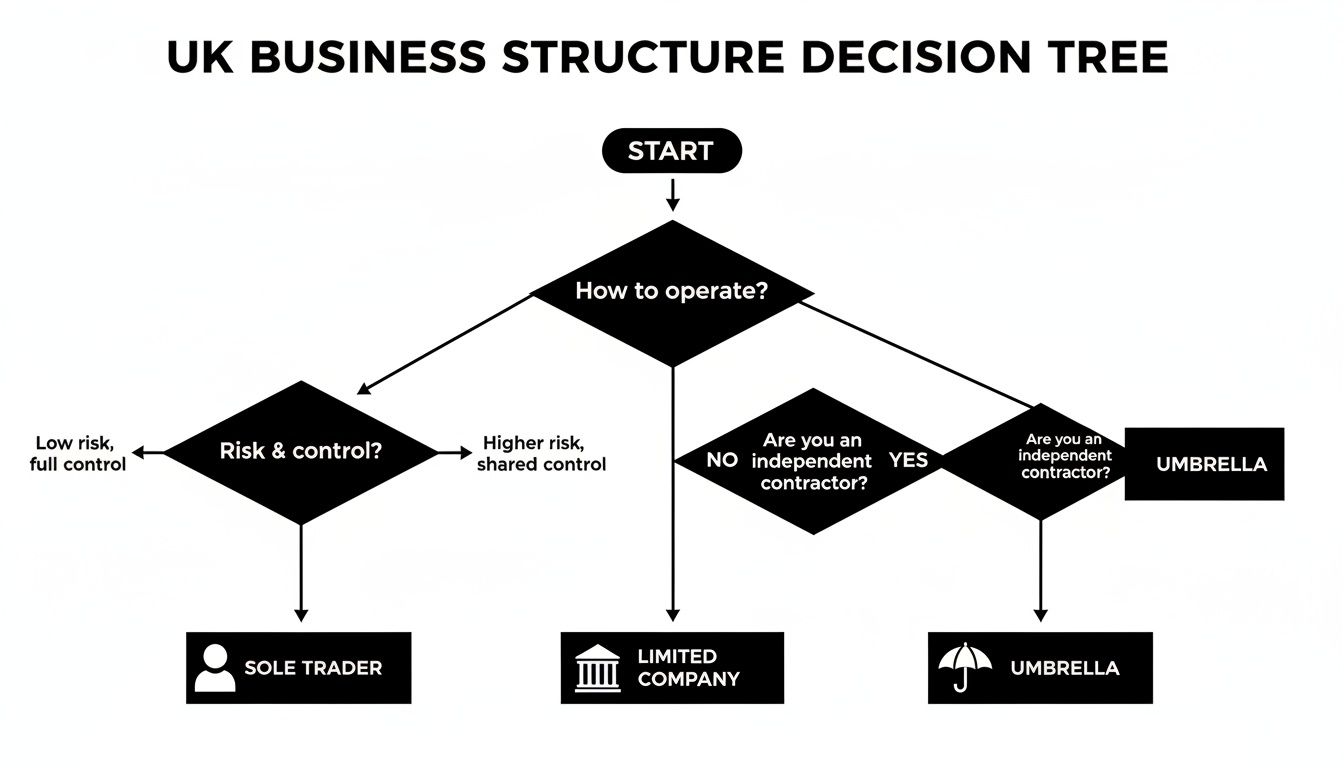
As the flowchart shows, while being a sole trader or running a limited company gives you autonomy, the umbrella company route offers a very simple path to compliance, especially for those inside IR35 contracts.
If your assignment is inside IR35, using a compliant, FCSA-accredited umbrella company is often the most sensible solution. The umbrella company becomes your legal employer, handling all your tax and NI deductions through PAYE (Pay As You Earn).
This setup offers some real, practical benefits:
- Full Compliance: The IR35 headache is gone. For you and your client, you are simply an employee of the umbrella company.
- Simplicity: You just submit your timesheets, and they handle payroll. No need to worry about Self Assessment for that income.
- Employment Rights: You get statutory rights like sick pay, holiday pay, and can be enrolled in a workplace pension.
At UmbrellaCompany.com, we make finding a trustworthy partner easy. Our comparison tool lets you filter and select from a list of fully vetted, accredited providers. It means you can get on with running your business from home with complete peace of mind, enjoying the freedom of contracting without the admin overload.
How to Choose the Right Umbrella Company
Picking the right partner to handle your earnings is one of the most important decisions you will make as a home-based contractor. The truth is, not all umbrella companies are created equal, and your choice has a direct impact on your income and your standing with HMRC.
A good comparison tool is invaluable here. It is designed to cut through the noise, helping you find a reliable, accredited provider that actually fits your needs without all the guesswork.
First Things First: Check for Accreditation
Before you even glance at the weekly or monthly margin an umbrella company charges, your first check should always be for accreditation. This is simply non-negotiable.
Look for accreditations from respected, independent professional bodies like the FCSA (The Freelancer & Contractor Services Association) or Professional Passport. These organisations put providers through rigorous audits, ensuring they comply with UK tax law and follow industry best practices.
Choosing an accredited provider is not just a box-ticking exercise. It gives you:
- Peace of Mind: You can be confident that your taxes and National Insurance are being handled correctly.
- Protection: It is your best defence against accidentally getting caught up in a disguised tax avoidance scheme.
- A Reliable Partner: You know the provider has met high standards for their business processes and customer service.
Frankly, going with an unaccredited provider is an unnecessary risk to your finances and professional reputation.
Using a Comparison Tool the Smart Way
Let us run through a real-world scenario. Say you are an IT contractor working from home on a project that has been determined to be 'inside IR35'. You need a straightforward, compliant payroll solution that also includes comprehensive insurance.
This is where a comparison tool really shines, letting you filter based on exactly those requirements.
This screenshot shows how you can quickly get a side-by-side view of the key details from accredited providers.
From a single screen, you can see the provider's margin, their accreditation status, and any extras like insurance. It allows you to make a quick, informed decision based on what matters most to you, not just on a flashy sales pitch.
How to Spot the Red Flags of a Non-Compliant Scheme
While the vast majority of umbrella companies are legitimate, some schemes are set up for one reason only: to help people avoid paying the tax they owe. They often make promises that sound too good to be true, because they are.
If an umbrella company is advertising that you can take home 80% to 90% of your contract value, it is a massive red flag. A legitimate PAYE payroll simply cannot generate those kinds of returns after UK tax and National Insurance are deducted.
Other warning signs to watch out for include:
- Payments being split, with some of your money coming from an offshore account.
- The payment being structured as a "loan" or "annuity" that you are told you will not have to repay.
- A total lack of transparency on your payslip about how your pay has been calculated.
Getting involved with these schemes, even unintentionally, can lead to serious trouble with HMRC, including back-taxes and hefty penalties. Using a comparison service that only lists vetted, accredited providers is your safest bet. If you are ever in doubt, it pays to read up on what to expect from a compliant umbrella company for contractors.
By focusing on accreditation from the start and using comparison tools to weigh your options, you can choose a partner you trust. This leaves your financial admin in safe hands, so you can get back to what you do best: delivering fantastic work from your home-based business.
Winning and Keeping Clients from Your Home Office

With your business structure in place, it is time to focus on what really fuels your success: finding and retaining good clients. Running a business from home is about more than just having the right operational setup; it is about building a reliable pipeline of work and forging strong client relationships.
This is not about chasing every opportunity. We are focusing on practical, proven strategies for UK contractors to move beyond one-off projects and build a sustainable, profitable career.
Turn Your Online Presence into a Client Magnet
Today, your digital footprint is your first impression. For a contractor, a sharp LinkedIn profile is not just a CV. It is a marketing tool that works for you 24/7.
Your profile needs to quickly tell potential clients who you help and what problems you solve. Your headline should be more than a job title; it is a mini-advertisement. For example, instead of “IT Consultant,” try “FCSA-Accredited IT Project Manager | Specialising in Agile Transformations for FinTech.”
This immediately flags your specialism and your grasp of compliance, which is a major plus for many clients.
Your professional network is one of your most valuable assets. Do not be afraid to proactively connect with hiring managers, recruiters, and decision-makers in your target industries. A short, personalised connection request can open doors to opportunities that are never publicly advertised.
Network Genuinely in Online Communities
Beyond LinkedIn, online forums and specialist groups on platforms like Slack or even Reddit can be a goldmine for leads. The secret is to give value first and sell second.
Instead of just posting "I'm available for work," get involved in discussions. Answer questions and share your knowledge freely. This builds your reputation as a go-to expert.
When you consistently provide helpful insights, people will start to see you as an authority in your field. This often leads to organic enquiries and referrals, which are usually the best-quality leads you can get.
Build Social Proof with Testimonials
Positive feedback is incredibly powerful. When a potential client sees that others have had a great experience with you, it dramatically reduces the perceived risk of hiring you.
Get into the habit of asking for a testimonial at the end of every successful project. You can make it simple for them by suggesting they leave a recommendation on your LinkedIn profile.
A handful of strong testimonials can be the deciding factor that gets you hired over another contractor. Display them clearly on your profile and website to build instant trust.
Craft Proposals That Get Signed
Your proposal is where you prove you have understood the client’s needs. A winning proposal is not a price list; it is a strategic document that outlines the value you are going to deliver.
Structure your proposals to include:
- A Clear Understanding of the Problem: Reiterate the client's challenges to show you were listening.
- Your Proposed Solution: Detail your approach, the key deliverables, and a realistic project timeline.
- Your Value Proposition: Explain why you are the right choice, referencing your specific skills and experience.
- Transparent Pricing: Break down your costs clearly so there are no surprises down the line.
Set Clear Boundaries with Robust Contracts
A solid contract is the bedrock of any professional relationship. It protects both you and your client by setting clear expectations from the start.
Your contract must cover the scope of work, payment terms, deadlines, and what happens if the project scope changes. Using a professional template can save you time and make sure you have all the legal bases covered.
If you need a reliable starting point, our guide includes a downloadable freelance contract template for UK contractors. This is a critical step in professionalising your home-based business and avoiding future disputes.
Scaling Your Business and Staying Compliant
Once your home-based business starts picking up steam, the real challenge begins: how to handle growth without burning out. Scaling properly is not just about cramming more projects into your diary. It is about being smart with your capacity, raising your rates, and keeping everything above board with HMRC.
Growth is what we all aim for, but it brings new kinds of pressure. Thinking ahead allows you to expand your services and boost your income, all while protecting that crucial work-life balance. This is where the compliant, stable foundation you have built really proves its worth.
Managing a Heavier Workload
When demand for your work starts to outstrip your available hours, the answer is not always to work later. The key is to work smarter. Before you find yourself pulling all-nighters, think about practical ways to manage the extra labour.
This could mean tightening up your processes, using software to automate your admin, or even subcontracting specific tasks to other trusted freelancers. The goal is to build a business that can grow without you personally having to do all the extra work. That is a vital mindset shift when your office is just down the hall from your living room.
Knowing When and How to Increase Your Rates
Are you consistently booked solid? Turning away new enquiries? That is your cue to take a hard look at your pricing. Putting your rates up can feel daunting, but it is a non-negotiable part of growing a successful business. It lets you earn more from the same hours, or even work less for the same income.
When you are ready to make the change, handle it professionally:
- Talk to your existing clients. Give them fair warning and frame it as a reflection of your increased experience and the value you deliver. Most reasonable clients expect this.
- Update your public-facing profiles. Make sure your new pricing is clearly stated on your website, LinkedIn profile, and any proposal templates you use.
- Own your value. You have earned this. Your track record and results speak for themselves, so be confident in the new rates you are quoting.
Staying Compliant Amidst Growth
As your income climbs, so does the importance of keeping immaculate financial records. Staying compliant with HMRC is not optional. You need to keep a sharp eye on your turnover, especially as you approach the VAT threshold (£90,000), and stay current on any changes to rules like IR35.
Growth inevitably brings complexity. While a home-based model protects you from many overheads, many small companies are feeling the pressure. In fact, 27% of small businesses expect to shrink in the coming years due to rising costs. You can learn more about these trends from UK small business statistics at Gosmallbusiness.co.uk.
A dependable umbrella company partnership provides the stable, compliant foundation needed for growth. It frees you to concentrate on delivering excellent work and expanding your services, secure in the knowledge your payroll and tax administration are expertly handled.
By working with an FCSA-accredited umbrella company, you can be confident that every payslip is correct and every tax deduction is handled according to the latest HMRC rules. It takes a huge administrative weight off your shoulders, freeing you up to focus on what really matters: strategy, client relationships, and building a business that lasts.
Your Top Questions, Answered
When you are setting up shop at home, a few questions always come up. Here we answer them so you can move forward with confidence.
Can I Claim Expenses for My Home Office?
Absolutely, but how you claim depends entirely on your business structure.
If you are running your own limited company or you are a sole trader, you can certainly claim a portion of your household running costs. This includes things like your heating, electricity, and internet bills. HMRC even offers a simplified flat-rate allowance to make life easier.
Working through an umbrella company is a different story. Since they are your employer, their rules dictate what is claimable. They will give you clear guidance on the expenses you can and cannot claim under their PAYE model.
Do I Need Business Insurance to Work from Home?
In short, yes. It is not just a good idea; it is often a deal-breaker.
Most clients will insist that you have professional indemnity insurance as a standard part of your contract. It is there to protect you if a client claims your work was negligent. Even though clients will not be visiting your home office, public liability insurance is also a smart move.
One of the big perks of using a quality umbrella company is that a comprehensive insurance package is usually included in their service, taking one more thing off your plate.
How Does an Umbrella Company Help with IR35?
This is a big one. An umbrella company simplifies IR35 by making it a non-issue for your specific engagement.
They become your legal employer, which means you are paid as an employee through PAYE. Because of this employer-employee relationship, the complex IR35 rules simply do not apply to you. This removes the compliance headache and risk for both you and your end client. It is the primary reason so many contractors working on 'inside IR35' projects choose to go down this route.
Getting these details right is much simpler when you have the right partner. At UmbrellaCompany.com, we help you compare fully-vetted, compliant providers to find the one that fits your contracting career perfectly. Start your comparison today.


