


If you’re a contractor working in the public sector, it’s easy to assume you might qualify for one of their valuable pensions. The reality, however, is that these schemes are almost always reserved for direct employees. This guide explains why you are not eligible and what you can do to build a strong retirement fund.
An Introduction to UK Public Sector Pensions
Working shoulder-to-shoulder with permanent staff in an NHS trust or a government department can throw the benefits they receive into sharp relief. One of the biggest perks is their pension. Understanding what a public sector pension is, and why it is so highly prized, is the first step in planning your own financial future as a contractor.
It helps you see exactly what you’re missing out on, so you can take the right steps to build a retirement fund that works for you. In this article, you will learn how these schemes work and why your status as a contractor puts you on a different track for pension savings.

The Two Main Pension Types: DB vs DC
At the heart of the UK’s pension system are two fundamentally different types of scheme. Grasping this is crucial to understanding why public sector pensions are considered the gold standard.
Defined Benefit (DB): These are the pensions you hear people raving about, and they’re typical in the public sector. They promise to pay you a guaranteed, predictable income for life when you retire. The amount you get is calculated using a set formula, usually based on your salary and how many years you paid in. Think of it as a guaranteed salary for your retirement.
Defined Contribution (DC): This is what you’ll find in the private sector and is the type of pension you’ll have as a contractor, usually through your umbrella company. With a DC scheme, you and your employer contribute to a personal investment pot. The final amount you have at retirement depends entirely on how much has been paid in and, critically, how well those investments have performed. It's more like a savings account where the final value is uncertain.
The real difference comes down to who takes on the risk. In a DB scheme, the employer guarantees your payout and carries all the investment risk. In a DC scheme, you, the individual, bear the risk of your investments not performing well.
Public Sector vs Contractor Pension Schemes at a Glance
This table gives you a quick snapshot of the key differences you’ll find between a typical public sector scheme and the pension you’ll be enrolled in as a contractor.
| Feature | Public Sector Pension (Typically DB) | Contractor Pension via Umbrella (Typically DC) |
|---|---|---|
| Retirement Income | Guaranteed for life, based on a formula | Depends on contributions and investment performance |
| Investment Risk | Borne by the employer (the scheme) | Borne by the individual member (you) |
| Contribution Source | Employee and significant employer contributions | Employee, employer (often from contract rate), and tax relief |
| Predictability | High, you know what you will get | Low, the final pot value is uncertain |
| Typical User | Direct employees (e.g., NHS staff, civil servants) | Contractors, private sector employees |
As you can see, the security offered by a DB scheme is a world away from the self-managed nature of a DC pot.
Why This Matters for Contractors
As a contractor, your legal employer is your umbrella company, not the NHS trust or local council you’re working for. This simple fact is why you do not qualify for their DB pension scheme.
Instead, under auto-enrolment rules, your umbrella company will enrol you into its own workplace pension, which will be a DC scheme. While this is a vital way to save for retirement, it does not come with the same guarantees as a public sector pension.
This makes it essential for you to be proactive. If you want a deeper dive into how your employment structure works, check out our guide on contracting in business. Understanding this setup is the key to making smart decisions about your long-term financial security.
Guaranteed Income vs Investment Pots Explained
When it comes to pensions, there are two fundamentally different ways to save for retirement. Understanding these models, known as Defined Benefit (DB) and Defined Contribution (DC), is crucial for any contractor trying to plan for the future. One promises a fixed income; the other is all down to you.
A Defined Benefit (DB) scheme is the gold standard of the public sector. Think of it as a guaranteed salary for life once you retire. The amount you get is calculated using a set formula, usually based on your salary and how long you’ve been in the scheme. Crucially, the scheme itself takes on all the investment risk, not you.
A Defined Contribution (DC) scheme, on the other hand, is what you’ll almost certainly have as a contractor. This is your own personal retirement savings pot. There are no guarantees on the final amount. It all depends on how much you pay in and, most importantly, how well your investments perform over the years.

A Contractor's Analogy: Guaranteed Salary vs Commission
As a contractor, you already live with the difference between a fixed day rate and a purely commission-based role. This is the perfect way to understand DB vs DC pensions.
- A DB scheme is like a guaranteed salary. You know exactly what you’ll get paid every month in retirement. It offers incredible security and predictability.
- A DC scheme is like being commission-only. Your final payout is all about performance. There’s potential for fantastic growth, but there’s also the risk your pot might end up smaller than you hoped.
This is exactly why public sector pensions are so prized. They provide a level of security that’s almost impossible for a contractor to replicate with their own investments. It brings home why you must take a much more active role in saving for your own retirement.
The Modern Public Sector Pension: CARE Schemes
You might have heard of “final salary” pensions, but most public sector schemes have now shifted to a model called Career Average Revalued Earnings (CARE). This is still a type of Defined Benefit scheme, just with a slightly different calculation.
Instead of basing your pension on your salary right at the end of your career, a CARE scheme calculates it based on your average earnings over your entire time in the scheme. Each year, you build up a 'slice' of pension based on what you earned that year. These slices are then added up and adjusted for inflation each year to form your total guaranteed retirement income.
A CARE scheme still gives you a predictable, guaranteed income for life. The key takeaway is that it remains a Defined Benefit setup where the employer shoulders the investment risk, a world away from the DC pot you build as a contractor.
The difference in generosity is stark. Public sector DB pensions see employer contributions of between 25% to 30% of salary. Compare that to the private sector, where the average employer contribution to a DC scheme is just 6%. It’s a huge gap that highlights just how important it is for contractors to maximise their own contributions.
For contractors using a limited company, figuring out how to pay yourself is a key part of maximising what you can put into a pension. Our article explaining the difference between taking a salary versus dividends can help you weigh up the options and how they affect your pension planning.
Exploring Major UK Public Sector Pensions
As a contractor, you’re not eligible to join a public sector pension scheme. So why should you care how they work?
Simple. The permanent staff you work alongside are building up a retirement pot that is often streets ahead of a standard private pension. Understanding the sheer value of their benefits gives you a crucial benchmark for your own financial planning. Let's take a look at the major players.
The NHS Pension Scheme
Chances are you’ve heard of the NHS Pension Scheme; it’s one of the largest in Europe. It’s the retirement backbone for hundreds of thousands of NHS staff across England and Wales, from doctors and nurses to the admin teams that keep things running.
This is a Career Average Revalued Earnings (CARE) scheme. In a nutshell, every year a member works, a slice of their pay is added to their pension pot. This pot is then revalued annually to keep pace with inflation, giving them a guaranteed, inflation-proofed income in retirement.
The Teachers' Pension Scheme
The Teachers' Pension Scheme mirrors the NHS model for teaching staff in England and Wales. It’s another CARE scheme, which means it offers a defined benefit, a guaranteed income for life once they retire.
Both teachers and their employers pay in, but the employer contributions are particularly hefty. If you're contracting in a school, it's worth remembering that your permanent colleagues are getting a top-tier retirement package as part of their job.
A Note on Inflation Protection: The real power of these schemes is how they handle inflation. Your personal pension relies on investment growth to beat inflation. Theirs is automatically increased each year, protecting its spending power. It’s a built-in guarantee that a contractor’s pension just doesn't have.
For instance, from 6 April 2026, benefits in schemes like the LGPS, NHS, and Civil Service will increase by 3.8%, a figure tied to the Consumer Price Index (CPI). This automatic uplift is a core benefit, safeguarding their future income in a way contractors have to plan for themselves. You can read more about these annual pension increases and how they work.
The Civil Service Pension Scheme
This scheme covers civil servants in government departments and agencies. The current primary scheme, known as Alpha, is another CARE-based defined benefit pension.
It works just like the others, providing a secure retirement income based on a member’s average earnings over their career. The combination of high employer contributions and an inflation-linked payout makes it an incredibly valuable perk.
This flowchart shows just how black and white the eligibility rules are.
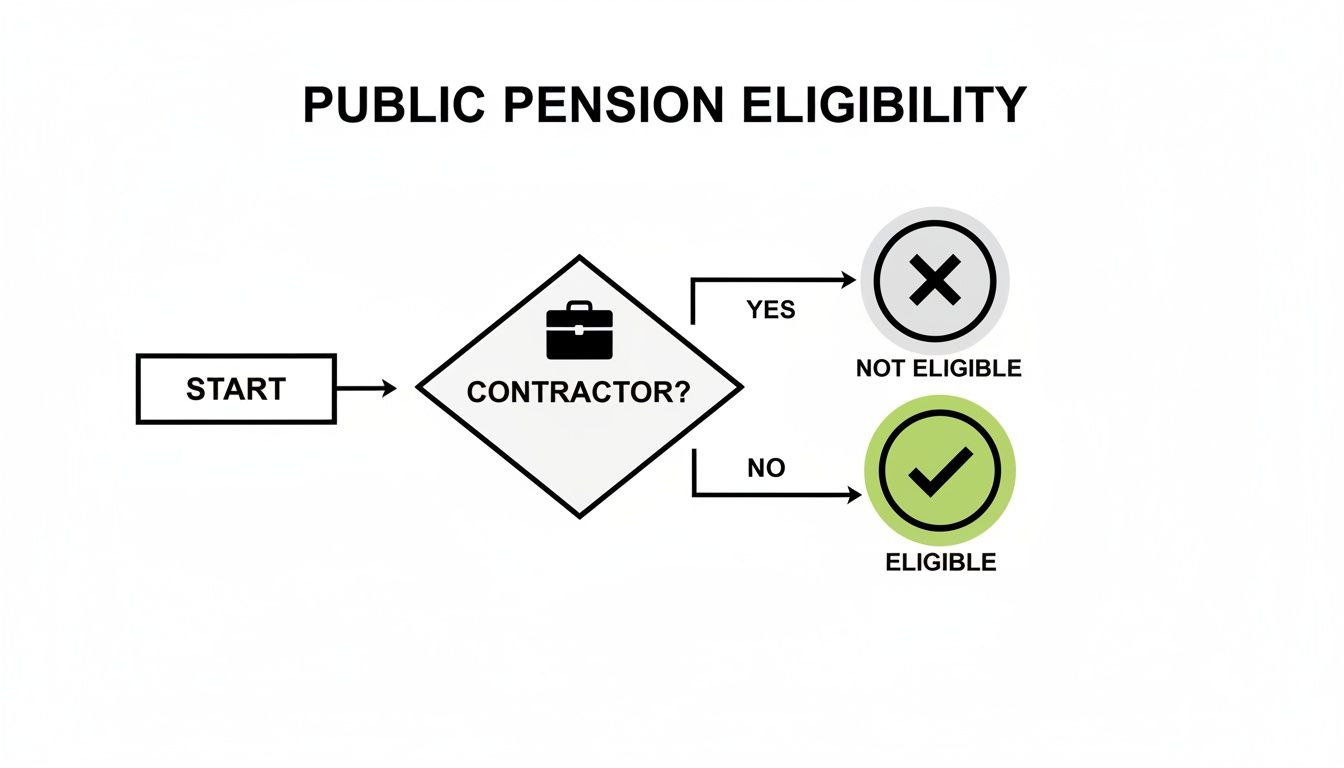
The visual says it all: if you're a contractor, you're on the outside looking in when it comes to the client's pension scheme. A direct employee, however, is eligible.
The Local Government Pension Scheme (LGPS)
The Local Government Pension Scheme (LGPS) is the odd one out, but only in its mechanics. Unlike the other schemes, which are largely paid for out of current taxation (unfunded), the LGPS is a funded scheme. This means employee and employer contributions are actively invested to grow the pot.
Despite this difference, the end result for a member is the same: a secure, CARE-based pension. It provides retirement income for people working in local councils and related bodies.
- Guaranteed Benefits: Members get a secure income for life, protected from inflation.
- Employer Contributions: Local authorities make very significant contributions on behalf of their staff.
- Flexibility: It offers some options for early or flexible retirement, although this can sometimes reduce the final pension amount.
For contractors, the lesson isn't about what you're missing out on. It's about knowing what you need to build for yourself. Recognising the huge value of these schemes should be a wake-up call to take your own pension planning seriously and build a fund that can support the retirement you want.
Why Contractors Cannot Join Public Sector Pensions
If you're working a long-term contract for a public body like the NHS or a local council, it’s natural to wonder: "Can I join their pension scheme?"
The short answer is almost always no. This is a fundamental part of contracting, and understanding why puts you in a much stronger position for planning your retirement.
The reason you’re not eligible for a public sector pension is simple: your legal employer isn't the public sector client. Whether you're working through your own limited company or an umbrella company like us, your contract of employment is with that intermediary, not the end client you do the work for.
Public sector pensions, like the NHS Pension Scheme or the Civil Service Pension, are statutory benefits. They are exclusively for the direct, permanent employees of those organisations. As a contractor, you are legally classified as a supplier of services, which is a completely different relationship.
Your Status as an Umbrella Company Employee
When you work through UmbrellaCompany.com, we become your employer of record. That means we handle all the statutory duties of an employer, including your payroll, tax deductions, and pension contributions.
We are legally required to enrol you into a workplace pension through a process called auto-enrolment.
The key point here is that you're enrolled into our workplace pension scheme, not the one offered by the public sector body where you're based. This is a crucial distinction. Our pension is a Defined Contribution (DC) scheme, where what you get out depends on what you put in and how the investments perform. It is not the inflation-linked Defined Benefit (DB) scheme your permanent colleagues might have.
The Impact of IR35 Deemed Employment
This is where things often get confusing, especially with the IR35 rules. If your contract is deemed 'inside IR35', HMRC treats you as a 'deemed employee' but for tax purposes only. This simply means you have to pay income tax and National Insurance just like a permanent employee would.
Being a 'deemed employee' does not give you the rights or benefits of a permanent member of staff.
Crucial Distinction: An 'inside IR35' determination is a tax status, not an employment status. It does not change the fact that your legal employer is your umbrella company. You do not gain access to the client’s sick pay, holiday pay, or, most importantly, their pension scheme.
Understanding this difference is vital. It explains why, even when you’re paying tax like an employee, you remain completely separate from the client's internal benefits. This knowledge highlights the need to take control of your own retirement savings. If you're new to this world, our guide on how to become a contractor offers more practical advice.
Proactive Pension Planning is Essential
Since you cannot get into these generous public sector pension schemes, the job of building a solid retirement fund rests entirely with you. While your umbrella company will set up your pension through auto-enrolment, it’s your responsibility to make sure the contributions are enough for the future you want.
Think of it this way:
- Auto-enrolment is your starting point, not the finish line. The minimum legal contribution levels are rarely enough for a comfortable retirement.
- You control your savings rate. Unlike a permanent employee whose pension contributions are fixed, you have the flexibility to contribute more, often through tax-efficient methods like salary sacrifice.
- You need a strategy. This means regularly checking your pension pot, thinking about additional personal pensions (like a SIPP), and making sure your savings plan matches your retirement goals.
Ultimately, being a contractor means you are the CEO of your own career and your financial future. Accepting that the door to a public sector pension is closed allows you to focus your energy where it truly matters: building your own secure, well-funded retirement pot.
How Your Pension Works with an Umbrella Company

When you take on a public sector contract, the pension side of things works very differently compared to your permanent colleagues. You cannot join their public sector pension scheme. Instead, your retirement savings are managed through your umbrella company.
Let's break down exactly how that works.
As a contractor with UmbrellaCompany.com, we are your legal employer. That means we handle all statutory duties, including your workplace pension under the government's auto-enrolment rules. We get you set up with a compliant pension scheme and make sure your contributions are processed correctly.
It’s a straightforward way to keep saving for retirement while you’re contracting, but it's vital you understand the mechanics, particularly where the money for contributions comes from.
Your Contributions and Employer Contributions
Under auto-enrolment, both you (the employee) and we (the employer) must contribute to your pension pot. These contributions are taken from your gross earnings before tax, which gives you valuable tax relief.
A common point of confusion for contractors is the "employer contribution." It is essential to realise that these contributions, along with all other employment costs like our margin and Employers' National Insurance, are funded from the single assignment rate agreed with your client or agency.
Think of the assignment rate as the total pot of money for your role. From this, all employment costs are paid first. What's left is your gross pay, and from that, your own employee pension contribution is deducted.
This is the standard, compliant model used across the industry. Understanding it is key to reading your payslip and managing your finances properly. For a deeper dive, take a look at our guide on how an umbrella company works.
The Power of Salary Sacrifice
Many compliant umbrellas, including us, offer a great way to boost your pension savings: salary sacrifice. This is simply an arrangement where you agree to give up a part of your salary, and in return, your employer pays a larger contribution directly into your pension.
The benefits are quite significant:
- More Tax-Efficient: The sacrificed portion of your salary is not subject to Income Tax or National Insurance. This means you save more on tax than you would with a standard employee contribution.
- Supercharge Your Savings: Thanks to the tax and NI savings, you can put a larger amount into your pension pot without a big hit to your take-home pay.
- Simple to Manage: The whole process is handled through your payslip, making it a hassle-free way to maximise your retirement fund.
This strategy is one of the most effective tools for contractors to build a substantial pension pot. It helps make up for not having access to a generous public sector pension.
It is also a crucial tool when you look at the bigger picture. While the UK State Pension provides a foundation, it may not be enough for a comfortable retirement on its own. The expected 4.7% rise from April 2026, thanks to the triple lock, brings the annual new State Pension to £12,534.60, just under the frozen personal tax allowance. As this analysis of the upcoming State Pension increase highlights, this reality underscores just how important it is for contractors to build their own private pensions.
Frequently Asked Questions for Contractors
Contractors working on public sector projects often have questions about pensions, especially when navigating the rules around IR35 and umbrella companies. Here are the answers to the most common queries.
Can I Join a Public Sector Pension if I Am Inside IR35?
The short answer is no. Your IR35 status is a tax classification only. It dictates that you must pay tax and National Insurance as if you were an employee, but it does not give you the employment rights or benefits of the end client.
Your legal employer is the umbrella company, not the government department you’re assigned to. This means you are only eligible for the workplace pension offered by your umbrella company, not the client's valuable public sector pension scheme.
Is My Umbrella Company Pension the Same as an NHS Pension?
No, they are entirely different types of schemes. An umbrella company pension is a Defined Contribution (DC) plan. Its final value is determined by the amount contributed and the performance of its investments, meaning you bear the investment risk.
The NHS Pension Scheme, by contrast, is a Defined Benefit (DB) scheme. It provides a guaranteed, inflation-adjusted income for life that is based on your career earnings. With a DB scheme, the employer (the NHS) takes on all the investment risk.
Understanding this difference is key. The NHS pension promises a predictable outcome, whereas a DC pension's value is uncertain. This is why proactive saving is so important for contractors.
What Is the Best Way to Save If I Cannot Join a Public Sector Pension?
Without access to a public sector pension, you need to take control of your own retirement planning. A proactive, multi-layered savings strategy is the most effective approach.
Consider taking the following steps:
- Maximise Your Workplace Pension: Start by contributing as much as you can afford to the workplace pension provided by your umbrella company.
- Use Salary Sacrifice: If your umbrella offers it, this is a very tax-efficient method for boosting your pension. You exchange a portion of your salary for an employer pension contribution, saving on both Income Tax and National Insurance.
- Open a Personal Pension: For more control and a wider choice of investments, a Self-Invested Personal Pension (SIPP) is a great option. It allows you to manage your own portfolio and consolidate pension pots from previous roles.
- Choose a Compliant Umbrella: Selecting an umbrella company with a competitive margin leaves more of your assignment rate as gross pay, which in turn means more money is available for your pension contributions.
Can I Transfer an Old Public Sector Pension into My Contractor Pension?
While technically possible in some circumstances, transferring out of a Defined Benefit scheme is heavily restricted and rarely a good idea. You would be giving up a guaranteed, inflation-linked lifetime income for a cash sum in a DC pot.
You are effectively trading a secure promise for market risk. The Financial Conduct Authority (FCA) has strict rules governing these transfers, and seeking independent financial advice is nearly always a legal requirement. Most financial experts agree it is far better to leave DB benefits preserved to provide a secure income foundation for your retirement.
What Happens to My Pension If I Switch Umbrella Companies?
Your pension pot from an old umbrella company does not disappear when you switch. You have a few options for managing it.
- Leave It Where It Is: You can leave the pension invested with the old provider. The main drawback is that you can end up with multiple small pension pots, which are difficult to track.
- Transfer It: A better approach is often to transfer the old pot into your new umbrella company’s pension scheme. This keeps all your active workplace savings in one place.
- Consolidate into a SIPP: Alternatively, you can move the funds into a personal pension like a SIPP. This creates a central pot that you control, no matter which umbrella you work with.
We recommend keeping your pension savings consolidated, as it makes managing your retirement fund much simpler in the long run.
At UmbrellaCompany.com, we specialise in helping contractors find the right compliant umbrella company for their needs. Our comparison tools and expert guides are designed to give you the clarity and confidence to manage your contracting career effectively. Compare trusted umbrella companies with us today!


