


You've unloaded your tools, checked the job address and arrived ready to work. Then the site manager asks for your public liability insurance certificate, spots that the limit doesn't match the contract, and stops you at the gate. For many UK subcontractors, that's where the difference between being legally able to trade and being contractually allowed to work becomes clear.
Public liability insurance for subcontractors isn't usually a universal legal requirement. In practice, however, main contractors, councils and commercial clients often make it a condition of onboarding, site access and payment. This guide explains what the cover does, how bona fide and labour-only arrangements differ, why policy limits need to align, and how to avoid paperwork and cash-flow problems before your next project begins.
Arriving on Site Without the Right Cover
At 7:30am, a sole-trader electrician arrives at a domestic refurbishment. The hi-vis is on, the tools are unloaded and the first job is ready to start. The site manager checks the induction documents, then pauses at the insurance certificate.
The certificate shows £1 million public liability cover, but the principal contractor's subcontract says every trade must carry £5 million. The electrician explains that the policy is active and that public liability isn't generally compulsory for most UK subcontractors. The manager understands the point, but still says the electrician can't enter the working area.
For the next twenty minutes, the van remains parked. No work begins, no payment is earned and the electrician is asked to contact the broker for corrected cover before returning. The problem isn't that the policy has expired. It's that the evidence doesn't satisfy the contract.
Practical rule: A valid policy can still be the wrong policy for a particular site.
This situation reflects the distinction highlighted in specialist guidance on contractors' insurance from RICS. A bona fide subcontractor normally arranges their own insurance, while a labour-only subcontractor may sit within the principal contractor's employers' liability arrangements.
The rest of this guide focuses on the decisions that prevent that gate-side conversation. You'll learn how public liability differs from other insurance, why contract wording matters more than assumptions, and how to check the limit, named parties and exclusions before accepting work.
What Public Liability Insurance Actually Covers
Public liability insurance responds to claims from third parties who suffer injury or property damage because of your work, where you're legally liable and the policy terms allow cover. A third party might be a client, visitor, member of the public, property owner or another contractor.
Think of a damaged property fence. If you reverse equipment into a client's wall or damage a building while carrying out an installation, public liability may help with covered compensation and legal defence costs. The trigger is usually an allegation that your negligent act, omission or work caused the injury or damage.
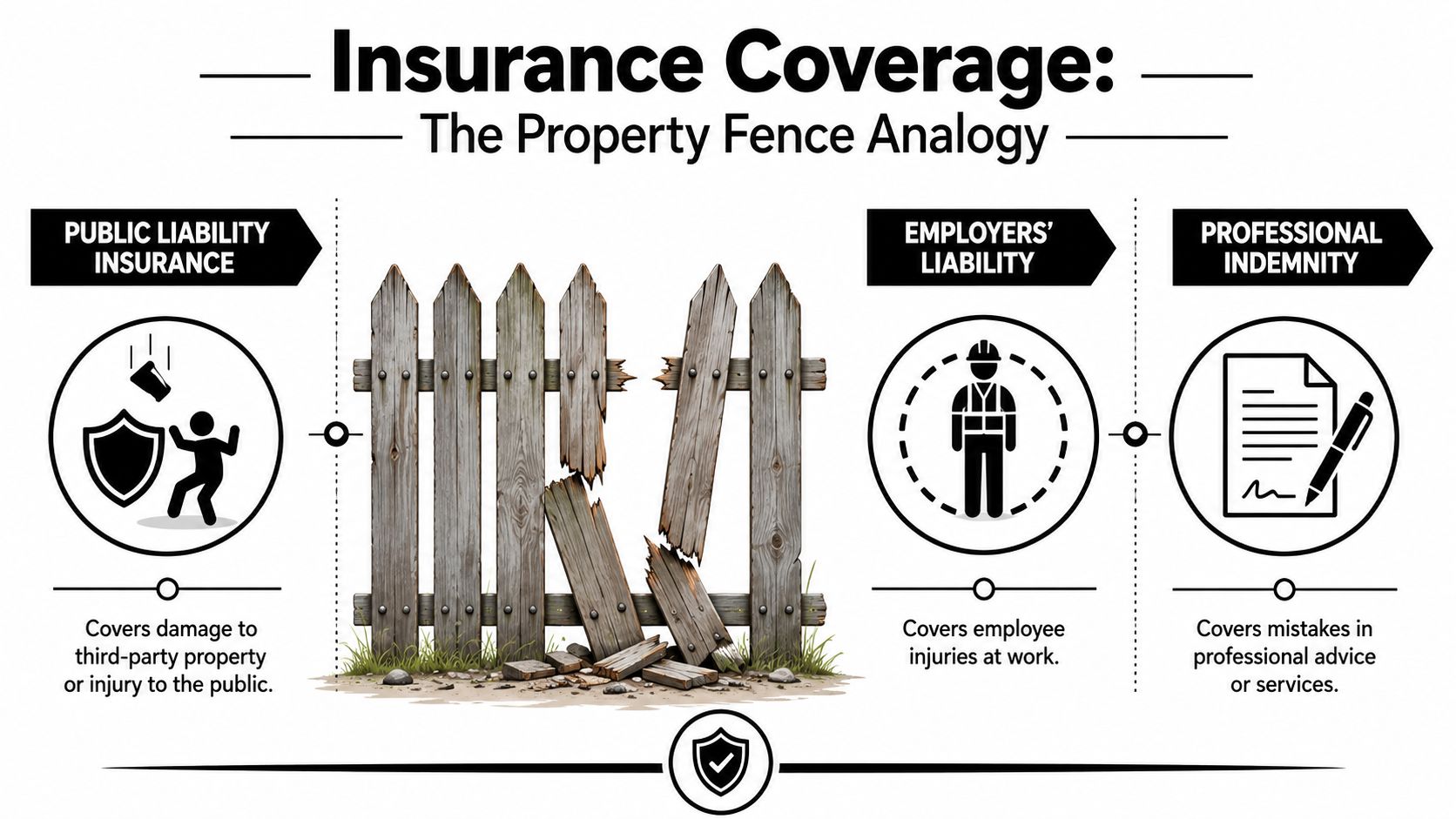
Three policies, three different risks
The fence analogy helps separate the main forms of cover:
- Public liability: Protects against covered injury to the public or damage to third-party property caused by your business activities.
- Employers' liability: Deals with workplace injury or illness involving people who work for your business. In the UK, employers' liability becomes legally required when a business has workers, with a minimum limit of £5 million, as explained in government procurement guidance from Clackmannanshire Council.
- Professional indemnity: Addresses financial loss connected with professional advice, design or specialist services. An error in electrical design that causes expensive rework may need professional indemnity rather than public liability.
Employment status affects how these risks are allocated. BoloSign's contractor compliance tips offer useful background on distinguishing independent contractors from employees, although your contract and working reality still need careful review.
Public liability generally doesn't insure your own tools, your own vehicle or deliberate damage. It also won't automatically cover every activity you undertake. Your trade description, policy extensions, conditions and exclusions all matter.
If you're arranging cover for contracting work, review the practical guidance on contractors' public liability insurance and check that the policy reflects the work you perform.
Legal Rules Versus Contract Rules for Subcontractors
The central point is simple: most UK subcontractors don't face a general statutory obligation to hold public liability insurance, but they may still be unable to work without it. A principal contractor can write insurance requirements into the subcontract, and a council or commercial client can require evidence before onboarding or site access.
That makes public liability a contractual gatekeeper. The contract can demand a specified indemnity limit, a current certificate, particular extensions or confirmation that the subcontractor's cover applies to the relevant project. If you don't meet those terms, the commercial consequences may include delayed mobilisation, withheld payment or removal from site.
Bona fide and labour-only arrangements
A bona fide subcontractor operates as an independent business. They may use their own tools, set their own price, organise their own work, complete their own risk assessments and accept responsibility for arranging suitable insurance.
A labour-only subcontractor usually works under the contractor's direction and control, often using the contractor's equipment and following their working arrangements. In insurance terms, that person may be treated more like an employee and typically falls within the main contractor's employers' liability policy, rather than relying on their own public liability policy. AXA's guidance on employers' liability and public liability sets out the practical indicators insurers may consider.
| Cover Type | Legal Requirement | Typical Contract Demand |
|---|---|---|
| Public liability | Generally not required by law for most subcontractors | Often required before work starts, with the limit set by the client or principal contractor |
| Employers' liability | Required when a business has workers, with a minimum limit of £5 million | Often evidenced through the main contractor or employing business |
| Professional indemnity | Depends on the work and contractual obligations | Common where the subcontractor provides design, advice or professional services |
Don't assume that calling yourself self-employed settles the question. The actual working arrangement matters, and a contract can still require independent cover even where the law doesn't impose it.
Typical Policy Limits and Costs in the UK
Arriving at a site with £1 million of cover can still leave you unable to start if the main contractor requires £5 million. Public liability insurance is generally optional in law for subcontractors, but the contract often sets the practical entry requirement. The right limit depends on the work, the site and the potential cost of a claim, not just your turnover.
A common UK range for subcontractor public liability is £1 million to £5 million per occurrence. Higher-risk construction and public-sector work may specify £10 million. Tradesman Saver's subcontractor guidance explains the difference between per-event and aggregate limits. A per-occurrence limit applies to one incident. An aggregate limit may cap the total paid during the policy period.
| Indemnity Limit | Typical Trades | Indicative Annual Premium |
|---|---|---|
| £1 million | Lower-risk work where the contract permits this level | Varies by trade, turnover, claims history and insurer |
| £2 million | Some lower-risk trades and interior fit-out contracts | Varies according to the declared activity and policy terms |
| £5 million | General construction and many commercial contracting arrangements | Varies with risk, excess and business profile |
| £10 million | Higher-risk construction, larger projects and some public-sector work | Usually priced according to the higher risk |
There is no dependable universal price for sole traders, small firms or limited companies. The insurer will assess your trade classification, annual turnover, claims history, use of subcontracted labour, chosen excess and the hazards involved. Roofing, demolition, hot works and work at height may produce a different quote from low-risk decorating or office-based consultancy.
Cash flow matters as well. If the contract requires £5 million, buying a cheaper £1 million policy can delay site access and leave you paying for a replacement policy before earning from the job. SubComply's guidance on verifying subcontractor insurance describes common contracting benchmarks, including £2 million for some lower-risk trades, £5 million for general construction and £10 million or more for higher-risk or larger projects.
Check whether the quote applies per occurrence or in the aggregate, and confirm the excess payable after a claim. A lower premium may carry a higher excess or narrower activity wording, so compare the protection as well as the price.
How to Get the Right Cover in Place
Start with the subcontract, not the quotation form. Identify the required indemnity limit, whether the client must be named or noted, the evidence deadline and any special conditions for hazardous activities.
You can approach a specialist trade insurer, use a broker panel or obtain a quotation directly online. A specialist may understand the exclusions attached to your trade. A broker can help compare policy wording where your work spans several activities. A direct provider may suit a straightforward sole-trader operation, provided you can describe the work accurately and interpret the schedule.
Prepare the information the insurer needs
Expect questions about:
- Your trade description: Explain the actual tasks, not a broad label that hides higher-risk work.
- Annual turnover: Give a realistic figure and update it if the business changes.
- Claims history: Disclose previous incidents and claims.
- Qualifications and memberships: Some activities may require evidence of competence.
- Subcontracted labour: Tell the insurer whether you engage other people and how they work.
- Work environment: Mention heights, hot works, groundworks, asbestos-related exposure or work on occupied premises where relevant.
A plumber comparing specialist options may also find this guide to liability insurance for plumbers useful for identifying questions specific to plumbing work.
Check the policy before paying
Ask whether the policy covers work carried out for the principal contractor, the project owner and any joint venture involved. Confirm whether the wording includes products you supply or install, temporary work and damage to existing property during alterations.
Read the certificate alongside the schedule. The certificate proves that cover exists, but the schedule and policy wording explain what the insurer agreed to cover. Before signing, confirm that the evidence meets every insurance clause in the subcontract.
For a wider view of insurance considerations affecting UK contractors, see insurance for contractors in the UK. Keep the certificate, schedule and broker contact details together so you can respond quickly to an onboarding request.
Sector Specific Considerations for Trades and Public Work
A decorator working inside a finished office may face different insurance requirements from a roofer, demolition contractor or heating engineer working near occupied premises. The contract limit usually reflects the work's risk, not just the size of the subcontractor's business.
Construction contracts commonly specify £5 million for general work, while larger or higher-risk projects can require £10 million. Public procurement documents may use different, risk-based thresholds, including £10 million for construction works and services and £1 million for supplies and services. These figures are not universal statutory minimums. They are contract standards linked to the perceived risk.
How expectations differ by trade
Electrical contractors may need evidence that their policy includes installation, testing, fault-finding and work in occupied buildings. Gas and heating contractors should describe their actual activities rather than relying on a broad plumbing classification.
Plumbing can cause water damage to existing property, particularly during alterations or emergency repairs. Check how the policy treats property being worked on. Cover may apply differently to the part you are actively repairing than to accidental damage elsewhere.
High-risk activities often receive closer attention:
- Roofing and work at height: Check height restrictions and required safety controls.
- Hot works: Confirm whether permits, fire watches or specific conditions apply.
- Demolition and groundworks: Ensure the declared trade includes excavation, structural work or relevant disturbance.
- Asbestos-related environments: Follow the client's training and control requirements. Do not assume the policy covers asbestos disturbance.
Councils, housing associations and NHS estates may request DBS checks, asbestos awareness training or proof of professional body membership. These requirements sit alongside insurance. Passing them does not replace the need for the policy limit stated in the contract.
A subcontractor can therefore arrive with valid public liability insurance and still be unable to start. If the limit is too low or the declared work is too narrow, arranging an amendment may delay the job and create a cash-flow problem through wasted travel, labour or equipment costs.
If you work through an umbrella company or payroll provider, establish who the named insured is and whether the arrangement covers your assignment. A payroll structure does not automatically transfer every business risk. Contractors in construction should also understand the Construction Industry Scheme and keep tax questions separate from insurance decisions.
Common Gaps Between Your Policy and the Main Contractor
Insurance problems often arise because three documents don't say the same thing: your policy schedule, your certificate and the subcontract. The certificate may show an active policy, but it won't remove an exclusion or increase a limit that the schedule doesn't provide.
A £1 million policy falls short when the contract requires £5 million or £10 million. The main contractor may refuse access, require you to arrange an upgrade or look to its own arrangements while disputing responsibility. That can leave you with an immediate cash-flow issue, particularly if you've already travelled, hired equipment or committed time to the project.
Read the wording, not just the certificate
Check whether the named insured matches the business signing the contract. A sole-trader policy may cover the sole trader's liability, but it doesn't automatically make the principal contractor an insured party or remove liability created by the subcontract wording.
Public liability is commonly written on an occurrence basis, so the policy in place when the incident happens may respond even if the claim arrives later. Professional indemnity usually works differently, with claims-made wording and possible reliance on a retroactive date or run-off arrangement. Don't treat the two structures as interchangeable.
Look closely at exclusions and conditions involving:
- Work at height: A policy may restrict work above a stated height.
- Hot works: The insurer may require permits or specific fire precautions.
- Asbestos: Disturbance or removal may be excluded unless expressly covered.
- Existing property: Alteration work can create restrictions for damage to the part being worked on.
- Contractual liability: The policy may not cover every liability you accept under a subcontract.
| Check Item | What to Confirm | Why It Matters |
|---|---|---|
| Limit match | The per-occurrence limit meets the subcontract | Prevents rejection at onboarding |
| Named-insured match | The legal business name is correct | Avoids uncertainty over who is insured |
| Retroactive date | Confirm it where claims-made cover applies | Protects continuity for earlier work |
| Exclusions schedule | Check height, hot works, asbestos and existing property | Reveals gaps hidden by a broad trade label |
| Certificate turnaround | Ask how quickly revised evidence can be issued | Reduces delays when a client changes its requirement |
Also review how liability is allocated between parties. Guidance on joint and several liability can help explain why more than one party may become involved in a claim, even where several businesses contributed to the work.
Wrapping Up and Your Next Steps
The electrician at the site gate didn't discover that insurance was always a legal requirement. They discovered that the contract had created a practical requirement, and that the certificate didn't meet it. That distinction is the reason public liability insurance for subcontractors deserves attention before the first morning on site.
Use this five-part check:
- Clarify your status: Establish whether you're a bona fide independent business or labour-only worker, based on the actual working arrangement.
- Match the contract: Choose the indemnity limit and extensions required by the principal contractor.
- Compare quotes: Obtain several suitable options and compare exclusions, excesses and wording, not just the headline premium.
- Prepare evidence: Keep your certificate and policy schedule ready for induction and onboarding.
- Review annually: Recheck the policy when your trade mix, turnover, project size or use of labour changes.
Insurance language can feel like administrative clutter when you're concentrating on tools, materials and deadlines. Once a suitable broker or specialist provider understands your work, checking certificates and limits becomes a routine part of running a compliant subcontracting business.
If you're also deciding whether an umbrella arrangement suits your next contract, compare providers carefully. Look at payroll handling, employment status, compliance support and whether any insurance included in the service covers your assignment and contracting structure.
Umbrella Company helps contractors and freelancers compare umbrella companies based on their role, pay rate and whether they need support inside IR35. Visit Umbrella Company to compare suitable options and take the next step towards a more organised contracting setup.


