


You're probably here because insurance feels muddier than it should.
You write code, deliver systems, fix infrastructure, or advise clients on technology. Then a contract lands in your inbox asking for public liability, professional indemnity, maybe cyber cover too. If you work remotely, you might be wondering whether public liability insurance is necessary, or whether it's just another box-ticking exercise.
Our view is simple. Most IT contractors misunderstand where public liability stops and where professional indemnity starts. That confusion leads people to buy the wrong cover, or to underinsure the risk that could hurt them. If you're weighing up public liability insurance for an IT contractor role, the right answer depends less on your job title and more on how you work, where you work, and what your contracts demand.
Your Essential Guide to Contractor Insurance
An IT contractor can trigger two very different kinds of problems.
One is physical. You visit a client office, knock over equipment, or someone trips over your bag or charging cable. The other is professional. You deliver advice, code, configuration, or a system change that causes a client financial loss. Those are not the same risk, and insurers don't treat them the same way.
That's where many contractors get caught out. They buy a policy because an agency asked for “liability cover”, but they never pin down what type of liability they need. That's a mistake.
Practical rule: If the problem is about injury or physical damage, think public liability. If it's about bad advice, faulty work, or financial loss, think professional indemnity.
For IT contractors, that distinction matters more than almost anything else in insurance.
A lot of generic contractor guides blur the line. They speak as if one policy handles everything. It doesn't. If you're on-site regularly, your exposure looks different from a developer who works from a home office and never touches client premises. If you're under an umbrella company, there's another layer again, because some cover may already sit inside the package, but that still needs checking.
If you want a broader overview of policy types and how they fit together in the UK market, our guide to contractor insurance in the UK is a useful starting point.
What Public Liability Insurance Actually Covers
Public liability insurance is physical-world cover. Think of it as insurance for accidental injury to other people, or accidental damage to their property, where your business is blamed.
For an IT contractor, that usually means something happens while you're on a client site, at a meeting, or working around other people and their equipment. It's not about poor coding, weak architecture, or a failed migration. It's about real-world accidents.
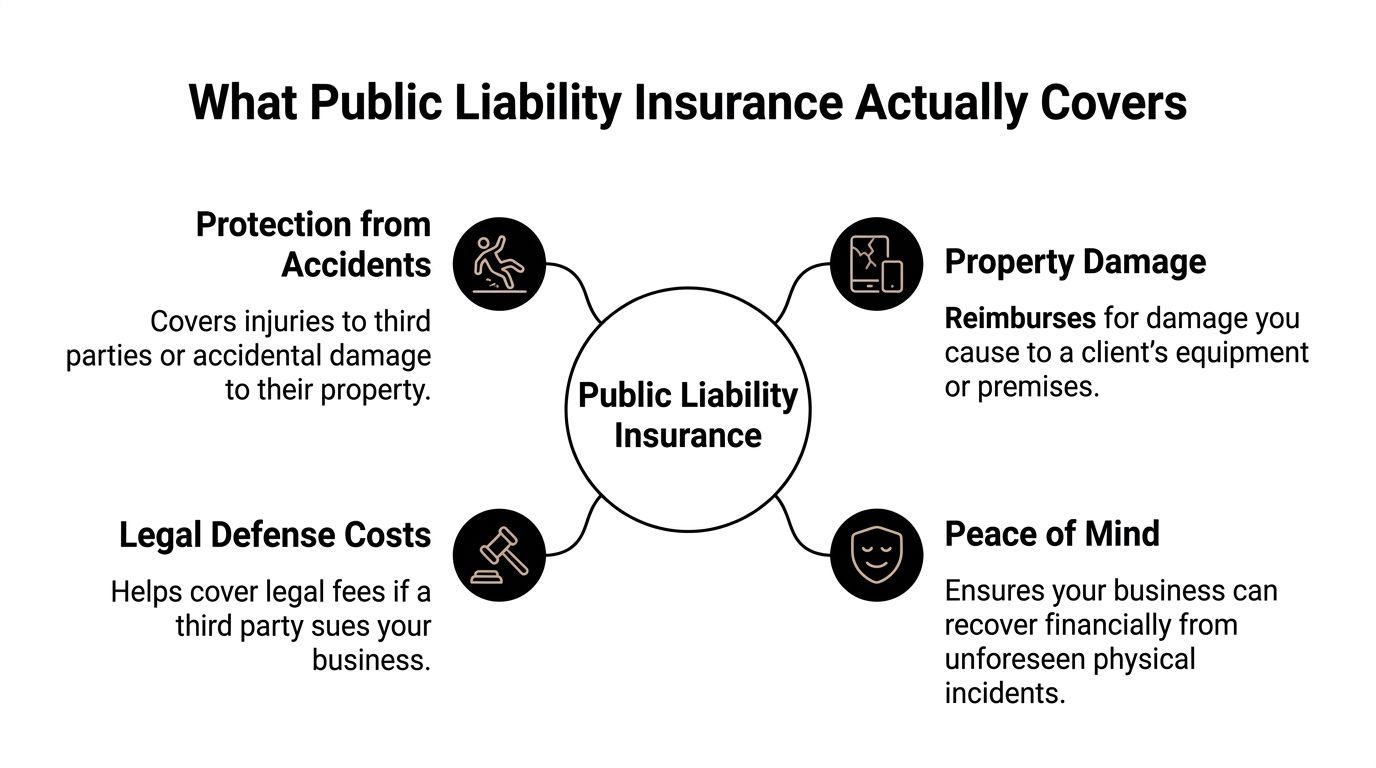
What counts as a public liability claim
A third party is usually anyone outside your own business. In practice, that could be:
- A client employee who trips over your laptop cable in a meeting room
- A site visitor injured because of equipment you left in a walkway
- A client business whose property you accidentally damage while working on-site
For IT work, common examples include:
- Damage to hardware: You spill a drink over a client laptop, monitor, or server-adjacent kit.
- Damage to premises: You break fittings, cabling, desks, or other property while setting up.
- Injury to someone else: A client or visitor falls over your gear and gets hurt.
- Legal defence costs: If a claim is made against you, the policy may also help with defending it, subject to the wording.
What it does not cover
Many contractors make a common mistake: public liability doesn't usually respond when your actual service causes the problem.
It is not there for:
- Faulty advice
- A software error
- A failed implementation
- A configuration mistake that causes financial loss
- A dispute about your professional judgement
A simple way to remember it is this:
| Scenario | Likely policy |
|---|---|
| You spill coffee on client equipment | Public liability |
| Your code breaks a client workflow and costs them money | Professional indemnity |
| A client trips over your equipment bag | Public liability |
| Your advice leads to an expensive project issue | Professional indemnity |
Public liability is about accidents in the physical world. It is not your catch-all safety net for IT delivery problems.
If you're comparing policy wording or want a plain-English reference point from a non-UK-specific market, you can secure business liability through TCDS and use that as a benchmark for the sort of physical-risk cover businesses often buy.
When an IT Contractor Genuinely Needs This Cover
Here's the blunt answer. Not every IT contractor needs public liability insurance as a top priority.
That upsets some brokers because “contractor insurance” is often sold as a bundle. But for many people in IT, the bigger risk isn't injuring someone or damaging property. It's getting blamed for a bad recommendation, a defective delivery, an IP issue, or a data handling dispute.

You probably need it if your work is hands-on or on-site
Public liability moves up the priority list when your working pattern creates a real physical exposure.
That includes contractors who:
- Work on client premises regularly
- Install or move hardware
- Attend data centres or comms rooms
- Carry tools, demo kit, or equipment into shared spaces
- Meet clients face to face in offices or hired venues
If you're a hardware engineer, network installer, field support contractor, or someone who regularly works around client equipment, skipping public liability is risky. The chance of a physical accident may still be low, but the exposure is obvious.
You may not need it first if you work fully remote
Contractor insurance guidance says public liability is not required for all contractors and is mainly relevant when your work could injure someone or damage property. For many IT contractors, the bigger exposure is IP or copyright issues, negligent advice, or data handling disputes, which sit under professional indemnity instead of public liability, especially for remote workers, as noted in this contractor insurance guidance.
That's the point many remote developers, analysts, consultants, DevOps engineers, and project specialists need to hear. If you never visit client sites, never host people at your premises, and your work is delivered digitally, public liability may be secondary.
If your risk lives mostly on a screen, your first insurance question shouldn't be “Do I need public liability?”. It should be “What happens if my work causes financial loss or a contractual dispute?”
Contracts can still force the issue
Even when the risk is low, clients and agencies sometimes require public liability as a contract condition. That doesn't mean it's your biggest risk. It just means procurement wants to see it.
That's common in larger organisations because standard supplier paperwork often isn't suitable for IT contractors. They ask for the same documents from software consultants that they'd ask from engineers, trainers, or facilities suppliers.
So your decision comes down to two tests:
Real exposure test
Do you physically interact with client people, property, or premises in a way that could cause accidental injury or damage?Contract test
Does the contract, agency, or umbrella arrangement require public liability before you can start?
If the answer to both is no, don't automatically put public liability at the top of your list. Focus first on the cover that matches your actual working model, especially if you're navigating IR35 as an IT contractor.
Public Liability vs Professional Indemnity and Other Policies
This is the part that needs to be crystal clear.
For an IT contractor, public liability and professional indemnity solve different problems. One deals with physical accidents. The other deals with claims that your expertise, service, or delivery caused loss.
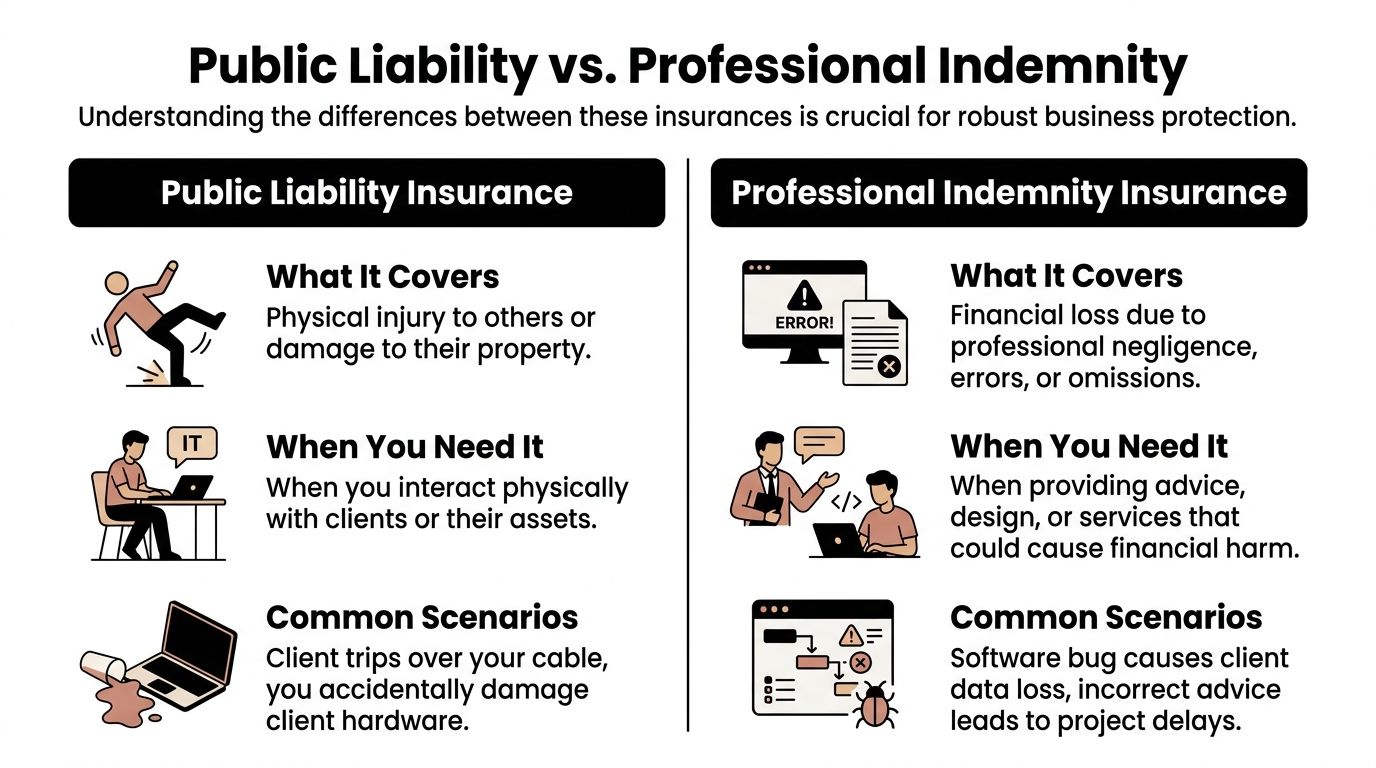
The key boundary for IT work
The boundary matters because IT contractors often work in both worlds. You might spend one day giving architecture advice, then another day visiting a client office to troubleshoot kit or present a rollout plan.
The distinction is well captured in contractor-focused guidance. A failed software implementation that causes financial loss sits under professional indemnity, which covers negligence in services and legal defence costs. A claim where you trip a client and they break their laptop sits under public liability, which covers accidental injury or property damage to third parties, according to this explanation of the public liability and professional indemnity boundary.
Side-by-side comparison
| Policy | What it's for | Typical IT example | Who should care most |
|---|---|---|---|
| Public liability | Injury to third parties or damage to their property | A client trips over your bag, or you damage office equipment on-site | On-site contractors, hardware installers, field engineers |
| Professional indemnity | Claims that your advice, service, code, or work caused financial loss | A software implementation fails and the client blames your work | Developers, consultants, architects, analysts, project specialists |
| Employers' liability | Liability linked to employees | Relevant if you employ staff | Contractors running a business with employees |
| Cyber cover | Risks linked to data, systems, and cyber incidents | A dispute linked to data handling or security exposure | Contractors handling sensitive systems or data-heavy work |
My recommendation for most IT contractors
If you only buy one policy, professional indemnity is often the stronger starting point for IT work. That's because most IT disputes aren't about someone slipping over your rucksack. They're about what you built, advised, configured, or failed to deliver.
That said, don't turn this into a false choice if your contract or working pattern points both ways. Plenty of IT contractors need both.
Use this quick decision guide:
Mostly remote software delivery
Professional indemnity first. Consider cyber cover next. Public liability may be optional unless your contract says otherwise.Hybrid role with office visits and workshops
Professional indemnity still matters, but public liability becomes sensible because you're physically present in client spaces.Hardware, networking, installations, or site support
Public liability is no longer optional in practical terms. You still may need professional indemnity if you also advise or design.
Advisor's view: Contractors often underthink professional indemnity because public liability sounds more familiar. For IT work, that's backwards.
Don't ignore employers' liability
A lot of solo contractors won't need to think hard about employers' liability unless they employ someone. But if you do have staff, even part-time, this moves from “nice to know” to “check your legal position immediately”.
If you want a deeper look at the policy that usually matters most for service-based disputes, read our guide to freelancer professional indemnity insurance.
Policy Limits and Typical Costs for IT Contractors
Most contractors ask two questions once they accept they need cover. How much do I need? And what's it likely to cost?
The honest answer on cost is that pricing varies by insurer, trade description, contract terms, and risk profile. Without a live quote, anyone giving you a neat figure is guessing. Don't buy based on guesswork.
Picking the right policy limit
For public liability insurance, the limit is the maximum amount the policy is set up to respond to, subject to wording and terms. In practice, contractors usually choose the limit that matches client requirements and realistic exposure.
A sensible approach is:
- Check your contract first: Some clients or agencies specify the minimum public liability limit they expect.
- Match the working environment: If you work around expensive hardware, busy offices, or public-facing spaces, a lower limit may not be enough.
- Avoid buying blind: Don't pick a limit just because it seems standard. Pick it because your contract and work pattern justify it.
What affects the premium
Insurers usually look at the details that change the chance or size of a claim.
Those often include:
The nature of your services
A remote software developer is usually a different risk from a contractor installing hardware on-site.Where you work
Home-based delivery tends to create less public liability exposure than regular client site attendance.Turnover and business activity
The bigger or broader the operation, the more closely insurers look at it.Claims history
If you've had previous claims or notifications, that can affect pricing and terms.Contract requirements
Some contracts push you towards higher limits or additional policy features.
What to do instead of chasing a cheap quote
Use a short checklist before you buy:
| Question | Why it matters |
|---|---|
| Does the policy match my actual work? | A vague trade description can create problems at claim time |
| Is the limit driven by contract or by guesswork? | You need a reason for the figure |
| Am I paying for cover I barely need? | Fully remote contractors often over-prioritise public liability |
| Have I checked exclusions carefully? | The cheapest policy can be the least useful one |
Cheap cover that doesn't fit your work is worse than no cover, because it gives you false confidence.
If you're comparing public liability insurance for an IT contractor setup, ask for quotes based on your real working model. Say whether you're remote, hybrid, or on-site. Say whether you install equipment. Say whether you advise on systems design. Those details matter.
Getting the Right Cover Through an Umbrella Company or Inside IR35
Insurance gets more confusing when you work through an umbrella company or take contracts inside IR35. Many contractors assume someone else has sorted it. That's exactly when mistakes happen.
Don't assume umbrella cover is enough
Some compliant umbrella companies include insurance within their service. That can be useful, but it does not remove your responsibility to check the detail.
You need to verify:
- What policies are included
- The level of cover provided
- Whether the wording fits your assignment
- Whether your client contract asks for something more specific
- Whether the cover applies to the work you personally perform
If you're comparing providers, Umbrella Company for freelancers can help you review options based on your setup and contract style.
Inside IR35 doesn't eliminate insurance questions
Some contractors think that being inside IR35 means insurance stops mattering because the umbrella, agency, or end client carries everything. That's too simplistic.
The practical question is who carries which risk under the actual arrangement. The end client may have its own cover. The umbrella may carry policies too. But your contract may still expect evidence of insurance, or your role may create exposures that need checking against policy wording.
The questions to ask before you start
Ask your umbrella company or agency for the documents, not just a verbal reassurance.
Request:
- The policy schedule
- The certificate of insurance
- Any relevant exclusions
- Confirmation that your assignment type is covered
- Confirmation that the limit satisfies client requirements
One factual option in this area is that Umbrella Company helps contractors compare umbrella providers based on their needs, including inside IR35 working arrangements. That's useful if you're trying to balance payroll support with practical compliance checks rather than treating insurance as an afterthought.
Never rely on “you should be covered”. Read the policy evidence and match it to the contract in front of you.
Key Questions to Ask Your Insurer
A good insurance conversation should feel specific to your work, not like a call-centre script.
If the insurer or broker can't explain where public liability ends and professional indemnity begins for your role, keep looking.
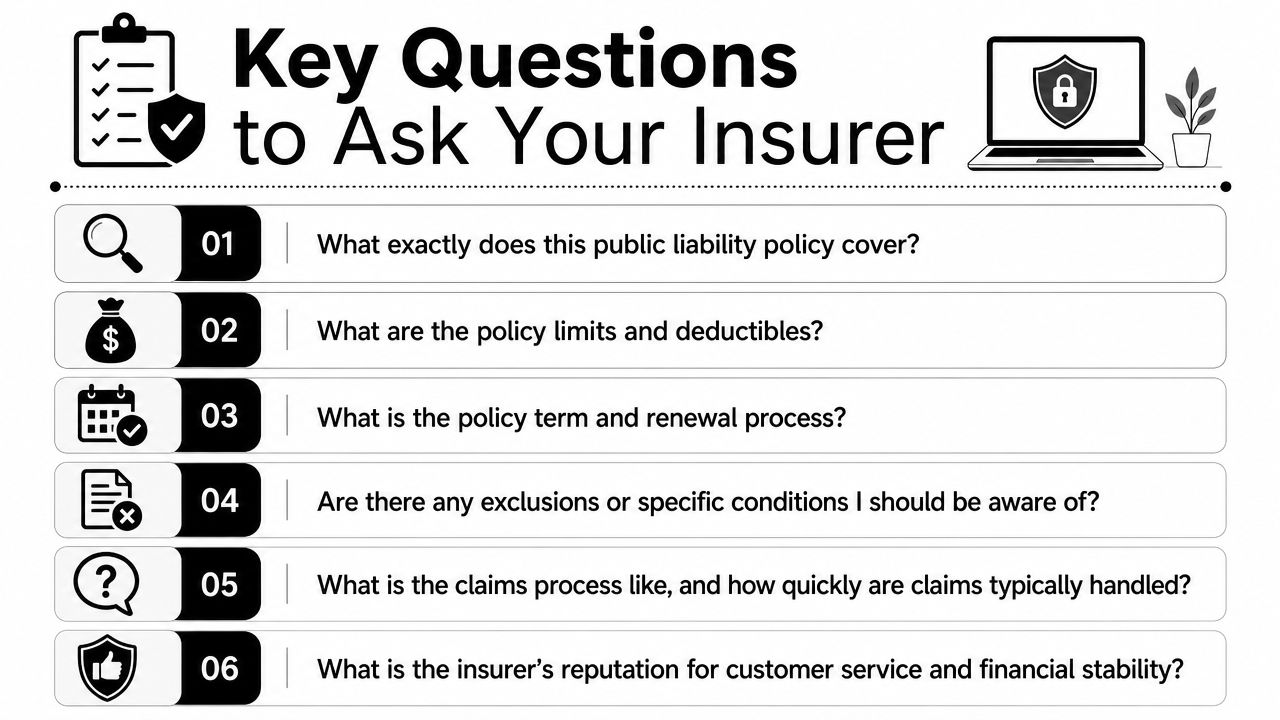
Use this checklist before you buy
What exactly does this policy cover for my type of IT work?
Don't accept a generic answer. Ask whether your work is classed as software development, consultancy, installation, support, or a mix.What isn't covered?
Exclusions matter as much as inclusions, especially around advice, data issues, overseas work, and subcontracting.Would this policy respond if I'm fully remote?
That helps you test whether public liability is necessary for your setup.Would this policy respond if I'm on a client site and damage their equipment?
That confirms the physical-risk side clearly.What policy limit am I buying, and why would I need that level?
If the broker can't justify the limit, they're probably just selling a standard package.How does the claims process work?
Ask what happens if you receive a complaint, letter of demand, or notification of a possible claim.
A final rule worth remembering
| If the issue is… | Ask about… |
|---|---|
| Physical injury or property damage | Public liability |
| Advice, code, service failure, or financial loss | Professional indemnity |
| Employment-related exposure | Employers' liability |
| Data and system-related incident risk | Cyber cover |
The point isn't to buy every policy available. It's to buy the right policy for the way you work.
If you're weighing up umbrella options and want to check how insurance, IR35 support, and contractor setup fit together, Umbrella Company can help you compare providers and make a more informed choice.


