


You've landed a promising IT contract. The rate looks right, the project sounds interesting, and then the paperwork throws in a line that stops you short: public liability insurance required before start date.
That catches a lot of contractors out. If you write code from home, manage cloud environments, or deliver architecture advice over Teams, it's easy to assume this kind of insurance is mainly for trades working on physical sites. In practice, clients often see it differently. They use insurance requirements as part of their onboarding and supplier risk checks, and that includes IT contractors.
The confusion usually starts here. You're trying to work out whether this is a legal requirement, a client preference, something your umbrella already covers, or another policy you now need to buy because of IR35. If you're still deciding whether to trade through your own company, it also sits alongside bigger setup questions such as banking, payroll, and how to incorporate a UK limited company.
We see this question come up regularly because insurance sits right at the point where contract compliance meets day-to-day business reality. It isn't just about worst-case claims. It can be the thing that decides whether you can accept an assignment at all. If you want a broader overview of cover options, Umbrella Company also has a useful guide to insurance for contractors in the UK.
Your Essential Guide to Contractor Insurance
Public liability insurance for an IT contractor is easiest to understand when you treat it as a business access requirement as much as a protection policy.
A typical example looks like this. You're due on site next Monday to help with a migration, your agency sends over the contract pack, and one schedule asks for evidence of public liability insurance. You weren't expecting it because the role is mostly remote. The client still wants proof before they issue a pass, confirm onboarding, or let procurement sign things off.
That isn't unusual. In the UK, public liability insurance is often requested in contractor agreements because it protects against third-party injury and property-damage claims arising from work activities, including on-site visits and remote work. For IT contractors, that matters even when physical contact is limited because a client can still require it as a contractual condition. It's also commonly treated as a baseline business-protection policy rather than an optional extra, especially for enterprise clients or work on client premises, as outlined in this explanation of public liability insurance for IT contractors.
Why this matters in real life
If a client asks for cover and you don't have it, the issue isn't theoretical. You may face:
- Delayed starts, because procurement won't complete supplier checks
- Contract friction, where you have to renegotiate wording at the last minute
- Missed opportunities, because another contractor can satisfy the requirement faster
Practical rule: If a contract mentions insurance, treat it as part of your go-live checklist, not a note to revisit later.
Where contractors get tripped up
Most confusion comes from mixing up three separate questions:
- What the policy covers
- Whether your working setup already includes it
- Whether the client is asking for a specific limit
Those points need separate answers. If you bundle them together, it's easy to overbuy, underbuy, or assume you're covered when you're not.
What Public Liability Insurance Covers for IT Contractors
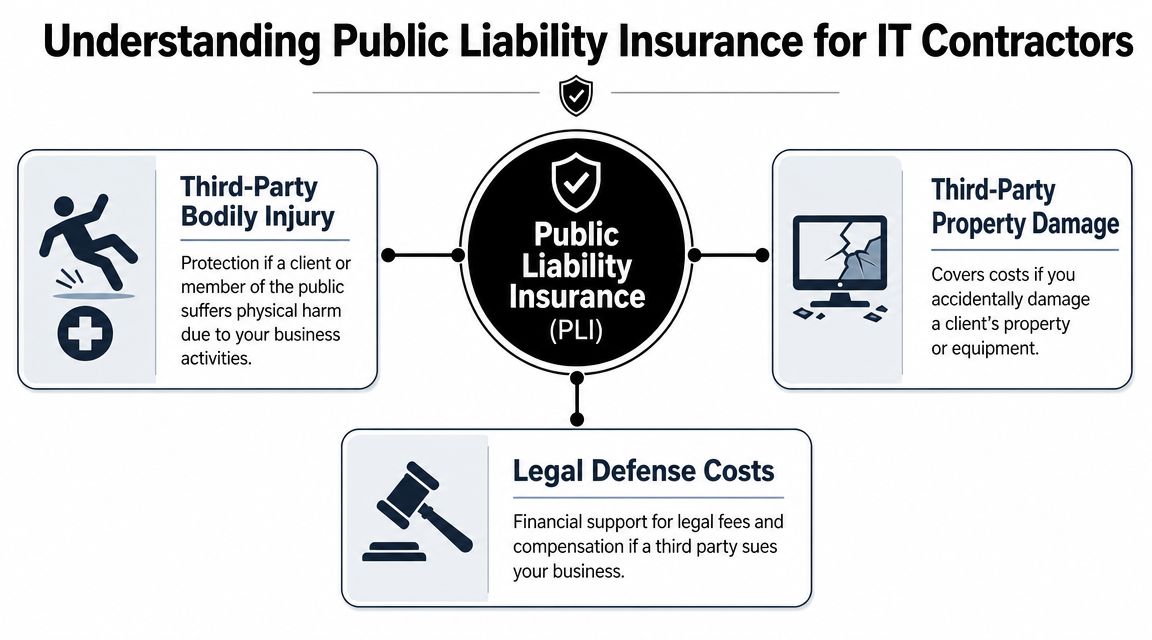
Think of public liability insurance as the business equivalent of the third-party side of car insurance. It's there for situations where someone else says your work activity caused them physical injury or damaged their property.
For an IT contractor, that usually means accidents linked to how you carry out the assignment, not mistakes in your technical advice. If you're visiting a client office, handling kit, moving around desks, setting up test devices, or working near expensive equipment, there's a physical risk even if your core service is digital.
What it does cover
A public liability policy is generally designed to deal with claims involving third-party injury or third-party property damage caused by your business activities.
For an IT contractor, common examples include:
- A trip hazard at a client site, such as a laptop lead or test cable causing someone to fall
- Accidental damage to client property, for example knocking over equipment while setting up
- Damage to premises, such as harming office fixtures during an installation or move
- Legal defence costs, if a claim is made against you and you need to respond formally
The key point is that this policy deals with the financial consequences of a claim from someone outside your business. That can include legal costs, settlements, and damage awards where the policy applies.
What it does not cover
Many contractors often misread the term “liability”.
Public liability insurance does not usually cover:
- Your own tools, laptop, or office equipment
- Poor technical advice or service errors
- Project losses caused by design, coding, or consultancy mistakes
- Tax issues, IR35 disputes, or contract payment problems
If your code deployment breaks a client system and they say your work caused financial loss, that points to a different type of cover. If you spill coffee over a client-owned device during a site visit, that's much closer to public liability territory.
Public liability is about physical injury and physical damage. It isn't the policy for technical negligence.
Why it still matters for remote contractors
It's tempting to dismiss this if you work mostly from home. But remote doesn't always mean risk-free. You may still attend kickoff meetings, occasional workshops, audits, hardware swaps, or handover sessions. Some clients also ask for the cover because their supplier onboarding rules require it across the board.
That's why public liability insurance for an IT contractor often functions as both a safeguard and a passport. It protects against real-world accidents, and it helps satisfy client risk-management checks before the work starts.
PLI vs Professional Indemnity and Employers' Liability
A client asks for your insurance schedule before they will issue the purchase order. You have public liability, but the contract also mentions professional indemnity and, in some cases, employers' liability. This is the point where many IT contractors realise the three policies sound similar but solve different problems.
The simplest way to sort them is to focus on the type of claim.
| Insurance Type | What It Covers | Example Scenario for an IT Contractor |
|---|---|---|
| Public Liability | Injury to another person, or damage to someone else's property caused by your business activities | You are on site, move equipment, and damage a client monitor |
| Professional Indemnity | Claims that your advice, design, configuration, or delivery caused a client financial loss | You recommend or implement a setup that fails, and the client says your work caused disruption or extra cost |
| Employers' Liability | Claims from employees who say they were injured or became ill because of their work for your business | A staff member or worker helping on a project says they were harmed while working for the company |
A practical test helps. Ask, "What went wrong, and who is claiming?"
If the issue is physical injury or physical damage to third-party property, that usually points to public liability. If the issue is bad advice, a technical mistake, or a service failure that led to loss, that usually points to professional indemnity. If the claim comes from someone working for your business, employers' liability is the policy to check.
Public liability and professional indemnity solve different client concerns
For IT contractors, these two covers often sit side by side rather than replacing each other. Public liability deals with physical accidents around the work. Professional indemnity deals with the work itself.
That distinction matters during supplier onboarding. A procurement team may ask for public liability because you will visit site, attend workshops, or work around client equipment. The hiring manager or legal team may also ask for professional indemnity because your advice, code, architecture, or configuration could trigger a separate kind of loss.
A useful comparison is this. Public liability covers what happens around your service. Professional indemnity covers what happens because of your service.
If you want a more detailed breakdown of service-related claims, our guide to contractor indemnity insurance explains where professional indemnity usually fits.
Where employers' liability catches contractors out
Employers' liability creates the most confusion because contractors often think, "I work alone, so this cannot apply to me." Sometimes that is true. Sometimes it is not.
The answer depends on how you trade and who is doing the work. If you run a limited company and employ staff, employers' liability may be relevant. The same question can arise if your company has workers involved in delivery. This is one reason tax structure and operating model matter in practice, not just on paper.
IR35 can add to the confusion. Inside IR35 contractors working through an umbrella company often find the umbrella handles employment-related insurance as part of the arrangement, which can simplify things. Outside IR35 contractors using their own limited company usually need to check each policy requirement themselves against their company structure and the contract terms.
That is the business point. Getting the insurance mix wrong does not just leave a gap in cover. It can slow contract approval, trigger client questions, or force a last-minute policy purchase before work starts.
Typical Cover Levels and Annual Costs for 2026
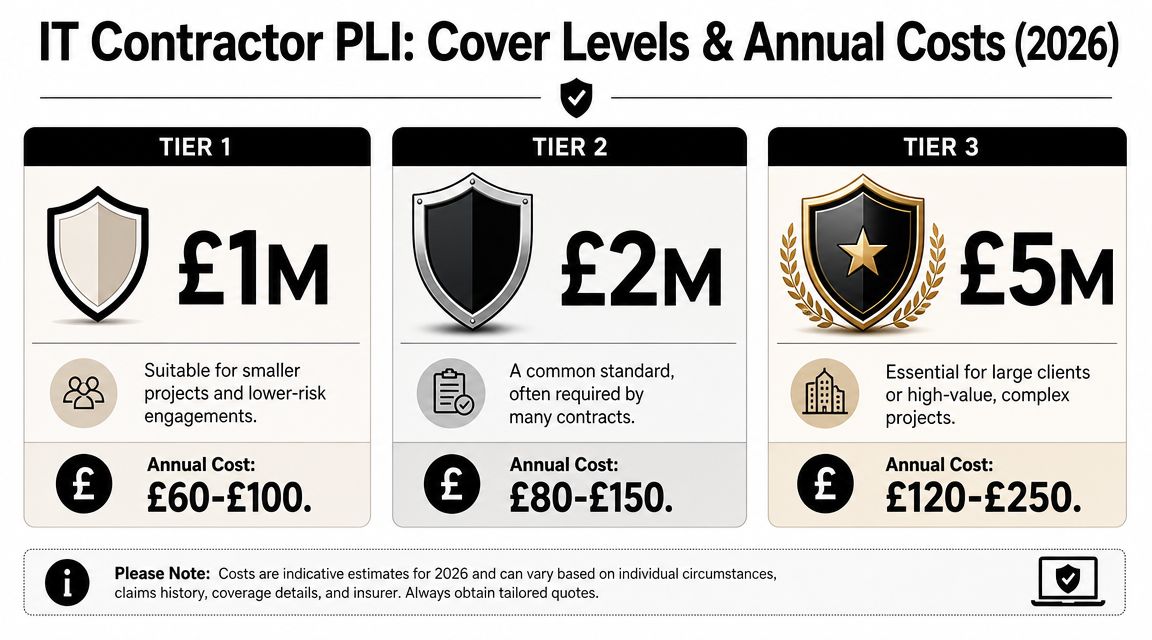
Clients rarely ask for “some insurance”. They usually ask for a specific minimum level of cover.
For public liability insurance for an IT contractor, the practical question is often whether your policy limit matches the contract wording. The benchmark many contractors see is £1 million, because many contracting agreements require at least that level of public or general liability cover, as noted in the earlier benchmark from Tufts' contractor insurance requirements. Beyond that, some clients ask for more depending on their procurement rules, premises, or internal risk standards.
Here's a visual summary of common tiers often discussed in the market.
What cover level should you choose
In practice, the right answer starts with your contract, not your preference.
A sensible order is:
- Check the client schedule. Look for the required minimum limit and any wording about maintaining cover throughout the assignment.
- Match your highest-demand client. If one client requires more than the others, contractors often align cover to that stricter standard.
- Think about access conditions. On-site work, enterprise environments, and shared premises tend to make insurance scrutiny more thorough.
About the 2026 cost question
You'll often see websites quote annual premiums for IT contractor public liability cover. We're not going to invent numbers here.
Actual cost depends on things such as:
- Your work profile, including whether you ever attend client premises
- The cover limit required, because higher limits usually change pricing
- Whether you bundle policies, such as public liability and professional indemnity
- Your insurer's view of risk, including the contract types you take on
So if you're budgeting for 2026, treat any quote as specific to your circumstances rather than a universal market rate.
This video gives a useful general introduction to thinking about contractor cover levels and business protection:
Why umbrella users should still pay attention
Even if you expect an umbrella company to deal with insurance, it still helps to understand the client requirement yourself. Some contractors only realise there's an issue when onboarding starts and the agency asks for policy confirmation.
If you're reviewing working options for inside IR35 roles, our guide to finding the best umbrella company in the UK can help you compare how providers handle practical matters like compliance and included protections.
The Role of Umbrella Companies and IR35
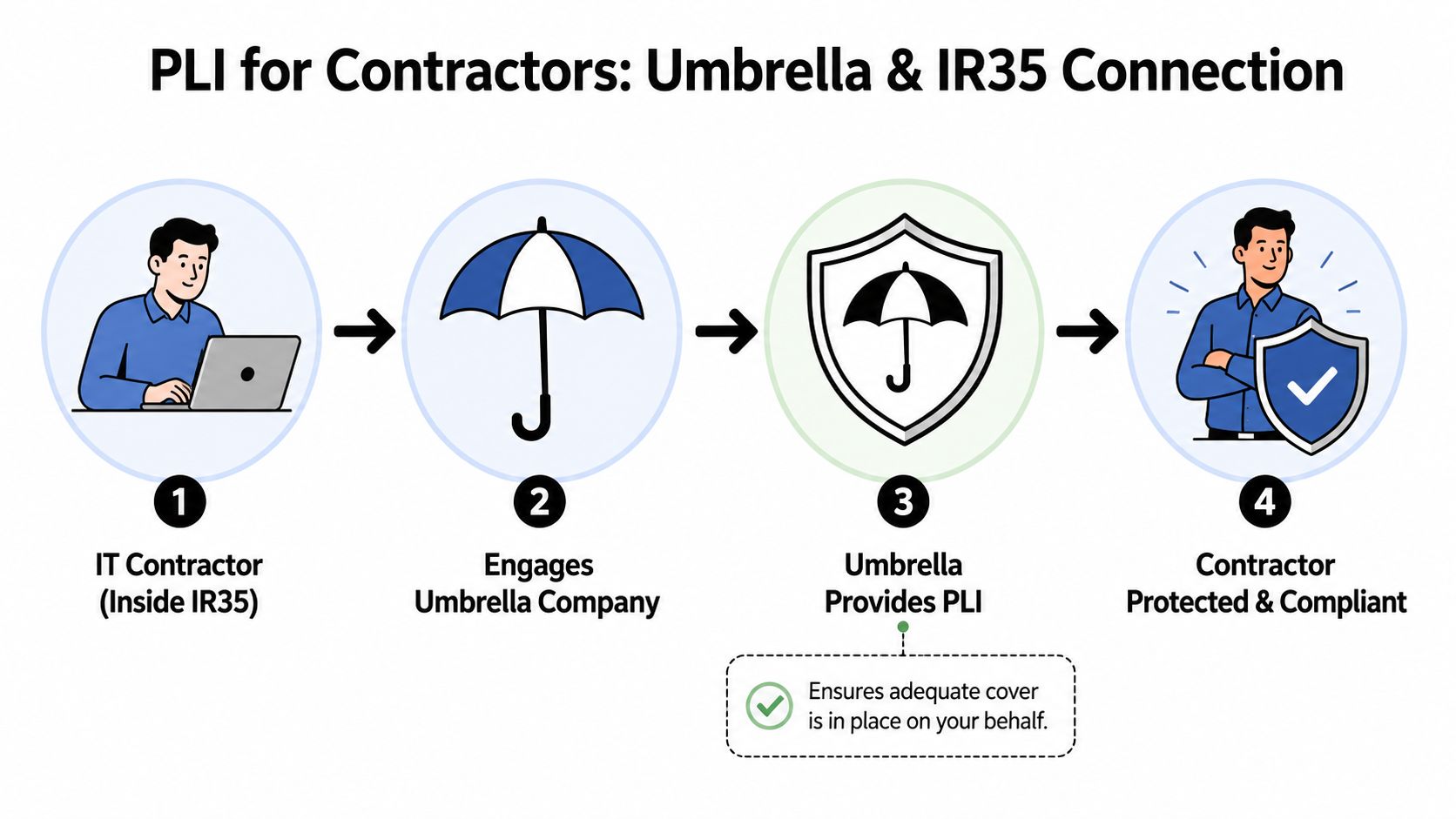
For contractors working inside IR35, insurance often becomes much simpler than people expect.
That's because an inside IR35 role commonly runs through an umbrella company. In that arrangement, the umbrella employs you, processes pay through PAYE, and contracts into the supply chain. From an insurance point of view, that changes the question from “What policy do I buy for my company?” to “What cover does the umbrella provide for the work I do through them?”
Why this matters under IR35
Inside IR35 engagements are about employment-style tax treatment. You're paid as a worker under PAYE rather than invoicing in the way an outside IR35 limited company contractor typically would.
That has a practical knock-on effect. If you're using a compliant umbrella, the umbrella usually handles core employment administration and often arranges the relevant business insurances attached to the assignments carried out under its model. That can remove a lot of friction from client onboarding.
The relief for contractors is mostly administrative:
- You don't need to source every policy personally for each inside IR35 contract
- The supply chain can confirm cover more easily when the umbrella already has established documentation
- You avoid duplicating admin while focusing on the assignment itself
What to check before you rely on umbrella cover
This is the important caveat. Don't assume all umbrellas operate the same way.
Ask for clarity on:
- Which policies are included, such as public liability, professional indemnity, and employers' liability
- Who is covered, meaning whether the policy applies to the work you'll personally perform
- Whether there are any role exclusions, especially if your assignment includes unusual activities or travel
- How evidence is provided, because agencies and clients often want a certificate or summary of cover
If you're inside IR35, the easiest insurance solution is often built into the umbrella arrangement. The key is confirming the scope before you start.
Where accredited umbrellas fit
Many contractors look for umbrellas with recognised compliance standards because they want confidence around payroll, employment rights, and insurance administration. Accreditation checks don't replace your own due diligence, but they can help narrow the field when you're comparing providers.
If you're freelancing or moving into an inside IR35 role, umbrella company options for freelancers are worth reviewing so you can compare how different providers support contractor setups. One option in that process is Umbrella Company, which lets users compare umbrella companies based on their role and circumstances.
Finding and Choosing Your IT Contractor Insurance
If you're outside IR35 or trading through your own limited company, you'll usually need to arrange your own insurance rather than rely on an umbrella's policy.
That doesn't mean the process has to be complicated. The most reliable approach is to start with your contract terms, then work outward to the policy details. Contractors often do it the other way round, buy a convenient package first, and only later notice the client required different wording or a higher limit.
Direct insurer or specialist broker
You'll usually have two routes.
Buying direct from an insurer can be straightforward if your work is standard and you already know exactly what cover you need. It can suit experienced contractors who are comfortable comparing policy wording.
Using a specialist broker can help when the contract wording is more technical or your setup is less typical. A broker can often explain the difference between policies, flag mismatches, and help you avoid buying cover that looks right on the headline but falls short in practice.
A practical buying checklist
Before you buy, verify these points carefully:
- Required cover level. Match the minimum in your client contract, not just what seems reasonable.
- Business description. Make sure the policy description reflects what you do, such as software development, cyber security consulting, project delivery, or infrastructure support.
- Excess amount. Check what you'd have to contribute if a claim is made.
- Key exclusions. Read the parts that carve out activities, locations, or circumstances.
- Proof of cover. Confirm how quickly you can get documentation for the agency or client.
- Contract alignment. Check whether your client asks for specific wording, named parties, or evidence before start date.
Questions worth asking the provider
Some questions save a lot of pain later:
- Does this policy fit IT contracting work carried out at client premises and remotely?
- Will it satisfy a client asking for public liability as a contractual condition?
- If I also need professional indemnity, should these be arranged together?
- What happens if my contract changes halfway through the year?
Buying tip: The cheapest policy is only useful if it actually matches the contract and your working model.
A good insurance decision is usually a boring one. The wording is clear, the limit matches the contract, the certificate arrives quickly, and no one has to scramble the day before you start.
Common Questions About Public Liability Insurance
A common contractor scenario goes like this. You have a contract ready to sign, the start date is close, and procurement asks for proof of public liability insurance. Suddenly, what looked like a minor admin item becomes the thing that can hold up the whole engagement.
That is why these questions come up so often. For IT contractors, public liability insurance is rarely about theory. It is about whether you can start on time, meet the client's supplier checks, and set up your contract correctly under your own company or an umbrella.
Do I need public liability insurance if I work fully remotely
In many cases, yes.
Remote work lowers some risks, but it does not remove the insurance requirement from the contract. Clients often apply one onboarding standard across all contractors, whether you are on site every day or logging in from a home office. You might also attend a kickoff meeting, collect equipment, visit a site, or join a workshop later in the project.
A simple way to look at it is this. The client is not only insuring against what you do at your desk. They are checking whether your business meets their supplier rules.
If the contract says you must hold public liability cover, the practical question is not whether the risk feels low. The practical question is whether you can satisfy that term before work starts.
My client has its own insurance, so doesn't that cover me
Usually, no.
Your client's insurance is built to protect the client's business. Your policy is there to protect your business if your actions lead to injury or property damage involving a third party. Those are two separate layers of cover, much like a building's insurance and a tenant's contents insurance. They relate to the same place, but they protect different interests.
This is an important distinction because some contractors assume the client's large corporate insurance programme makes the requirement unnecessary. In practice, a client's internal risk process often explains why they insist on seeing your own certificate.
Can I claim the cost as a business expense
Often, yes, if the cost is incurred wholly and exclusively for the business.
The tax treatment depends on your setup. If you contract through a limited company, the company usually pays and records the cost. If you work through an umbrella, insurance may be included within the umbrella arrangement instead of being a separate expense you handle yourself.
That difference matters under IR35. The right answer is tied to the structure you are using for that contract, not just the type of insurance.
If you are unsure, check with your accountant or tax adviser before you file anything.
What if I'm inside IR35
Inside IR35 changes who is responsible for the contract chain, payroll, and often the insurance administration as well.
If you are working through an umbrella, public liability cover may already be in place under the umbrella's policy. That can remove a lot of friction. Instead of buying a separate policy for one assignment, you may be able to rely on cover already arranged for workers under that umbrella model. Still, you need to confirm the detail, not assume it.
Check three things:
- Whether public liability is included
- Whether your assignment fits the policy scope
- How proof of cover is provided to the agency or client
If the role is inside IR35 but you are not using an umbrella, ask the agency or client who is expected to hold the insurance. That question is easier to resolve before signing than after onboarding stalls.
Is public liability enough on its own
Sometimes, but many IT contractors need more than one policy.
Public liability deals with third-party injury or property damage. It does not usually cover a claim that your advice, code, configuration, or project work caused the client a financial loss. That is where professional indemnity often enters the picture.
A useful rule of thumb is this. If the concern is someone gets hurt or something gets damaged, think public liability. If the concern is your work causes the client to lose money, think professional indemnity.
The contract should tell you a lot here. Some clients ask for both because they are guarding against two different types of risk.
What should I do before accepting a contract
Start with the insurance clause, not the premium.
Read the wording carefully and check who must hold the policy, what minimum limit is required, and when proof has to be provided. Then match that against your trading setup. A limited company contractor, a sole trader, and a contractor working through an umbrella can face the same client requirement but satisfy it in different ways.
Use this quick pre-start check:
- Read the insurance clause carefully
- Confirm whether the client specifies a minimum cover limit
- Check whether you're responsible personally, through your company, or through an umbrella
- Get proof of cover lined up before onboarding starts
A few minutes spent here can save a lost start date, last-minute paperwork, or a policy that does not fit the contract.
Public liability insurance can sound like a standard box-ticking exercise until a client asks for evidence and will not release the purchase order without it. At that point, it becomes part of winning and starting the contract. If you understand how it fits with client requirements, your business structure, and IR35, you can deal with it early and keep the contract moving.
If you're weighing up an inside IR35 role or want a simpler way to compare providers, Umbrella Company can help you review umbrella company options based on your contract and working arrangement.


