


Thinking about making the leap into project manager contracting? It’s a move that promises fantastic flexibility and earning potential, but it can feel like you are trying to assemble a puzzle without the box lid.
This guide is that box lid. It is your complete roadmap, designed to help you not just survive, but thrive in this fast-paced world.
Launching Your Project Manager Contracting Career
We will break down exactly what it takes to succeed, from landing those high-value contracts to understanding critical UK rules like IR35. Think of this as your practical playbook for turning your hard-earned project management skills into a proper contracting business.
We will cover the nuts and bolts of setting a competitive day rate that truly reflects your skills. We will also show you how to find the roles that match your career goals, and explain the simplest, most compliant way to get paid: using an umbrella company.
What You Will Learn
Throughout this guide, we will give you the essential, real-world knowledge you need to make the switch to contracting a success. Our goal is simple: to provide clear, actionable advice that cuts through the jargon and helps you build a career that lasts.
Here are the key areas we will be exploring:
- Understanding the Market: We will pinpoint which sectors are crying out for contract project managers and show you how to position yourself to get noticed.
- Setting Your Rate: We offer a no-nonsense framework for calculating a day rate that genuinely reflects your experience and qualifications, removing the guesswork.
- Navigating IR35: We will demystify the off-payroll working rules so you can stay fully compliant and steer clear of any nasty tax surprises.
- Winning Contracts: We provide proven tactics for getting your CV to the top of the pile, finding the best opportunities, and acing the interview.
- Getting Paid Simply: We explain in straightforward terms how an umbrella company works and why it is the go-to choice for so many contractors.
Becoming a contractor means shifting your mindset from employee to business owner. You are no longer just managing projects; you are managing your own professional services organisation, and you are the star player.
Building a Foundation for Success
The first step on your journey into project manager contracting is understanding the fundamental differences between a permanent job and providing your services on a contract basis. It is a big shift that demands a proactive approach to finding work, managing your own finances, and keeping everything legally compliant.
The rewards, though, are well worth it. Greater control, higher earning potential, and the chance to get involved in diverse and exciting projects are just a few of the perks that attract so many top professionals to this path.
If you are just starting out, building a solid foundation is non-negotiable. You can get a head start by reading our detailed guide on how to become a contractor in the UK. By the end of this complete overview, you will have the clarity and confidence to build a successful contracting career, entirely on your own terms.
Understanding the UK Contracting Market

The demand for skilled project managers in the UK is always strong, but landing the best opportunities means knowing where to look. The world of project manager contracting is not a level playing field. Some sectors are genuine hotspots, offering better day rates and far more interesting work. Understanding these trends is your first step toward becoming the go-to candidate.
Organisations do not hire contractors on a whim. They bring you in because they have a specific problem to solve. This could be a short-term digital transformation, a critical infrastructure programme needing expert leadership, or just a lack of labour to hit a tight deadline. This project-based need is your biggest asset. It means clients are looking for someone who can make an immediate impact, and they are willing to pay a premium for it.
Your job is to spot these pain points and position yourself as the perfect solution. That means shaping your CV, your professional brand, and your interview pitch to speak directly to what the client needs right now.
Key Sectors for Project Manager Contractors
While you can find contracts almost anywhere, three sectors consistently lead the pack when it comes to hiring project managers. Focusing your search here can seriously boost your chances of landing a high-value role.
- Information Technology (IT) and Tech: This sector never stands still. You will find projects covering everything from software development and cybersecurity upgrades to cloud migrations. Solid expertise in Agile and Scrum is almost non-negotiable here.
- Financial Services: Banks, insurance firms, and fintech companies rely heavily on contractors to manage regulatory compliance projects, system integrations, and new product launches. If you have a decent understanding of financial regulations, you have a massive advantage.
- Construction: From huge infrastructure works to commercial property developments, this sector needs project managers who can see complex builds through from start to finish. Demand here is growing fast.
The UK contracting market rewards specialists. Do not be a generalist. Aim to become the go-to expert for a specific type of project within one of these high-demand sectors. That is how you build a reputation and start commanding top-tier day rates.
Recent data shows just how much construction is booming. The number of construction project managers and similar professionals in the UK hit an estimated 102,100 in the first quarter of this year. That is a huge jump from previous quarters, proving just how strong the demand is for your skills. You can explore the numbers in the latest construction industry statistics on Statista.
Aligning Your Skills with Market Demand
The best contracts go to those who can match what they offer with what clients desperately need. If your background is in IT, for instance, you need to be highlighting your experience with specific software like Jira or your Agile certifications. If you are a finance specialist, show off your track record of delivering projects within tricky regulatory frameworks.
This alignment is absolutely crucial when it comes to setting your day rate. A project manager with niche skills in a high-demand sector can justify a much higher rate than a generalist. To get a feel for what your earnings could look like, it is worth comparing a contractor's day rate to an equivalent annual salary.
By understanding how the market works, you can strategically place yourself where your skills are most valuable. It is a proactive approach that helps you stand out from the crowd and build a rewarding, sustainable career in project manager contracting.
How to Set Your Project Manager Day Rate
Figuring out your day rate is probably one of the biggest hurdles when you first start contracting. It is more than just a number on an invoice; it is a direct reflection of your value, your experience, and the specific expertise you bring to the table. Get it right, and your contracting career will be both rewarding and sustainable.
Pitch too low, and you not only undervalue your skills but also make it much harder to negotiate higher rates later on. Aim too high without the track record to back it up, and you risk pricing yourself out of great opportunities. The sweet spot is a strategic balance: a competitive yet profitable figure that you can support with solid market evidence.
Let us walk through how to pin down that number with confidence, so you can justify your value and negotiate effectively with clients and recruiters.
Factors That Influence Your Day Rate
Your day rate is essentially a blend of your professional history, qualifications, and what the market is willing to pay right now. Nailing these down is crucial for benchmarking yourself accurately.
Think of it like this, these are the main ingredients that make up your market worth:
- Years of Experience: It almost goes without saying, but seasoned project managers with a proven history of delivering complex projects on time and on budget can command higher rates. Clients pay a premium for the peace of mind that comes with hiring an expert who has seen it all before.
- Specialised Qualifications: Certifications are a powerful way to stand out. Holding qualifications like PRINCE2, Agile (CSM, PSM), or a PMP shows you have a formal grasp of key methodologies, which immediately boosts your credibility and earning potential.
- Industry Focus: Your background in high-demand sectors like finance, technology, or construction has a direct impact on your rate. A project manager who knows how to navigate the maze of financial regulations, for example, is far more valuable to a bank than a generalist.
- Location: Day rates can vary massively across the UK. Contracts in London and the South East almost always offer more, simply to reflect the higher cost of living and the sheer concentration of large organisations.
Benchmarking Against the Market
Before you pluck a number out of the air, you need to know what other project managers are actually earning. Market data is your best friend here. It gives you a realistic baseline for your calculations and stops you from guessing, allowing you to walk into negotiations armed with facts.
To give you a snapshot, the UK market for project manager contractors has seen steady growth, which points to strong demand. In the six months leading up to November, the median daily rate for project managers was £526. This is a decent jump from £500 in the same period a year ago.
Here is a quick look at how the rates break down across the UK:
UK Project Manager Contract Day Rates
| Rate Percentile | Daily Rate (UK) | Daily Rate (UK ex. London) |
|---|---|---|
| Median (50%) | £526 | £509 |
| Upper (75%) | £625 | |
| Top (90%) | £713 |
Source: IT Jobs Watch, based on data for the 6 months to 25 November.
As you can see, top earners in the 75th percentile were commanding £625, while those in the top 10% hit £713. Even outside the London bubble, the median rate held strong at £509. This kind of data is invaluable for positioning yourself correctly.
A well-researched day rate is not just a number; it is a statement of your professional value. Use market data as your anchor, then adjust based on your unique skills and experience to find your perfect figure.
Calculating Your Target Day Rate
Once you have a feel for the market, you can work out a specific day rate that meets your own financial goals. A common way to do this is to work backwards from the annual income you want to earn, while remembering the realities of contracting.
Unlike a permanent job, you only get paid for the days you actually work. That means you have to build in a buffer for non-billable time, such as holidays, sick days, and the inevitable gaps between contracts. A safe bet is to assume around 230-240 billable days in a year.
Here is a simple back-of-the-envelope calculation: just divide your target annual income by the number of billable days. For instance, if your goal is to bring in £100,000 per year, your sum would be £100,000 ÷ 230 days = £435 per day. This gives you a solid starting point, which you can then tweak up or down based on the market benchmarks you just looked at.
For a more precise figure, our handy contractor rate calculator can help you model different scenarios and factor in all the variables.
Navigating IR35 Rules as a Contractor
If you are contracting in the UK, you will hear two letters crop up constantly: IR35. Often called the ‘off-payroll working rules’, this is a critical piece of tax legislation from HMRC that every contract project manager simply has to understand. Ignoring it is not an option.
These rules were created to determine whether a contractor is a genuine, independent business or a ‘disguised employee’ for tax purposes. Getting it wrong can land you with a hefty bill for back-taxes and National Insurance, so knowing exactly where you stand is key to a stress-free contracting career.
Inside IR35 vs Outside IR35
At its heart, IR35 asks a simple question: does your working relationship with a client look more like traditional employment, or is it a genuine business-to-business service? The answer to that question determines your IR35 status.
- Inside IR35: If a contract is deemed 'inside IR35', HMRC sees your work for the client as being very similar to that of a permanent employee. This means you will pay income tax and National Insurance Contributions (NICs) just like you would on a salary.
- Outside IR35: A contract 'outside IR35' signals a true business-to-business relationship. This status allows you to manage your finances in a more tax-efficient way, usually by paying yourself through your own limited company without standard PAYE deductions.
For most project managers working with medium or large companies, the client is now responsible for deciding your IR35 status. Their decision sets the entire financial foundation for the contract.
The Key Tests for IR35 Status
HMRC does not just look at one thing; they build a picture of your working practices using a few key tests. Understanding these will help you evaluate the roles you are offered.
The three main pillars of any IR35 assessment are:
- Control: This is all about who calls the shots on how, when, and where you do your work. If the client dictates your 9-to-5 schedule, tells you exactly how to complete your tasks, and insists you work from their office, that points strongly towards employment (inside IR35). A genuine contractor has much more freedom over how they deliver the project.
- Substitution: Can you send someone else to do the job? A hallmark of a real business is the right to send a substitute. If you could provide another equally qualified project manager to finish the work if you were unavailable, this is a massive tick in the 'outside IR35' box. If the client is paying for your personal service and only yours, it looks a lot more like employment.
- Mutuality of Obligation (MOO): This is about expectations. In a normal job, an employer is obliged to provide work, and the employee is obliged to do it. For a contractor, that obligation should not exist beyond the current project. Once the work is done, the client has no duty to offer you more, and you have no duty to accept it.
A good rule of thumb is to ask yourself: "Am I part of the furniture or a visiting expert?" If you are treated like any other member of staff with a line manager and set hours, you are almost certainly inside IR35. If you are brought in to deliver a specific outcome with the autonomy to get it done, you are likely outside.
Understanding the Status Determination Statement (SDS)
When you start working with a medium or large private-sector client, they are legally required to give you a Status Determination Statement (SDS). This is a formal document that clearly states their decision on your IR35 status for that contract and the reasoning behind it.
The client has to show they have taken 'reasonable care' to get it right. If you read it and think they have made a mistake, you have the right to appeal their decision. For a much deeper dive into the rules, check out our guide on IR35 and how it affects contractors. Getting this right is a cornerstone of professional project manager contracting.
The infographic below helps to visualise some of the key factors that shape a project manager's contracting path, many of which also feed into these IR35 considerations.
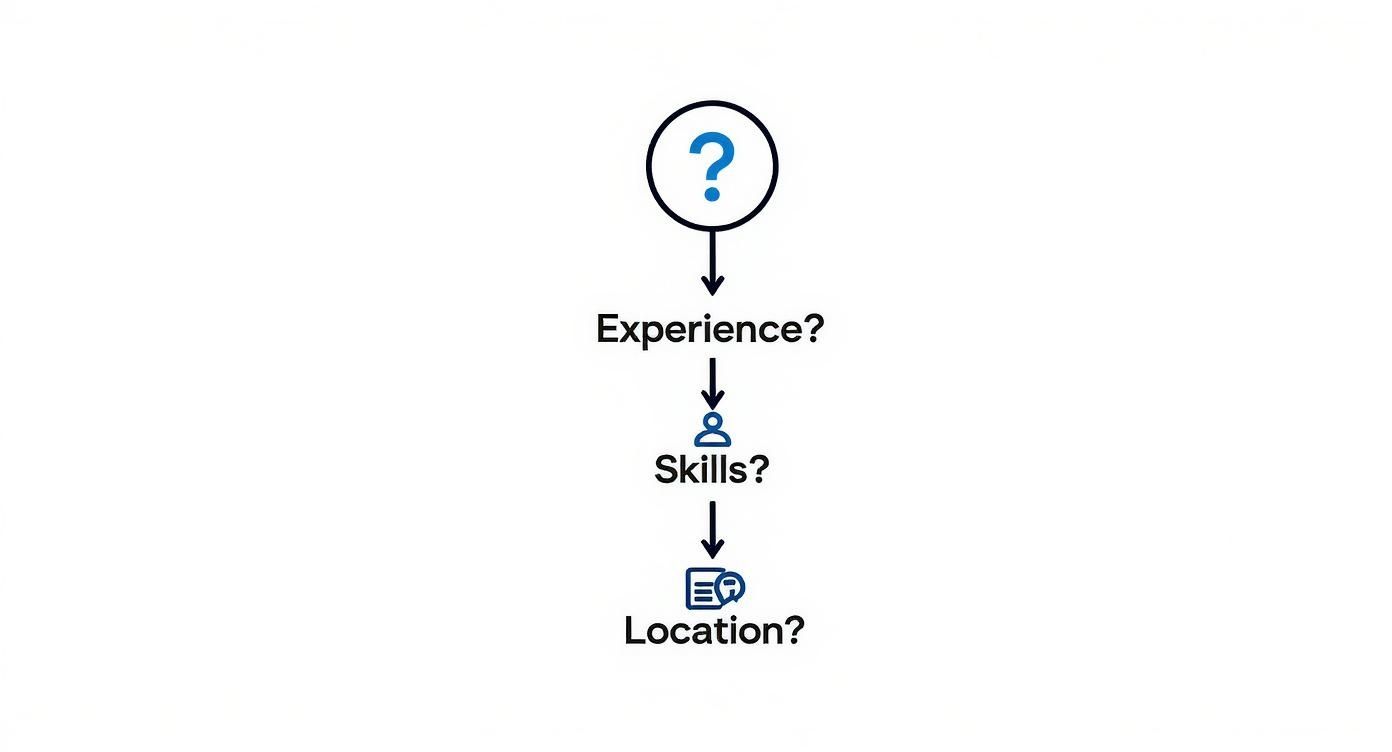
As you can see, your experience, skills, and even location all play a part in shaping the types of contracts you will land and how you will operate within them.
How to Secure Your Next Contract Role
Landing a great project manager contract is not just about having a solid CV. It demands a different mindset: a strategic, proactive one. In the fast-paced contract market, you need a proper game plan to consistently win high-value work. This means rethinking how you present yourself, knowing exactly where to look, and mastering a very different kind of interview process.
The big secret is to shift your CV from a boring list of duties to a powerful showcase of your achievements. Clients are not hiring a job title; they are paying for specific, tangible outcomes. Your CV has to immediately answer their number one question: “What value can this person bring to my project, right now?”
Optimising Your Contractor CV
Think of your CV as your single most important marketing tool. It needs to be laser-focused. For every role you have had, ditch the responsibilities and concentrate on the quantifiable results. This is what truly separates a contractor’s CV from a permanent employee’s.
So, instead of saying you "managed a project budget," you need to be specific. Say you "delivered a £2 million software rollout 10% under budget." Do not just say you "led a team"; state that you "mentored a team of five to increase productivity by 15%." You can see the difference.
Here is how to get your CV fighting fit:
- Lead with an Impactful Summary: Kick things off with a punchy professional profile. This should summarise your expertise, your key skills (like Agile or PRINCE2), and the sectors you specialise in.
- Focus on Achievements, Not Duties: Use bullet points under each role to hammer home those specific, measurable outcomes. Think metrics, percentages, and bottom-line results.
- Tailor for Every Application: A one-size-fits-all approach will not cut it. Tweak your CV for every single role you apply for, making sure you highlight the skills and experiences that directly match what they are looking for.
Finding the Best Opportunities
Once your CV is ready to go, you need to know where the best project manager contracts are hiding. It is good to cast a wide net, of course, but focusing your energy on the right channels will get you much better results, much faster.
Your job search should be a smart mix of active applications and old-fashioned networking. Specialist job boards are a great place to start, but it is the relationships you build that will sustain your career over the long haul.
Think of recruiters as your strategic partners, not just gatekeepers. A good recruiter who specialises in project management can bring you a steady stream of relevant opportunities, often before they are even advertised publicly.
These are the most effective places to find your next contract:
- Specialist Job Boards: Sites like Jobsite, CWJobs, and Technojobs are goldmines for contract roles, especially in the IT and finance sectors.
- LinkedIn: Your LinkedIn profile should be a mirror image of your achievement-focused CV. Get active, connect with recruiters and hiring managers in your target industries and engage with their content.
- Recruitment Agencies: Find a few reputable agencies that really know the project management space. Build relationships with them. They have direct lines to clients and an inside-out understanding of the market.
Acing the Contractor Interview
The interview for a contract role is a different beast altogether. The client already assumes you have the technical skills, that is why you are in the room. What they really need to know is that you can hit the ground running as a self-sufficient expert. They need to feel confident you can slot into their team and start delivering value from day one.
Be ready to talk about your past projects in granular detail. Focus on the challenges you overcame and the brilliant results you delivered. You need to frame every answer around providing a solution, proving you are the low-risk, high-impact professional they have been looking for. Get this right, and you will build a consistent pipeline of rewarding work.
How Does an Umbrella Company Work?

When you are starting out in project manager contracting, especially if your contract is ‘inside IR35’, using an umbrella company is the simplest and most compliant way to operate. It strips away all the administrative headaches, leaving you free to focus on what you are paid to do: deliver brilliant projects.
Think of us at UmbrellaCompany.com as your personal HR and payroll department, rolled into one. For the duration of your contract, we become your official employer. We are the ones who handle all the fiddly financial stuff, like managing your PAYE tax and National Insurance contributions and making sure everything is reported correctly to HMRC. It provides a simple, stress-free process.
This setup gives you a fantastic blend of contractor freedom with the stability of traditional employment. You still get to pick and choose your projects, but you also gain access to statutory employment rights like holiday pay, sick pay, and a workplace pension. It is the best of both worlds.
How the Process Works
Getting set up with us is refreshingly simple. We have designed the whole process to be quick and painless, so you can get started on your new contract right away.
Here is a quick look at the journey from signing up to getting paid:
- Quick and Easy Onboarding: First, you register with us. It is a straightforward form where you provide your personal details and contract information. We then sort out the contract with your recruitment agency or the end client.
- Submit Your Timesheets: At the end of each week or month, you just need to send us your approved timesheet showing the hours or days you have worked.
- Get Paid: As soon as the agency or client pays us, we process your payroll. We will deduct all the necessary taxes, our margin, and anything else agreed upon, then pay the net amount straight into your bank account.
It is vital to choose a reputable, FCSA-accredited provider like us. This accreditation is your guarantee that your finances are being managed properly and compliantly, protecting you from the nasty surprises that come with dodgy tax avoidance schemes.
Understanding Your Payslip
One of the biggest advantages of working this way is the total transparency. Every time we pay you, you will get a detailed payslip that breaks everything down clearly.
You will see the full contract value we received from the client, followed by a simple reconciliation. This will show all the deductions: employer’s National Insurance, the Apprenticeship Levy, our margin, and your own PAYE tax and employee National Insurance. It is an honest, no-nonsense approach to your earnings.
The earning potential is what attracts many to contracting in the first place. A typical project manager's day rate of £526 can translate to an annual income of around £115,720 before any deductions. That premium reflects the value of your expertise and flexibility. You can learn more about average contractor salaries on Jobsite.
Ultimately, working through an umbrella company lets you pour all your energy into your client and the project. We handle the complexities of payroll and compliance, so you can get on with being a top-tier project manager.
Your Top Contracting Questions Answered
If you are thinking about making the leap into project manager contracting, you probably have a few questions. Here are some straightforward answers to the ones we hear most often, designed to give you the clarity you need to move forward.
How Much Can I Earn as a Contract Project Manager?
Your day rate really comes down to your experience, your specialism, and where you are based. The median day rate often hovers around £526, which can work out to a gross annual income over £115,000.
However, that is just a benchmark. If you are a seasoned professional in a high-demand sector like finance or tech, especially in London, you could be looking at rates of £700 per day or even more. The trick is to do your homework and see what the market is paying for your specific skills before you start talking numbers.
Should I Use an Umbrella or a Limited Company?
This decision is usually made for you by your contract's IR35 status. If the role is deemed ‘inside IR35’, an umbrella company is almost always the most sensible and compliant way to go. It takes all the administrative hassle off your plate and ensures you are paying the right amount of tax.
For contracts that are genuinely ‘outside IR35’, setting up your own limited company can be more tax-efficient. But be warned, it comes with a lot more paperwork and the legal duties of being a company director. For simplicity and peace of mind, especially when you are just starting out, an umbrella company is the preferred route for most.
What Skills Are Clients Looking For in PM Contractors?
Right now, Agile and Scrum are still king, particularly for tech and digital transformation projects where things move fast. Being an expert with project management software like Jira will also put you head and shoulders above the competition.
But it is not all about the technology. Clients are desperate for contractors with brilliant stakeholder management, risk mitigation, and communication skills. More than anything, though, they want to see a solid, proven track record of delivering projects successfully, on time, and on budget. That is what will land you the best contracts.
Ready to start your contracting journey with confidence? At UmbrellaCompany.com, we make it simple to compare trusted, accredited umbrella companies so you can find the perfect fit for your needs. Get started in just a minute.


