


A project management contract often lands in your inbox at exactly the wrong moment. You’ve just secured the assignment, the rate looks workable, the start date is close, and then a long document arrives full of clauses on deliverables, liability, payment timing, substitution, confidentiality, and employment status. Most contractors skim it, sign it, and hope the details sort themselves out once the project starts.
That’s where trouble usually begins.
For UK contractors, especially those working through an umbrella company, a project management contract is rarely a simple agreement between two parties. It usually sits inside a three-way arrangement involving the end client, the agency or umbrella, and you. Terms can be passed down, altered, or summarised. If you don’t know which clauses matter, you can end up arguing about scope, chasing payment, or dealing with an avoidable IR35 problem halfway through the engagement.
A good contract does more than protect the client. It gives you a workable brief, a fair payment process, and a clear route for resolving issues before they become disputes. If you want a broader view of the market before signing anything, it helps to understand how project manager contracting works in practice across UK assignments.
Your Guide to Mastering Project Management Contracts
You get the call on Tuesday, the rate is agreed by Wednesday, and by Thursday an umbrella contract lands in your inbox with a start date that leaves little room to argue. That is usually the point where contractors focus on rate and notice period, then miss the clauses that decide how the engagement runs.
A project management contract should give you a clear operating brief. You need to see what you are expected to deliver, who can direct the work, how acceptance works, when money is released, and which terms have been passed down from the client through the umbrella. If any of that is vague, the problem will show up later as scope creep, delayed payment, or a dispute about whether you met the brief.
That three-party structure matters. In a direct contract, the client and contractor usually argue from the same document. Under an umbrella arrangement, you may be employed by the umbrella, supplied through an agency, and still judged against client terms you were never shown in full. That creates practical risk, especially where performance targets, substitution wording, timesheet approval, and termination rights do not line up cleanly across the chain. Contractors who want a better sense of how project manager contracting works in UK assignments should understand that the paperwork is often as important as the rate card.
IR35 also changes what a sensible review looks like. A clause about supervision, direction, control, personal service, or fixed working patterns is not just legal wording. It affects status, tax treatment, and how the engagement is likely to be managed in practice. Under an umbrella, you also need to separate two questions that often get blurred together. One is your employment relationship with the umbrella. The other is the client-side terms that shape how your work is assessed and controlled.
A useful rule is simple. If a clause affects your day-to-day delivery, your pay, or your exposure when the project slips, review it properly before you sign.
I treat the contract as a risk map. Read it once for the commercial points, once for delivery obligations, and once for status and liability. That approach catches the issues contractors miss when they only skim for rate and start date. Similar discipline applies in other contract settings too, including mastering feedback for client Upwork contracts, where the wording around expectations and acceptance can shape the whole working relationship.
By the end of your review, four points should be clear:
- What you are being engaged to deliver
- How approval, timesheets, and payment will work in practice
- Which client terms have been pushed through the umbrella or agency
- Which clauses affect IR35, liability, or performance and need clarification
Deconstructing Your Project Management Contract
Most project management contracts look more complicated than they really are. The wording is formal, but the job of the document is straightforward. It allocates work, money, responsibility, and risk. Once you read it in that order, the contract becomes far easier to assess.

A useful starting point is contract literacy. PMI notes that contract literacy and issue recognition skills are critical for project managers, and that UK contractors using umbrella companies often lack enough guidance on clauses tied to IR35, payment terms, and risk allocation in a three-party arrangement, as discussed in PMI’s piece on problem prevention in contracting. In practice, that means you cannot rely on the contract being self-explanatory. You need to read it with the job in mind.
The clauses that do the real work
The first clause to review is usually the Statement of Work. In this section, the commercial relationship starts to become operational. It should set out the project objective, your role, major tasks, reporting lines, and any milestones or dependencies. If the contract references a separate schedule, make sure you read that too. A vague SoW often leads to extra work being treated as if it were already included. If you want a more detailed breakdown, this guide to the Statement of Work is worth keeping open while you review the contract.
Then look at deliverables and acceptance criteria. A project manager is often hired for oversight, planning, governance, stakeholder management, or delivery recovery. Those activities can be hard to measure unless the contract defines what “done” means. Is success tied to weekly reporting, RAID management, governance packs, sprint planning support, mobilisation, or something else entirely? If the client can reject work without a clear acceptance process, the contract leaves too much room for argument.
Next comes payment. A good contract states the rate, invoicing route, approval process, timesheet requirements, and payment timing. If an umbrella or agency sits between you and the client, the wording should make clear whether payment depends on client payment upstream or whether approved time triggers payment as normal. This is one of the areas where passed-through wording creates confusion.
A quick clause reference
| Clause | What It Means | What to Look For |
|---|---|---|
| Statement of Work | Defines the services you’re providing | Specific tasks, boundaries, named outputs, reporting expectations |
| Deliverables | Sets what you must produce or achieve | Clear ownership, approval criteria, deadlines, dependencies |
| Payment terms | Explains how and when you’re paid | Rate, invoice route, approval process, payment timing, deductions |
| Intellectual property | Covers ownership of work product | Whether documents, templates, plans, or methods transfer automatically |
| Termination | States how either side can end the engagement | Notice periods, immediate termination rights, payment for work already done |
| Liability | Allocates financial responsibility if something goes wrong | Whether liability is capped, proportionate, and tied to your actual role |
| Confidentiality | Limits use and disclosure of information | Reasonable obligations, practical wording, no accidental conflict with portfolio use |
| Variation or change control | Describes how scope changes are agreed | Written approval route, impact on rate, timeline, and responsibilities |
Clauses contractors often underestimate
Intellectual property is easy to ignore when your role is “management” rather than making a product. But project managers create plans, reports, governance packs, process documents, templates, and recovery strategies. Check whether ownership transfers only for paid work, or whether the clause is written so broadly that it captures everything you produce, including pre-existing methods or personal frameworks.
Termination needs close reading. Some contracts allow the client to terminate on very short notice while holding you to a longer notice period. Others include broad wording around “convenience” or “performance dissatisfaction” without a cure period. That leaves you exposed if a stakeholder changes direction or funding is pulled.
A project can be healthy and still have a poor contract. Delivery discipline and contract discipline are not the same thing.
Liability is another area where contractors need to slow down. If you are managing delivery but not controlling the client’s staff, suppliers, or strategic decisions, unlimited liability makes little commercial sense. A project manager can influence outcomes, but cannot guarantee them. The contract should reflect that reality.
You should also read non-compete, non-solicitation, and confidentiality clauses together. A restrictive combination can constrain your next move. A short client-specific restriction is one thing. A broad ban on working in a whole sector is another.
For contractors who also pitch for future assignments, it helps to think beyond legal review and look at how your communication and documentation shape the client relationship. Good habits such as status updates, documented decisions, and clean close-out notes support both contract performance and reputation. That is one reason practical guidance on mastering feedback for client Upwork contracts can still be useful, even outside freelance platforms, because the underlying discipline is the same. Clarify expectations, record outcomes, and leave as little open to interpretation as possible.
What a readable contract should let you answer
Before you sign, you should be able to answer these without guessing:
- Scope. What is included, and what clearly is not?
- Authority. Who approves your work, time, and changes?
- Payment. What has to happen before payroll runs?
- Risk. Which losses are you realistically being asked to carry?
- Exit. If the project stops, what notice and payment protections apply?
If you can’t answer those from the document pack, the project management contract is not finished, even if someone has sent it for signature.
IR35 and Your Employment Status
A project manager can look independent on paper and still be treated like an employee in practice. I see that happen most often when the client, agency, and umbrella each describe the role differently. By the time the first payslip arrives, the position is already harder to challenge.

For project managers, IR35 needs a closer look because the job often sits near the client’s leadership team. You may attend steering meetings, use internal systems, and coordinate delivery across multiple functions. Those facts alone do not decide status. What matters is whether the paperwork and the day-to-day reality point to an employment-style arrangement or a genuine contract engagement.
The clauses HMRC usually examines first
Start with control. If the contract gives the client the right to dictate your hours, methods, daily priorities, and place of work in detail, that creates a stronger employment signal. A contract assignment can still require attendance at key meetings or reporting milestones, but it should leave room for professional judgment in how outcomes are delivered.
Then check substitution. This clause carries weight only if it could work in real life. A right to send a substitute means little if the approval test is so tight that no substitute would ever be accepted. Reasonable approval, based on capability and security requirements, is more credible than a clause that exists only to improve the wording.
The third area is mutuality of obligation, usually shortened to MOO. In practical terms, ask whether the client has to keep offering work and whether you have to keep accepting it beyond the defined assignment. A well-drafted project contract describes a specific piece of work, with a start point, an end point, and a basis for extension if both sides agree.
One mismatch appears regularly in umbrella arrangements. The assignment schedule may describe project-based deliverables, while the conduct on site feels like staff augmentation with day-to-day supervision. That gap matters. If HMRC reviews the engagement, it will look past labels.
Inside IR35 and outside IR35 in practice
If the role is inside IR35, tax is handled broadly like employment income. For many project managers, that means payment through PAYE, often via an umbrella company. In those cases, the immediate question is not whether umbrella working is good or bad. The key question is whether the status decision is sound and whether the rate offered still works once employer costs, umbrella margins, and holiday pay treatment are understood.
If the role is outside IR35, the standard is higher than many contractors expect. The written terms need to support an independent business relationship, and your working practices need to match them. If the contract says you control delivery but the client manager allocates tasks hour by hour, the paper will not save you.
For a plain-English summary of how status affects tax and contract choices, IR35 for contractors is a useful companion to your own review.
Read the SDS with the contract, not after it
If the client is responsible for status decisions, ask for the Status Determination Statement, or SDS, before you start. Read it against the assignment terms, not as a separate admin note.
The SDS should explain how the client reached its conclusion. If it says there is limited supervision, but the contract requires line-by-line direction or fixed daily reporting into a client manager, raise that point straight away. The same applies if the SDS assumes project autonomy but the schedule describes an open-ended resource role.
I also check whether performance language has been passed through accurately. Some umbrella paperwork shortens the client terms into broad obligations such as “follow all client directions” or “work under client supervision”. Those phrases may be harmless in context, or they may undercut an outside IR35 position. Read the original assignment wording where possible.
For contractors refreshing their market profile while reviewing roles, these contractor resume examples can help you present delivery ownership, defined outcomes, and specialist expertise more clearly.
A short explainer can help if you want a visual overview before you dig back into the paperwork.
Questions worth asking before you accept the role
- Who issued the status decision? The end client, agency, and umbrella should not be describing your status in conflicting ways.
- Does the SDS match the contract wording? Check control, substitution, scope, notice, and any performance obligations.
- Will the working practices support the written terms? A good clause is weak protection if the client manages you like an employee.
- If the role is inside IR35, has the pay route been explained properly? Ask how PAYE, holiday pay, deductions, and approval processes will work through the umbrella.
- Are any client clauses being passed through in summary form? If they are, ask for the source wording before you sign.
The safest position comes from alignment. The client terms, the SDS, the umbrella paperwork, and the actual working arrangement should all point in the same direction.
The Umbrella Company's Role Explained
A lot of confusion around a project management contract comes from assuming there is only one contract in play. Usually there are several. The end client may have one agreement with an agency or umbrella. The umbrella has an employment contract with you. The assignment terms may sit in a separate schedule. Some clauses are copied across, some are shortened, and some are passed through in summary form.
That’s why contractors sometimes feel they have agreed one thing commercially, then find different wording in the umbrella paperwork.
How the three-party arrangement works
At a practical level, the umbrella company becomes your employer for the duration of the assignment. You submit approved time or agreed records, the umbrella processes payroll, and tax is handled through PAYE where relevant. The client receives project services, but your employment relationship is with the umbrella, not the end client.
The key point is that the umbrella contract does not replace the assignment terms. It sits alongside them. You still need to understand what the client expects, what the agency has agreed, and what the umbrella will process for payment.
Here is a clean approach:
- Client to agency or umbrella. This covers the commercial supply of project services.
- Umbrella to contractor. This creates the employment relationship and payroll route.
- Assignment schedule. This usually describes the role, rate mechanism, location, expected duration, and approval process.
If one of those documents conflicts with another, ask for clarification before the first day. Small mismatches become expensive arguments later, especially around timesheet approval and payment timing.
What to check in the umbrella contract itself
The first point is the margin. You need to know what the umbrella charges, how it is shown, and whether anything else is deducted separately. If the pricing is hard to follow, that is already useful information.
The second point is payment operation. Check the payroll frequency, cut-off times, holiday pay treatment, pension handling, and what happens if a client approves time late. These are not minor details. They affect cash flow.
The third point is insurance and support. Reputable providers usually explain what cover is included and what is not. If the contract mentions insurance but does not define it, ask for the policy type and scope.
When an umbrella arrangement is clear, the admin feels boring. That is a good sign.
The type of project contract matters here too. PMI’s discussion of contract choice notes that UK contractors often need to balance skill scarcity with regulatory hurdles such as IR35, and that Time & Materials contracts are common via umbrellas, while opaque fee structures can drive disputes. It also notes that proactive contract selection can lift project success rates from 60% to 85% in regulated UK sectors, as outlined in PMI’s decision matrix approach to project contracts. In practical terms, that means the payment model, approval route, and allocation of commercial risk should fit the work, not just the recruiter’s preferred template.
What tends to work and what doesn’t
What works:
- Clear pass-through terms that show which client obligations affect you
- Simple payslip logic with deductions explained in plain language
- Defined approval routes for time, expenses, and milestone sign-off
- Written answers to any questions on holiday pay, pension, and notice
What does not work:
- Opaque fee wording that makes it hard to tell what the umbrella keeps
- Verbal assurances that conflict with the contract pack
- Loose assignment descriptions that create uncertainty about what payroll can process
- Late clarification after you have already started the role
If you need a primer on the mechanics before reviewing providers, this overview of how umbrella companies work is useful background. It helps separate the employment contract from the project assignment itself, which is where many contractors get crossed wires.
Identifying Red Flags and Negotiating Terms
The biggest contract mistakes are rarely dramatic. They are usually quiet. A vague scope. A missing approval route. A payment clause with too many conditions. A liability clause copied from a supplier agreement that no individual contractor should accept.
Poor contract management is expensive. UK businesses can lose up to 9% of annual turnover through contract value leakage, and a 2026 report cited by Juro found that 40% of a contract’s value can be lost through poor management practices, while 9 in 10 contract professionals struggle to locate specific contracts efficiently, according to Juro’s contract management statistics. For an individual contractor, that same sloppiness shows up as delayed payment, unpaid change requests, and arguments over responsibility.
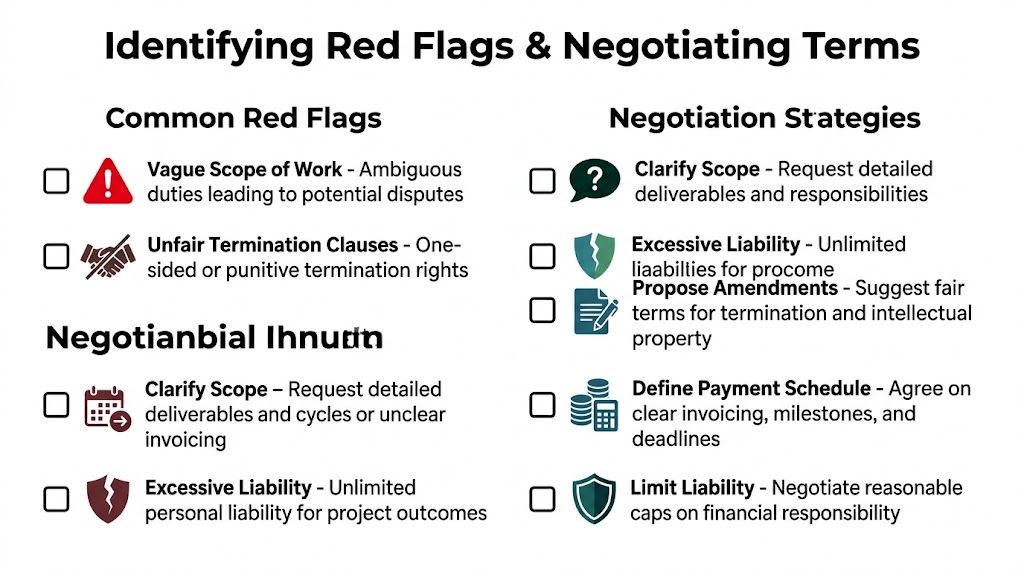
Red flags worth treating seriously
Some clauses deserve immediate challenge, even if the rest of the deal looks fine.
- Vague scope wording. If the contract says you will provide “project support as required” or “other duties as needed”, the client has too much room to stretch the role.
- Payment terms tied to too many conditions. If payment depends on client payment, multiple approvals, or undefined evidence of performance, cash flow risk moves towards you.
- Unlimited liability. This is rarely appropriate for an individual project manager delivering advisory or coordination services.
- One-sided termination rights. If the client can terminate immediately for convenience while you must serve longer notice, the balance is poor.
- Broad restrictive covenants. A narrow non-solicitation clause may be manageable. A broad non-compete can interfere with your next contract.
- Missing change control. If there is no way to document changes to scope, every extra request becomes a judgement call.
What to say when a term needs fixing
Negotiation does not need to be confrontational. In fact, the strongest approach is usually calm, specific, and tied to delivery clarity.
Try language like this:
“I’m happy with the assignment in principle. I’d like to tighten the Statement of Work so the deliverables and approval points are explicit.”
That works because it frames the request as a delivery improvement, not an argument.
You can also say:
- On scope. “Can we list the core deliverables and exclude work outside that list unless agreed in writing?”
- On payment. “Please confirm payment is triggered by approved time or agreed milestones, rather than dependent on upstream payment.”
- On liability. “Given the nature of the role, I’d like liability to be capped at a reasonable level tied to the fees for this engagement.”
- On termination. “Can we make the notice provisions mutual, so both parties have a fair and workable exit?”
- On change requests. “If the project expands, I’d prefer a written variation process covering timescales, responsibilities, and any rate impact.”
Where to push and where to be realistic
Some terms are more flexible than others.
Usually negotiable:
- Rate structure
- Notice period
- Scope wording
- Approval steps
- Reporting expectations
- Liability caps
- Change control wording
Less flexible in larger organisations:
- Core confidentiality language
- Data protection obligations
- Mandatory client policies
- Standard onboarding clauses
- IR35 route where the client has made a firm determination
That does not mean fixed terms should go unquestioned. It means your challenge needs to be precise. If a bank, insurer, or public sector body uses a standard clause, ask for written clarification on how it will be applied in practice. A short side email confirming interpretation is often better than a broad argument you are unlikely to win.
A practical review order
When a contract pack is long, review it in this order:
- Commercials first. Rate, term, payment route, notice.
- Scope next. Deliverables, meetings, reporting, outputs.
- Risk allocation. Liability, indemnities, IP, confidentiality.
- Operational detail. Timesheets, expenses, location, equipment.
- Pass-through terms. Anything imported from the client agreement.
The red flag is not always a harsh clause. Sometimes it is the absence of a clause that should be there.
The best negotiations improve clarity for both sides. If a client or agency resists every reasonable request for precision, treat that as a commercial signal. It often tells you how the engagement will run once the project gets busy.
Answering Your Top Contract Questions
Contractors usually have a handful of questions that only appear after the first proper read-through. Those questions matter because they sit right where legal wording meets day-to-day delivery.
Can I challenge an IR35 status decision
Yes, but do it properly and early. Start by requesting the basis for the determination and comparing it against the actual contract terms and expected working practices. If the client provides a Status Determination Statement, read it closely and identify any mismatch between the written rationale and the actual role.
Keep your challenge factual. Point to clauses on control, substitution, project-based scope, and any other features that don’t align with the conclusion. Avoid turning it into a general complaint about tax. The stronger route is a documented request for review based on the assignment as written and intended.
What should I do when the scope changes halfway through the project
Treat scope change as a contract event, not just a delivery issue. When stakeholders ask for extra reporting, governance support, supplier coordination, or recovery work beyond the original agreement, write it down and ask for confirmation.
A short email can be enough if it captures the change clearly. State what has been requested, what impact it has on time or priorities, and whether it affects rate, duration, or deliverables. If the contract includes a variation clause, use it. If it does not, create a written record anyway. The mistake is doing the extra work first and trying to tidy the contract later.
Who is liable if something goes wrong, me, the umbrella, or the client
That depends on the wording, and that is exactly why contract review matters. The umbrella company is usually responsible for payroll and employment administration. The client controls the project environment and business decisions. You are typically responsible for performing your agreed services with reasonable care and skill.
The problem starts when contracts blur those lines. If the assignment terms suggest you carry responsibility for matters outside your control, such as third-party supplier failure or the client’s strategic choices, the allocation is too wide. Read liability clauses alongside the practical reality of the role. A project manager coordinates and advises. That is not the same as guaranteeing every project outcome.
Do I still need my own insurance if I work through an umbrella company
Sometimes yes. Do not assume the umbrella’s cover automatically protects every situation relevant to your assignment. Ask what is included, what limits apply, and whether the cover is designed for your role and sector.
If the client contract requires specific cover, check whether the umbrella policy satisfies that requirement in writing. Also check whether the policy responds to the sort of work you are doing, such as advisory, governance, programme recovery, or supplier management. If there is any doubt, get clarification before the assignment starts rather than after a dispute appears.
Conclusion Your Pre-Signing Checklist
A project management contract should make the engagement easier to run, not harder to understand. If the role, payment model, IR35 route, and risk allocation are clear on day one, you are far more likely to spend your time managing delivery instead of untangling avoidable admin and legal issues.
Structured contract management matters because projects move quickly and assumptions harden fast. The Association for Project Management outlines a four-stage method that includes understanding obligations, planned progress reviews, and formalised reporting, and notes that UK projects using structured processes have reduced delays by 28%, according to APM’s guidance on managing contracts in project management. That disciplined approach works just as well before signature as it does after kickoff.

Pre-signing checklist
- Confirm the scope. Make sure the Statement of Work defines deliverables, boundaries, approvals, and reporting expectations.
- Check the IR35 position. Read the status decision alongside the contract wording and expected working practices.
- Verify payment mechanics. Confirm rate, approval steps, payroll timing, and any conditions that trigger payment.
- Review liability carefully. Make sure financial responsibility is proportionate to your actual role and level of control.
- Read termination terms both ways. Look for fair notice, sensible immediate termination triggers, and payment for completed work.
- Test the change process. Ensure there is a written route for handling extra scope, revised timelines, or new responsibilities.
- Scrutinise the umbrella paperwork. Check margin, deductions, insurance, holiday pay treatment, and assignment terms.
- Get key clarifications in writing. If a recruiter or client explains something verbally, ask for written confirmation before signing.
A calm, methodical review does more than reduce risk. It also makes you easier to work with because expectations are clear from the start.
If you’re comparing providers for an inside IR35 role or want a simpler way to assess your options, Umbrella Company helps UK contractors review and compare umbrella companies based on their needs, sector, and contract setup.


