


If you've worked through a run of contracts, umbrella assignments, and short-term roles, there's a good chance you've built up more than one pension pot. One might sit with an old workplace scheme, another with an umbrella company pension, and another with a provider you barely remember setting up. Keeping track of all that can feel harder than earning the money in the first place.
A pension transfer to a SIPP can bring those scattered pensions into one place. For many contractors, that means more control, clearer oversight, and a pension setup that better suits an irregular working life. It can also carry real trade-offs, especially if any existing scheme includes benefits you can't replace once they're gone.
We're going to unpack the practical side of this decision in plain English. You'll see what a SIPP is, how transfers work, where contractors often get caught out, and when regulated advice is required. If your income changes from contract to contract, it also helps to understand your wider finances alongside pension planning, which is why our guide on how to structure your contractor income in the UK can be useful background reading.
Your Guide to Consolidating Contractor Pensions
For contractors, pension admin often becomes fragmented by default. You finish one assignment, join another payroll, move between umbrella arrangements, or switch from employment to freelancing. Each change can leave behind another pension pot.
That isn't just untidy. It can make retirement planning harder because you can't easily see what you hold, how it's invested, or whether the old schemes still fit your needs.
A Self-Invested Personal Pension, usually called a SIPP, is one route people use to bring those pension savings together. Instead of logging into multiple pension accounts and trying to compare different provider documents, you may be able to move eligible pensions into one SIPP and manage them from a single account.
Practical rule: Consolidation is only useful if the new arrangement is better for you overall, not simply neater on a screen.
For contractors and freelancers, that distinction matters. Flexibility is valuable, but so are employer contributions, protected features, and lower-cost arrangements that you may already have. The strongest decisions usually come from comparing what you're gaining against what you're giving up.
What Is a SIPP and How Do Pension Transfers Work
A SIPP is a personal pension that gives you a wider say over how your retirement savings are invested. If a standard workplace pension is like a menu with a limited set of dishes, a SIPP is closer to a larger investment shelf where you have more choice over what goes in your pension.
That extra control is the main reason many contractors look at SIPPs. A working pattern built around projects and changing clients often makes people want a pension they can carry with them, rather than one tied to whichever payroll arrangement they're currently using.
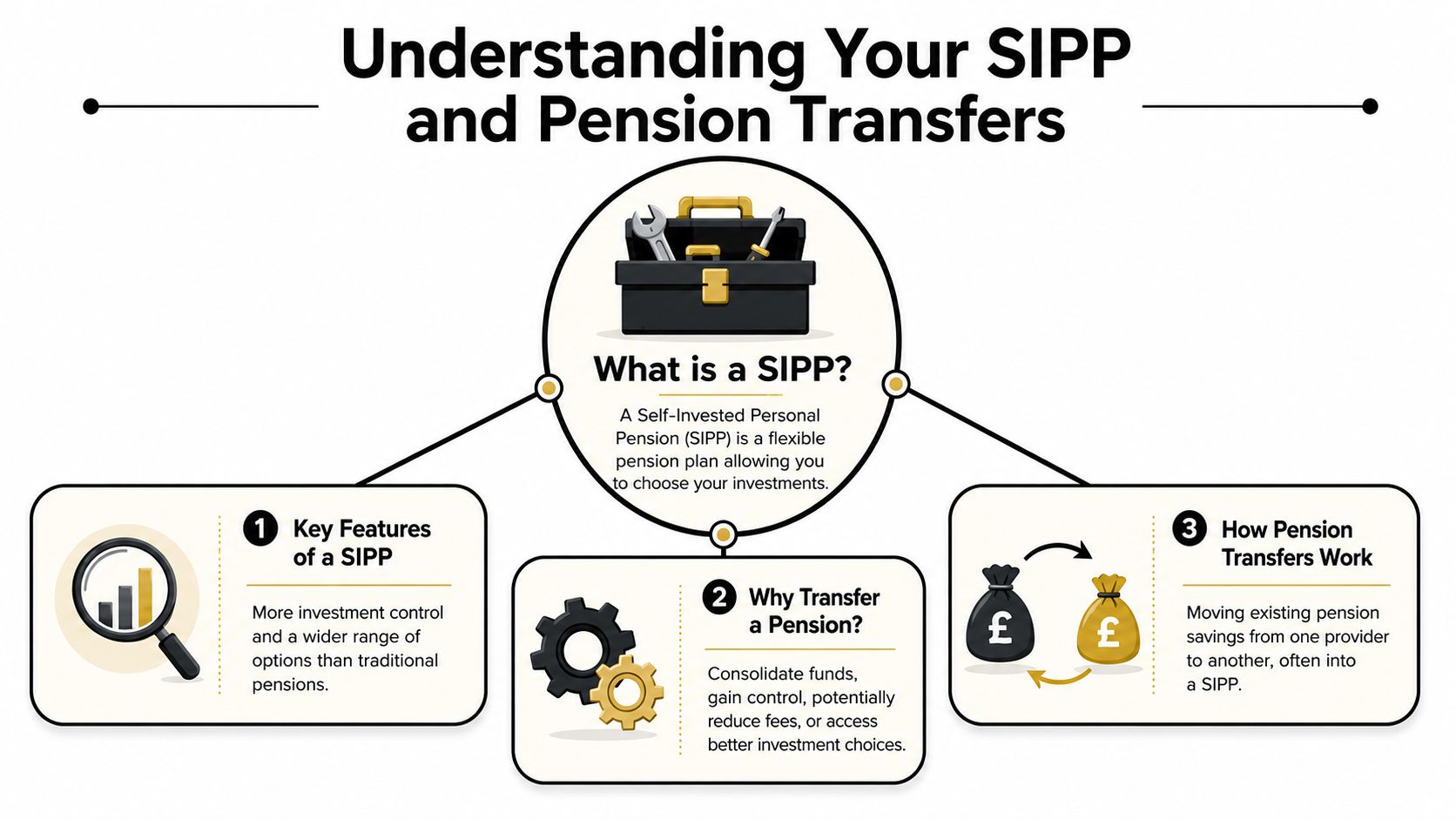
What a SIPP does differently
A workplace pension is usually set up by an employer or umbrella payroll arrangement. It often gives you a smaller range of investment choices and is designed to work smoothly in the background.
A SIPP is more hands-on. Depending on the provider, you may be able to choose from a broader range of funds and investments. That can suit a contractor who wants a single long-term pension home instead of several smaller legacy pots.
Key differences often include:
- Investment choice. A SIPP usually offers broader investment options than a standard workplace pension.
- Control. You decide how the pension is organised and, in many cases, how it is invested.
- Portability. It stays with you as you move between contracts and clients.
- Responsibility. More freedom usually means more decisions for you to make.
If you're reviewing tax and take-home pay at the same time as pension planning, our guide on how to reduce PAYE tax as a contractor can help join the dots.
What a pension transfer actually means
A pension transfer doesn't mean withdrawing your pension money into your bank account. It means moving pension savings from one pension scheme to another.
In practice, that usually works in one of two ways:
| Transfer type | What happens | What it means for you |
|---|---|---|
| Cash transfer | Existing investments are sold and the cash is moved | Simpler in many cases, but your money is temporarily out of the market |
| In-specie transfer | Investments move across directly if the new provider can accept them | Can preserve holdings, but the process is often more complex |
Often, people get confused. They assume every old pension should be rolled into a SIPP because it feels tidier. But a pension transfer SIPP decision is really about fit. You're asking whether one personal arrangement now serves your working life better than several old schemes built around past jobs.
A transfer is an administrative process, but the decision behind it is financial. Those are not the same thing.
Weighing the Benefits and Risks of a SIPP Transfer
A SIPP transfer can be sensible. It can also be a poor move if you focus only on convenience. Contractors usually benefit most when they look at both sides with equal care.
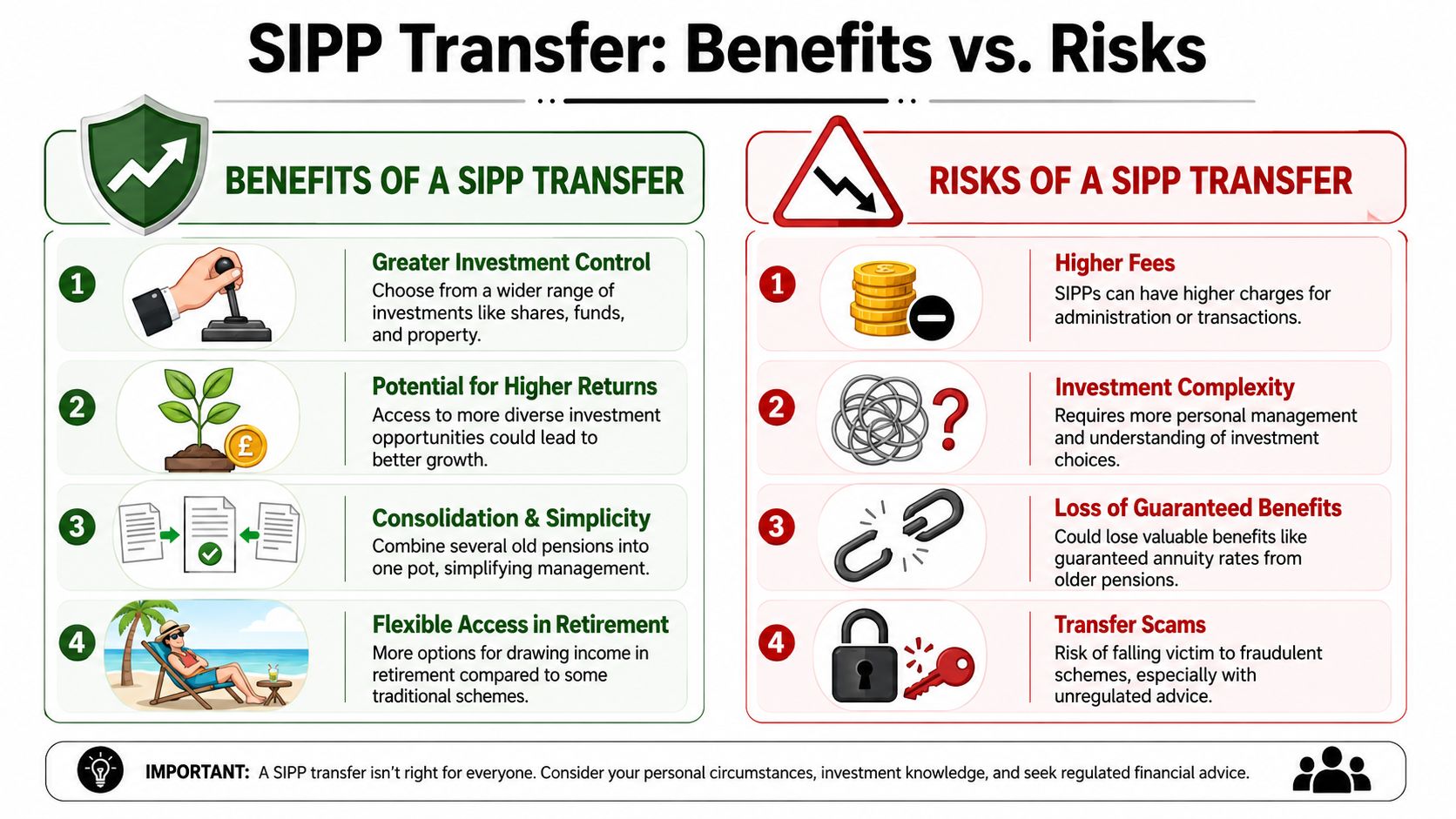
Where a SIPP can help
If you've built up several pension pots through different contracts, consolidation can make your retirement planning easier to manage.
Common advantages include:
- One place to monitor. You can see your pension savings together rather than across several providers.
- Clearer investment strategy. It's easier to avoid accidental overlap when your pensions sit in one arrangement.
- Greater personal control. A SIPP may suit contractors who want more say over how their pension is invested.
- Long-term continuity. Your pension doesn't need to change every time your work arrangement changes.
For freelancers who like to keep their finances organized, this can feel like a natural step. It fits the same mindset behind reviewing business structure, tax planning, and contract setup. Our article on the best ways to reduce tax as a contractor in the UK looks at that wider planning picture.
What you might lose
This is the part many people rush past.
UK consumer guidance stresses that transfers can mean giving up valuable safeguarded benefits such as guarantees, protected pension age, or employer contributions, and the FCA has repeatedly warned that transfer decisions should be made on the basis of lost benefits as well as fees and investment choice, as outlined by M&G's pension scheme transfer guidance.
That matters even more for contractors because some old schemes may still contain features that are hard to replicate elsewhere.
Watch for:
- Guaranteed benefits. Some pensions include features that a SIPP won't reproduce.
- Protected pension age. Certain schemes may allow access earlier than standard arrangements.
- Employer input. If you're still actively building benefits in a workplace pension, moving it may not be wise.
- Decision burden. More choice can become a drawback if you don't want to manage investments.
A better question than can I transfer
A lot of people ask whether they can transfer a pension to a SIPP. That's only the first hurdle.
The stronger question is this:
Will moving this pension leave me in a better position than staying where I am?
Sometimes the answer is yes. A contractor with several small defined contribution pots from old roles may prefer one portable SIPP they can keep for years.
Sometimes the answer is no. If an old pension carries valuable protections or you're comparing flexibility against secure benefits, tidiness alone isn't enough reason to move.
Navigating Pension Transfer Rules and Advice Requirements
The rules around pension transfers exist because some pension rights are easy to move, and others are too valuable to give up casually. Regulators treat the higher-risk cases with extra caution.
The Financial Conduct Authority views pension transfers as high-stakes because they are usually irreversible. Its expectations for advisers include comparing the specific receiving scheme, expected investment returns, risks, and all costs and charges before recommending a transfer, as set out in the FCA's guidance on advising on pension transfers.

When advice is legally required
For transfers from a defined benefit scheme with a cash equivalent transfer value above £30,000, regulated financial advice is a legal requirement before the transfer can proceed, according to The Pensions Regulator's transfer request guidance.
A defined benefit scheme is often called a final salary or career-average pension. Instead of building a pot that rises and falls with investments, it promises retirement benefits based on scheme rules.
That's why the law treats these transfers differently. You are not just moving money. You may be giving up:
- Inflation-linked income
- A spouse's pension
- Guaranteed early-retirement terms
- Other safeguarded rights
Once those guarantees are surrendered, you usually can't get them back.
The £30,000 point contractors need to know
The £30,000 threshold causes confusion because people think it applies to every transfer. It doesn't.
The legal advice requirement is tied to safeguarded benefits and the value involved. The FCA also states that advice may be given without a mandatory advice requirement where safeguarded benefits are worth £30,000 or less, while larger transfers involving safeguarded benefits can trigger compulsory advice requirements under UK rules, as noted in the FCA guidance linked above.
If your old pensions are straightforward defined contribution pots from previous roles, the process is often simpler. If one of them comes from a defined benefit arrangement or contains special guarantees, the analysis becomes much more serious.
Tax position and anti-scam checks
Transfers between registered UK pension schemes are generally treated differently from withdrawals. As a result, they are usually not hit with unauthorised payment charges when done within the rules. Pension administrators also carry out checks on the receiving scheme and, in some cases, ask for supporting evidence for occupational or overseas transfers to reduce scam risk, as The Pensions Regulator explains in the guidance already referenced above.
For contractors, the practical message is simple:
- Use regulated firms
- Read scheme paperwork carefully
- Don't sign transfer forms until you understand what you're giving up
- Treat pressure or urgency as a warning sign
Your Step-by-Step Guide to the Transfer Process
Once you've decided a transfer is worth exploring, the process is usually more orderly than people expect. Most of the heavy lifting is handled by the receiving provider, but your part still matters because mistakes at the start can slow everything down.
A typical transfer starts with paperwork, identity checks, and information gathering. From there, the new provider asks the old scheme to release the pension.
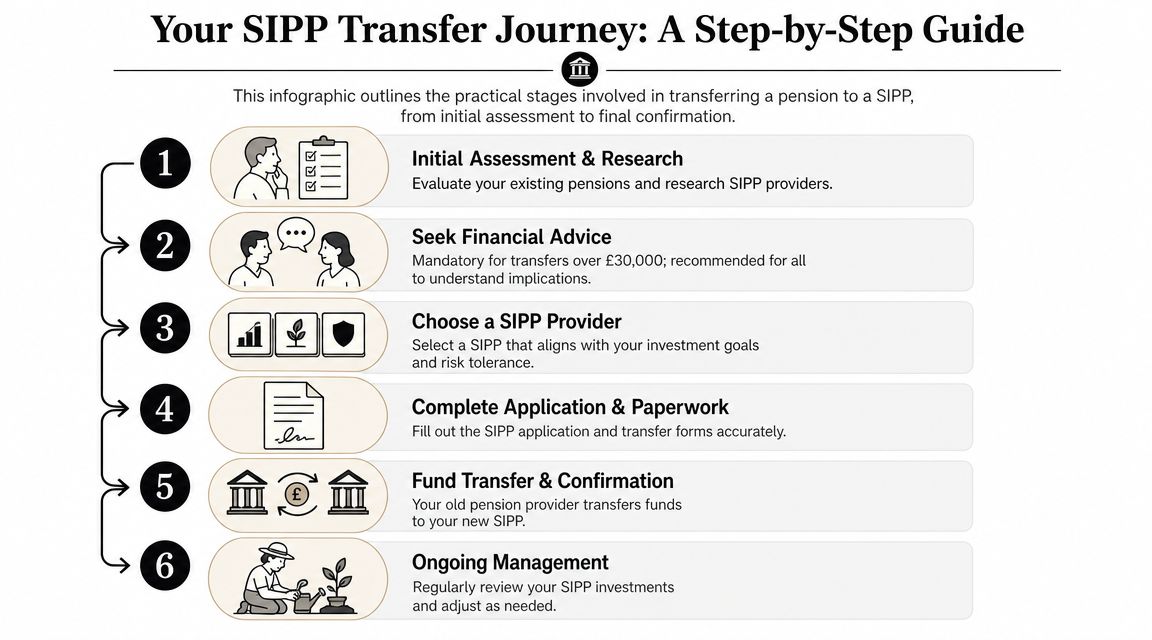
Step 1 to Step 3
List every pension you want to review
Gather provider names, policy numbers, recent statements, and any documents that mention guarantees or special terms.Check what type of pension each one is
A defined contribution pot from an old job is a very different case from a defined benefit scheme or a plan with safeguarded benefits.Choose the SIPP provider carefully
Look at investment range, service model, charges, and whether the provider accepts the type of transfer you need.
One practical point for umbrella workers is that some services can support pension administration alongside contractor pay arrangements. For example, Umbrella Company provides comparison and guidance for contractors who need to coordinate payroll and pension decisions as part of a broader setup.
To see the process explained visually, this short video is useful:
Step 4 to Step 6
Complete the transfer application
Your new provider will usually ask for your personal details, pension references, and authority to contact the old scheme.Decide on cash or in-specie transfer
A cash transfer from an existing pension into a SIPP typically takes around 2 to 6 weeks, while an in-specie transfer can take 8 to 12 weeks, according to this pension transfer timing guide. The same source notes that members have a right to move savings between registered schemes without unauthorised payment charges.Check the money once it arrives
A transfer isn't finished just because the old provider says it has been sent. Confirm receipt, holdings, cash balance, and your chosen investment setup inside the new SIPP.
Where delays usually happen
Delays are often less dramatic than people fear, but they do happen. Common causes include:
- Missing references. Old paperwork may have outdated account details.
- Unclear benefits. If the old scheme needs to confirm whether guarantees exist, the process can slow down.
- Investment compatibility issues. An in-specie transfer only works if the new platform can accept the holdings.
- Identity or compliance checks. Providers must be satisfied that the transfer is legitimate.
Checklist thought: Before submitting forms, ask yourself whether you're transferring because the SIPP is genuinely suitable, or because you're tired of paperwork. The first reason is stronger.
Pension Transfers for Contractors and Umbrella Workers
Contractors don't experience pensions in the same way as permanent employees. A permanent employee may spend years in one scheme. A contractor might touch several payroll arrangements over a relatively short period, then move into self-employment or another umbrella setup.
That creates a different kind of pension question. It isn't only about growth or charges. It's also about portability, admin, and whether your pension setup still matches how you work.
The contractor with several old pots
A common scenario looks like this. You spent time on one inside IR35 contract, moved to another role through a different umbrella company, then took a direct fixed-term assignment. Each role enrolled you into a pension scheme. None of the pots is necessarily wrong. They're just spread around.
For this person, a SIPP can be useful because it creates one long-term pension base that doesn't change every time the contract does.
That said, the strongest approach is usually selective, not automatic. Review each old pot on its own merits before deciding whether it belongs in a SIPP.
The umbrella worker leaving a scheme behind
Another frequent situation involves someone who has just finished working through an umbrella company. The workplace pension attached to that assignment may remain in place after the contract ends, but the worker no longer contributes to it.
At that stage, the options often include:
- Leaving the pension where it is if the scheme remains suitable
- Transferring it to a SIPP if you want one portable pension home
- Keeping the old workplace pension and opening a separate SIPP for future personal planning
If you're comparing payroll models at the same time, our guide on umbrella vs PAYE helps explain how employment structure can shape the practical side of contractor finances.
The freelancer balancing flexibility and security
Freelancers often value flexibility because income patterns can vary through the year. A SIPP can fit that mindset because it isn't tied to one employer. But flexibility isn't automatically the same as better value.
A contractor who is still in an active workplace arrangement needs to think carefully before moving anything that includes current employer support or other protections. A former workplace pension and an active one are not the same decision.
The inside IR35 contractor who wants a cleaner setup
Inside IR35 contractors often end up with more employment-style admin than they expected, including workplace pensions that change with assignments. That makes a pension transfer SIPP discussion especially relevant.
The key is not to assume that every inside IR35 pension should be moved. A cleaner setup is appealing, but the main test is whether the SIPP improves oversight and long-term suitability without stripping away useful scheme features.
Contractors usually need pension planning that matches a mobile career, not pension planning copied from a permanent employment handbook.
Is a SIPP Pension Transfer Right for You
A pension transfer to a SIPP can make sense if you want one pension home that follows you through contract changes, umbrella work, and freelance periods. It can simplify admin and give you more control.
But the right decision isn't always the neatest one. If an existing pension includes guarantees, safeguarded benefits, or support that a SIPP can't match, transferring could leave you worse off. That's why the quality of the decision matters more than the speed of the transfer.
If you're worried that pension money has been mishandled, moved improperly, or exposed to fraud, legal support may help you recover lost retirement funds in serious cases. That isn't part of normal pension planning, but it can be relevant where a transfer has gone badly wrong.
Use the facts, check every scheme carefully, and get regulated advice when the rules require it or when the stakes feel too high to judge alone.
If you want help making sense of contractor pay, umbrella options, and the pension choices that sit around them, explore the guides and comparison tools from Umbrella Company.


