


You've just formed a UK limited company, sent your first invoice and started thinking about what happens when the contract ends. A pension may be the last thing on your list, especially when salary, dividends, IR35 and Corporation Tax already compete for attention. Yet the right pension for directors strategy can depend on a detail many generic guides overlook: how your company employs its directors and workers.
We'll start with that employment structure, then look at automatic enrolment, employer contributions, salary sacrifice, personal pensions, annual allowances and practical compliance. The examples use clear figures, but your accountant or regulated financial adviser should confirm the treatment for your own company before you make a large contribution.
Why Director Status Changes the Pensions Conversation
Sarah has recently incorporated her IT contracting business. She's the only director, works through the company and expects to take a modest salary alongside dividends. A generic employee pension guide tells her to wait for automatic enrolment and contribute through payroll. That advice may not fit her company at all.
The first question isn't which pension product Sarah should choose. It's whether her company has automatic enrolment duties, and that depends on the employment relationships inside the business.
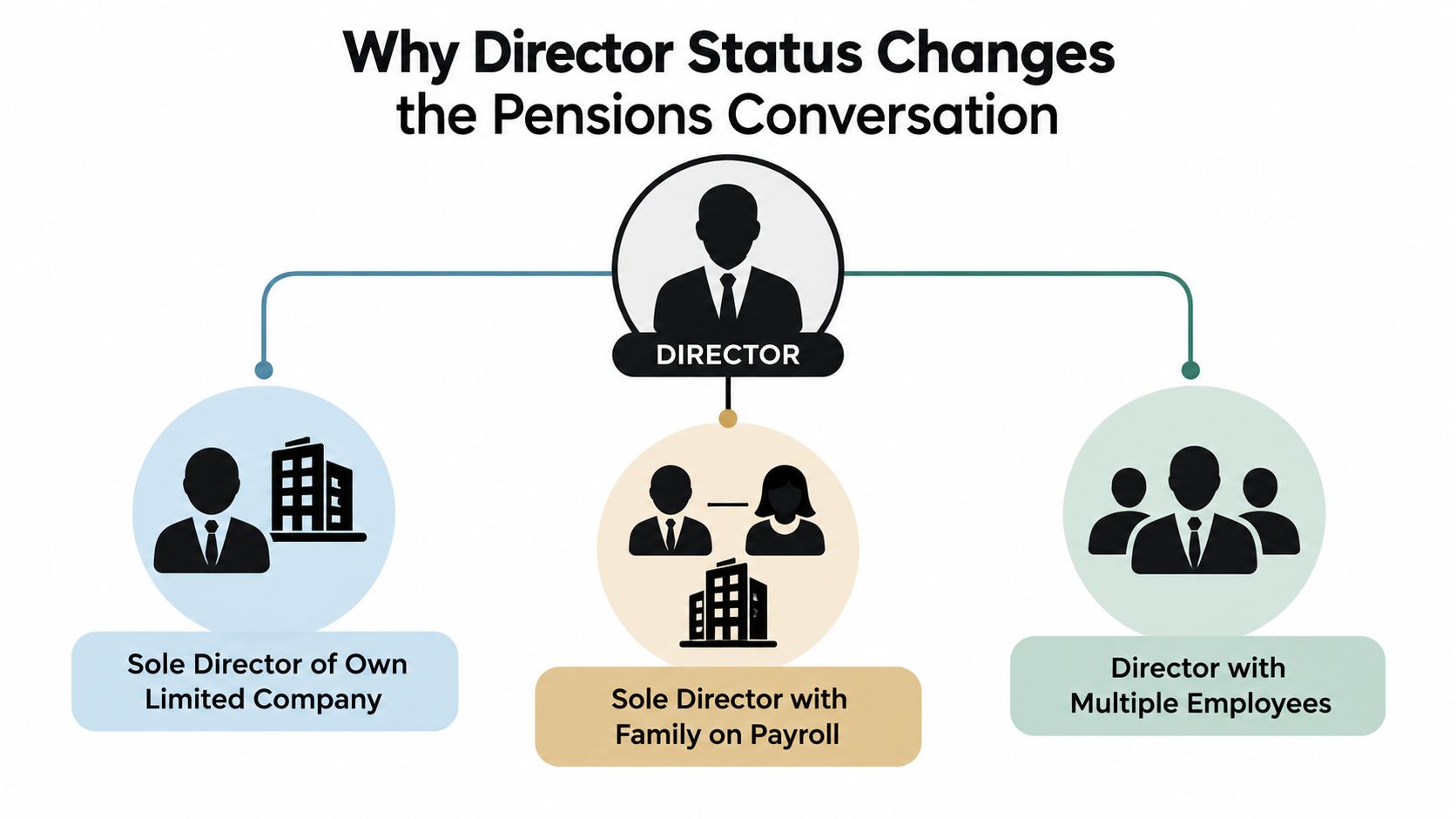
Three structures create different outcomes
A sole director with no employment contract is always exempt from automatic enrolment duties. The same applies to a directors-only company where the directors aren't employed under contracts. That doesn't stop the director from arranging a pension. It means the company may be able to notify The Pensions Regulator that it has no automatic duties, rather than enrolling the director as an ordinary worker. The Pensions Regulator explains the relevant director exemptions from automatic enrolment.
The position changes when the company has other workers. A director with an employment contract can fall within automatic enrolment if the company employs another worker. A company with two or more directors who have contracts of employment must treat those directors as workers for automatic enrolment purposes.
A third structure is a growing company with several directors and employees. Here, the boardroom title doesn't remove ordinary workplace pension responsibilities. The company must assess eligible directors and staff using the relevant age and earnings rules.
Sarah's salary and dividends don't answer every question
Sarah's salary, dividends and pension payments serve different purposes. Salary is employment income. Dividends are distributions of available company profits, not pensionable earnings in the same way as salary. An employer pension contribution is paid by the company into a pension and is considered through the company's remuneration and tax position.
That's why a contractor-director shouldn't copy an employee's pension routine without checking the structure first. If Sarah later puts her partner on the payroll, or appoints another employed director, the company's duties may change.
Practical rule: Start with contracts of employment, payroll records and the number of workers. Choose the pension arrangement afterwards.
If you're weighing a limited company against an umbrella arrangement, our guide to a limited company director explains the wider responsibilities that come with running your own company.
Auto-Enrolment Duties and Director Exemptions
Automatic enrolment is a workplace duty, not a compulsory product choice for every person who holds the title “director”. The Pensions Regulator's guidance focuses on whether a director is also a worker under an employment contract and whether the company employs anyone else.
Start with the company's worker position
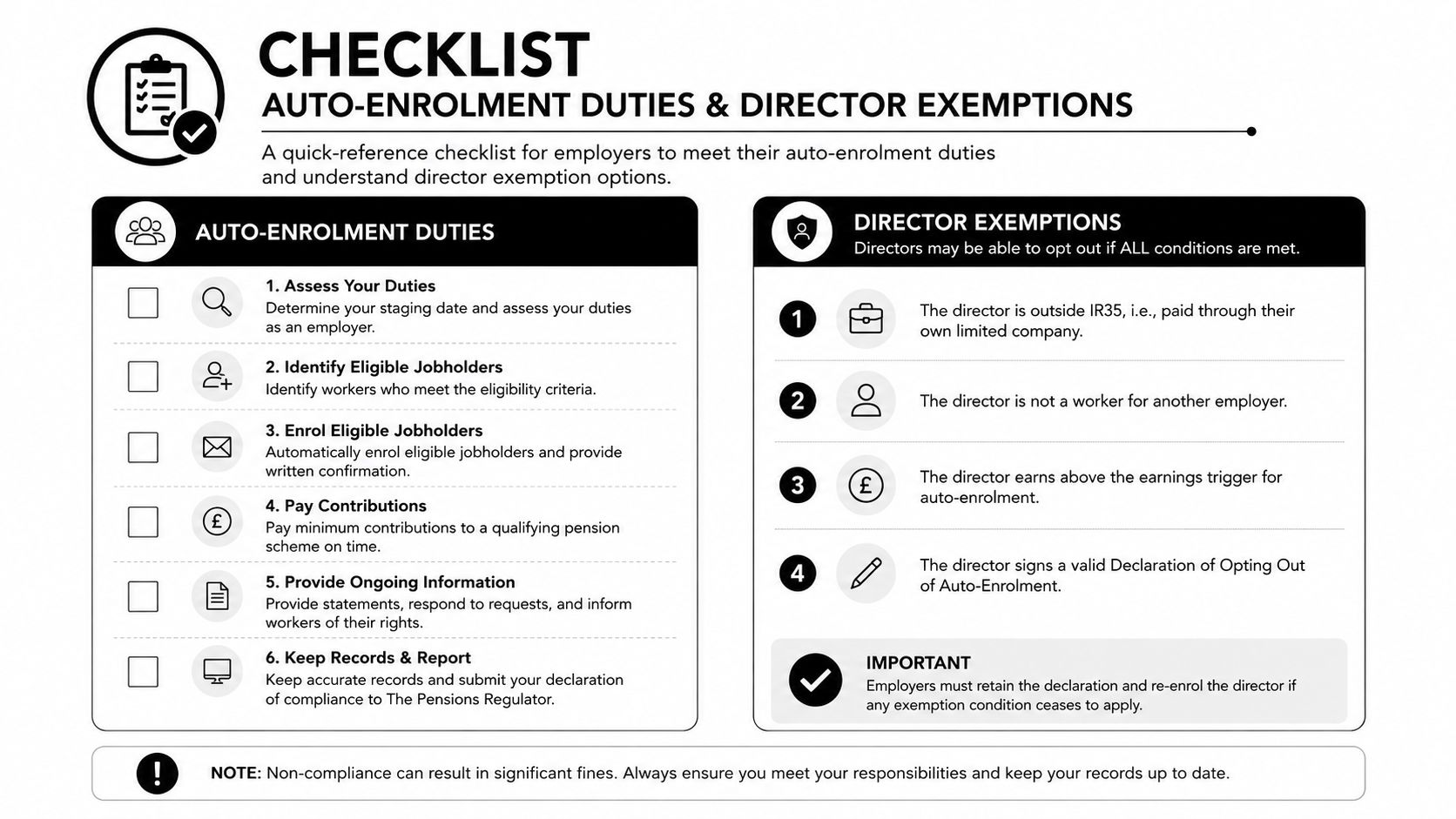
Work through these questions in order:
Does the company have any workers? A director with no employment contract is always exempt. A company with other workers may need to assess an employed director.
Are there two or more directors with employment contracts? If so, those directors become workers for automatic enrolment purposes and the company must apply its duties to them.
Does an assessed worker meet the eligibility conditions? The usual trigger applies to a person aged from 22 to State Pension Age who earns over £10,000 a year, £833 a month or £192 a week. These thresholds are set out by The Pensions Regulator's guidance for directors and automatic enrolment duties.
A director who meets the conditions may need to be enrolled, unless an exemption applies to the company's structure or the director makes a valid decision to opt out after enrolment. Opting out doesn't erase the employer's original assessment duty.
Keep the administration under control
A directors-only company with no employment contracts can notify the regulator that it has no automatic enrolment duties. A company with multiple employed directors must assess and enrol eligible directors in the same way it assesses other staff.
Your working checklist should include:
- Check the contracts: Confirm which directors have employment contracts and whether the company has other workers.
- Assess the payroll: Review age and earnings against the applicable automatic enrolment thresholds.
- Use a qualifying scheme: Select a workplace pension that meets the required quality standard where enrolment is necessary.
- Issue the scheme notice: Give the required workplace pension information to affected workers.
- Keep records: Retain enrolment records for six years, as required by the relevant compliance process.
- Complete regulator communications: Make the required declaration or notification through The Pensions Regulator's portal.
For a plain-language explanation of earnings that can count towards workplace pension calculations, see our guide to pensionable pay. The important point is that automatic enrolment compliance and voluntary director pension planning are separate decisions.
Employer Contributions Versus Salary Sacrifice
A contractor-director has three main ways to fund a pension: the limited company can make an employer contribution, the director can exchange salary through salary sacrifice, or the director can pay personally into a SIPP. The right route depends on how the director is employed by the company, how payroll operates and whether the company has regular profits.
Employer contribution from the limited company
Suppose a sole director's company pays a £20,000 employer contribution directly into the director's pension. At a Corporation Tax rate of 25 per cent, the illustrative Corporation Tax reduction is £5,000, giving an illustrative net company cost of £15,000, provided the payment satisfies HMRC's rules and the company has taxable profits against which the expense can be relieved.
The company should record the commercial reason for the payment. It needs to be part of the director's remuneration and meet the wholly and exclusively test, rather than look like an unexplained withdrawal of profits. The director's role, pay level and company circumstances help explain why the contribution is reasonable.
The director normally does not receive taxable employment income or pay employee National Insurance on an employer contribution paid directly into the pension. The company also avoids employer National Insurance on that contribution. This route is often straightforward for a sole director, while a company with several employed directors should consider whether contributions are being applied consistently under each person's remuneration arrangements.
Salary sacrifice through a workplace scheme
Salary sacrifice changes the payroll arrangement. The director agrees to give up £20,000 of salary, and the employer pays £20,000 into the pension instead. The sacrificed amount is then removed from salary for income tax and employee National Insurance purposes, provided the contractual change, pension scheme and payroll records are handled correctly.
This can fit a company with regular payroll and a workplace pension. It is less natural where a director takes irregular pay or is not employed under a contract. The company must make a genuine contractual change before the salary is given up, then show the revised amount on payslips and retain clear records. Guidance on boosting retirement with salary sacrifice can help explain the arrangement, while this guide to salary sacrifice in the UK covers practical payroll mechanics.
Personal payment into a SIPP
With a personal contribution, the director receives salary or dividends first and then pays into a SIPP. The provider normally claims basic-rate relief, while the director may claim further relief through Self Assessment where applicable. This separates the pension payment from the company's payroll, but the director must consider the personal tax treatment of the salary or dividends used to fund it.
| Route | Net Cost to Company | Gross Pension Contribution | Personal Tax Saving | NI Impact |
|---|---|---|---|---|
| Employer contribution | Illustratively £15,000 after Corporation Tax relief on a £20,000 payment | £20,000 | Usually no personal income tax charge on payment | No employer or employee NI on the contribution |
| Salary sacrifice | Salary cost is reduced by £20,000, with the employer paying that amount to the pension | £20,000 | Income tax and employee NI removed from sacrificed salary | Employer and employee NI treatment can improve, subject to payroll |
| Personal SIPP contribution | Company pays salary or dividends first | Grossed up by the provider's tax relief rules | Basic-rate relief is normally claimed by the provider | Salary and dividend routes retain their own tax treatment |
The table shows the routes, not a personal tax calculation. Company profits, the director's salary, dividends, payroll structure and pension allowance can change the outcome.
Annual Allowance, Carry-Forward and Tapered Relief
A sole director paying £40,000 into a pension has used £40,000 of the standard £60,000 annual allowance, leaving £20,000 for that tax year before any carry-forward is considered. The allowance covers employer and personal contributions together. It limits pension input that can usually receive tax relief, rather than setting a separate limit on the company's Corporation Tax deduction.
Those are two different checks. The company must consider whether its contribution is an allowable business expense, while the director must check the pension input against their available annual allowance. The rules therefore apply to the company and the individual separately.
Carry-forward can support uneven company profits
Contractor-directors rarely receive identical profits each year. A strong year may be followed by a gap between assignments, so a fixed contribution pattern may not suit a sole-director company.
Carry-forward can potentially use unused annual allowances from the previous three tax years. The director must have been a member of a registered pension scheme during the relevant period, and the other conditions must be met.
For example:
- 2021/22: £40,000 paid into pensions
- 2022/23: £20,000 paid into pensions
- 2023/24: Nothing paid
- Current year: potential carry-forward available, subject to the rules and the standard allowance applying to those earlier years
The figures show unused amounts totalling £120,000 before checking the current-year allowance and other pension input. They do not automatically give the director permission to pay £120,000 without further review. The calculation must use the allowance for each year, account for contributions already made and confirm that the carry-forward conditions are satisfied.
A multi-director company needs the same individual review for each director. One director's unused allowance cannot be treated as another director's available allowance.
Tapering looks at personal income
The standard annual allowance can be tapered when adjusted income exceeds £260,000. It reduces by £1 for every £2 above that level, down to a minimum tapered allowance of £10,000. The 2026/27 figures and explanation are set out in this UK pension tax relief guide for directors.
| Adjusted Income | Minimum Annual Allowance | Reduction Rate |
|---|---|---|
| Up to £260,000 | £60,000 | No taper |
| Above £260,000 | Can reduce below £60,000 | £1 for every £2 above £260,000 |
| High adjusted income | £10,000 minimum | Taper stops at the minimum |
For a contractor-director drawing a relatively low salary, the company's profit alone does not determine tapering. The test uses the individual's adjusted income, not the limited company's profit figure. Pension investment growth can also form part of pension input, so the director should ask the scheme administrator for the relevant figures before making a large payment.
Choosing Between a SIPP and a Workplace Scheme
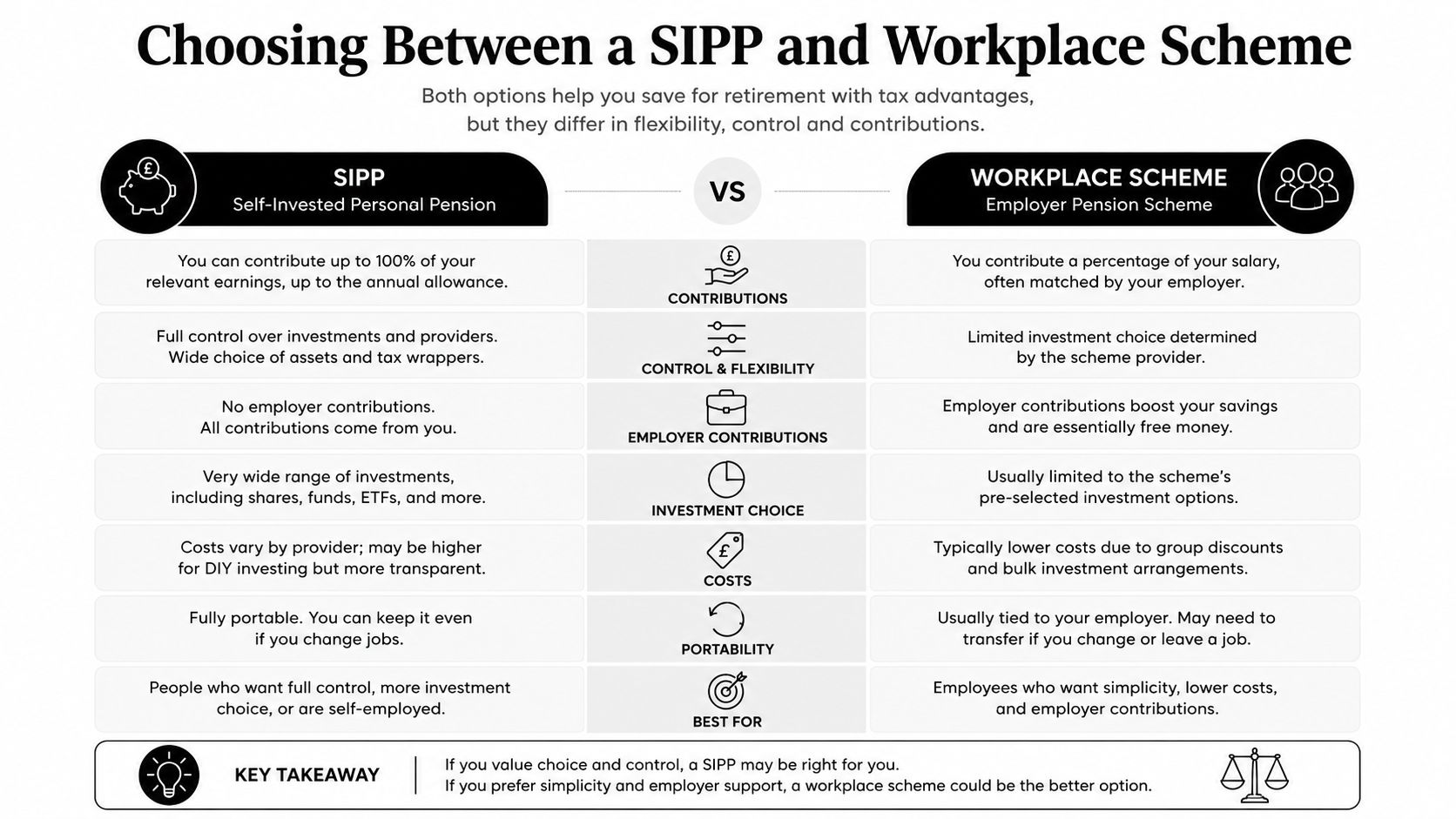
A SIPP can suit a sole-director contractor who wants investment choice and expects contributions to vary. A workplace scheme can be more convenient where the company runs regular payroll, has several workers and needs a straightforward automatic enrolment process.
The right choice depends less on the label and more on how much administration you're prepared to handle.
When a SIPP fits
A Self-Invested Personal Pension, or SIPP, normally offers a wider range of investment choices than a standard default workplace arrangement. That control can appeal to a director who understands investment risk, wants to choose funds personally or needs to make employer contributions at irregular times.
Before opening one, check:
- Corporate payment acceptance: The provider must accept contributions from the limited company and explain the required references.
- Investment charges: Compare platform, fund and dealing costs. Our SIPP fees comparison can help you identify the categories to investigate.
- Contribution timing: Allow enough time for the provider to receive and allocate the payment before the company year-end.
- Tax records: Keep invoices, payment confirmations and board approval with the company accounts.
Some arrangements may allow more complex funding features, but “unlimited contributions” isn't a substitute for annual allowance checks. Pension tax relief limits still apply, and a provider's acceptance of a payment doesn't prove that the company can deduct it for Corporation Tax.
When a workplace scheme is simpler
A workplace scheme can provide default investment governance, payroll integration and easier administration for a company with multiple employed directors or staff. NEST and other master trust arrangements are examples of workplace options, but compare charges, investment design and employer support before choosing.
If the company needs to meet automatic enrolment duties, it should also complete its required declaration or notification on The Pensions Regulator's portal. Keep the scheme status, contribution records and worker assessments together, rather than relying on a director's personal pension file.
Here's a short visual walkthrough of the decision:
A Worked Example for a Contractor-Director
Sarah's company is now trading as an IT consultancy. In this illustration, it makes £95,000 profit, and Sarah takes a £12,570 salary. The company pays £40,000 directly into her SIPP as an employer pension contribution.
The contribution isn't Sarah's dividend and doesn't pass through her personal bank account. The company records it as part of her remuneration, keeps board approval and retains evidence that the payment is commercially justifiable under the wholly and exclusively test.
What the contribution does
At a Corporation Tax rate of 25 per cent, the illustrative Corporation Tax saving on a £40,000 allowable contribution is £10,000. The company therefore experiences an illustrative post-relief cost of £30,000, while Sarah receives a £40,000 gross pension contribution.
Sarah has used £40,000 of the standard £60,000 annual allowance, leaving £20,000 unused in the current year before any other pension input is considered. She should still check contributions made to every pension, pension input periods and available carry-forward before paying more.
The pension payment doesn't create a personal income tax charge in the illustration. That doesn't mean Sarah's overall tax position is automatically settled, because her salary, dividends and other income require separate calculations.
The dividend alternative isn't equivalent
If Sarah takes the same company value as dividends instead, the company must have sufficient distributable profits and Sarah may face dividend tax. The brief example uses 33.75 per cent as the relevant personal dividend tax rate, but the actual outcome depends on her tax band and wider income.
A dividend also doesn't become a pension contribution until Sarah personally pays money into a pension. She would then use the personal contribution process, rather than the employer contribution process.
| Route | Corporation Tax | Personal Tax/NIC | Net Cost to Company |
|---|---|---|---|
| £40,000 employer contribution | Illustrative £10,000 saving at 25 per cent, if allowable | No personal income tax charge on the payment in this illustration | Illustrative £30,000 |
| £40,000 taken as dividends | Company's Corporation Tax position applies before dividends are distributed | Illustrative dividend tax at 33.75 per cent, depending on Sarah's wider position | £40,000 distributed, before personal tax |
| £40,000 salary sacrifice | Salary is exchanged for employer pension funding | Income tax and employee NI aren't charged on the sacrificed amount, subject to correct operation | Depends on the original salary and payroll costs |
The comparison shows why employer contributions often appeal to contractor-directors, but it isn't a recommendation to pay a fixed amount every year. Sarah must balance retirement funding against cash reserves, upcoming tax bills and the company's ability to support the payment.
Planning Moves and Compliance Pitfalls
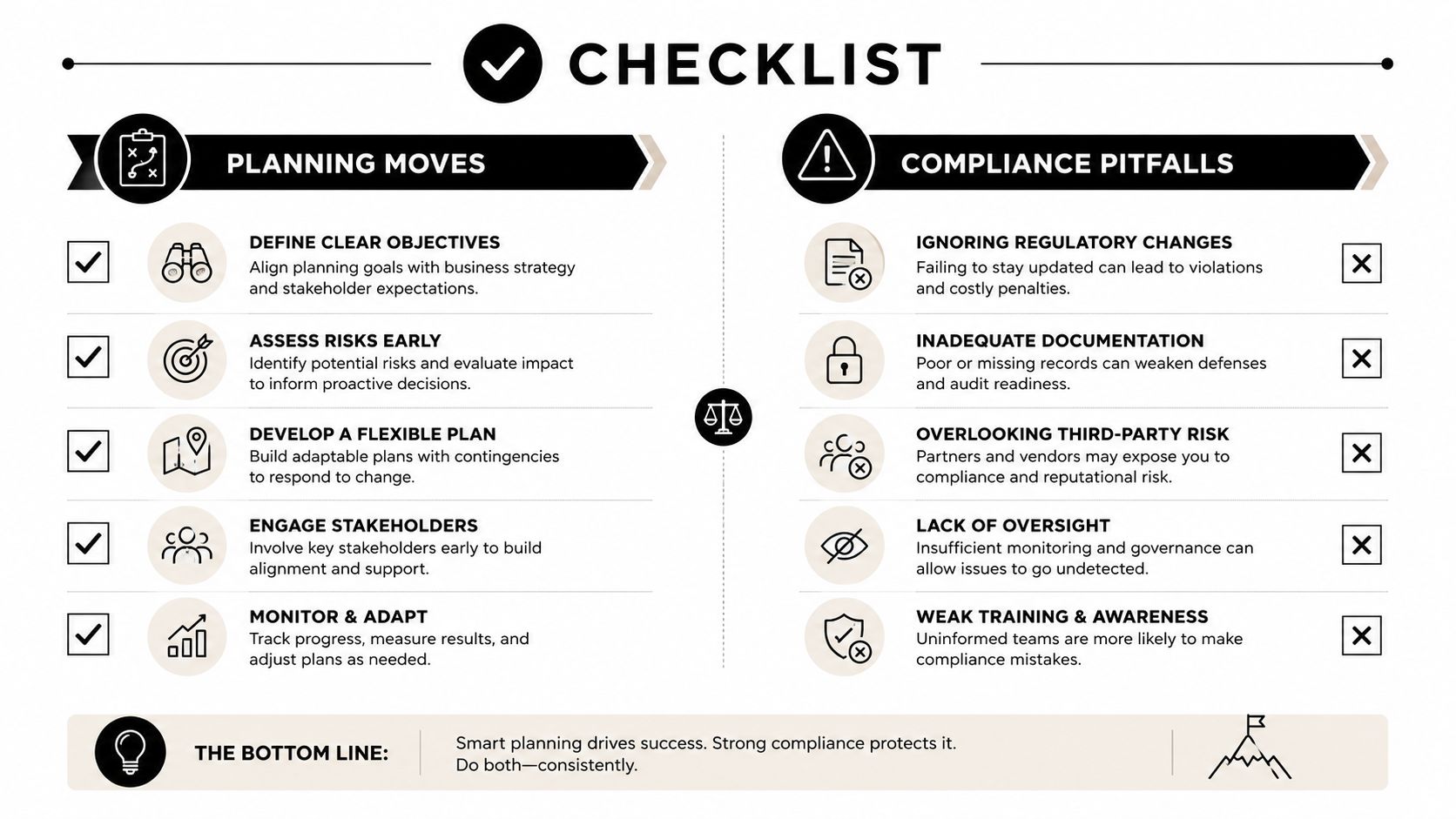
Good director pension planning happens throughout the year, not on the day the accounts are prepared. The company should decide what it can afford, why the contribution is commercially reasonable and how the payment fits with Sarah's personal allowance, dividends and expected contract income.
A practical annual routine looks like this:
- Review salary: Check whether the trading salary still fits the company's work, cash flow and wider tax plan.
- Set the contribution early: Decide the employer contribution before the company year-end, then confirm the pension provider's processing time.
- Check 5 April timing: Personal contributions belong to the relevant tax year, so coordinate them with the 5 April deadline.
- Use carry-forward carefully: Request records from every pension and calculate unused allowances before making a large payment.
- File workplace declarations: Confirm automatic enrolment notifications, declarations and worker communications were completed on time.
The mistakes that create avoidable questions
Directors often focus on tax relief and overlook the evidence behind the payment. Problems can arise when the company pays a contribution without trading profits, breaches the wholly and exclusively rule, misses a three-year re-enrolment date or treats dividends as pensionable earnings.
Salary sacrifice creates its own paperwork. The company must change the contractual salary arrangement properly and issue payslips that show the sacrificed salary and pension payment. Directors should also check the current pension rules rather than relying on old lifetime allowance figures, because the treatment of benefits and benefit crystallisation events needs specialist review.
Build an evidence trail
Keep board minutes authorising each employer contribution. Record the remuneration rationale, the company's trading position and the benefits test that supports the payment. After every contribution, reconcile the pension input amount against the annual allowance and ask the provider or administrator for confirmation where the position isn't clear.
Before paying: Ask whether the company can afford the contribution, whether the accounts support it and whether your total pension input remains within the available allowance.
Your concrete step this week is to gather your employment contract, payroll summary, pension statements and latest company accounts, then ask your accountant or regulated adviser to confirm the contribution amount and automatic enrolment position in writing. Umbrella Company helps contractors compare umbrella providers and understand employment, payroll and pension considerations, so visit Umbrella Company if you're deciding whether your current structure still suits your work.


