


You've landed a new contract, the agency says it's inside IR35, and PayStream is on the shortlist. That's a common place to be in 2026. The problem isn't understanding the sales pitch. It's understanding what the arrangement does to your payslip, your expenses, and your risk.
That's where most guides fall short. They tell you an umbrella company handles payroll and compliance, which is true but incomplete. What matters is how the numbers move, what gets deducted before you see your net pay, and whether the provider's processes will stand up if HMRC ever looks closely.
We're going to treat PayStream like a working contractor would. Practical, not fluffy. You'll get a plain-English view of how a PayStream umbrella company fits into the chain, how payroll works, where contractors get caught out on fees and expenses, and what to check before you sign anything.
Your Guide to Contracting with PayStream in 2026
If you're choosing a PayStream umbrella company, you're probably balancing three things at once.
First, you need fast onboarding because the contract starts soon. Second, you want clean compliance because agencies and clients are taking umbrella due diligence far more seriously now. Third, you want to protect your take-home pay, which is where umbrella decisions stop being administrative and start being personal.
That last point matters most. Contractors often compare umbrella companies on the headline margin and stop there. That's a mistake. What matters is the full payroll treatment, including employer costs, pension handling, holiday pay treatment, and the way reimbursed expenses are processed.
Practical rule: Never choose an umbrella company from a recruiter's one-line recommendation alone. Ask for a sample payslip and challenge anything you don't understand.
PayStream is a well-known name in the market, but brand recognition isn't enough on its own. You still need to understand how the setup works and where your money goes.
This market is no niche corner of contracting anymore. The UK umbrella company worker pool grew from about 100,000 workers in 2008 to an estimated 700,000 in 2024/2025, a seven-fold increase that has made umbrellas a dominant model for contractors and freelancers, according to analysis of the UK umbrella market.
What Is a PayStream Umbrella Company
A PayStream umbrella company is an employer of record for contractors working on temporary assignments. In simple terms, PayStream becomes your official employer while you carry out work for the end client.
An umbrella company serves as a central payroll department for contract workers. You do the assignment for the client, the agency pays the umbrella, and the umbrella runs payroll for you under PAYE.
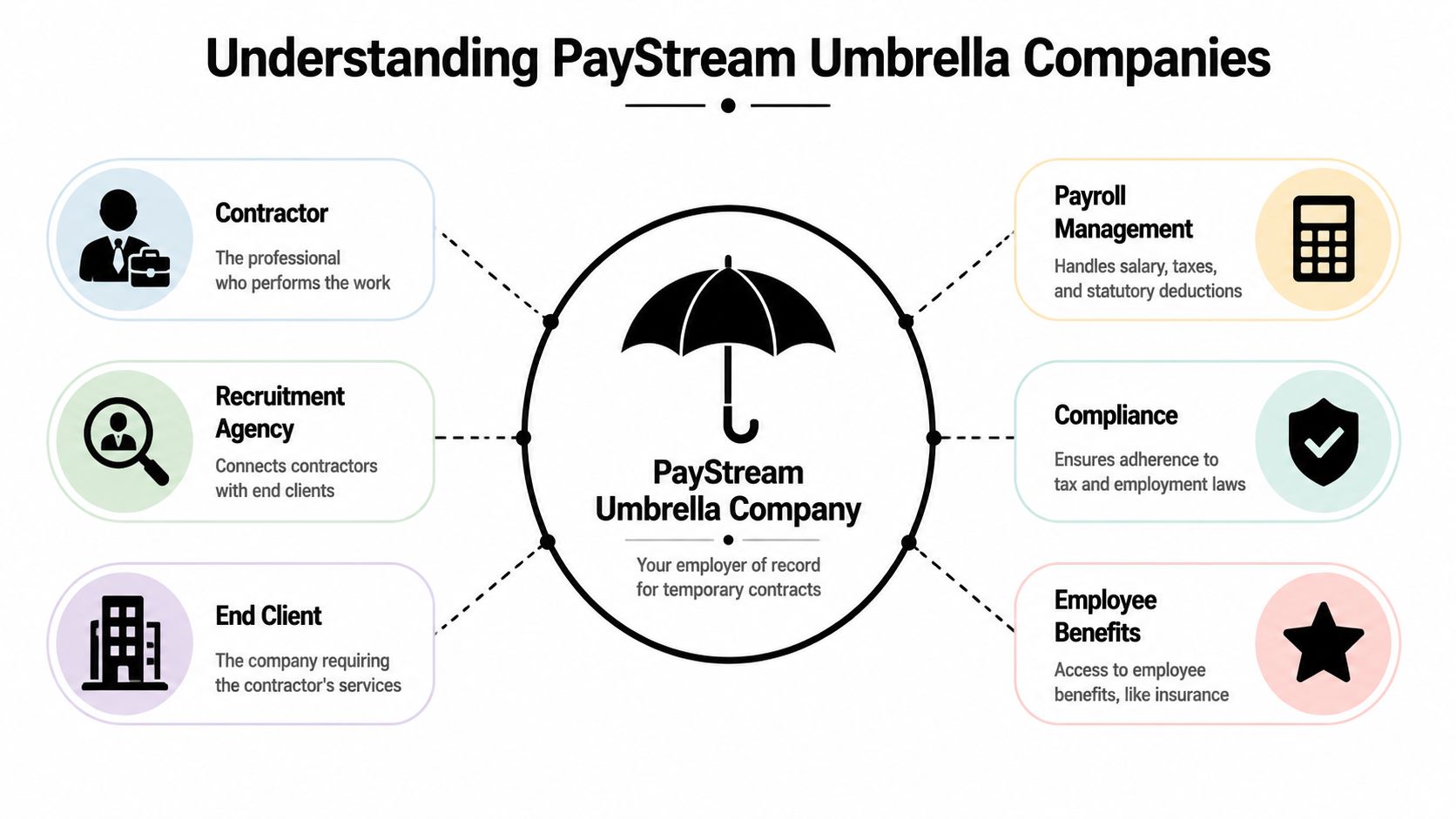
Who does what in the chain
There are four moving parts in a standard arrangement:
- You, the contractor: You deliver the work, submit timesheets or approved hours, and receive a payslip as an employee of the umbrella.
- The recruitment agency: The agency places you with the client and usually pays the umbrella company after receiving approved invoices.
- The end client: This is the business buying your labour.
- PayStream: PayStream employs you, processes payroll, deducts tax and National Insurance, and issues your payslip.
This structure exists because many inside IR35 roles need PAYE treatment. Agencies and clients want a payroll intermediary that can handle employment administration without putting every contractor directly onto the client's payroll.
Why contractors use umbrellas at all
An umbrella company solves a practical problem. It gives the agency and client a route to engage flexible workers while making sure tax is deducted through payroll. It also gives the contractor an employment wrapper that can include statutory rights such as holiday pay and sick pay, depending on the arrangement and eligibility.
That doesn't mean all umbrellas are equal. The structure is simple. The execution isn't.
The right way to view an umbrella is this: it's not just a payroll processor, it's the legal and tax mechanism sitting between your contract value and your net pay.
The money flow in plain English
Here's the basic sequence:
- You work the assignment and submit your hours or days.
- The client approves the work through the agency process.
- The agency pays PayStream based on the agreed contract rate.
- PayStream runs payroll, applying employment costs and tax deductions.
- You receive net pay plus a payslip showing how the figures were calculated.
If you're new to umbrella working, that last step is where the confusion usually starts. Contractors often assume the contract rate equals gross salary. It doesn't.
How the PayStream Payroll Model Works
The biggest misunderstanding with any PayStream umbrella company setup is this: your contract value is not the same as your taxable salary. The umbrella receives an assignment rate, then builds your employment cost model from that amount.
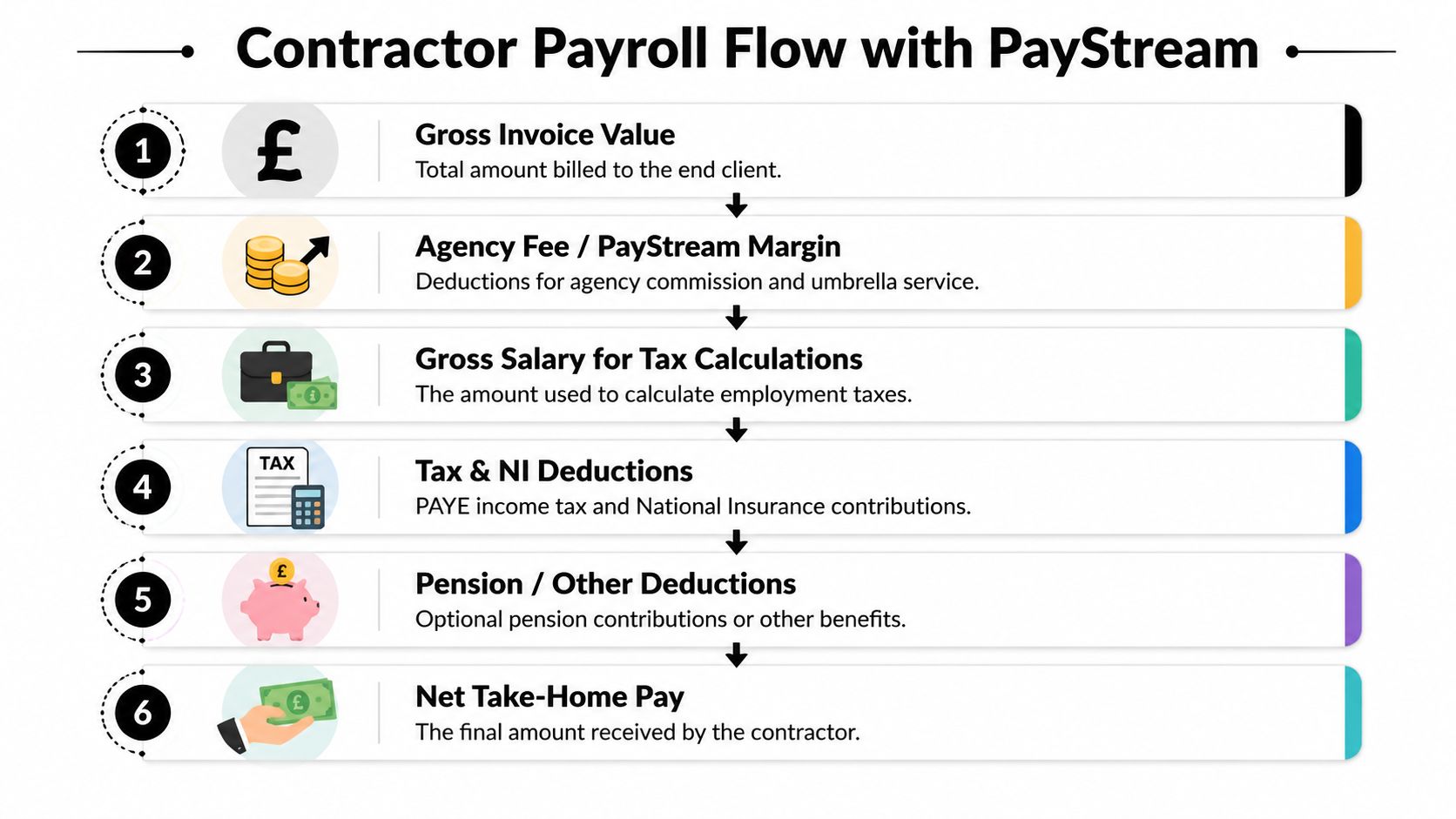
What gets deducted before your net pay
For the 2026/27 tax year, Employee National Insurance is 8% on salaries between £12,570 and £50,270, while Employer's National Insurance is 15% on earnings above £5,000 per year, and umbrella companies must deduct both from the contract value, as outlined in PayFit's summary of the 2026/27 NI changes.
That single point catches out a lot of first-time umbrella contractors. They see “employer” and assume it has nothing to do with their rate. Under an umbrella, it does, because the assignment income funds the whole employment package.
A line-by-line way to read the payslip
A typical umbrella payroll calculation works in this order:
- Assignment income comes in from the agency.
- The umbrella margin is deducted for running the service.
- Employer costs are accounted for, including Employer's NI, because the umbrella is employing you.
- A gross taxable salary is produced for payroll purposes.
- PAYE income tax and Employee's NI are deducted from that salary.
- Other deductions may follow, such as pension contributions, depending on your setup.
- Net pay is paid to you.
If your payslip feels harder to read than a standard permanent employee payslip, that's because the umbrella has to bridge two worlds. It receives a contract-based payment, then converts it into an employment payroll outcome.
Why Employer's NI matters so much
Contractors often resent this part, and I understand why. You negotiate a day rate based on market value, then find that employment costs are being funded from that same pot.
That's not a PayStream-only issue. It's how umbrella payroll works across the sector.
Here's the practical takeaway:
- Don't compare your umbrella take-home pay with a permanent employee on the same salary basis, because your contract rate is carrying more cost.
- Don't compare umbrella offers on margin alone, because a low headline fee doesn't guarantee the best net outcome.
- Do ask for a full illustration, showing all standard deductions before you sign.
For a plain-English breakdown of the mechanics, this guide on how an umbrella company works is worth reading alongside any sample payslip you receive.
What to verify before your first payment
Use this checklist against the first illustration or payslip:
| Check | What you want to see |
|---|---|
| Margin shown clearly | A specific service charge, not a vague bundled figure |
| Employer costs identified | You should be able to see what was accounted for before gross salary |
| Tax code visible | Make sure payroll is using the correct code |
| Holiday pay treatment explained | Rolled up or accrued should be made clear |
| Pension position stated | Whether auto-enrolment applies, and how contributions are taken |
Checklist mindset: If you can't explain your own payslip back to someone else, ask questions before the next one lands.
Analysing PayStream Fees and Your Real Take-Home Pay
The weekly or monthly margin is the least interesting part of the decision. It matters, but it's not where most contractors lose clarity. The key issue is how the umbrella handles the details that sit behind the advertised fee.

The expense issue contractors keep raising
Contractor discussions point to a recurring concern. Users report that reimbursed expenses are taxed as income above a very low daily limit, and they also question how fixed fees behave when pay varies, as highlighted in this contractor discussion about PayStream expense handling.
That matters because many contractors assume a reimbursement is neutral. It isn't always neutral in practice under an umbrella. The payroll treatment depends on the underlying tax rules, the nature of the expense, and the umbrella's process.
Don't rely on the headline margin
A contractor with steady weekly billing can often tolerate a simple fixed umbrella fee. A contractor with gaps between assignments, fluctuating hours, or uneven monthly billing needs to ask harder questions.
Use this framework:
- Billing pattern: If your income varies, ask exactly when fees apply and whether any charge appears during inactive periods.
- Expense treatment: If the role involves travel or subsistence, ask how reimbursements are processed and when they may be taxed through payroll.
- Pension effect: If you contribute to a pension, ask how that changes the net calculation and whether the illustration reflects your actual choice.
- Holiday pay method: Accrued and rolled-up holiday pay feel very different in the bank, even when the underlying entitlement is the same.
A lot of contractors don't model these points until after the first payment. By then, frustration replaces analysis.
How to test the real cost
Ask for a worked example based on your own expected pattern, not a generic estimate. If your week-to-week income changes, a flat “you'll take home around X” style summary isn't good enough.
You want answers to practical questions like these:
- What happens in a low-billing month?
- How are reimbursements displayed on the payslip?
- Is the fee fixed or conditional in any way?
- What changes if I opt into or out of pension contributions?
If you want a quicker sense check before speaking to any provider, try this PayStream calculator and compare the output against the provider's own illustration.
Here's a useful explainer to watch before you commit:
My recommendation on fees and expenses
Be sceptical of simplicity when your contract isn't simple.
If your assignment has regular travel, unusual reimbursed costs, or inconsistent billing, get the policy in writing before you onboard. A polished FAQ page won't protect your take-home pay. A clear written explanation of payroll treatment will.
Ask one blunt question before signing: “Show me how my pay changes in a normal month, a low month, and a month with reimbursed travel.”
PayStream IR35 and Ensuring Tax Compliance
Compliance is no longer a background issue. It's a front-end commercial issue, because agencies and clients now have stronger reasons to care who sits in the umbrella slot.
From 6 April 2026, Joint and Several Liability rules allow HMRC to recover unpaid tax from a recruitment agency or end client if an umbrella company fails to pay, which makes supply-chain choice critical, as explained in this overview of the April 2026 umbrella tax rules.
Why accreditation matters
Standards such as FCSA and Professional Passport have practical importance. They don't make a provider perfect, but they do give you a better starting point than a cheap payroll outfit with unclear processes and no recognised oversight.
If a provider says it operates compliantly, test that claim. Ask:
- Which accreditation do you hold right now
- How often are your processes reviewed
- How do you handle payslip transparency
- What due diligence information can the agency or client review
That's the same mindset used in wider audit preparation. If you want a practical checklist for organised compliance thinking, Superdocu's audit preparation tips are useful because they force attention onto documentation, ownership, and review discipline.
IR35 under an umbrella
A lot of contractors ask whether IR35 still matters if they're already working through an umbrella. In day-to-day payroll terms, the answer is simpler than people think. Under an umbrella, you are generally being paid as an employee through PAYE for that assignment.
What still matters is understanding why the role was structured that way and whether the client, agency, and umbrella each have a clean process. If you want a focused explanation, this guide on whether IR35 applies when you work through an umbrella company lays it out clearly.
My view on using PayStream for compliance
I'm opinionated on this. Choose the compliant provider over the clever provider. If a sales line sounds like it reduces tax in a way your gut doesn't fully understand, walk away.
A contractor can recover from a slightly higher margin. Recovering from a messy tax dispute is far harder.
Good umbrella compliance feels boring. That's exactly what you want.
Weighing the Pros and Cons of Using PayStream
If you strip away the branding, the choice comes down to whether the umbrella model suits your contract and whether PayStream's way of running that model suits your priorities.
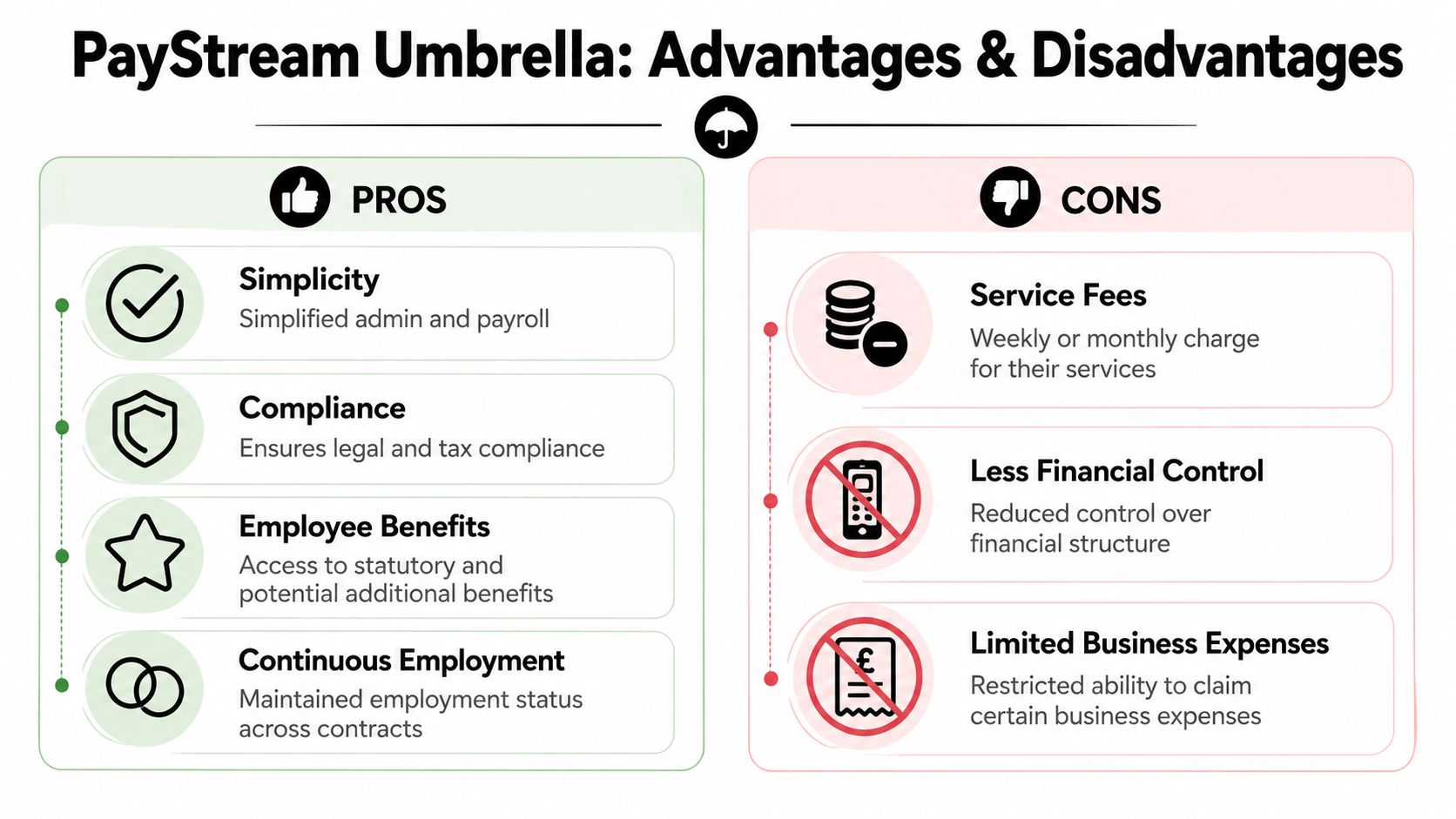
The case for using PayStream
The strongest arguments in favour are practical:
- Less admin: You're not running a limited company, handling payroll filings, or juggling corporation tax and dividend planning.
- Employment framework: You're paid through PAYE and usually have access to statutory rights linked to employment status.
- Agency-friendly setup: Recruiters and clients generally understand the model, which makes onboarding easier.
- Compliance comfort: In a market where non-compliant umbrella schemes are estimated to cost workers and the UK exchequer up to £4.5 billion annually, using an accredited provider is the clearest way to reduce financial and legal risk, according to the TUC report on non-compliance in the umbrella market.
The frustrations you need to accept
The drawbacks are just as real:
- Your take-home pay feels compressed: Employment costs and payroll deductions come out of the contract value.
- You lose structural control: You can't shape remuneration in the way a limited company contractor once might have.
- Expense treatment can be restrictive: If your assignment includes reimbursed travel or irregular costs, the payroll handling may not match your assumptions.
- The fee isn't the whole story: Even if the margin looks reasonable, the lived experience depends on payslip clarity, support quality, and accurate illustrations.
A quick decision test
PayStream is more likely to suit you if:
- You want straightforward PAYE handling
- Your agency prefers a recognised umbrella
- You value process and compliance over tax planning flexibility
It may be less attractive if:
- You obsess over every payslip line and want maximum financial control
- Your assignment pattern is irregular enough that fee structure and expense treatment become a recurring headache
- You're comparing it with a viable outside IR35 route
If you're still weighing alternatives, compare the setup against other umbrella company options before making the final call.
Your Step-by-Step PayStream Setup Checklist
If you've decided to move ahead, keep the onboarding simple and controlled. Most delays happen because contractors rush the sign-up and only ask detailed questions after payroll has started.
What to prepare first
Have these ready before registration:
- Proof of identity: Passport or other accepted photo ID for right-to-work checks.
- Personal details: Address, contact information, National Insurance details, and bank information.
- Contract information: Agency name, end client name, assignment rate, and expected start date.
- Payroll preferences: Pension position, holiday pay questions, and any documentation you want clarified before first payment.
What to do in order
- Register and review the employment documents carefully. Don't skim the key terms.
- Check the pay illustration against your expected assignment pattern. If your income fluctuates, say so now.
- Ask about expenses before the first timesheet is processed. Don't assume reimbursement means tax-free treatment.
- Confirm how holiday pay is handled. You want that understood before money starts moving.
- Tell the agency the setup is complete so they can route the contract and payment flow correctly.
- Scrutinise your first payslip line by line. That's your baseline. Fix errors immediately.
A contractor who asks sharp questions at onboarding usually has a smoother experience later. A contractor who treats setup like a box-ticking task often ends up untangling avoidable payroll confusion after the first remittance.
If you want to compare PayStream with other vetted options before committing, Umbrella Company helps contractors review providers based on role, pay rate, and IR35 setup so you can choose with more confidence.


