


Deciding how you get paid is one of the biggest calls a contractor has to make. The difference between PAYE vs umbrella boils down to one key thing: agency PAYE means you are employed directly by your recruitment agency for that one specific job. An umbrella company, on the other hand, acts as your continuous employer across many different contracts and agencies, which can seriously cut down on your admin. This guide will help you understand the core differences so you can choose the right path for your career.
Understanding the Basics for UK Contractors
Getting your head around these two payment models can seem a bit daunting at first, but once you grasp the fundamentals, you will be able to pick the right path for your contracting career. It is worth remembering that both are perfectly legitimate, compliant ways to get paid for contracts that fall inside IR35, making sure your tax and National Insurance are all handled above board.

The real difference is all about your employment status and how your money is actually processed. Let us break down what each option means for you in the real world.
Key Concepts Explained
With agency PAYE (Pay As You Earn), the recruitment agency that finds you the role becomes your employer, but only for the length of that particular contract. They are responsible for your payroll, deducting income tax and your National Insurance contributions straight from your wages before you see them. It is often seen as the most straightforward route. For a deeper dive into the mechanics, you can read our guide on how Pay As You Earn works.
An umbrella company is a bit different. It slots in as an intermediary between you and your agency or client. You become a full-time employee of the umbrella company itself. The biggest advantage here is gaining continuity of employment. This is a huge plus if you are hopping between short-term gigs with various agencies, as it keeps all your payroll flowing through one single, consistent channel.
At a Glance Comparison: PAYE vs Umbrella Company
To make things a bit clearer, the table below gives a quick summary of the main features of each payment structure. Think of it as a high-level cheat sheet to help you see the fundamental differences at a glance.
| Feature | Agency PAYE | Umbrella Company |
|---|---|---|
| Employment Status | Employee of the recruitment agency | Employee of the umbrella company |
| Continuity of Employment | No, employment ends with each contract | Yes, continuous across multiple contracts |
| Tax & NI Deductions | Handled directly by the agency | Handled by the umbrella company |
| Administration | Minimal for the contractor | You submit timesheets to the umbrella |
| Best For | Single, long-term contracts | Multiple short-term contracts |
| Additional Costs | None | A weekly or monthly margin is charged |
Ultimately, this comparison highlights the trade-offs. Agency PAYE offers simplicity with no extra costs, while an umbrella company provides employment continuity and streamlined admin across multiple jobs, in exchange for a small fee.
How Each Payment Model Actually Works
Before you can choose between PAYE vs umbrella, you need to get your head around how the money actually flows in each setup. Both are perfectly legitimate, compliant ways to get paid, but the journey from your client to your bank account is quite different.
The crux of the matter is who your legal employer is. This one detail changes everything, including how payroll is run, who sorts out your tax, and the whole structure of your working life.
The Agency PAYE Process Explained
When you go down the agency PAYE route, things are pretty straightforward. The recruitment agency that found you the gig also becomes your employer for that specific contract. Simple as that.
Because it is so direct, the agency takes care of all the payroll admin themselves. They will calculate your income tax and employee National Insurance Contributions (NICs), deducting them at source before the money hits your account. The payslip you get from them will clearly show your gross earnings and all the standard deductions.
Here is how it typically plays out, step by step:
- Contract Signed: You sign an employment contract directly with the recruitment agency for a specific role.
- Timesheets In: You send your weekly or monthly timesheets to the agency to get them approved.
- Payroll Run: The agency's in-house payroll team works out your pay, tax, and employee NICs based on the tax code HMRC has given you.
- Payment Out: You get your net pay straight into your bank, along with a payslip breaking down all the deductions.
Once the contract is over, your employment with that agency ends too. If your next job is through a different agency, you will start a brand new employment relationship with them.
How an Umbrella Company Manages Your Pay
Working through an umbrella company puts an intermediary in the middle who acts as your continuous employer. It is a model built for contractors juggling multiple assignments, often with different agencies or clients. You become a permanent employee of the umbrella company, not the agency.
There are a few more moving parts, but it comes with the huge advantage of having a single, unbroken employment record. This can be a game-changer when you are trying to get a mortgage or a loan. We cover this in much more detail in our complete guide on how an umbrella company works.
A common point of confusion is how employment costs are handled. The assignment rate you agree with the client is an all-inclusive figure. It is designed to cover not just your gross pay but also all the associated employment costs, like the umbrella company's margin, Employer's National Insurance, and the Apprenticeship Levy.
Here is a look at the typical payment flow:
- You sign one overarching contract of employment with us, your chosen umbrella company.
- We then sign a business-to-business contract with your recruitment agency.
- You do the work, get your timesheets approved, and send them to both the agency and us.
- The agency invoices your client. Once they are paid, they send the funds over to us.
- We then process your payroll. This involves deducting our margin, all the necessary employment costs (like Employer's NI), and the statutory deductions (your tax and employee NI).
- Finally, you receive your net salary and a detailed payslip that explains every single deduction.
This way of working has absolutely boomed. Recent reports show the UK umbrella sector now looks after roughly 700,000 contractors. Its growth has been turbocharged by the IR35 reforms, leading to umbrella companies contributing around £11.8 billion in tax and NICs to the UK Treasury. It really cements their place in the UK's compliant tax system. You can find more insights in the 2023 PayePass 'Shifting Sands' report.
A Financial Breakdown of Your Take-Home Pay
Let us get straight to the point. The most pressing question for any contractor weighing up PAYE vs umbrella is simple: which one leaves more money in my pocket at the end of the week?
The answer is not always black and white. It comes down to how your pay is structured and what gets deducted before it hits your bank account. To really understand the difference, we need to look at how each model handles tax, National Insurance, and other costs.
How Agency PAYE Deductions Work
When you are paid through an agency on a standard PAYE basis, the calculation is pretty straightforward. The rate you see is the rate you get, it is your gross pay, and the only deductions are your own personal tax obligations.
On your payslip, you will see deductions for:
- Income Tax: Calculated using your personal tax code.
- Employee’s National Insurance Contributions (NICs): The standard statutory deduction every employee pays.
Crucially, the agency, as your employer for tax purposes, covers the cost of Employer’s National Insurance Contributions. This cost is not taken from your agreed pay rate.
How an Umbrella Company Calculates Your Pay
This is where things get a little more complex, and it is the most common source of confusion for contractors new to the umbrella model.
With an umbrella company, the "assignment rate" you agree with the agency or client needs to cover all employment costs, not just your pay. The deductions are made from this higher rate in a specific order:
- The Umbrella Margin: This is our fee for handling all the payroll and employment admin for you.
- Employment Costs: This includes Employer’s NICs and the Apprenticeship Levy. As your legal employer, we are required by law to pay these on your behalf.
- Your Gross Pay: What is left after these deductions is your gross pay. This amount is then subject to the usual employee deductions: Income Tax and your own NICs.
This infographic shows just how much UK contractors contribute to the economy through these very tax and NICs.
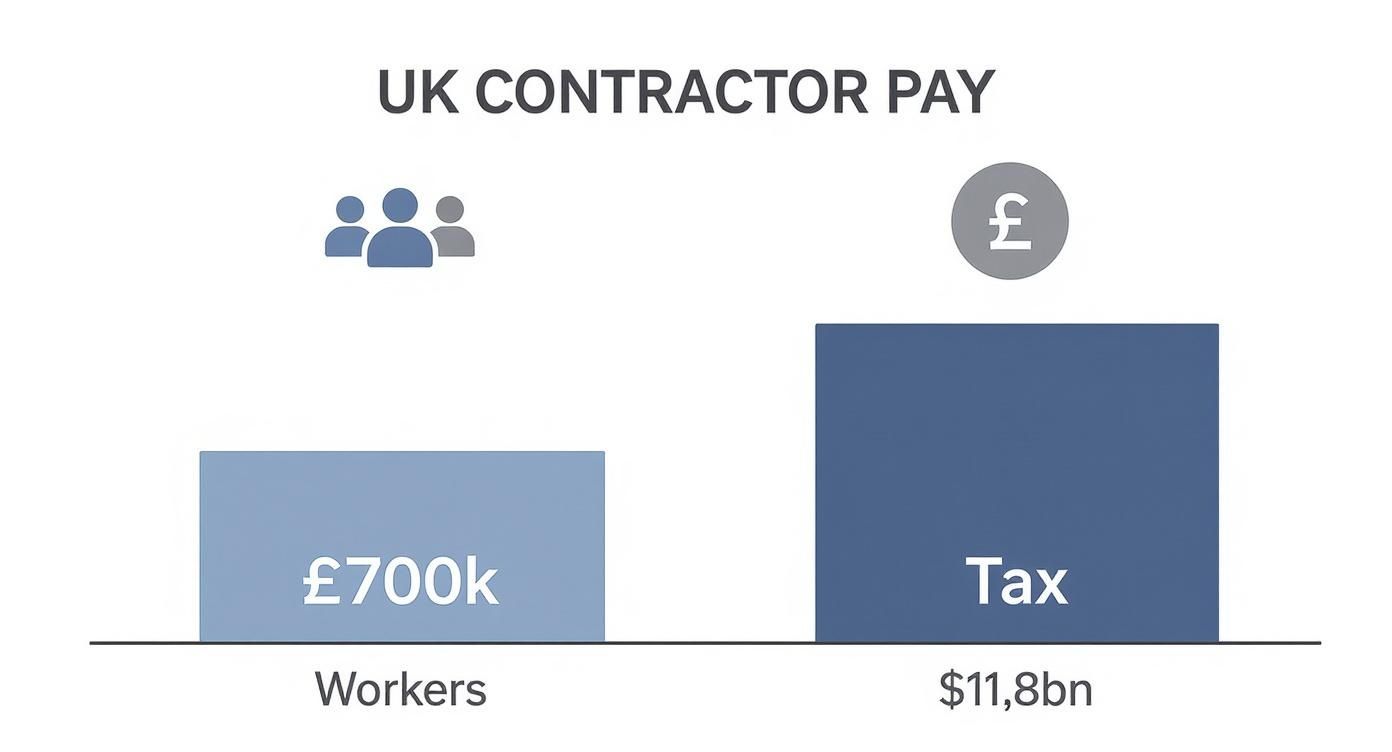
The numbers are staggering, the UK's 700,000 contractors contribute a massive £11.8 billion in tax. It really highlights why compliant payment structures are so important.
Side-by-Side Worked Examples
Let us put some real numbers to this using a typical day rate. Bear in mind these are illustrations; for a precise breakdown based on your own situation, it is always best to use a dedicated tool. You can get a personalised estimate with our PAYE vs umbrella calculator.
Scenario: A Contractor on £500 per day (5-day week)
| Deduction Stage | Agency PAYE Example | Umbrella Company Example |
|---|---|---|
| Weekly Assignment Rate | N/A (Rate is Gross Pay) | £2,500.00 |
| Gross Pay for Tax | £2,500.00 | £2,150.29 |
| (After Umbrella Costs)* | ||
| Income Tax | – £648.60 | – £553.00 |
| Employee's NICs | – £150.96 | – £132.99 |
| Take-Home Pay (Weekly) | £1,700.44 | £1,444.30 |
*Includes a typical umbrella margin (£20), Employer's NI (£302.91), and Apprenticeship Levy (£12.50). Figures are for illustration purposes only.
Key Takeaway: At first glance, agency PAYE seems to deliver a much higher take-home pay. But this is the crucial part: agencies often offer an uplifted assignment rate for umbrella contractors specifically to cover those additional employment costs. This uplift is designed to level the playing field.
The financial trade-off is clear. A contractor on a £75,000 annual equivalent might take home around £52,700 via agency PAYE. Through an umbrella, that same role might result in a take-home of £49,500 after all deductions. That difference, often between 6% and 10%, is exactly why you must ensure the umbrella assignment rate you are offered is high enough to account for these costs.
Ultimately, the choice is not just about the final number on your payslip. It is a balance between the simplicity of a direct payroll process and the wider benefits an umbrella company can offer, like employment continuity and dedicated support across multiple contracts.
Comparing Your Employment Rights and IR35 Compliance
Let us be honest, understanding your employment rights and staying on the right side of HMRC are non-negotiables for any UK contractor. When you are weighing up PAYE vs umbrella, it is easy to get fixated on the take-home pay figure. But the real difference lies in how each model supports your career and protects you legally.
First things first: both agency PAYE and a compliant umbrella company are perfectly legitimate ways to get paid for contracts deemed 'inside IR35'. This means if your contract falls under these rules, either option ensures your tax and National Insurance are deducted correctly at source. No nasty surprises from the taxman.
Where the two paths really diverge, however, is in the structure of your employment. This has a massive impact on your rights and your long-term financial stability.

Continuity of Employment: The Key Differentiator
If there is one standout benefit to using an umbrella company, it is achieving continuity of employment. Because you are a permanent employee of the umbrella, your employment record stays intact as you move between different contracts, agencies, or clients.
This single, unbroken record is gold dust when you are applying for big-ticket financial products like a mortgage or a significant loan. Lenders want to see a stable, consistent employment history, something that is notoriously tricky to show when you are jumping between short-term PAYE contracts.
An umbrella company effectively smooths over the gaps between your assignments. To a lender, this paints a picture of reliable, continuous income, which can seriously strengthen your mortgage application and boost your chances of getting approved.
With agency PAYE, your employment is tied directly to each contract. The minute an assignment ends, so does your employment with that particular agency. This leaves you with a fragmented work history that can raise a red flag for cautious mortgage underwriters.
Accessing Your Statutory Rights
As a UK worker, you are entitled to certain statutory rights, and both models deliver them. The difference is in the admin and how easily you can access them. These rights include:
- Statutory Sick Pay (SSP): A safety net that provides an income if you are too unwell to work.
- Holiday Pay: Accrued as you work, allowing you to take well-earned paid time off.
- Pension Contributions: Your contributions, and your employer's, are paid into a workplace pension via auto-enrolment.
With an umbrella company, these are all managed under one roof. Your holiday pay builds up in one continuous pot, and your pension contributions go into a single scheme, no matter how many clients you work with. It makes keeping track of your benefits incredibly straightforward.
Under agency PAYE, on the other hand, these rights are handled by each individual agency. If you work for three different agencies in a single year, you could end up with three separate pension pots and a confusing mess of holiday pay accruals. It can quickly become an administrative headache. We cover more on how IR35 and umbrella companies work together to create a compliant framework for these benefits.
Comparing Rights and Compliance Features
To lay it all out, let us look at a side-by-side comparison of the practical differences in rights, compliance, and administration.
| Attribute | Agency PAYE | Umbrella Company |
|---|---|---|
| IR35 Compliance | Fully compliant for 'inside' roles. | Fully compliant for 'inside' roles. |
| Employment Continuity | No. Employment is tied to each individual contract. | Yes. One single, continuous employment record. |
| Mortgage/Loan Applications | Can be challenging due to a fragmented work history. | Stronger. Continuous employment is favoured by lenders. |
| Statutory Rights Admin | Managed separately by each agency per contract. | Centralised management of sick pay, holiday, and pension. |
| Pension Scheme | A new scheme may be started with each new agency. | One consistent pension scheme across all contracts. |
While both routes are completely safe from a tax perspective for inside-IR35 work, the umbrella model is built from the ground up for the career contractor. It provides that stable employment foundation that makes life so much easier when you need to access financial products or just manage your statutory entitlements throughout a long and varied contracting career.
PAYE vs Umbrella: Which Path Is Right for Your Contracting Career?
Choosing between agency PAYE and an umbrella company is not just about the numbers on a payslip. It is a strategic decision that needs to line up with your professional goals and how you prefer to work. There is no single right answer, but by taking a hard look at your own situation, you can pick the path that gives you the right mix of simplicity, flexibility, and support.
The trick is to think beyond a single contract and consider the bigger picture. Are you digging in for one long-term project, or are you building a dynamic career hopping between different clients and agencies? Your answer to that question is probably the biggest clue to making the right choice.
When Agency PAYE Is the Ideal Choice
For plenty of contractors, simplicity is king. If you want a straightforward, no-fuss way to handle your employment and finances, agency PAYE is often the perfect fit. This model really works well in specific situations where its directness is a massive plus.
Agency PAYE is usually the best bet if you:
- Work on a single, long-term contract: If you are committed to one project with one agency for a good while (say, six months or more), the administrative perks of an umbrella company start to feel a bit redundant.
- Prioritise simplicity over flexibility: You would rather have a clear, direct employment relationship with your agency and not have to deal with a third-party umbrella provider.
- Do not require continuity of employment: If getting a mortgage or a big loan is not on your radar anytime soon, the need for a continuous employment record is less of a worry.
Scenario Example: The IT Project Manager
An IT contractor lands a 12-month contract with a major bank, placed by a single recruitment agency. The role is inside IR35, so a PAYE solution is a must. Since they have no plans to jump ship to another project for at least a year, the straightforward nature of agency PAYE is ideal. Their pay is handled directly, and there are no extra margins to think about.
When an Umbrella Company Makes More Sense
On the flip side, the career contractor who thrives on variety and juggles multiple clients needs a more robust setup. This is where an umbrella company really comes into its own, providing a stable employment anchor that smooths out the admin of a fast-moving career.
You should give an umbrella company serious thought if you:
- Juggle multiple short-term contracts: If your work life involves moving between different projects, clients, and recruitment agencies, an umbrella pulls all your payroll into one neat package.
- Need a continuous employment record: This is absolutely vital if you are planning to apply for a mortgage, remortgage, or loan. An unbroken employment history makes your application much, much stronger.
- Value centralised administration: You want one pension pot, one place for your holiday pay to build up, and one point of contact for any payroll questions, no matter which contract you are working on at the time.
Key Decision-Making Insight: Your choice between PAYE and umbrella should really be driven by your career path. Agency PAYE is great for a stable, singular focus, whereas an umbrella company is built from the ground up to support a dynamic, multi-client contracting career.
Scenario Example: The Freelance Graphic Designer
A graphic designer takes on three different projects over a six-month period, each sourced through a different creative agency. By using an umbrella company, they are technically employed by one company for the whole time. This keeps their tax affairs simple, ensures their pension contributions are consistent, and gives them the continuous employment record they will need to apply for a mortgage later in the year.
Ultimately, the best approach comes down to your personal and professional circumstances. By thinking about your work patterns, career plans, and how much admin you are willing to handle, you can make a properly informed decision that will set you up for success.
The Future of UK Umbrella Company Regulation
https://www.youtube.com/embed/xB734c4v9mY
The world of contracting never sits still, and the regulatory landscape for umbrella companies is heading for its biggest shake-up in years. If you are deciding between PAYE vs umbrella, understanding these changes is crucial for protecting your finances and making smart career moves.
The UK government is rolling out some major reforms aimed at boosting transparency and accountability right across the contracting supply chain. This is a direct response to the explosion in the umbrella market, with the goal of shutting down non-compliant schemes and making the system fairer for everyone.
Understanding the Shift in Tax Liability
The most dramatic change is all about who is responsible for PAYE tax. Right now, your umbrella company, as your legal employer, handles your tax and National Insurance Contributions (NICs), paying them directly to HMRC. That is all set to change.
From April 2026, the legal responsibility for ensuring PAYE is correctly paid will shift up the supply chain. It will land squarely on the recruitment agency that places you in the role. If there is no agency in the picture, the liability falls directly to the end client you are working for.
This is a landmark move by the government, designed to give HMRC more oversight and make it much tougher for dodgy schemes to operate. To get the full picture, you can read the government's official guidance on tackling non-compliance.
This is not just a minor bit of administrative shuffling. It fundamentally redraws the lines of risk and responsibility, putting huge pressure on recruitment agencies and end clients to ensure total compliance. For contractors, it means the partners you work with will be under a microscope like never before.
Why Choosing a Compliant Partner Is More Critical Than Ever
These new rules make your choice of umbrella company more important than it has ever been. With agencies and clients now legally on the hook for any tax shortfalls, they will become incredibly selective about which umbrella companies they are prepared to work with.
You can expect to see a 'flight to quality', where only the most reputable, fully compliant providers will be considered viable partners. The best way to protect yourself is to be proactive and choose an umbrella company that already holds recognised accreditations.
Look for these key signs of a trustworthy provider:
- FCSA Accreditation: The Freelancer & Contractor Services Association is the gold standard. Its members are rigorously audited against a strict code of compliance.
- Professional Passport Accreditation: This is another top-tier independent body that vets providers to make sure they stick to UK tax law and industry best practices.
By partnering with an accredited provider like UmbrellaCompany.com, you are ensuring you operate within a compliant framework. It gives you, your agency, and your end client complete peace of mind as these new regulations take effect.
A Few Final Questions
Even with a detailed comparison of PAYE vs umbrella, it is perfectly normal to have a few questions lingering. We have pulled together some of the most common queries we get from UK contractors to help you get over the finish line and make a choice with total confidence.
Can I Switch from Agency PAYE to an Umbrella Company Part-Way Through a Contract?
Yes, this is usually possible. The key is to coordinate with your recruitment agency, as they will need to update their payment process to work with your chosen umbrella company.
It is really important to get this transition right to make sure you do not face any delays in getting paid. Our best advice is to have this conversation with your agency as soon as you can to find out exactly what their process involves.
Is an Umbrella Company Always the Best Option for Inside IR35 Roles?
Not always, no. Both an umbrella company and agency PAYE are completely compliant ways to work on an 'inside IR35' contract. The right choice really comes down to your career plans.
If you tend to work on multiple contracts with different agencies, an umbrella offers the huge advantage of continuous employment. But if you are on a single, long-term contract and do not need that continuity, agency PAYE can be a simpler and slightly cheaper route.
The Bottom Line: This is a personal decision. It really boils down to whether you prefer the simple admin of agency PAYE for one-off jobs, or the long-term career benefits and employment record an umbrella company provides when you are moving between multiple assignments.
How Do I Know if an Umbrella Company Is Compliant?
This is a critical check to make. The most reliable way is to look for accreditations from respected, independent professional bodies like the FCSA (The Freelancer & Contractor Services Association) or Professional Passport.
These organisations carry out demanding audits to make sure their members follow strict UK tax and employment law. A major red flag is any provider promising unusually high take-home pay, you should always steer clear, as this almost certainly points to a non-compliant tax avoidance scheme.
Why Is Employer's National Insurance Taken from My Rate?
This is a common point of confusion, and it is a fair question. When you work through an umbrella, they legally become your employer for tax purposes. UK law requires all employers to pay Employer's National Insurance Contributions on their employees' earnings.
The assignment rate you agree with the end client is an overall figure that is designed to cover all employment costs. This includes the umbrella's margin and the Employer's NI, before your own gross pay is worked out. A fully compliant umbrella will always break these deductions down transparently on your payslip.
Trying to navigate the choice between PAYE and an umbrella company can feel like a minefield, but you do not have to figure it out on your own. At UmbrellaCompany.com, we specialise in helping contractors find the right compliant payment solution. Compare trusted, accredited providers in minutes and move forward in your contracting career.


