


Deciding on your payroll as a UK contractor is a big question: agency PAYE or an umbrella company? It’s a crucial decision that directly impacts your pay, employment rights, and how you manage your career. Getting this right from the start is fundamental to making the most of your earnings and staying compliant.
The core difference boils down to your employment status. With agency PAYE, the recruitment agency employs you, but only for the length of that specific contract. Once the assignment is over, so is the employment. An umbrella company, on the other hand, acts as your continuous employer, neatly bridging the gaps between your different assignments and giving you a single, unbroken employment record.
This guide will break down what that distinction means for you in practical terms. We'll cut through the jargon and get straight to the point on take-home pay, tax, employment rights, and how IR35 fits into the picture.
To kick things off, let's get a quick overview of the key distinctions.
Key Differences at a Glance
This table gives you a quick snapshot of the main differences between being paid via agency PAYE and through an umbrella company. Think of it as your starting point for figuring out which model fits your situation.
| Feature | Agency PAYE | Umbrella Company |
|---|---|---|
| Employer | The recruitment agency, but only for the contract's duration. | The umbrella company, providing continuous employment. |
| Employment Continuity | Your employment stops when the contract ends. | You stay employed, even between different assignments. |
| Fees and Costs | No extra fees are charged to you. | An administrative margin is deducted from your earnings. |
| Pension Options | You'll usually get access to a basic auto-enrolment pension. | Often provides access to more flexible salary sacrifice pension schemes. |
| HR Support | Limited to whatever the recruitment agency offers. | You get access to a dedicated HR function from the umbrella company. |
Understanding these points is the first step. If the whole umbrella concept is new to you, it's worth taking a moment to understand what an umbrella company is and how the model works in detail.
By the end of this guide, you will have a clearer picture of which route suits your professional goals and working style, so you can move forward with confidence. Now, let's dive deeper into what each of these points means for you.
How Agency PAYE Works for Contractors
For many contractors, especially those just starting out or taking on shorter assignments, agency PAYE is the most straightforward payroll option. When you go this route, the recruitment agency that found you the job also becomes your employer for that contract's duration. It’s a simple, transparent relationship.
The agency takes care of all the payroll administration for you. They are responsible for calculating and deducting your Income Tax and National Insurance (NI) contributions from your gross pay. Everything runs through the Pay As You Earn (PAYE) system, exactly as it would in a permanent role.

The Agency PAYE Process Explained
The process of getting paid under agency PAYE is refreshingly simple. It’s a clear, repeating cycle that removes any guesswork from payday.
Here’s how it usually works:
- Submit Your Timesheet: At the end of the week or month, you send your approved timesheet over to the recruitment agency. This is just a record of the hours you have worked.
- Agency Processes Payroll: The agency's payroll team then works out your gross earnings based on your agreed rate. From there, they deduct the necessary tax and NI based on your tax code.
- Receive Your Pay: The net amount lands directly in your bank account on payday. You will also get a detailed payslip that breaks down your gross pay, all the deductions, and the final net figure.
This setup means you do not have to deal with the administrative hassle, letting you concentrate entirely on your assignment.
A huge plus for agency PAYE is its transparency. There are no hidden fees or margins taken from your pay; your earnings are only subject to standard HMRC deductions. This makes your payslip easy to follow.
Your Rights and Entitlements
Even on a temporary contract, working through agency PAYE gives you certain statutory employment rights. As your legal employer, the recruitment agency is required to provide these.
Key entitlements you can expect include:
- Statutory Sick Pay (SSP): If you are too ill to work, you may be eligible for SSP, as long as you meet the standard criteria.
- Holiday Pay: You will build up paid holiday entitlement based on the hours you work. This is calculated at 12.07% of your hourly rate, which is the statutory minimum.
- Workplace Pension: If you meet the age and earnings requirements, the agency must automatically enrol you into their workplace pension scheme.
It’s important to remember, though, that these rights are tied to your specific contract. When your assignment ends, so does your employment with the agency and your ability to accrue these benefits. While the tax side is straightforward, if you are looking to be more strategic with your earnings, our guide on how to reduce PAYE tax as a contractor has some valuable insights, no matter how you are paid.
Understanding the Umbrella Company Model
When you are weighing up PAYE vs umbrella, you first need to get your head around how an umbrella company actually works. Think of it as your single, continuous employer, even when you are moving between different contracts and clients. This structure gives you a seamless employment record, no matter how many projects you juggle.
Essentially, you become a proper employee of the umbrella company, not the agency or the end client. This setup can really simplify your professional life, as you have one consistent employer handling all your pay. It is a well-established path for career contractors who want stability without the administrative headache.
How Does the Payroll Actually Work?
The payment process with an umbrella company is straightforward and, most importantly, keeps you on the right side of HMRC. We handle all the invoicing and payment chasing on your behalf, so you do not have to.
Here’s the typical flow:
- Submit Your Timesheet: You do the work, get your timesheet signed off, and send it to both your agency and us.
- We Invoice the Agency: We then invoice the recruitment agency for the hours you’ve worked at your agreed rate.
- We Process Your Pay: Once the agency settles the invoice, we run your salary through our own PAYE system, just like any other employer.
- Deductions and Payment: We will deduct all the necessary income tax, National Insurance, any pension contributions, and our own admin fee (the margin) before sending the net amount straight to your bank account.
This whole process means your tax affairs are always sorted, taking a massive administrative weight off your shoulders.
The Big Advantage: Continuous Employment
One of the single biggest draws of using an umbrella company is achieving continuous employment. This is a game-changer. Unlike agency PAYE, where your employment technically stops and starts with each contract, you stay on the umbrella's books even during quiet spells between assignments.
That unbroken employment history is worth its weight in gold. It is exactly the kind of stability lenders want to see, making it much easier to get a mortgage, loan, or other credit. For many contractors, this benefit alone is enough to make the umbrella route the clear winner.
Having a single, consistent employer on your record demonstrates financial stability and reliability to lenders. This can be a crucial factor when making major life purchases like a home.
Choosing a Compliant Provider Is Non-Negotiable
The UK's contracting world is heavily regulated, and it’s absolutely vital you only work with a compliant umbrella company. You will see plenty of dodgy schemes promising suspiciously high take-home pay, but they often use unlawful tax avoidance methods that can land you with a huge tax bill and penalties from HMRC down the line.
To keep yourself safe, always pick an umbrella that’s accredited by a recognised professional body. You are looking for stamps of approval from organisations like:
- The FCSA (Freelancer & Contractor Services Association)
- Professional Passport
These bodies carry out tough, independent audits to make sure their members are operating completely by the book. Partnering with an accredited provider gives you the peace of mind that your money is being handled ethically and legally, protecting you and your finances.
Comparing the Financial Impact on Your Pay
When you are weighing up agency PAYE against an umbrella company, the bottom line is usually the first thing on your mind. Your choice directly hits your take-home pay, tax situation, and overall financial health. Agency PAYE is simple and has no direct fees, but an umbrella company can open up routes to better financial planning, especially if you are a long-term contractor.
The most obvious difference is how your pay is calculated and what comes off before it hits your bank account. Agency PAYE contractors get paid straight from the agency after all taxes and National Insurance are sorted, which is straightforward but offers little flexibility. An umbrella company, on the other hand, invoices the agency or client on your behalf and then pays you, deducting their margin (usually somewhere between £15 to £30 per week) alongside the usual PAYE taxes.
Understanding the Key Deductions
No matter which route you take, standard deductions like Income Tax and employee's National Insurance are a given. But an umbrella company's payslip will have a few extra lines because they are legally your employer.
These additional deductions, which are covered by the assignment rate paid by the agency, include:
- Employer's National Insurance: As your employer, the umbrella company has to pay this.
- Apprenticeship Levy: A UK tax on larger employers that helps fund apprenticeship schemes.
- The Umbrella Margin: This is simply the fee the umbrella company charges for running your payroll.
It is vital to grasp that these are not extra costs you are paying out of pocket. They are accounted for within the overall assignment rate agreed with your agency. Any compliant umbrella will make this crystal clear from the start.
A Hypothetical Pay Breakdown Example
To paint a clearer picture, let's crunch some numbers. Imagine you are a contractor with a day rate of £500, working a standard five-day week. The financial split might look something like this.
Hypothetical Financial Breakdown at a £500 Daily Rate
| Financial Aspect | Agency PAYE Example | Umbrella Company Example |
|---|---|---|
| Gross Weekly Invoice Value | N/A (Rate agreed with agency) | £2,500 |
| Employer Costs (NI, Levy) | Covered by the agency | Approx. £290 (deducted from invoice) |
| Umbrella Margin | £0 | £25 |
| Gross Pay for Tax Purposes | £2,500 | Approx. £2,185 |
| PAYE & Employee's NI | Approx. £810 | Approx. £695 |
| Estimated Net Take-Home Pay | Approx. £1,690 | Approx. £1,490 |
Based on this simple breakdown, agency PAYE looks like the winner, leaving you with more in your pocket. However, this table does not tell the whole story, and the big missing piece is pensions.
The Power of Salary Sacrifice Pensions
This is where umbrella companies can offer a real financial edge. Most compliant providers let you contribute to a pension through a salary sacrifice scheme. This means your pension contributions are taken from your gross earnings before any tax or National Insurance is calculated.
By using salary sacrifice, you lower your taxable income, which means you pay less in tax and NI. It is one of the most effective ways to boost your net income while saving for your retirement at the same time.
Agency PAYE schemes generally just offer the standard auto-enrolment pensions, which do not come with the same tax-saving benefits. This single factor can often close the take-home pay gap and, in some cases, make the umbrella option the more profitable choice. To see just how different payroll models affect your earnings, have a look at our detailed guide on which payroll solution gives the highest take-home pay.
Ultimately, the best financial route depends entirely on your situation: your day rate, your attitude to pension savings, and your long-term goals. It is about finding the right balance between the no-fee simplicity of agency PAYE and the potential for tax-efficient saving through a good umbrella company.
Navigating IR35 and Ensuring Compliance
If you are a contractor in the UK, you simply have to get your head around the Off-Payroll working rules, better known as IR35. In short, the legislation is there to make sure contractors who work like permanent employees pay roughly the same tax and National Insurance. When a contract is determined to be 'inside IR35', it’s a clear signal that, for tax purposes, you’re treated as an employee.
That determination completely changes how you can get paid. If a contract is inside IR35, using your own limited company is almost certainly off the table if you want to stay compliant. Instead, the legal duty to deduct tax and NI contributions at source shifts to the 'fee-payer', which is nearly always the recruitment agency or your end client.

Compliant Routes for Inside IR35 Contracts
This is exactly where agency PAYE and umbrella companies step in. They are the two main, fully compliant ways to work on inside IR35 contracts. Both are set up to handle PAYE deductions correctly, keeping you and everyone else in the supply chain on the right side of HMRC.
- Agency PAYE: With this option, the agency simply adds you to their own payroll. They deduct all the necessary taxes before paying you. It is a very straightforward, HMRC-approved way of managing inside-IR35 roles.
- Umbrella Company: Here, the umbrella company becomes your legal employer. They process your pay through their PAYE system, managing all deductions on your behalf. This also provides a totally compliant solution, which gives agencies and end clients real peace of mind.
Both routes effectively eliminate the IR35 compliance risk for any assignment that falls under the rules. If you need to get into the detail of the legislation, our guide explains in full what IR35 is and how it really affects contractors.
Why Umbrella Companies Are More Popular Than Ever
Since the IR35 reforms hit the private sector back in 2021, many end clients have become much more cautious about risk. It is now common for them to insist that any contractor on an inside-IR35 project must use either agency PAYE or an umbrella company. This single change has massively driven the popularity of the umbrella model.
The numbers back this up. The use of umbrella companies has shot up since the off-payroll rules were introduced. Industry analysis points to growth of over 30% in the sector between 2017 and 2022, as more contractors looked for a compliant and low-administration way to get paid. It is now thought that over 300,000 UK contractors work through an umbrella company.
For a lot of recruitment agencies and clients, working with an accredited umbrella company is now their go-to method for inside-IR35 contracts. It lets them outsource all the employment liability and payroll headaches, guaranteeing compliance while slashing their own administration.
By choosing either agency PAYE or a trusted umbrella company, you’re ensuring you operate correctly under the off-payroll rules. It means you can get on with your work, confident that your tax affairs are being handled properly and you are protected from any potential HMRC investigation. It’s all about making a smart, compliant choice for your contracting career.
Making the Right Choice for Your Career
So, agency PAYE or an umbrella company? This decision really does shape your contracting career. There’s no single right answer for everyone; it all comes down to your personal circumstances, your professional goals, and what you truly value in your working life. It is about weighing day-to-day simplicity against long-term benefits.
To help you figure it out, we have put together a few practical questions. Think of it as a quick self-assessment to clarify which path genuinely aligns with your needs and priorities. Your answers should point you towards the right payroll solution for you.
Questions to Guide Your Decision
Mulling over these points will help you compare PAYE vs umbrella in a way that’s actually relevant to you:
- How long do you plan on contracting? If you are just dipping your toe in with one or two short-term assignments before heading back to permanent work, the sheer simplicity of agency PAYE is often the best fit. For career contractors, an umbrella company offers that valuable continuity of employment.
- Do you value a continuous employment record? This is a big one. For major financial commitments like applying for a mortgage or a significant loan, the unbroken employment history you get with an umbrella company can be a massive advantage.
- How important are enhanced pension options? If your priority is to maximise your retirement savings through tax-efficient salary sacrifice schemes, a compliant umbrella company is the clear winner.
- Do you need comprehensive HR support? Umbrella companies typically offer far more robust HR support and access to statutory benefits like sick pay and maternity leave, all managed by a dedicated employer.
Scenario-Based Recommendations
To make it even clearer, here are a few typical contractor profiles and what we would usually recommend for each.
You should probably stick with Agency PAYE if:
- You’re brand new to contracting and just want the simplest possible setup.
- Your current assignment is very short-term (e.g., less than three months).
- You do not need a spotless, unbroken employment history for any credit applications.
An umbrella company is likely the better choice if:
- You are a career contractor juggling multiple assignments each year.
- You are planning to apply for a mortgage or other major credit in the near future.
- You really want to maximise your pension contributions using salary sacrifice.
This infographic gives you a simple visual of how take-home pay can differ, based on a gross figure of £1,000.
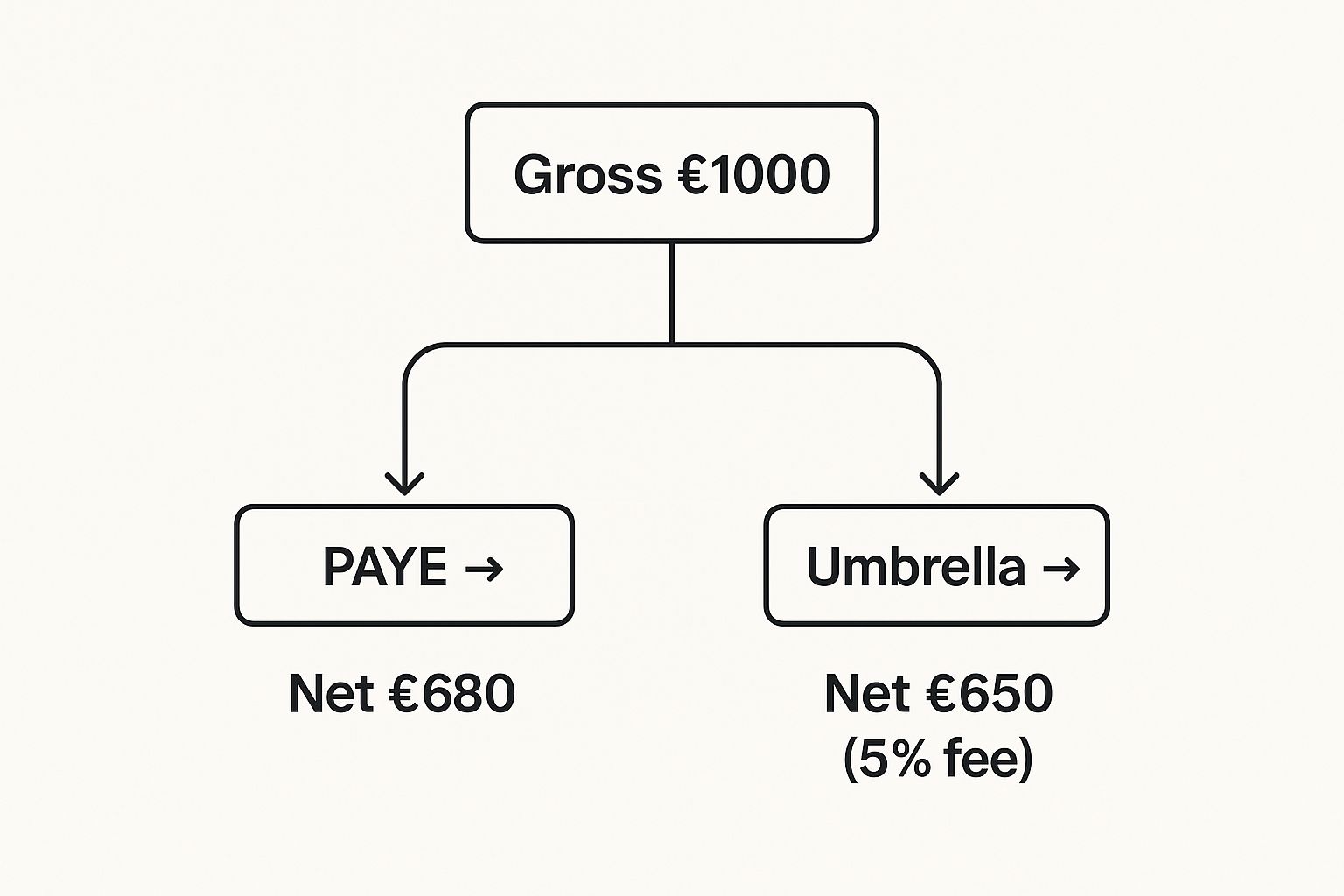
What this shows is that while PAYE might look higher at first glance, the umbrella figure does not yet account for potential tax savings from a salary sacrifice pension, which could easily close that gap.
Your choice is a strategic career decision. It is not just about the numbers on a single payslip, but about setting yourself up for financial stability and professional success down the road.
As you think about the long-term impact of your choices, exploring broader strategies for successful project management contractors can give you some valuable perspective on career development. Ultimately, picking the right payroll partner is about finding a solution that supports where you want to go.
Got Questions? We Have Answers
Deciding between PAYE and an umbrella company can throw up a few tricky questions. Let's tackle some of the most common ones we hear from contractors just like you.
Will an Umbrella Company Always Boost My Take-Home Pay?
Not always. While an umbrella company can open up routes to better financial efficiency, especially through things like salary sacrifice for pensions, it really hinges on your day rate and individual situation.
For some contractors, once you factor in the umbrella's margin, the take-home figure might end up looking very similar to agency PAYE. The only way to know for sure is to ask for a personalised pay illustration before you commit.
Can I Jump from Agency PAYE to an Umbrella Mid-Contract?
It’s often possible, but the final say rests with your recruitment agency. Most agencies work with a preferred list of umbrella companies and can usually facilitate a switch.
Your best bet is to have a direct chat with your recruitment consultant. They will help you navigate the process, making sure everyone is on the same page before you make a move.
Are All Umbrella Companies Safe to Use?
Sadly, no. The vast majority play by the rules, but a few operate as disguised tax avoidance schemes that could land you in hot water with HMRC.
To stay protected, you absolutely must choose a provider that’s accredited by a professional body like the FCSA or Professional Passport. These accreditations are your assurance that the company's processes are fully compliant with UK tax law, saving you from any nasty surprises down the line.
What Happens When I am Between Contracts with an Umbrella?
This is where one of the biggest perks of using an umbrella company comes into play: continuity of employment.
Even when you are between projects, you technically remain an employee of the umbrella company. This creates a solid, unbroken employment record, which is incredibly useful if you are applying for a mortgage or a loan. You will not get paid during these gaps, of course, but your employment contract stays active, ready for you to start your next assignment.


