


For UK contractors, the big question is always the same: does agency PAYE or an umbrella company leave more money in my bank account at the end of the month?
It's a fair question. While both routes use the PAYE system to handle your taxes, your actual take-home pay can be quite different. This is because an umbrella company deducts its margin and other employment costs, like Employer’s National Insurance, from your gross contract value.
The only real way to see the pounds-and-pence difference is to use a PAYE vs umbrella calculator.
Comparing Your Earnings: Agency PAYE vs Umbrella
Choosing between agency PAYE and an umbrella company directly impacts your net income. Both are perfectly legitimate, HMRC-compliant ways to get paid for inside IR35 contracts, but the way the numbers are processed is fundamentally different. Understanding these differences is the first step to properly forecasting your earnings.
In this guide, we will walk you through how to use a calculator effectively, so you get a transparent breakdown of your potential pay. This isn't about guesswork; it's about making an informed decision based on clear, factual information.
Key Factors That Influence Your Take-Home Pay
A few key elements will affect the final amount you receive:
- Employment Costs: When you work with an umbrella company, costs like Employer's National Insurance Contributions (NICs) and the Apprenticeship Levy come out of your assignment rate. If you are on an agency's PAYE, the agency shoulders these costs directly.
- Umbrella Margin: This is simply the fee the umbrella company charges for running your payroll and handling all the administration. It’s usually a fixed weekly or monthly amount. Agency PAYE has no equivalent charge.
- Assignment Rate: This is crucial. A good agency should offer you a higher, uplifted rate if you choose to work through an umbrella. This is to help offset those extra employment costs you are now covering. Without that uplift, your earnings will definitely be lower.
To get a quick sense of how these payroll solutions stack up, the table below gives a high-level overview before we dive into the details of a real calculation. If you want to go even deeper, check out our detailed guide on which payroll solution gives the highest take-home pay.
At a Glance: Agency PAYE vs Umbrella Company
This table breaks down the main differences that affect your take-home pay.
| Feature | Agency PAYE | Umbrella Company |
|---|---|---|
| Employment Costs | Paid by the agency directly | Deducted from the contractor's assignment rate |
| Admin Fees | None | A weekly or monthly margin is charged |
| Employment Rights | Provided by the agency | Provided by the umbrella company |
| Contract Rate | Standard PAYE rate | Higher assignment rate to cover costs |
As you can see, the core difference lies in who pays for the employment costs and whether you are charged an administration fee. Now, let's put some real numbers to this.
How an Umbrella Company Structures Your Pay

To really compare your pay options, you first need to understand how an umbrella company actually works. When you join one, they effectively become your employer for the contract's duration, which lifts a huge administrative weight off your shoulders. This setup gives you a continuous employment record, a real bonus if you are moving between different projects.
The process itself is pretty straightforward. You do the work, you submit your timesheets to the umbrella company, and they handle the rest. They will invoice your agency or client for the hours you have logged.
Once they get paid, the umbrella company runs your money through their own payroll. It is at this point they will make all the necessary deductions before sending the final net amount over to your bank account. For a deeper dive into this model, check out our full guide on what is an umbrella company.
Understanding the Key Deductions
The total figure an umbrella company invoices your agency for is called the assignment rate. It is always higher than a standard PAYE salary because it’s designed to cover all the costs of employment. Before that money hits your account, the umbrella company will deduct:
- Employment Costs: This covers things like Employer’s National Insurance Contributions (NICs) and the Apprenticeship Levy.
- Umbrella Margin: This is their fee (a fixed amount they charge for handling your payroll and administration).
- Your Statutory Deductions: This is your own Income Tax and Employee's NICs, which are calculated on what is left over.
This whole process is designed to keep you fully compliant with HMRC. Your payslip will lay all of this out clearly, showing you exactly where every penny goes. You are essentially paying for the employment benefits and flexibility of contracting, all rolled into one service.
Assignment Rate vs PAYE Rate
It is crucial to understand the difference between the assignment rate and the PAYE rate. The assignment rate is the total pot of money the agency pays the umbrella. Your PAYE rate, on the other hand, is your gross pay after the umbrella has taken its margin and covered the employment costs. This PAYE rate is the figure that your personal tax and National Insurance are based on.
The PAYE (Pay As You Earn) system is the bedrock of the UK payroll industry, used by over 30.3 million workers. While both agency and umbrella routes operate under PAYE, the umbrella model has its own financial structure, including a fee that’s usually around £20 to £30 per week.
Getting to grips with these deductions is the key to managing your finances as a contractor. For a wider view on how deductions can affect your taxable income, a guide on tax deductions and expense management can offer some great general principles. It all helps to demystify the umbrella payslip and shows you exactly what you are getting for the fee you pay.
Getting an Accurate Picture with a PAYE vs Umbrella Calculator
A PAYE vs umbrella calculator is your best friend when you need a clear, side-by-side forecast of your potential take-home pay. It cuts through the noise by applying all the right deductions to each scenario, painting a realistic financial picture before you commit. To get a result you can actually trust, though, you need to be precise with the details you put in.
Thankfully, these online tools are designed to be pretty straightforward. You just need to pull together some basic information about your contract to get a proper comparison.
What Information to Have Ready
To make sure your calculation is spot-on, it is a good idea to gather these key details before you start:
- Your Contract Rate: This is your gross rate, whether it’s hourly or daily (e.g., £400 per day).
- Your Working Pattern: Simply the number of hours you work per day and the days you work each week.
- Your Tax Code: This one is absolutely crucial for an accurate income tax calculation. For the 2024/25 tax year, the standard code is 1257L.
- Pension Contributions: If you plan on paying into a pension, have the percentage you want to contribute handy.
- Umbrella Company Margin: You will need to enter the fee the umbrella company charges. This is usually a weekly or monthly figure, like £25 per week.
The calculator takes this information and essentially runs a simulation of your earnings under both agency PAYE and an umbrella company, clearly laying out the difference in your net pay.
How the Calculator Does the Maths
The real magic of a PAYE vs umbrella calculator is how it handles employment costs. This is the part that often catches people out.
For the umbrella company calculation, it correctly deducts costs like Employer’s NICs and the Apprenticeship Levy from your gross contract value before working out your personal tax. This is exactly how umbrella payroll operates in the real world. On the agency PAYE side, it assumes the agency is covering these costs separately from your rate.
Here is what a typical calculator interface looks like.
As you can see, it clearly shows where to input your daily rate, hours, and those specific umbrella costs to get the two figures.
Let’s walk through a quick example. Imagine a contractor earning £400 per day, working five days a week on a standard tax code. They would enter those figures, along with the umbrella's margin of, say, £25 per week. The calculator then crunches the numbers for two separate payrolls. One shows the take-home pay if the agency paid them directly via PAYE, and the other shows what is left after the umbrella company has deducted its margin and all the necessary employment costs.
A common mistake is forgetting to use an "uplifted" rate for the umbrella comparison. A good agency should offer a higher assignment rate to umbrella contractors to help offset those extra employment costs. If you use the exact same rate for both calculations, the umbrella option will always look much worse financially.
To make sure your forecast is as reliable as possible, always double-check your tax code and factor in all potential umbrella fees.
And if you are not sure what your day rate needs to be to hit a certain take-home pay target, some tools can help you work backwards. Our contractor daily rate calculator, for instance, lets you start with your desired income to figure out the rate you need. That gives you a much stronger starting point for any contract negotiations.
Analysing Your Calculator Results Line by Line
Once you have plugged the numbers into a PAYE vs umbrella calculator, you will get two columns of figures side-by-side. Most people jump straight to the bottom line (the final net pay), but to really make an informed choice, you need to understand what is happening on each line. It is the only way to see exactly where your money is going.
Let's break down the results you will likely see, sticking with our example of a contractor on a £400 daily rate. This will shine a light on the small but crucial differences between the two models, especially the hidden costs tucked away in an umbrella setup.
Gross Project Revenue and Employment Costs
The first number you will spot in the umbrella column is usually labelled Gross Project Revenue or Assignment Rate. This is the full amount the agency is billed for your work. You might notice the figure in the agency PAYE column is lower; that is because it is an equivalent rate where the agency has already factored in their own employment costs.
Right away, the umbrella's assignment rate gets hit with the big deductions: the employment costs:
- Employer’s National Insurance Contributions (NICs): This is a hefty chunk that, under an umbrella, comes directly out of your assignment rate.
- Apprenticeship Levy: A much smaller percentage taken to fund UK apprenticeship schemes.
These costs are precisely why umbrella contractors need a higher, 'uplifted' assignment rate. Without it, they would never achieve a take-home pay that is even close to their agency PAYE counterparts.
Umbrella Margin and Taxable Gross Pay
After those employment costs are gone, the next specific deduction for the umbrella route is the Umbrella Margin. This is simply the flat fee the provider charges you for running their payroll and handling the administration. It is usually a weekly or monthly fee, something like £25 per week.
Only after all that is deducted are you left with your Taxable Gross Pay. This is the number that your personal income tax and employee’s NICs are calculated on. Think of it as your salary, just like a permanent employee.
The key takeaway here is that your taxable pay under an umbrella company is calculated after all employment costs and the company's margin have been paid from the initial assignment rate. This is the fundamental difference compared to agency PAYE, where the agency handles those costs separately.
To give you a clearer picture, let's lay out the numbers for our £400 per day contractor.
Example Breakdown: PAYE vs Umbrella on a £400 Daily Rate
| Line Item | Agency PAYE (Equivalent Rate) | Umbrella Company (Assignment Rate) |
|---|---|---|
| Daily Rate | £315.00 | £400.00 |
| Deductions | ||
| Employer's NI | Covered by Agency | – £44.29 |
| Apprenticeship Levy | Covered by Agency | – £1.58 |
| Umbrella Margin | N/A | – £5.00 |
| Gross Pay (for tax) | £315.00 | £349.13 |
| Employee's NI | – £24.18 | – £28.28 |
| Income Tax | – £55.96 | – £69.61 |
| Net Pay (Take-Home) | £234.86 | £251.24 |
As the table shows, even though the starting umbrella rate is much higher, the deductions for Employer's NI and the umbrella's fee eat into that headline figure before your personal tax is even calculated.
When using a PAYE vs umbrella calculator, the umbrella's fees are a critical variable. They can range from £20 to £30 per week, and that is before you factor in the Employer's NICs being passed on to you. These combined deductions can seriously shrink your earnings. While agency PAYE does not have these extra costs, many contractors find the continuity and statutory rights that come with an umbrella company a worthwhile trade-off. You can learn more about the different umbrella company fee structures and their impact on pay.
This chart gives you a quick visual summary of how the deductions stack up.
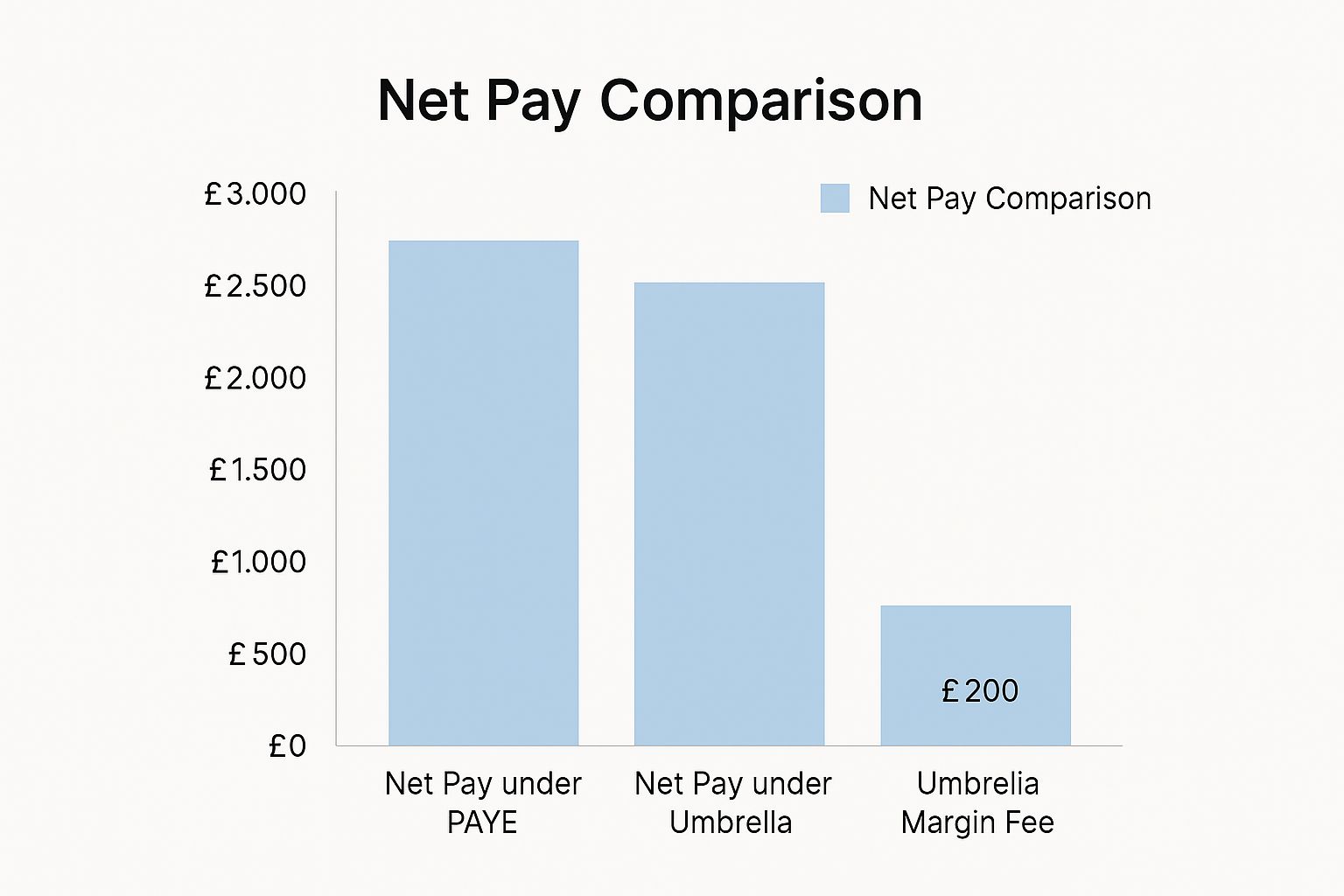
It makes it pretty clear: while the gross rates are different, it is the umbrella margin and those employment costs that ultimately shape your final take-home pay.
Choosing the Right Option for Your Career

A PAYE vs umbrella calculator is great for crunching the numbers, but your career choice often comes down to more than just the bottom line. Personal circumstances, your career goals, and even just your preferred way of working all have a massive part to play.
The figures give you a vital starting point, of course, but they simply do not tell the whole story. It is about weighing that final take-home pay against the practical, day-to-day realities and benefits of each route. Let’s look at a few real-world situations to help you see beyond the payslip.
When an Umbrella Company Makes Sense
For many contractors, a slightly lower take-home pay is a price well worth paying for the stability and sheer simplicity an umbrella company brings to the table. It is a route that really shines in certain scenarios.
Imagine you are a contractor juggling multiple, short-term projects with different agencies. This is where an umbrella company can be a lifesaver:
- A Continuous Employment Record: This is gold dust when you are applying for a mortgage or a loan. It shows a steady employment history, not a patchwork of short gigs.
- Administrative Simplicity: You just submit your timesheets, and that is it. The umbrella company handles all the invoicing, payroll, and tax headaches, leaving you free to actually do the work you are being paid for.
- Statutory Benefits: You get access to things like statutory sick pay and holiday pay. This provides a safety net that you would not get if your PAYE assignments were spread across different agencies.
- Inclusive Insurance: Most compliant umbrella companies wrap professional indemnity and public liability insurance into their service, which is one less thing for you to worry about and pay for.
For contractors who value convenience and a clean employment record, that small umbrella margin is often a small price to pay for genuine peace of mind.
When Agency PAYE is More Advantageous
On the flip side, there are plenty of times when the straightforward nature of agency PAYE is the most logical and financially sound choice. It cuts out the middleman, and that can be very appealing.
Take a contractor on a single, long-term assignment that is clearly ‘inside IR35’. In this case, the main benefits of an umbrella company start to feel a bit redundant.
The primary advantage here is purely financial. With no umbrella margin to pay and no additional employment costs being carved out of your rate, more of your earnings hit your bank account.
While this guide focuses mainly on the PAYE and umbrella debate, it is worth noting that many contractors also consider setting up their own limited company. Understanding the tax implications of forming a UK limited company is absolutely critical if you are exploring all your options. Ultimately, the right decision has to align with both your immediate financial needs and your long-term career goals.
Why You Must Choose a Compliant Provider
When you are running numbers through a PAYE vs umbrella calculator, the results you see are only as solid as the provider behind the tool. Choosing a fully compliant umbrella company is not just a box-ticking exercise; it is absolutely fundamental to your financial security and professional standing. The market is unfortunately littered with non-compliant providers pushing dodgy tax avoidance schemes.
These schemes almost always dangle the carrot of unusually high take-home pay, which should be an immediate red flag. They often use clever but illegal methods like disguised remuneration or mini-umbrella company structures to sidestep paying the right amount of tax. If you get caught up in one, you could face a major HMRC investigation and a massive tax bill years after the fact.
Checking for Compliance Accreditations
So, how do you spot a trustworthy provider? The simplest way is to look for accreditations from respected, independent UK bodies. Keep an eye out for approvals from organisations like the FCSA (The Freelancer & Contractor Services Association) or Professional Passport.
These groups put their members through rigorous audits to make sure they are operating to the highest compliance standards. Seeing one of their logos is a very strong sign that the umbrella company is legitimate, transparent, and genuinely committed to protecting its contractors. If a provider’s take-home pay calculation looks too good to be true, it always is. To get a better feel for how compliant providers work, check out our guide on finding a tax-efficient umbrella company in the UK.
Upcoming Legislation Changes
The government is also tightening the screws on non-compliance. From April 2026, new rules on joint and several liability are coming into force. This means recruitment agencies and even the end-clients could be held financially responsible for an umbrella company's unpaid tax debts.
This change is going to force everyone in the supply chain to be far more careful about who they work with, making your choice of a compliant partner more critical than ever. You can read more about the new liability rules to understand the full scope of these reforms.
Your due diligence protects not only you but everyone involved in your contract. A compliant provider ensures your taxes are paid correctly, providing complete peace of mind and safeguarding your future.
A Few Final Questions
Navigating your payment options can bring up a few final queries. We have gathered some of the most common questions contractors ask when weighing up their choices with a PAYE vs umbrella calculator.
Is My Take-Home Pay Always Lower with an Umbrella Company?
In most like-for-like scenarios, yes. An umbrella company has its own margin to cover, and you will see deductions for employment costs like Employer’s NICs. This means that compared to an identical agency PAYE rate, the net pay is usually lower.
However, a good recruitment agency should recognise this and offer an uplifted assignment rate to help offset these extra costs. The only way to know for sure is to run the numbers through a reliable calculator to see the real-world difference.
Can I Still Claim Expenses Through an Umbrella Company?
This is a common point of confusion, but the rules are now quite strict. Following changes to legislation, specifically the rules around Supervision, Direction, or Control (SDC), most contractors can no longer claim tax relief on travel and subsistence expenses.
Claims are really only possible if you can prove you are not under the SDC of the end client, which is rare for inside IR35 roles. Your best bet is always to get clear guidance from a compliant umbrella company about what is permissible before you assume anything.
Are Umbrella Companies the Only Choice for Inside IR35 Contracts?
Not at all. When a contract is deemed 'inside IR35', you have two fully compliant payment solutions: agency PAYE or working through an umbrella company.
Both routes ensure that the correct Income Tax and National Insurance contributions are properly deducted at source, keeping you on the right side of HMRC. The choice often comes down to the rate offered, continuity of employment, and administrative preference.
Ready to see how the numbers stack up for your next contract? At UmbrellaCompany.com, we make it easy to compare trusted, compliant umbrella providers.
Find the best option for your needs in just a minute: https://umbrellacompany.com


