


If you’re a contractor, the term PAYE might sound like something straight out of a permanent employee’s handbook. In a way, it is. It's the standard system the UK uses to collect Income Tax and National Insurance from your earnings.
When you work through an umbrella company or a recruitment agency, they become your employer for tax purposes. This means we handle all the payroll administration, deducting the correct amount of tax and NI and sending it straight to HMRC for you. It’s a straightforward way to make sure you're fully compliant, particularly for contracts that fall inside IR35.
Your Guide to Navigating PAYE as a Contractor
Stepping into the world of contracting is exciting. It offers a level of freedom and opportunity that traditional employment often can't match. But with that freedom comes the responsibility of managing your own finances, and that’s where things can get confusing. This guide is here to demystify the Pay As You Earn (PAYE) system for UK contractors.
Our aim is to give you the confidence that comes from understanding your money. We will break down what PAYE is and show you how it works when you're paid via an umbrella company or agency. Getting to grips with this is vital for staying on the right side of HMRC and making smart choices for your career.
What You Will Learn in This Guide
Throughout this guide, we will cover the key aspects of the PAYE for contractors system. You will gain a solid grasp of the core areas, so you can handle your financial obligations without the headache.
Here’s a look at what we’ll cover:
- The Mechanics of PAYE: How an umbrella company takes your gross contract value and processes it into your net pay, deducting tax and National Insurance along the way.
- The IR35 Connection: We will explore the crucial link between the off-payroll working rules (IR35) and why PAYE is often the required payment method for 'inside' roles.
- Reading Your Payslip: We will explain a typical contractor payslip, detailing what each deduction and figure means, from gross assignment income to your final take-home pay.
- Umbrella vs. Limited Company: A clear comparison of the two main ways of working, helping you weigh up which one makes the most sense for your situation.
By the end of this guide, you will be able to read your payslip with confidence, stay compliant, and make better-informed decisions. For a deeper dive into the basics first, check out our detailed explanation of the Pay As You Earn system.
Now, let's explore how PAYE works when you're a contractor.
Understanding How PAYE Works for Contractors
Pay As You Earn (PAYE) is HMRC's standard system for collecting Income Tax and National Insurance. It is the usual way most people in the UK pay their taxes. For contractors, an umbrella company usually manages this for you by becoming your employer for tax purposes.
This setup ensures your taxes are paid correctly and on time, just like a permanent employee. The main benefit for you is that it removes the complex tax administration from your workload, allowing you to focus on your work.
Here’s the basic flow: your client or agency pays the umbrella company for the work you’ve done. The umbrella then processes this through their payroll, manages all the tax deductions, and pays the final net amount into your bank account.
The Flow of Funds From Client to Contractor
It is helpful to understand the journey your money takes. It is not a straight line from the client to your pocket. When you're with an umbrella, the payment follows a clear, compliant path built to handle all necessary employment costs and taxes correctly.
At first glance, it might look complicated, but it's the standard, compliant way of operating under PAYE for contractors. This process ensures that all liabilities (like Employer’s National Insurance) are paid before your personal tax is calculated.
Here’s a quick rundown of the steps:
- 1. Invoice and Payment: The umbrella company invoices your agency or client for your time. The value of this invoice is often called the assignment rate.
- 2. Employment Costs Deducted: Once the invoice is paid, the umbrella first deducts its margin and the legal employment costs. This covers things like Employer’s National Insurance and the Apprenticeship Levy, which any UK employer must pay.
- 3. Gross Pay Calculation: What’s left after those costs are deducted is your gross pay. This is the figure used to calculate your personal Income Tax and Employee's NI, much like a regular salary.
- 4. Final Deductions and Net Pay: From your gross pay, the umbrella then deducts Income Tax (based on your tax code) and your Employee's NI. The amount remaining is your net pay, the money that lands in your account.
What Is Deducted Under PAYE
When you receive your payslip, you'll see a list of deductions that turn your initial contract value into your take-home pay. It's crucial to understand these, as they're all legitimate costs of being employed through an umbrella. Some are employment costs, and others are your personal taxes.
The UK's private sector is vast. The construction industry alone has over 384,000 VAT and/or PAYE-registered businesses. Across every industry, companies rely on systems like PAYE to stay compliant, especially since the IR35 reforms. You can explore more data on UK enterprise statistics if you're interested in the numbers.
By acting as your employer, a compliant umbrella company takes on the responsibility for these deductions. We provide you with full employment rights and ensure you pay the correct amount of tax to HMRC. This structure is the cornerstone of compliant contracting for inside IR35 roles.
The table below breaks down the key deductions you should expect to see on your payslip.
Key Deductions Handled Under PAYE for Contractors
This table summarises the standard deductions a contractor can expect to see on their payslip when paid via PAYE through an umbrella company.
| Deduction Type | Description and Purpose |
|---|---|
| Umbrella Margin | A small, fixed fee the umbrella company retains for running your payroll and providing its services. This is their only source of income from you. |
| Employer's NI | A contribution the employer (the umbrella) must pay to HMRC on your earnings. This is a mandatory cost of employment. |
| Apprenticeship Levy | A levy paid by large UK employers to fund apprenticeship schemes. It's calculated as 0.5% of the annual pay bill. |
| Income Tax | Your personal tax on earnings, calculated using your specific tax code and the current government tax bands. |
| Employee's NI | Your personal National Insurance contribution, which pays for services like the NHS and your State Pension. |
| Pension Contributions | If you've been auto-enrolled into a workplace pension through the umbrella, your contributions will be deducted from your gross pay. |
Familiarising yourself with these deductions means no surprises on payday. It also gives you the confidence that your finances are being handled correctly and compliantly.
The Critical Link Between IR35 and PAYE
For any UK contractor, understanding the relationship between the off-payroll working rules (known as IR35) and PAYE is essential. The two are completely intertwined.
Simply put, IR35 is tax legislation that examines your contract and working practices to determine if you're a genuine independent business or a 'disguised employee' for tax purposes.
If your contract resembles traditional employment, it is classified as ‘inside IR35’. This decision has a direct consequence: your earnings must be taxed through PAYE, just like an employee's salary. This makes PAYE for contractors the only compliant payment route.
This is why so many conversations about contractor pay focus on IR35. Your status is not a personal choice, it is a legal requirement with significant financial implications.
Who Determines Your IR35 Status?
The rules changed a few years ago. For most public and private sector contracts, the responsibility for deciding your IR35 status now rests with your end client. This was a major shift, introduced to the public sector in 2017 and rolled out across the private sector in 2021.
In practice, this means the company you are working for must assess the engagement. They then issue a formal document called a Status Determination Statement (SDS), which declares the role as either inside or outside IR35. This SDS must be passed down to you and whoever pays your invoices (usually your recruitment agency).
Because clients are now financially liable for incorrect determinations, many have become more cautious. This has led to a significant increase in roles being classified as inside IR35, making a reliable PAYE payroll solution more important than ever.
Scenarios That Lead to an Inside IR35 Determination
An 'inside IR35' decision is not just about your contract's wording; it reflects the reality of your working relationship with the client. HMRC looks for signs of an employer-employee dynamic.
Here are a few classic indicators that often point to an inside IR35 status:
- Control: The client has a high degree of control over your work. They specify not just what to do, but also how, when, and where you do it, for example, by insisting you work 9-to-5 from their office.
- Substitution: You do not have a genuine right to send a qualified substitute to perform the work. If the client is paying for you personally, it looks like employment.
- Mutuality of Obligation (MOO): This concept is about mutual expectation. If the client is expected to offer you work and you are obliged to accept it, this mirrors a standard employment agreement.
If these elements are central to your engagement, it is almost certain to be classed as inside IR35. Understanding these rules is vital. You can dive deeper by reading our full guide on what IR35 is and how it impacts contractors.
Why PAYE Is the Compliant Solution for Inside IR35
When a role is determined to be inside IR35, HMRC insists that your income is taxed at source through PAYE. This is non-negotiable. This process ensures the correct Income Tax and National Insurance Contributions are deducted and paid, just as they would be for a permanent member of staff. Trying to circumvent this (for example, by paying yourself dividends for an inside-IR35 contract) is a fast track to being accused of tax avoidance.
This is where a compliant umbrella company becomes the default solution for thousands of contractors. By employing you for the duration of the contract, we take care of the entire PAYE process. It ensures you, your agency, and your end client are all fully compliant with HMRC's rules.
Using a service like ours offers a simple, risk-free way forward. We handle all the deductions (Employer's and Employee's NI, Income Tax, the Apprenticeship Levy) and provide you with a clear, detailed payslip showing every calculation. This gives you complete peace of mind, letting you focus on your work knowing your taxes are handled correctly.
How to Read Your PAYE Contractor Payslip
Your payslip is more than just a summary of your pay. It tells the complete story of your earnings, from the client's invoice to the money landing in your bank account. We believe every contractor should be able to read theirs with total confidence.
Let's walk through a typical payslip, line by line, so you can see exactly where every pound goes.
From Assignment Rate to Your Gross Pay
The first and usually largest number you'll see is the assignment rate or contract value. This is the total amount invoiced to your agency or client for your work. It is an important starting point, but it's not what you'll take home.
Before we can calculate your personal tax, a few deductions must be made. These are the mandatory costs of employment that we, as your legal employer, must handle and pay to HMRC on your behalf.
Here’s what comes off first:
- Our Margin: This is the simple, fixed fee we charge for running your payroll and handling all the administration. It's the only income we make from the process.
- Employer’s National Insurance: A standard, compulsory contribution every UK employer must pay on their employees' earnings.
- Apprenticeship Levy: A UK-wide tax on larger employers that helps to fund national apprenticeship programmes.
Once these employment costs are taken from the initial assignment rate, what's left is your gross pay. This is the figure on which your personal tax deductions will be calculated.
This flowchart shows how a contract determined to be 'inside IR35' flows directly into a compliant PAYE payroll process like this one.
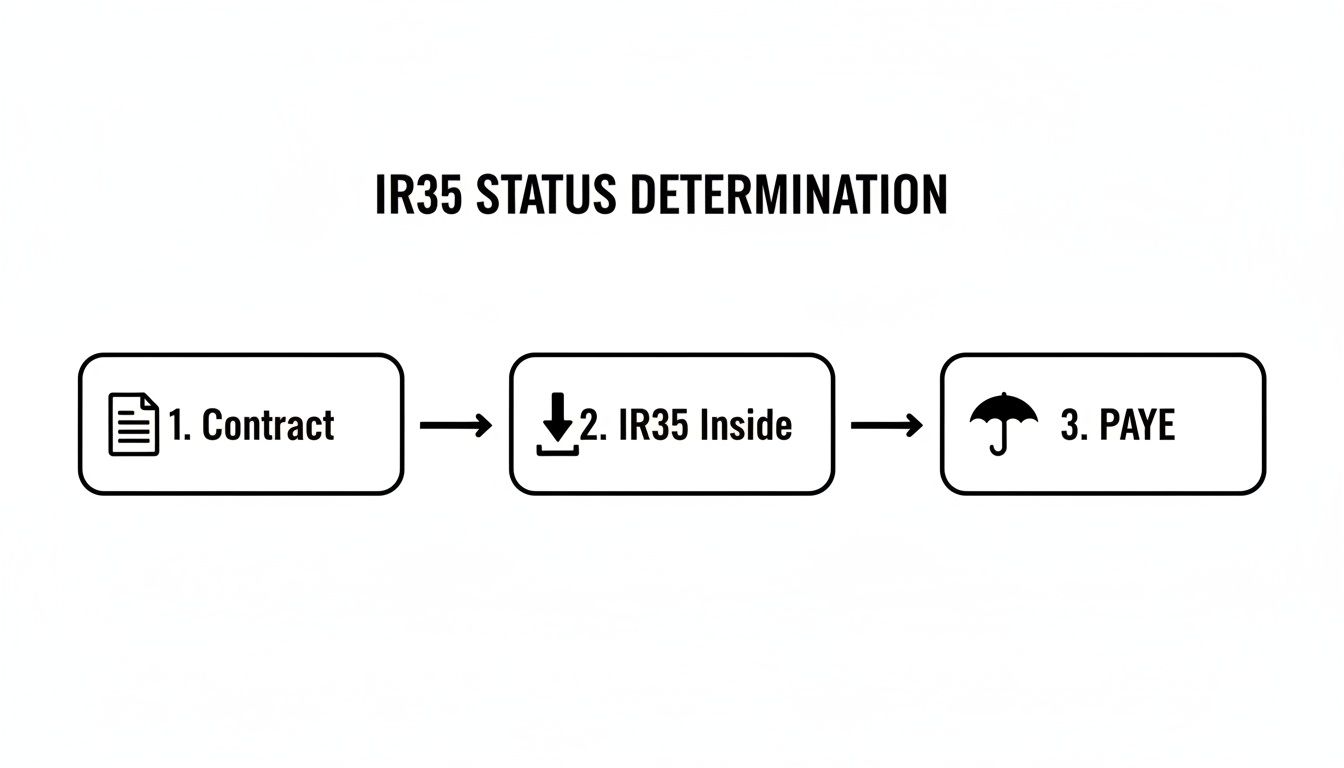
As you can see, once an engagement is assessed as inside IR35, using a PAYE umbrella is the compliant path forward, ensuring all tax responsibilities are correctly met.
Example PAYE Payslip Calculation for a Contractor
To make this crystal clear, let's look at a worked example. This table breaks down how an invoice for a week's work is turned into your take-home pay, step by step.
| Item | Calculation/Description | Example Amount (£) |
|---|---|---|
| Assignment Rate | Total invoiced to agency/client (e.g., £600/day for 5 days) | £3,000.00 |
| Less Employment Costs | ||
| Umbrella Company Margin | Our fixed weekly fee for services | – £25.00 |
| Employer's NI | Calculated on earnings above the threshold | – £342.92 |
| Apprenticeship Levy | 0.5% of the payroll bill | – £14.66 |
| Gross Pay (for tax) | The amount subject to your personal deductions | £2,617.42 |
| Less Employee Deductions | ||
| Income Tax (PAYE) | Based on your personal tax code | – £876.60 |
| Employee's NI | Your personal National Insurance contribution | – £132.82 |
| Workplace Pension | Your optional contribution (e.g., 5%) | – £130.87 |
| Net Take-Home Pay | The final amount transferred to your bank account | £1,477.13 |
This two-stage calculation, first to find your gross pay and then to find your net pay, is standard for all compliant umbrella companies.
From Gross Pay to Your Net Take-Home Pay
Now we get to the part of the payslip that deals with your personal contributions. Starting with your gross pay, we calculate your Income Tax and your Employee's National Insurance Contributions (NICs). These are the same kinds of deductions a permanent employee would see on their payslip.
The amount deducted depends on your personal tax code (provided by HMRC) and the current tax and NI thresholds set by the government each year.
The main deductions from your gross pay are:
- Income Tax: Calculated using the standard UK tax bands (Basic, Higher, and Additional rates).
- Employee’s National Insurance: This is your contribution towards state benefits like the NHS and your State Pension.
- Pension Contributions: If you’ve opted into our workplace pension scheme, your contributions are taken here.
After all deductions, the final figure is your net pay or take-home pay. This is the amount we send directly to your personal bank account. For a more detailed look at the calculations, you can check out our guide on how PAYE is calculated.
A clear, transparent payslip is the hallmark of a compliant umbrella company. It should detail every single deduction, leaving no room for confusion. If a payslip seems vague or includes odd terms like 'loan' or 'advance', it's a massive red flag.
By understanding this two-stage process, you get full visibility over your earnings. This knowledge gives you the power to check your pay is always being handled correctly and compliantly.
Choosing Your Path: PAYE Umbrella vs. Limited Company
As a contractor, one of the biggest decisions you'll make is how to structure your work. You are essentially choosing between two main paths: operating through a PAYE umbrella company or setting up your own limited company.
Each route has its own responsibilities and benefits. This decision is not just about tax; it’s about matching your business structure to your career goals, risk appetite, and how much administration you are willing to handle. Let's break down the options so you can make an informed choice.
The Simplicity and Security of a PAYE Umbrella
For many contractors, especially those whose contracts fall 'inside IR35', an umbrella company is the most straightforward and secure option. When you join an umbrella, you become their employee for tax purposes. This step removes the burden of administration and compliance risk from your shoulders.
So, what are the main benefits of using a PAYE umbrella company?
- Immediate IR35 Compliance: If your role is inside IR35, an umbrella is the industry-standard solution. It guarantees all your earnings are taxed correctly through PAYE, keeping you, your agency, and your client compliant with HMRC.
- Minimal Administration: The umbrella handles everything, from invoicing the client to processing your payroll and paying taxes. You just need to submit your timesheets. We do the heavy lifting so you can focus on your job.
- Statutory Employment Rights: As an employee of the umbrella, you get legal protections. This includes statutory holiday pay, sick pay, and a workplace pension scheme, providing a safety net often missing from contracting.
- Continuity of Employment: Working on multiple contracts through the same umbrella gives you a continuous employment record. This can be a great help when you're applying for a mortgage or other credit.
The umbrella route is ideal for contractors who want to focus on their work without the headache of running a company. It's all about simplicity and peace of mind.
The Control and Efficiency of a Limited Company
Setting up your own limited company, often called a Personal Service Company (PSC), puts you in control. It can be more tax-efficient but is only suitable for contracts genuinely 'outside IR35'. It also comes with significant legal and administrative responsibilities.
As the director of your own company, you are in charge. You manage the finances, make key decisions, and are legally responsible for maintaining compliance.
A major appeal of a limited company is the potential tax efficiency. Directors can draw a small salary and take the rest of their income as dividends, which are taxed at lower rates. This can often lead to a higher take-home pay compared to a standard PAYE setup.
However, this financial freedom requires careful management. For example, determining the most tax-efficient salary is complex. For the current tax year, many experts suggest a director's salary of £12,570 to maximise National Insurance credits without triggering income tax. This shows the level of detailed financial planning required.
A Head-to-Head Comparison
To help you see the options clearly, let's put them side-by-side. Remember, your personal situation, especially the IR35 status of your contracts, will be the biggest factor. For an even deeper dive, check out our full article comparing an umbrella company vs a limited company.
| Feature | PAYE Umbrella Company | Limited Company |
|---|---|---|
| Best For | Contractors with 'inside IR35' roles or those who value simplicity and low administration. | Contractors with 'outside IR35' roles who are happy to take on more responsibility. |
| IR35 Risk | Very low. The entire model is built to be compliant for inside-IR35 work. | Higher. You are responsible for the IR35 status determination and carry the risk if HMRC challenges it. |
| Administration | Minimal. Your main job is submitting timesheets. | High. You handle invoicing, bookkeeping, tax returns, and Companies House filings. |
| Tax Efficiency | Less tax-efficient as all income is processed through PAYE. | Potentially more tax-efficient via salary and dividends (only for outside-IR35 work). |
| Control | Less control over business finances. You're an employee. | Full control over your company's money and all business decisions. |
| Statutory Rights | You receive the full package: holiday pay, sick pay, and pension. | No automatic rights. You have to arrange and fund these yourself. |
Ultimately, the choice comes down to your priorities. If you want hassle-free compliance and a secure setup (especially for inside IR35 work), the umbrella company is a clear winner. If you're working outside IR35 and are ready to be a company director for potentially greater financial rewards, a limited company could be the right move.
How to Select a Compliant Umbrella Company
Choosing the right umbrella company is one of the most critical decisions you will make as a contractor. A trustworthy partner will protect your finances and keep you compliant with HMRC. The market is crowded, and some providers promote non-compliant tax avoidance schemes that could lead to serious problems.
This section is a practical guide to finding a reliable, compliant partner. We will equip you with the knowledge to spot red flags and provide a straightforward checklist for your search. Making a safe, informed decision is key to a stress-free contracting career.
Your Checklist for Choosing a Compliant Provider
When evaluating potential umbrella companies, look past the marketing for real proof of compliance. Any reputable provider will be transparent, properly accredited, and happy to answer your questions without fuss.
Use this checklist to vet any company you're considering:
- Check for Professional Accreditation: Look for membership with respected, independent bodies like the FCSA (The Freelancer & Contractor Services Association) or Professional Passport. These organisations audit their members to ensure they operate to the highest compliance standards.
- Insist on Transparent Payslips: Before signing up, ask for a sample payslip and a take-home pay illustration. The calculations should be clear, showing all deductions like the umbrella's margin, employer’s NI, and your taxes. There should be no confusing jargon.
- Confirm Comprehensive Insurance: As your employer, a compliant umbrella must provide proper insurance cover. This should always include Professional Indemnity, Public Liability, and Employers’ Liability insurance as standard.
- Verify Their Onboarding Process: The sign-up process should be thorough and professional. They must check your Right to Work in the UK and provide you with a formal contract of employment, just as any other employer would.
A compliant umbrella company’s job is simple: process your pay correctly through the PAYE system. Their business model should be just as simple. They charge a fixed margin for their service, and that is it. If a company's sales pitch focuses on maximising your take-home pay using "creative" methods, be extremely cautious.
Red Flags to Watch Out For
Tax avoidance schemes often try to attract contractors with promises that sound too good to be true, like keeping 80%, 90%, or even 95% of your earnings. These arrangements are illegal and can lead to significant tax bills from HMRC when they are discovered.
Keep an eye out for these warning signs:
- Mentions of ‘Loans’ or ‘Annuities’: If a company suggests part of your payment will come as a non-taxable loan, credit, or another type of advance, it is a disguised remuneration scheme. Avoid them.
- Offshore Payment Structures: Any arrangement involving offshore accounts or trusts is a major red flag for tax avoidance.
- Unclear or Vague Explanations: A compliant provider will explain how they work clearly. If their answers are confusing or they avoid direct questions about pay calculations, it's time to walk away.
Taking time to do these checks is a vital investment in your financial security. A good, compliant umbrella provides peace of mind, letting you focus on your contract work, confident that your PAYE for contractors obligations are being handled correctly.
Your PAYE Questions Answered
To finish, let’s run through some of the most common questions we get from contractors about working through a PAYE umbrella. These queries appear frequently, so here are some clear, straight-to-the-point answers.
Can I Still Claim Expenses on an Umbrella PAYE Contract?
For the most part, no. Since HMRC introduced stricter rules around Supervision, Direction, or Control (SDC), claiming tax relief on general travel and food expenses is no longer possible for most umbrella contractors. HMRC generally views each assignment as a regular workplace, not a temporary one.
However, some very specific, genuine business expenses might still be allowable. It really depends on the details of your contract and your exact role. The best advice is to speak with a fully compliant umbrella company. They will provide correct guidance and keep you compliant with the tax authorities.
Does Using a PAYE Umbrella Mean I’m No Longer Self-Employed?
This is a great question, as it addresses the core of the umbrella model. For tax and legal purposes, the umbrella company is your employer. This gives you access to statutory employment rights like holiday pay and a workplace pension, which is a fantastic safety net.
But in terms of your day-to-day work for the client, you remain an independent professional. You maintain the autonomy and flexibility that defines contracting. Think of it as a hybrid setup: you get the security of employment without giving up the freedom you value as a contractor.
The PAYE umbrella model cleverly blends the security of employment with the operational freedom of contracting, offering a compliant and practical solution for many UK professionals.
If My Contract Is Outside IR35, Can I Still Use a PAYE Umbrella?
Yes, absolutely. It might seem counterintuitive, but many contractors with an 'outside IR35' determination still choose to work through an umbrella company. The reason usually comes down to simplicity.
Using an umbrella gives you complete peace of mind that all your tax and National Insurance are handled correctly, with zero administrative headaches. While you might take home slightly less than you would through your own limited company on the same contract, you completely avoid the responsibilities and risks of being a company director.
At UmbrellaCompany.com, we specialise in helping contractors find and compare fully compliant, accredited umbrella companies. Our goal is to make your choice simple and secure. Find the right PAYE umbrella for you today.


