


If you're a contractor in the UK, figuring out how you get paid can sometimes feel like solving a puzzle. This guide is here to put all the pieces in place. In simple terms, an umbrella company steps in to act as your employer, handling your pay through the same standard UK system that permanent employees use: Pay As You Earn (PAYE).
Your Guide to PAYE and Umbrella Company Payroll

Getting to grips with how PAYE and umbrella companies work together is vital, especially if you're new to contracting or taking on roles that fall ‘inside IR35’.
Here’s a simple way to think about it. PAYE is HMRC's standard method for collecting Income Tax and National Insurance directly from your wages. The umbrella company is the business that manages this whole process on your behalf.
Here at UmbrellaCompany.com, we make this process as transparent and simple as possible. We will walk you through how it all works, giving you the confidence you need to make smart choices for your contracting career.
What You Will Learn in This Guide
Our main aim is to give you total clarity on how your money is managed. We are going to break down the key areas so you have a full picture, from the moment you agree your rate to the day the money lands in your bank.
Here’s a sneak peek at what we will cover:
- The nuts and bolts of PAYE: How your tax and National Insurance contributions are worked out and deducted.
- The role of an umbrella company: How we take the payment from your agency or client and handle your employment administration.
- IR35 and staying compliant: Why a PAYE umbrella is the most secure way to work on contracts deemed inside IR35.
- Your status as an employee: The rights and benefits you get, like holiday pay and sick pay, by being employed by an umbrella.
By the end of this guide, you will be able to follow every penny of your payment journey, from the gross assignment rate your agency offers to the final net pay that hits your account.
This setup gives you a continuous employment record, which is a massive help when you need to do things like apply for a mortgage. While the terms might seem confusing at first, the actual difference is pretty straightforward. To dig a bit deeper, check out our detailed article on the difference between PAYE and umbrella.
How PAYE Works for UK Contractors
So, what exactly is PAYE? Forget the jargon for a moment. Think of it simply as HMRC's way of collecting Income Tax and National Insurance Contributions (NICs) straight from your earnings, before the money ever lands in your bank account. It’s the standard, tried-and-tested method for paying tax on employment income here in the UK.
If you are a contractor working through a compliant umbrella company, this process is virtually identical to that of a permanent employee. We effectively become your employer for tax purposes. That means we take care of all the number-crunching and make sure the right payments get to HMRC on your behalf, keeping you fully compliant and worry-free.
It all kicks off with your unique tax code, which HMRC provides. This little code is crucial. It tells us how much tax-free income you can earn in a year (your personal allowance) and allows us to calculate the correct amount of Income Tax to deduct based on the current tax bands.
Getting to Grips With Your Payslip Deductions
When your first umbrella payslip arrives, it shows your gross earnings followed by a list of deductions. It might look a bit different from a payslip you would get in a permanent role, but the core principles of PAYE and umbrella payroll are exactly the same. The key is simply understanding what each line item means.
The deductions you will see generally fall into two main camps: statutory deductions (the ones required by law) and employment costs (which are part of the overall project rate). A fully compliant umbrella company will always break this down clearly for you. Transparency is non-negotiable.
Here are the standard deductions you should expect to see:
- Income Tax: Calculated based on what you earn and your personal tax code.
- Employee’s National Insurance: Your contribution towards state benefits, like the state pension.
- Employer’s National Insurance: A cost the employer is legally required to pay on your earnings.
- Apprenticeship Levy: A UK-wide tax on employers that helps fund apprenticeship training.
- Umbrella Company Margin: This is the flat fee the umbrella company charges for its services.
- Workplace Pension Contributions: Your payments into a pension scheme, assuming you have opted in.
Now, it is vital to understand that Employer's NICs and the Apprenticeship Levy are employment costs. They are factored into the overall "assignment rate" agreed with your agency or client, not sliced out of your personal salary. A compliant umbrella company’s job is to process these costs correctly before working out your taxable pay. For a deeper dive into how this all works, check out our comprehensive guide on Pay As You Earn.
So, Why Are Employer Costs Deducted From My Rate?
One of the most common questions we get from new contractors is, "Why am I seeing Employer's NICs on my payslip?" It is a fair question, and it highlights a key difference between permanent employment and umbrella contracting. It all comes down to the assignment rate.
When you are a permanent staff member, your employer handles these costs behind the scenes. You never see them on your payslip because they are an additional cost to the business on top of your salary. As a contractor, however, the rate you negotiate with the agency or client needs to cover all the costs associated with your employment.
Think of the 'assignment rate' as a single, all-inclusive pot of money. It contains your gross pay plus all the associated employment costs, such as Employer’s NICs, the Apprenticeship Levy, and the umbrella’s margin. The umbrella company simply lists these costs on your payslip so you can see exactly where every penny is going.
This is the standard, compliant model for all reputable umbrella companies. It ensures every legal and financial box is ticked, providing you with full employment rights while protecting you from any unexpected tax bills down the line. If a provider ever suggests these costs can be magically avoided, you should see that as a major red flag for a non-compliant scheme.
To help make this clearer, the table below summarises the main deductions and who is ultimately responsible for them.
Key Deductions Processed Through PAYE
This table outlines the standard deductions an umbrella company processes via the PAYE system on a contractor's behalf.
| Deduction Type | What It Is | Who Pays It |
|---|---|---|
| Income Tax | A tax on your personal income above your allowance. | The Contractor (deducted from gross pay) |
| Employee's NICs | Your personal contribution to state benefits. | The Contractor (deducted from gross pay) |
| Employer's NICs | The employer's contribution to state benefits. | The Employer (paid from the assignment rate) |
| Apprenticeship Levy | A levy to fund UK apprenticeships. | The Employer (paid from the assignment rate) |
| Umbrella Margin | The fee for payroll and administrative services. | The Contractor (deducted from the assignment rate) |
Understanding this breakdown is the first step to confidently managing your finances as an umbrella contractor and ensuring you are working with a provider who has your best interests at heart.
The Umbrella Company's Role in Managing Your Pay
So, where does an umbrella company fit into your contracting life? Think of us as the central hub that connects the hard work you do on a project with the money that actually lands in your bank account. The whole point is to make this process straightforward and, most importantly, completely compliant with HMRC rules.
It all starts when your end client pays the recruitment agency for the work you have done. The agency then sends this payment, known as the assignment rate, over to us, your chosen umbrella company. Our job is to process this entire amount through a standard PAYE payroll, exactly like any other UK employer would for their staff.
From Assignment Rate to Take-Home Pay
One of the first things new contractors ask is about the difference between the 'assignment rate' they hear from the agency and the final 'take-home pay' on their payslip. It is a really important distinction to grasp because it is the foundation of how compliant umbrella employment works.
The assignment rate is the total, all-inclusive figure that your agency agrees for the contract. This single amount is not just your salary; it is designed to cover all the necessary employment costs as well.
These costs include things like:
- Employer's National Insurance Contributions (NICs): A legal requirement for every employer in the UK.
- The Apprenticeship Levy: Another statutory deduction paid by employers to help fund apprenticeships.
- Holiday Pay: This is set aside for you, ensuring you are still paid when you take a well-earned break.
- Our Margin: This is the small, flat fee we charge for handling all the payroll and administration on your behalf.
Once these employment costs are covered from the assignment rate, what's left becomes your gross pay. It is from this gross pay that your personal deductions, like Income Tax and your own Employee's NICs, are calculated and paid to HMRC. It is a transparent process where every penny is accounted for. To get a deeper look at the mechanics, you can explore our detailed guide on how an umbrella company works.
This diagram shows the simple flow from your gross earnings to your net pay.
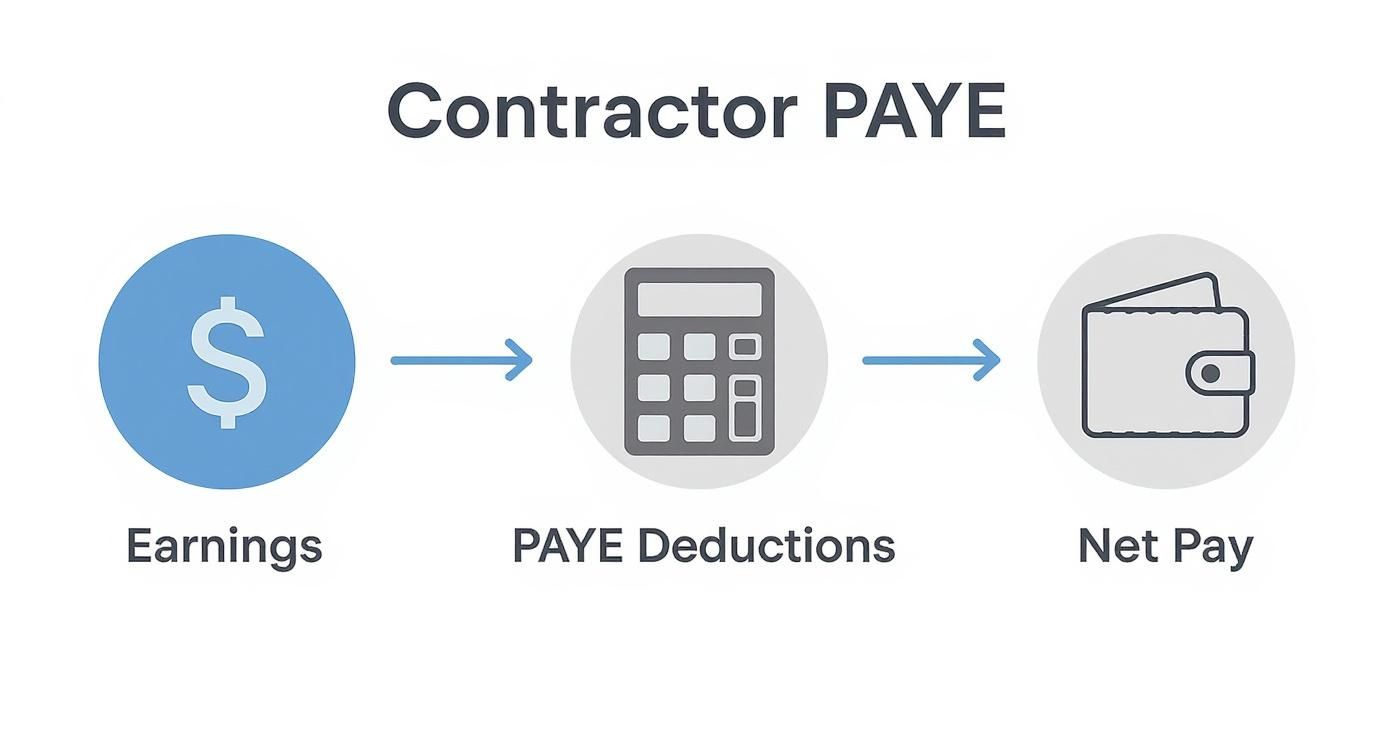
As you can see, the PAYE deductions are the necessary step between what you earn and what you take home, ensuring you stay fully compliant with UK tax law.
Why This Is the Compliant Standard
Honestly, this is the only legitimate way for an umbrella company to operate. By processing your pay this way, you build up a continuous record of employment, which is incredibly useful when you need to apply for a mortgage or a loan. You also get full access to statutory rights like sick pay and a workplace pension, even while you move between different projects and clients.
This structure means you are taxed correctly at source, which protects you from any nasty surprises like a future HMRC investigation or an unexpected tax bill. Any company that claims it can help you bypass these costs is likely a disguised remuneration scheme, and you should avoid those at all costs. With a compliant umbrella, you get the peace of mind that comes from knowing your finances are being managed correctly and professionally.
Navigating IR35 with an Umbrella Company
https://www.youtube.com/embed/wGy7POq7YdQ
If you are a contractor in the UK, getting your head around the off-payroll working rules, better known as IR35, is non-negotiable. At its core, IR35 is all about fairness. It is designed to make sure that contractors who work in a way that is similar to a permanent employee pay roughly the same tax and National Insurance.
When a project is deemed ‘inside IR35’, it is a formal way of saying the role looks and feels like a standard job. This determination triggers a legal requirement: your earnings must be processed through the PAYE system, exactly like a regular salary.
This is where a good, compliant umbrella company steps in. By working through a PAYE umbrella service, you are, by definition, an employee of that umbrella. This simple fact neatly sidesteps the entire IR35 headache, as you are already being taxed at source.
Why an Umbrella is the Go-To for Inside IR35 Contracts
Joining an umbrella company gives you a clear and unambiguous employment status. You are an employee of the umbrella, and all your income is handled via PAYE. For HMRC, this ticks all the right boxes, leaving no grey areas about your tax obligations.
This setup is not just good for you; it brings peace of mind to the entire contracting chain. Your recruitment agency and the end client can relax, knowing that all the necessary taxes are being paid correctly from day one, which removes any potential liability from their shoulders.
With HMRC ramping up its compliance checks, the PAYE umbrella model has become the recognised, safe-harbour route for handling inside-IR35 contracts. It is the most straightforward way to ensure you are fully compliant, protecting you from the stress of a future tax investigation. For a deeper dive, check out our guide that answers does IR35 apply if I work through an umbrella company?
The Spotlight on Supply Chain Compliance
The world of temporary work is getting tighter. With around 700,000 people in the UK contracting through umbrella companies, the government is bringing in new rules to clamp down on dodgy providers. New legislation planned for April 2026 will hold the entire supply chain responsible for unpaid taxes.
What does this mean in practice? If a non-compliant umbrella goes bust without paying its tax bill, HMRC can now chase the recruitment agency or even the end client for the shortfall. It is a huge shift, aimed at cleaning up the industry and recovering billions in lost revenue. You can learn more about the upcoming umbrella tax legislation to understand the full impact.
This makes your choice of umbrella company more important than ever. Partnering with a fully compliant, accredited provider is not just about protecting yourself. It is about protecting your professional reputation and the stability of the entire supply chain you work within.
Ditching the IR35 Admin Burden
Let's be honest, one of the best things about using an umbrella company for inside-IR35 work is the sheer relief from administration. You can forget about trying to decipher your own IR35 status, wrestling with complex tax calculations, or worrying about setting money aside for a huge tax bill down the line.
Your job becomes beautifully simple:
- Submit your timesheets.
- Let the umbrella company manage everything else.
We handle all the calculations, make the right payments to HMRC on your behalf, and send you a clear payslip every time you get paid. It frees you up to do what you do best: focus on your client and deliver great work, confident that all the financial paperwork is being handled professionally and correctly.
How to Choose a Compliant Umbrella Company

Picking the right umbrella company is one of the biggest decisions you will make as a contractor. It is not just about getting paid; your choice has a direct impact on your financial security and your peace of mind. The market is crowded, so learning how to tell a trustworthy partner from a dodgy operator is a crucial skill.
Think of this section as your practical checklist for doing your homework properly. We will walk through exactly what you should look for in a solid, compliant provider and, just as importantly, the red flags that scream "danger". Dodging a non-compliant scheme could save you a world of trouble with HMRC down the line.
Look for Official Accreditation
The easiest place to start is with official accreditations. Think of them as a quality seal of approval. Independent professional bodies audit umbrella companies against strict codes of conduct to make sure they are playing by the rules and operating to the highest standards.
An accreditation tells you that a provider’s internal processes have been put under the microscope and found to be fully compliant with UK tax and employment law. This is your first and best line of defence against risky companies.
The two most respected accreditation bodies in the UK are:
- The FCSA (Freelancer & Contractor Services Association): A leading professional body that champions compliance across the temporary work sector.
- Professional Passport: Another highly regarded, independent body known for its rigorous compliance assessments of umbrella companies and payroll providers.
If an umbrella is accredited by one or both of these, you can have a high degree of confidence that you are in safe hands.
Analyse Their Fee Structure
A compliant umbrella company will be completely upfront about how it makes its money. The industry standard is a straightforward, flat weekly or monthly margin. This fixed fee is deducted from your assignment income to cover their administrative costs for running your payroll and providing employment support.
Be very wary of any provider that wants to charge a percentage of your invoice value. This model can make your take-home pay inconsistent and often works out to be far more expensive, especially if you are a high earner. A flat fee means you always know exactly what you are paying, with no nasty surprises.
A clear, fixed margin is the hallmark of a transparent and honest umbrella company. If a provider's fee structure is confusing or seems too good to be true, it almost certainly is.
Red Flags of Non-Compliant Schemes
Unfortunately, the market is not entirely clean. There are dishonest providers out there pushing what are essentially tax avoidance schemes. They are designed to sound incredibly attractive but can land you with a huge, unexpected tax bill and penalties from HMRC. Protecting yourself means learning to spot the warning signs.
The following quick comparison table highlights the key differences between a safe pair of hands and a scheme you should run a mile from.
Compliant Umbrella vs Non-Compliant Scheme Red Flags
| Feature | Compliant Umbrella (What to Look For) | Non-Compliant Scheme (Red Flags to Avoid) |
|---|---|---|
| Take-Home Pay Promise | Realistic illustrations based on standard tax and NI deductions. | Promises of incredibly high take-home pay (85%, 90% or even 95%). |
| Payment Structure | One single payment of salary, fully taxed via PAYE. | Complex structures involving 'loans', 'bonuses', or 'credits'. |
| Accreditation | Proudly displays accreditation from the FCSA or Professional Passport. | No recognised UK accreditations, or they claim to be "HMRC Approved". |
| Transparency | Clear, detailed payslips showing all deductions. | Vague or confusing explanations about where your money is going. |
| Fee Model | A simple, flat weekly or monthly margin. | Percentage-based fees or hidden charges. |
Spotting these red flags is key to staying safe. Be on high alert if a company makes any of these claims:
- Promises of suspiciously high take-home pay: If an umbrella tells you that you can keep 85%, 90% or even 95% of your contract value, it is a massive red flag. Compliant PAYE payroll simply does not work that way.
- Mentions of 'non-taxable' payments: Run for the hills if you hear terms like 'loans', 'annuities', 'bonuses', or 'credit facilities'. These are classic hallmarks of disguised remuneration schemes designed to illegally sidestep tax.
- Confusing or secretive payment structures: A legitimate provider will happily give you a clear, detailed pay illustration. If a company gets cagey when you ask how you will be paid, walk away immediately.
By keeping these points in mind, you can confidently vet potential providers and choose a PAYE and umbrella partner that truly has your back.
Umbrella PAYE: The Pros and Cons
Deciding to work through an umbrella company really comes down to a trade-off. It is a classic case of balancing simplicity against cost, and to get the full picture, you need to weigh up both sides of the coin.
The biggest draw for most contractors is the sheer peace of mind. Knowing that all your Income Tax and National Insurance contributions are being calculated and sent straight to HMRC for you is a huge weight off your shoulders. It gets rid of a massive administrative headache, letting you just get on with the job.
Another often overlooked benefit is that it gives you a continuous record of employment. This can be a game-changer when you are trying to get a mortgage or a loan, as lenders love to see that kind of stability on your application.
The Upsides of Umbrella Employment
When you team up with a compliant umbrella company, you are essentially getting the best of both worlds. You keep the freedom of contracting but gain the security and legal rights that come with being an employee.
- Full Employee Rights: You get all the statutory perks you would expect in a permanent role. We are talking holiday pay, sick pay, maternity or paternity leave, and a workplace pension scheme.
- Guaranteed Compliance: If your contract is inside IR35, going through a PAYE umbrella is the safest and most straightforward way to work. It completely removes any worries about falling foul of the off-payroll working rules.
- Zero Admin Hassle: We take care of all the paperwork. All you need to do is submit your timesheets, and we handle the rest, from processing your pay to sending you a clear, easy-to-understand payslip.
- Essential Insurance Included: Any good umbrella company will provide you with vital business insurance as part of their service, covering you with things like Professional Indemnity and Public Liability.
This setup provides a valuable safety net that many contractors miss out on, making it a very appealing choice for anyone who prioritises security.
Understanding the Downsides
Now for the other side of the equation. The main drawbacks are the costs that are deducted from your overall assignment rate. It is important to be clear: these are not hidden fees; they are a standard, necessary part of how a compliant umbrella company operates.
There are two main costs you will see on your payslip:
- Employer’s National Insurance: Because the umbrella company is your legal employer, they have to pay this on your earnings. This cost is always factored into the headline assignment rate you get from your agency.
- The Umbrella Margin: This is simply the flat fee the umbrella company charges for running your payroll and handling all the administration.
These deductions mean your take-home pay might look a bit lower than if you were, say, running your own limited company. But for anyone working on an inside-IR35 project, the value of guaranteed compliance and having zero administration to worry about usually makes it well worth it.
At the end of the day, you are trading a bit of your gross contract rate for total simplicity, full employment rights, and complete security.
It is also worth remembering that the UK umbrella market does not exist in a bubble. Big economic changes, like the annual rise in the National Minimum Wage, can affect a contractor's take-home pay. This means umbrella companies must constantly stay on top of their game, updating payroll and compliance procedures to keep in line with PAYE and IR35 rules. It really underlines why picking a provider who knows their stuff is so important.
So, What's Next on Your Contracting Journey?
For most UK contractors, especially when a project falls inside IR35, working through a compliant PAYE umbrella company is simply the most straightforward and secure way to get paid. It gives you the stability and rights of an employee, with none of the stress, so you can just get on with the job you were hired to do.
As we have walked through, the link between PAYE and umbrella companies is pretty simple. PAYE is just the standard system HMRC uses to collect tax and National Insurance from employees. A good umbrella company just acts as your employer, handling all that payroll administration for you, correctly and on time.
The Most Important Things to Remember
Your number one priority has to be protecting yourself and your money. That means doing your homework before signing up with any umbrella company. Jumping in too quickly without checking them out properly could leave you facing a huge, unexpected tax bill from HMRC down the line.
Keep these three golden rules in mind:
- Compliance is everything: Do not even consider an umbrella company that is not accredited by a professional body like the FCSA or Professional Passport.
- Look for total transparency: You want to see a simple, flat fee (their margin) and a payslip so detailed you can track every single penny. No funny business.
- If it sounds too good to be true, it absolutely is: Run a mile from any company promising you will take home an unbelievably high percentage of your earnings. It is a classic red flag for a tax avoidance scheme.
Following this advice will help you sift through the noise and find a reliable partner who genuinely has your best interests at heart. A properly compliant umbrella ensures every penny of tax is paid correctly, without you ever having to lift a finger.
Choosing Your Umbrella with Confidence
Hopefully, this guide has armed you with the knowledge to feel confident about your next move. Think of the checklist we provided earlier as your secret weapon. Use it to properly vet any potential umbrella company and make a choice you will not regret.
Ultimately, teaming up with a provider that puts compliance and transparency first is one of the smartest investments you can make in your contracting career. Our team is always here if you need some clear, no-strings-attached advice to help you on your way. We are here to see you succeed.
At UmbrellaCompany.com, we make it easy to find a trusted, compliant payroll partner. Our comparison service helps you cut through the options and choose the right umbrella for you.


