


When you are self-employed in the UK, sorting out your own tax and National Insurance is part of the deal. The main way you will pay National Insurance is through your annual Self Assessment tax return, and the amount you owe is calculated based on your profits. This guide explains what you need to pay, how it is calculated, and the steps to file and pay your bill.
Understanding Your National Insurance Obligations

Getting to grips with your responsibilities can feel like a lot at first, but it is a non-negotiable part of being your own boss. National Insurance (NI) is a tax on your earnings that funds crucial state benefits like the State Pension, Maternity Allowance, and Employment and Support Allowance.
Every contribution you make builds up your personal NI record. This record determines whether you can access these benefits later. If you do not have enough qualifying years, you could find yourself without a safety net when you need it most. That is why it is vital to get it right from day one. If you are just starting out, have a look at our guide on when to register as self-employed.
The Two Types of Self-Employed National Insurance
As a sole trader, you will mainly come across two types of National Insurance. They each have different rules and rates, and understanding how they work is key to figuring out what you owe.
- Class 2 NI: You might remember this as a flat, weekly contribution. However, things changed significantly from April 2024, and mandatory Class 2 contributions have now been abolished for most self-employed people.
- Class 4 NI: This is the main one for most people now. It is calculated as a percentage of your annual profits.
These two classes ensure you are contributing fairly based on what you earn, while also protecting your entitlement to state benefits.
Key Changes from April 2024
The government has simplified the rules for self-employed National Insurance. Starting from the 2024/25 tax year, you no longer have to pay Class 2 NI contributions if your profits are over the Small Profits Threshold.
Even though you're not paying, you'll still be treated as if you have. This means you continue to build qualifying years towards your State Pension and other benefits without the extra cost.
This move was intended to reduce the admin and financial burden for sole traders. But what if your profits fall below that threshold? In that case, you might want to consider making voluntary Class 2 contributions to protect your NI record. We will get into that a bit later.
How to Calculate Your Class 2 and Class 4 NI

Getting to grips with how HMRC calculates your National Insurance bill is crucial for good financial planning. When you pay National Insurance as a self-employed person, the amount you owe is calculated directly from your annual profits.
The good news is that you do not need to do complex sums yourself. This all happens automatically when you file your Self Assessment tax return. You declare your total income and your allowable business expenses, and HMRC’s system calculates your final profit figure and the Class 4 NI liability that comes with it.
Your NI Rates for the 2025/2026 Tax Year
For self-employed people, the main contribution you will make is Class 4 National Insurance. This is charged as a percentage of your taxable profits. It's worth noting that from 6th April 2024, the government abolished mandatory Class 2 NI for most, simplifying things considerably.
The thresholds and rates are updated regularly, so it is vital to work with the correct figures for the relevant tax year.
Here is a quick summary of what you will be paying for the 2025/2026 tax year.
Self-Employed NI Rates and Thresholds for 2025/2026
| NI Class | What You Pay On | 2025/2026 Rate |
|---|---|---|
| Class 4 | Profits from £12,570 to £50,270 | 6% |
| Class 4 | Profits over £50,270 | 2% |
| Class 2 | Voluntary contributions (if profits < £6,845) | £3.45 per week |
This tiered structure means your NI bill scales with your success. You do not pay anything on the first slice of your profits, and the rate drops for very high earners, keeping it proportionate.
A Practical Example of a Class 4 NI Calculation
Let's put those percentages into a real-world scenario. Say you are a self-employed consultant and your annual profit for the tax year, after all allowable expenses are deducted, comes to £40,000.
Here is how HMRC would calculate your Class 4 NI bill:
- You pay nothing on the first £12,570 of your profit.
- The next portion of your profit is £27,430 (which is £40,000 minus £12,570).
- Your NI bill is 6% of this amount: £27,430 x 6% = £1,645.80.
Because your profit is below the Upper Profits Limit of £50,270, the 2% rate does not apply.
If you want to run some numbers to see how different profit levels might affect your net income, our UK payroll calculator can give you a solid estimate.
What If My Profits Are Low?
What happens if you have a quieter year? If your profits for the 2025/2026 tax year are below the Small Profits Threshold of £6,845, you do not have to pay any Class 4 NI.
Under the new rules, if your profits fall between £6,845 and the Lower Profits Limit of £12,570, you now get a National Insurance credit automatically without paying a penny.
This helpful change is designed to protect self-employed people with lower earnings. It ensures you continue building qualifying years towards your State Pension and other key benefits, even when you are not making direct contributions.
If your profits are below the £6,845 threshold, you will not get these automatic credits. In that case, you have the option to make voluntary Class 2 contributions. Doing so prevents gaps from appearing in your NI record, which could otherwise affect your future entitlement to state benefits.
Filing and Paying Your NI Bill Through Self Assessment
Knowing your National Insurance liability is one thing; paying it is another. For the self-employed, this all happens through the Self Assessment system. It is the same process you use for Income Tax, and once you get the hang of it, it is a straightforward annual task.
Your Class 4 NI contributions are calculated automatically from the profit figures you report on your tax return. You do not need to do a separate calculation, which simplifies things considerably.
Registering for Self Assessment
If you are new to self-employment, your first port of call is registering with HMRC. You must do this by 5th October in the tax year after you start trading. So, if you went self-employed in June 2025 (which falls into the 2025/26 tax year), your registration deadline would be 5th October 2026.
After you register, HMRC will issue your ten-digit Unique Taxpayer Reference (UTR). This is your personal identifier for all things Self Assessment, so keep it somewhere safe.
The system relies on you to report your income and settle your bill on time. For a deeper dive into upcoming changes, you can find more details about National Insurance changes for 2025 and beyond on no-worries.co.uk.
Completing Your Tax Return
When you fill out your Self Assessment tax return, you will use the self-employment section (form SA103). This is where you declare your total business income and then subtract any allowable business costs to find your taxable profit.
Smart use of self-employed tax deductions is key here, as it can significantly lower your profit figure and, in turn, reduce both your Income Tax and your Class 4 National Insurance bill.
How to Pay Your National Insurance Bill
Once your tax return is submitted, HMRC will confirm the final amount you owe. You have a few different ways to pay, so you can pick the one that suits you best.
- Online or Telephone Banking: A direct bank transfer is usually the quickest method. Just be sure to use HMRC’s correct bank details and your UTR number as the payment reference so they can identify your payment.
- HMRC Online Portal: You can pay instantly with a debit card via your government gateway account. Personal credit cards are not accepted, and using a corporate credit card will result in a fee.
- Direct Debit: Setting up a Direct Debit is a great way to avoid missing a payment deadline. You can use it for a single, one-off payment or to manage your regular 'payments on account'.
Do not leave it until the last minute. Some payment methods, especially bank transfers, can take a couple of business days to clear. Always double-check HMRC's official guidance for the processing times for each option.
The deadlines for filing and paying are firm. For online returns, everything must be submitted and paid by midnight on 31st January. Miss that date, and you are looking at automatic penalties and interest. To stay on top of all the key dates, have a look at our complete guide to Self Assessment deadlines in the UK.
Common National Insurance Mistakes and How to Avoid Them
Even the most seasoned self-employed professionals can get tripped up by National Insurance. When you are responsible for your own NI payments, a few common slip-ups can easily lead to penalties, issues with your state pension record, or just a lot of unnecessary stress. We can help you sidestep them.
At its heart, the process is quite simple. Getting this basic flow right from the start is your best defence against making mistakes.
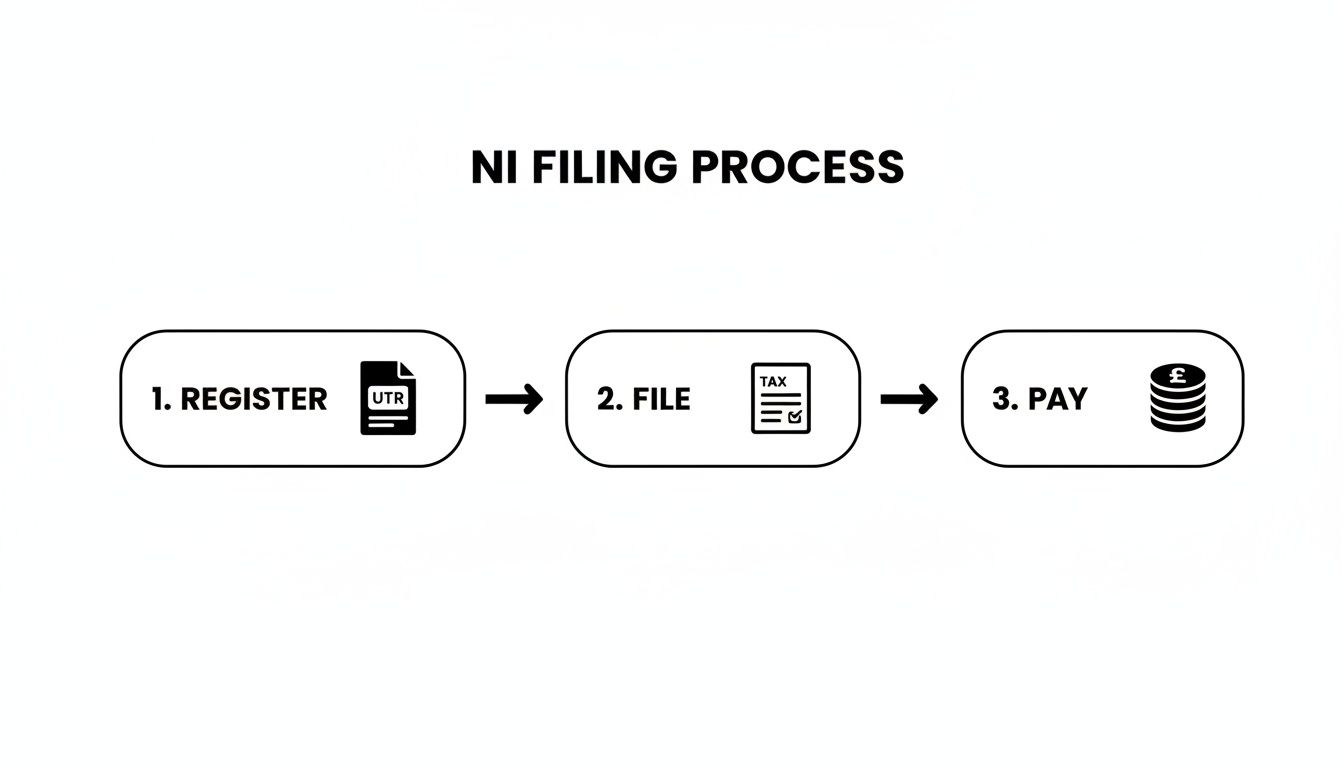
Mastering these three steps, registering, filing, and paying, will help you avoid the most frequent headaches that self-employed people run into.
Failing to Keep Proper Records
This is easily the biggest mistake we see. If you do not keep accurate records of your income and outgoings, you cannot calculate your profit correctly. This will not just throw off your NI calculation; it often means you end up paying far more tax than you need to.
- Our advice: Use accounting software or a well-organised spreadsheet from day one. Get into the habit of logging every single invoice and receipt as it comes in, not trying to piece it all together months down the line. It gives you a clear, real-time picture of your business's health.
This simple habit makes filling out your Self Assessment a breeze and gives you solid proof if HMRC ever queries your figures.
Miscalculating Profits and Expenses
Another classic pitfall is not understanding what you can and cannot claim as a business expense. Claiming for personal costs can attract unwanted attention from HMRC, but forgetting to claim legitimate expenses means you are just giving away money.
An expense has to be "wholly and exclusively" for your business. Think office supplies, your professional insurance, software subscriptions, or business mileage.
Forgetting to deduct all your allowable expenses directly inflates your taxable profit. A higher profit means a higher Class 4 National Insurance bill, so meticulous expense tracking is essential for keeping your liabilities as low as legally possible.
For example, if you are a freelance graphic designer, your Adobe Creative Cloud subscription is a perfectly valid expense. Your personal Spotify subscription is not. Keeping a clear line between the two is crucial.
Missing Key Payment Deadlines
HMRC's deadlines are non-negotiable, and missing them means automatic penalties. The two big dates for your diary are 31st January for filing your online return and paying your bill, and 31st July for your second 'payment on account'.
Leaving things until the last minute is a recipe for disaster. Bank transfers are not always instant, and websites can have technical glitches.
- Here is a pro tip: We advise planning to file your return and make your payment at least a week before the deadline. Better yet, set up a Direct Debit through your HMRC online account to automate the payment and guarantee you are never late. Building good habits around these deadlines saves a lot of stress in the long run.
Is an Umbrella Company a Better Option for You?
Wrestling with Self Assessment and managing your own National Insurance is a classic part of self-employed life, but it is certainly not the only way to operate. For a growing number of contractors, particularly those whose projects are deemed ‘inside IR35’, joining an umbrella company offers a much simpler route.
Think of it this way: instead of you being responsible for calculating NI on your profits, the umbrella company hires you as their employee for the duration of your contract. They handle all your tax and National Insurance deductions through the familiar Pay As You Earn (PAYE) system, just like a permanent job.
The Shift from Self-Employed to Employed NI
When you are paid via an umbrella company, you can forget about Class 2 and Class 4 NI. Instead, you will pay Class 1 National Insurance.
This is deducted directly from your earnings before the money ever hits your bank account. For any income earned this way, you do not need to file a Self Assessment tax return, which is a huge administrative relief for many.
This way of working has become a lot more common since the IR35 off-payroll working rules were overhauled. The changes pushed many contracts into the 'inside IR35' category, nudging many contractors towards umbrella employment.
Under this setup, you are essentially treated like a traditional employee for tax purposes. You will pay the employee NI rate of 8% on your earnings in the main band, and the umbrella company, as your employer, pays the employer NI contributions.
The Pay-Off: Simplicity and Compliance
The biggest draw for most contractors is the sheer simplicity. An umbrella company manages your payroll, ensuring the correct tax and NI is paid on time, every time. It effectively removes the risk of miscalculating your tax bill or missing HMRC's deadlines, both of which can lead to painful penalties.
Working with a compliant umbrella company brings peace of mind. It means your tax affairs are handled by experts, which frees you up to concentrate on your actual contract work without the headache of running a limited company or dealing with Self Assessment.
For many, this is a trade-off that makes perfect sense. You also gain access to statutory employment rights, like sick pay and holiday pay, and build up a continuous employment record.
If less financial admin sounds good to you, it is worth exploring how an umbrella company for freelancers can work. Ultimately, it is a much more straightforward way to pay National Insurance when you are working on contracts that fall outside the traditional self-employed model.
Your National Insurance Questions Answered
When you are self-employed, National Insurance can throw up a few curveballs. It is not always straightforward, and it is easy to wonder if you are getting it right. Let's tackle some of the common questions we see from freelancers and contractors to clear things up.
Getting these details right is crucial for keeping your finances in order and staying on the right side of HMRC.
What if I’m Both Employed and Self-Employed?
It is really common these days to run a business or freelance on the side of a permanent job. If that is you, you will find yourself paying different types of National Insurance on each income stream.
Your employer handles your Class 1 NI contributions, deducting them straight from your salary via their PAYE payroll. For your self-employed work, you are responsible for paying Class 4 NI on your profits, which you will sort out through your annual Self Assessment. There is an annual maximum amount of NI you have to pay across all your jobs, so if you think you have overpaid, you can claim a refund after the tax year ends.
Do I Pay National Insurance if My Profits Are Low?
Good news here. For the 2025/2026 tax year, you do not have to pay any Class 4 NI if your profits fall below the Lower Profits Limit of £12,570. The rules for Class 2 have also changed quite a bit.
Here is a quick breakdown:
- Profits between £6,845 and £12,570: You do not pay a penny in NI, but you still get automatic NI credits. This is a huge plus, as it means your State Pension record is protected without you having to do anything.
- Profits below £6,845: You will not pay NI or receive automatic credits. However, you can choose to make voluntary Class 2 contributions if you want to fill any gaps in your National Insurance record.
Can I Claim National Insurance as a Business Expense?
This is a question we hear a lot, and the answer is a firm no. You cannot claim your personal National Insurance payments, whether Class 2 or Class 4, as an allowable business expense on your tax return.
Think of these contributions as a personal tax, just like Income Tax. They are calculated on your profits after you have already deducted all your legitimate business expenses from your income.
It is also worth remembering that National Insurance is just one piece of your financial puzzle. As a self-employed professional, you have to create your own safety net. Looking into things like self-employed life insurance is a smart move to make sure your family is protected.
What Are Payments on Account?
If you have filed a Self Assessment before, you might have come across these. Payments on account are advance instalments towards your next year's tax bill, and this includes your Class 4 NI.
HMRC will usually ask you to make them if your last tax bill was more than £1,000. You will make two advance payments, each one typically being 50% of your previous year’s bill. The deadlines are always 31 January and 31 July. It is HMRC’s way of helping you spread the cost, so you do not get hit with one giant bill at the end of the tax year.
If juggling your own NI and tax sounds like a headache you could do without, UmbrellaCompany.com can help. We make it easy to compare compliant umbrella companies that handle all your payroll and deductions for you, so you can focus on your work. Find the perfect fit for your contracting career at https://umbrellacompany.com.


