


Starting a new contract often feels exciting right up until the practical question lands. How will you get paid, and how do you know the payroll setup is safe? If you're looking at Parasol umbrella company, you're probably trying to answer that before signing anything.
That's the right instinct. First-time contractors often focus on the contract rate, then realise later that the bigger issue is whether deductions are clear, whether pay arrives correctly, and whether someone is handling the admin in a compliant way. Those details shape your day-to-day experience more than any sales pitch does.
Parasol is one of the more established names in the UK umbrella market. In this guide, we'll look at it through the questions contractors usually care about most, including take-home pay clarity, compliance, admin support, and whether the service fits the way you work.
Is Parasol the Right Umbrella Company for You
If you've just accepted a role through an agency, you might already have been told that an umbrella is the easiest route. That can be true, but “easy” only matters if it also means clear deductions, reliable payroll, and lower compliance risk.
Parasol is a long-established UK umbrella company. It was incorporated on 6 March 2000 and is registered in Warrington, Cheshire, according to the Companies House record for Parasol. Independent profile data also describes it as a sizeable provider, with about $379.8 million in annual revenue and roughly 208 employees, with another profile showing 234 employees, which suggests a substantial operation rather than a very small intermediary, as shown on the RocketReach company profile.
That matters because scale can affect the contractor experience in practical ways. A larger provider may have more structured payroll processes, more support staff, and more established systems. It doesn't automatically mean it's the right fit for you, but it does mean you're looking at a business with a visible track record.
The real question to ask
The useful question isn't “Is Parasol well known?” It's this:
Are you better off using it than using another payroll route for your contract?
To answer that, look at four things:
- Pay clarity: Can you understand how your gross contract income becomes net pay?
- Admin effort: Do you want someone else handling payroll, tax, and employment paperwork?
- Compliance comfort: Are you inside IR35 or working in a sector where risk is a serious concern?
- Support needs: If something goes wrong, will you need human help rather than just an online system?
Some contractors also compare umbrella services with broader outsourced employment models. If you want context on that overall situation, this guide to the advantages and disadvantages of a PEO helps explain where outsourced employment support can help and where it can limit flexibility.
If you're still deciding what “good” looks like, our guide to a good umbrella company is a useful benchmark before you compare Parasol with other providers.
How Umbrella Companies Work in the UK
An umbrella company sits between you and the agency in the payment chain. You do the work for the end client, but the umbrella company becomes your employer for payroll purposes.
That sounds more complicated than it is. In simple terms, the umbrella takes the contract income that flows through the agency, processes it through PAYE, makes the required deductions, and pays you as an employee.
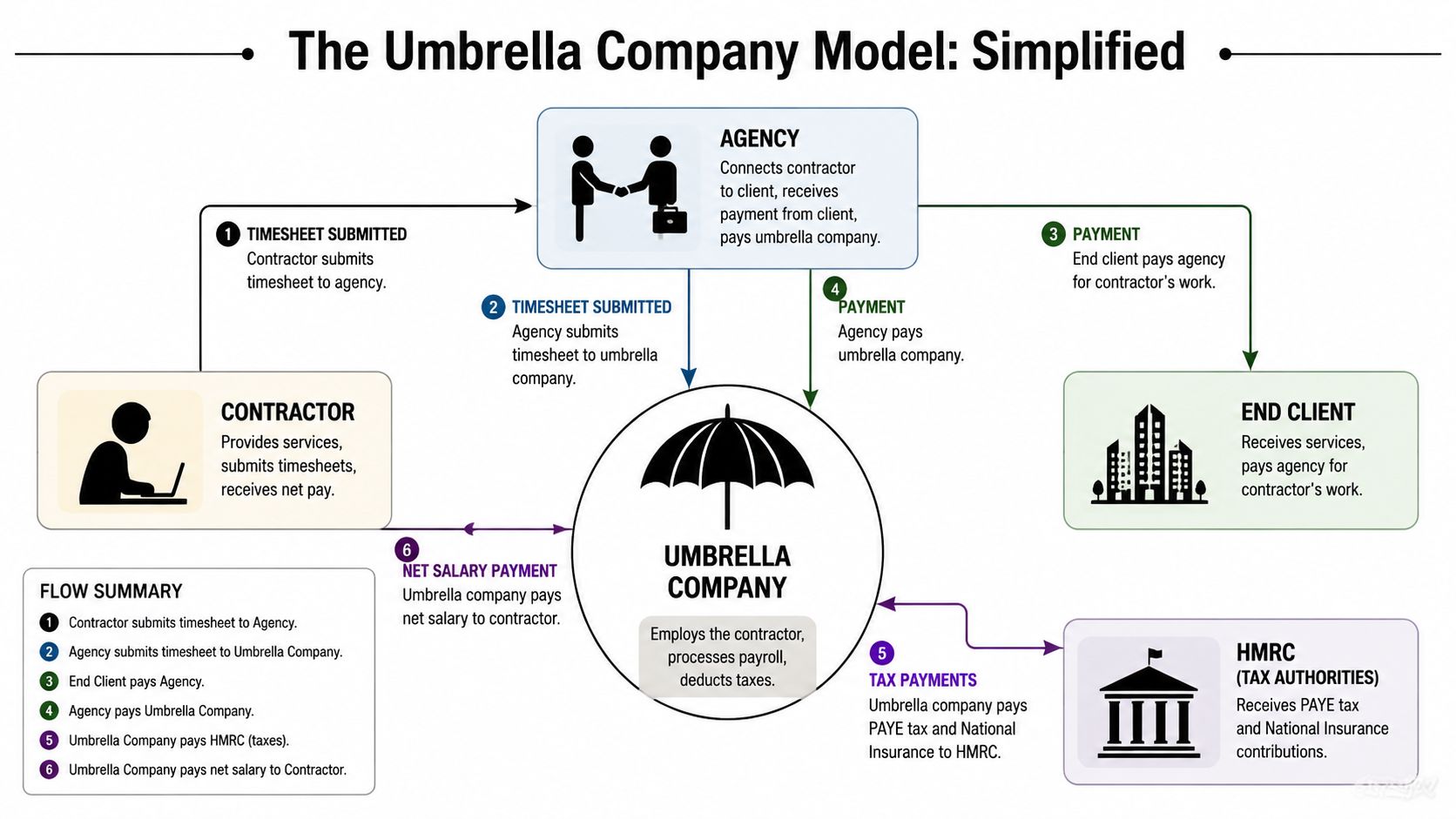
The basic chain
Most umbrella arrangements follow a structure like this:
- End client: Receives your work and pays the agency.
- Agency: Manages the placement and passes funds to the umbrella.
- Umbrella company: Employs you, runs payroll, and handles deductions.
- You: Submit timesheets and receive net salary.
What happens to the money
Many first-time contractors often encounter confusion. The contract rate is not the same thing as your take-home pay.
A typical flow looks like this:
- You submit a timesheet to confirm the work completed.
- The agency invoices the client and receives payment.
- The umbrella receives funds linked to your assignment.
- Payroll runs through PAYE, which means tax and National Insurance are deducted in the usual employee way.
- You receive your net pay and a payslip showing the deductions.
Key terms in plain English
A few words come up again and again with umbrella payroll.
- PAYE: Pay As You Earn. This is the standard UK payroll system for deducting income tax and National Insurance.
- Margin: The umbrella company's fee for providing its service. It is usually shown as a fixed charge rather than a percentage.
- Payslip: The document that shows gross pay, deductions, and net pay.
- Holiday pay: Money linked to your statutory annual leave entitlement. You need to understand whether it is accrued or rolled up, and how it is shown.
A good umbrella setup shouldn't leave you guessing where your money went. You should be able to follow the payslip line by line.
Why some contractors use an umbrella
For many inside IR35 roles, the umbrella route is used because it gives a straightforward employment structure. Instead of running your own limited company payroll and tax admin, the umbrella handles the employment side for the assignment.
That often appeals to contractors who want:
- Less paperwork: Fewer moving parts than running a company.
- Employment rights: Access to statutory rights linked to employee status.
- One employer across contracts: Useful if you move between assignments.
If you want a fuller explanation of the mechanics, our guide on how an umbrella company works breaks down the process in more detail.
A Deep Dive into Parasol's Services and Pricing
When contractors look at a parasol umbrella company, they usually see a familiar list of features. Portal access, payslips, timesheets, support, and standard employment administration all tend to appear near the top of the page.
The hard part is judging what those features mean in real life. A portal is only useful if it helps you check pay quickly. Support only matters if you can get clear answers when deductions don't look right. A payroll service only earns its keep if it reduces errors and saves you time.
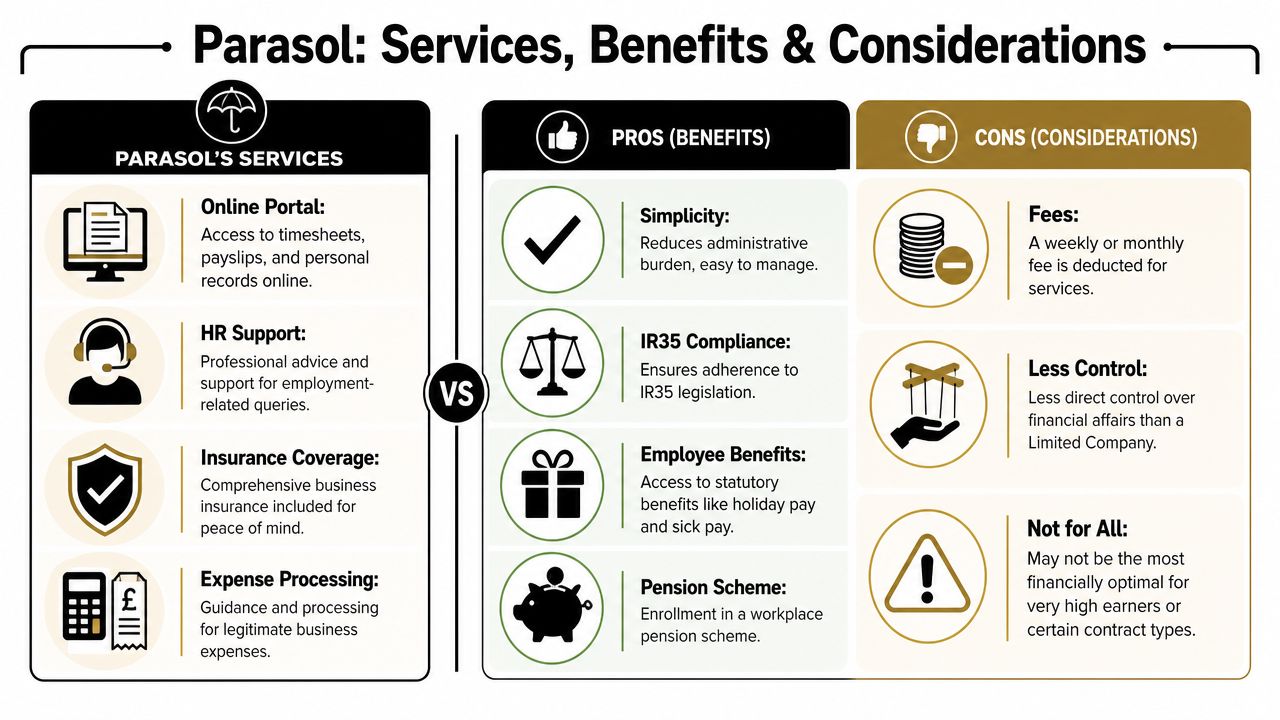
Coverage of Parasol describes a service-oriented model with access to employment records and tax information online, plus support availability during the week and access to key admin functions. At the same time, a contractor-focused review points out that the ultimate test isn't feature availability but pay accuracy, transparency of deductions, and the actual take-home pay realised, as discussed in this Parasol review on IT Contracting.
Services that matter in practice
For most contractors, these are the core service areas worth checking closely.
Online access and self-service
Digital access sounds basic, but it can save a lot of friction. You want a simple place to:
- View payslips
- Check timesheet status
- Access tax records
- Review employment documents
That matters most when something doesn't line up. If a payment is lower than expected, quick access to records helps you spot whether the issue is hours, holiday pay treatment, or deductions.
Payroll and employment administration
This is the centre of the umbrella model. The provider handles PAYE payroll and the employer administration that sits around it.
Look beyond the phrase “we manage payroll” and ask practical questions:
- Is the payslip easy to follow?
- Can they explain each deduction clearly?
- How quickly do they resolve payroll queries?
- How do they handle late timesheets or agency disputes?
Support and HR help
New contractors often underestimate this part. If you've never worked through an umbrella before, the first few payslips can feel unfamiliar.
Useful support usually includes help with:
- Starter paperwork
- Holiday pay questions
- Pension enrolment
- Leaver process
- General employment queries
How pricing usually works
Umbrella companies generally charge a fixed weekly or monthly margin for their service. The article brief asks us to discuss that pricing approach, but there is no verified amount available here for Parasol, so the sensible move is to focus on the method rather than inventing a figure.
That means your job is to ask for the charge in writing and to see how it appears on your illustration or payslip. Don't settle for a vague answer.
Practical rule: If you can't see the fee clearly before you join, pause the process and ask again.
What value should a contractor expect
A good umbrella service should deliver three things.
| What you want | What that looks like in practice |
|---|---|
| Confidence in payroll | You understand your payslip and can query it easily |
| Lower admin burden | Fewer forms, less chasing, less tax confusion |
| Peace of mind | Clear treatment of deductions, holiday pay, and statutory payroll items |
If you're comparing providers rather than choosing one in isolation, Umbrella Company offers a way to compare umbrella firms by role and requirements. That can help you check whether Parasol's service setup fits your contract type without relying on marketing language alone.
Navigating IR35 and Compliance with Parasol
You accept a contract, submit your timesheets, and expect the hard part to be the client work. Then the first payslip arrives and the question starts. Are you being paid in a way that is both correct and easy to understand?
That is the heart of IR35 and umbrella compliance. For many contractors, this is not really about paperwork. It is about protecting take-home pay from avoidable surprises, reducing the risk of tax problems later, and making sure the payment process does not become a weekly source of stress.
If your assignment is inside IR35, an umbrella company usually puts you into a straightforward PAYE employment model. In practical terms, that means income tax and National Insurance are handled through payroll, rather than you trying to run a limited company for work already being taxed like employment. For a first-time contractor, that often feels less like giving something up and more like using the correct lane on a motorway. It is not the route with the most flexibility, but it is often the route with fewer compliance hazards.
Why this matters to your actual outcome
A compliant umbrella should help you answer three basic questions without chasing for clarity.
- What am I being paid?
- What is being deducted, and why?
- Who is responsible if something in the chain goes wrong?
If those answers are blurry at the start, they rarely become clearer later. The risk is not only confusion. It can mean deductions you did not expect, holiday pay you do not fully understand, or a dispute over payroll responsibility between the agency and the umbrella.
That is why a contractor should judge Parasol, or any umbrella, by outcomes rather than brand familiarity alone. Does the setup make your take-home pay easier to predict? Does it lower the chance of a compliance problem landing on your desk months later? Does it reduce admin, or instead hide it behind unfamiliar payslip language?
What FCSA accreditation does and does not tell you
Parasol Group is an FCSA accredited member, according to the FCSA membership listing for Parasol. For a contractor, that is a useful trust signal because it shows the company is being checked against external standards rather than relying only on its own marketing.
That said, accreditation is a checkpoint, not a substitute for reading your own documents. A safety certificate on a car tells you it passed testing. You would still want to know how the brakes feel before driving it home.
In plain English, accreditation can give you more confidence around:
- Payroll processes
- Financial transparency
- Documented standards
- Ongoing external oversight
That can support peace of mind, especially if your agency prefers or requires an accredited umbrella. But your day-to-day experience still depends on whether Parasol explains deductions clearly, processes payroll accurately, and answers questions without sending you in circles.
The better test is simple. If an umbrella cannot explain your payslip in plain English before you join, do not assume it will become clearer after you start.
Checks to make before joining Parasol
Start with the employment contract and key policy documents. Read them slowly, ideally before your first timesheet is due. You want a clear picture of your employment status, how holiday pay is handled, when payroll runs, how the margin is shown, and what happens when the assignment ends.
Next, ask who does what in the supply chain. That sounds technical, but it affects real life. If the agency, end client, and umbrella each assume someone else is responsible for a payroll issue, you can end up waiting for answers while your pay is delayed. This guide to Stewart Accounting PAYE rules is useful if you want a clearer view of why supply-chain responsibility matters so much.
Then look closely at any take-home pay illustration. A compliant umbrella should be able to walk you through the figures line by line. Be cautious if the numbers look unusually generous and the explanation is thin. Higher promised take-home pay is not a benefit if it depends on a pay model you cannot properly identify or defend later.
If you want a simple grounding in how these rules fit together, our guide to how umbrella companies and IR35 work together explains the basics in plain terms.
For many contractors, Parasol will feel safer than trying to piece together payroll compliance on their own. The sensible question is narrower than that. Does Parasol give you enough clarity, enough predictability, and enough support to make the umbrella route easier for you, not just theoretically compliant on paper?
Who Should Use Parasol A Profile Analysis
Parasol won't suit everyone equally. The best way to judge fit is to think in profiles rather than headlines.
The first-time contractor
You've landed your first contract through an agency. You don't want to set up a company, you don't know how contractor payroll works yet, and you'd rather avoid spending evenings reading tax guidance.
For this person, Parasol may feel reassuring because a larger, established provider usually offers more structure around onboarding, payslips, and support. The attraction isn't glamour. It's having a system and a team in place when everything else about contracting still feels new.
A first-time contractor often benefits most from:
- Clear onboarding
- Simple payroll administration
- Help with understanding deductions
- A route that avoids limited company admin
The inside IR35 IT contractor
This contractor already knows the market. They may have worked through a limited company before, but a current assignment has been assessed inside IR35, so the priority shifts from tax planning to compliant payroll and low admin.
Parasol can make sense here if the contractor wants one employer handling PAYE, pension administration, and payslip processing while they focus on project delivery. The value is practical. Less time on admin, fewer moving parts, and a more standardised way to get paid on agency-led contracts.
If your contract is clearly inside IR35, simplicity can be more valuable than squeezing for extra control you may not be able to use meaningfully.
The public sector or regulated-sector worker
Some sectors come with tighter scrutiny and more cautious agency processes. Contractors in public sector, healthcare, or education-linked supply chains often need a provider that agencies recognise and are comfortable engaging.
For that profile, a provider like Parasol may be attractive because established umbrellas tend to fit more easily into approved supplier conversations. The contractor's concern here is less about novelty and more about passing compliance checks cleanly.
Who may want to look elsewhere
Parasol may be less appealing if you:
- Prefer maximum control: A limited company gives you more direct control over business administration.
- Dislike employee-style structures: Umbrella working means PAYE employment, not independent company operation.
- Need a very niche service model: Some contractors want highly personalised support from a smaller specialist provider.
The right answer depends on your contract, your appetite for admin, and how much compliance reassurance you want built into the arrangement.
Parasol Versus Other Contractor Options
A useful way to compare Parasol with other routes is to ask a simple contractor question: after tax, fees, and admin time, am I actually better off?
That shifts the comparison away from product labels and onto outcomes. For one contractor, "better off" means fewer payroll surprises and less compliance worry. For another, it means keeping more control because the contract sits outside IR35 and the extra admin is worth it.
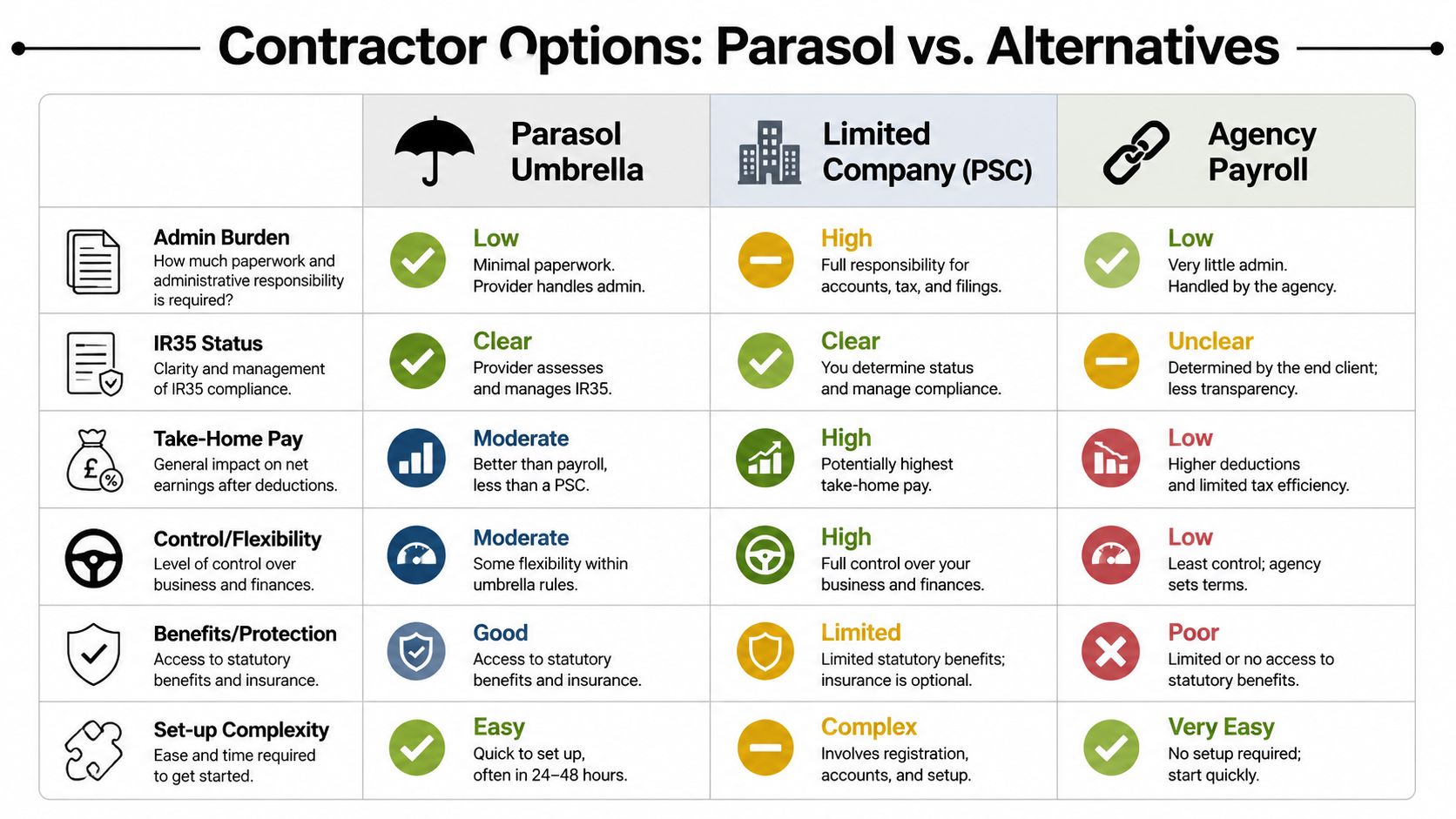
A simple side-by-side view
| Option | Admin burden | Compliance handling | Control | Employment rights |
|---|---|---|---|---|
| Parasol umbrella | Lower | Structured PAYE route | Moderate | Yes |
| Limited company | Higher | More responsibility on you and advisers | Higher | Not in the same employee sense |
| Agency PAYE | Lower | Straightforward payroll | Lower | Usually yes, but with less portability between roles |
The table helps, but the difference shows up in three places. Your take-home pay. Your exposure to compliance mistakes. The amount of weekly admin you need to carry yourself.
Here's a quick explainer before the next comparison point:
Where Parasol may come out ahead
Parasol tends to make sense when simplicity has a cash value for you. If an umbrella margin is the price of avoiding company accounts, payroll administration, and ongoing tax tasks, some contractors decide that trade is fair.
It can also reduce stress on inside IR35 contracts, where the main question is often not "how do I optimise this structure?" but "how do I get paid correctly and keep problems off my desk?" In that situation, Parasol's appeal is less about maximum take-home pay and more about predictable processing and fewer admin loose ends.
Parasol may suit you if you want:
- Lower personal admin
- A PAYE route that fits inside IR35 work
- One ongoing employer rather than changing payroll setups
- Help with payslips, deductions, and routine payroll queries
- Less hands-on responsibility for employment administration
Where a limited company may leave you better off
A limited company can work better if control has a clear financial benefit for your contract pattern. That usually matters more when your assignments are outside IR35, your day rate supports the extra administration, and you are comfortable managing the business side properly.
The extra control is real, but so is the responsibility. You are choosing a structure that works more like running a small business than joining a payroll service. Some contractors prefer that. Others find the additional filings, record-keeping, and decision-making eat into the benefit.
If you want a clearer breakdown of those trade-offs, this guide to umbrella company vs limited company explains the differences in practical terms.
Where agency PAYE can be the simplest answer
Agency PAYE is often the plainest route. If your agency can employ and pay you directly, there may be fewer parties involved and no separate umbrella margin to assess.
That said, simple does not always mean better. Agency PAYE may offer less continuity between contracts, less specialist contractor support, and less flexibility if you move between agencies regularly. It works best when your priority is basic payroll processing rather than portability or added service.
The practical test
If Parasol saves you time, gives you clearer pay administration, and lowers the chance of compliance confusion, it may be worth the cost.
If the fees feel high compared with the value you receive, or if your contract setup rewards greater control, another route may leave you better off. The strongest choice is the one that matches your contract position, your tolerance for admin, and the kind of risk you want to handle yourself.
Your Contractor Checklist Final Questions for Parasol
By the time you're close to signing up, the choice usually comes down to detail. At this stage, you stop reading broad claims and start asking direct questions.
A good parasol umbrella company should answer these without hesitation.
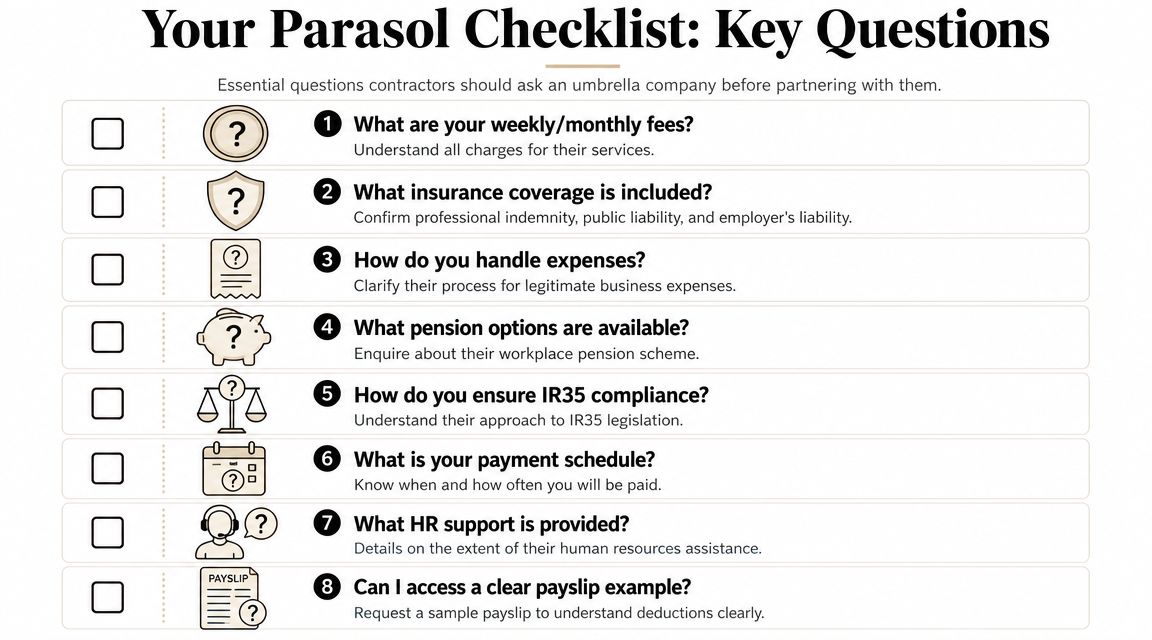
Questions worth asking in writing
- What is your margin, and how is it shown? Ask for the exact charge and where it appears on your pay illustration or payslip.
- Can I see a sample payslip? You should be able to review deductions before joining.
- How is holiday pay handled? Ask whether it is accrued or rolled up, and how you request or receive it.
- When will I be paid? Confirm the payroll timetable and what happens if the agency submits hours late.
- What support do you provide if there is a payroll issue? You want a clear route for resolving mistakes.
- What happens when I leave? Ask about final pay, unused holiday pay, and the leaver process.
- What insurance is included? Make sure you understand the categories of cover provided.
- How do you explain deductions to new contractors? The answer tells you a lot about how transparent the provider really is.
What a strong answer sounds like
Good answers are specific, calm, and easy to follow. Weak answers are vague, defensive, or overloaded with jargon.
Final check: If you leave the call more confused than when you started, don't ignore that feeling.
The best decision usually isn't the one with the slickest branding. It's the one where you understand how you'll be paid, what you're being charged for, and who is responsible when questions come up.
If you want a practical next step, Umbrella Company lets you compare umbrella providers based on your role, pay setup, and IR35 needs, so you can assess Parasol alongside other options before making a final decision.


