


If you're self-employed, you won't get a P60 because it's a PAYE employee document. If you work through an umbrella company, you will get a P60 because the umbrella employs you and pays you through payroll.
That catches a lot of people out. A mortgage adviser asks for a P60, a letting agent adds it to a checklist, or a recruiter mentions end-of-year documents, and suddenly you're wondering whether you've missed something important.
In most cases, you haven't.
The confusion usually comes from one simple issue. In everyday conversation, people often use self-employed, contractor, and freelancer as if they all mean the same thing. For tax documents, they don't. A sole trader and an umbrella contractor can both do project work for clients, but they won't receive the same paperwork.
For P60 self employed questions, the practical answer depends on how you're paid. If your income goes through payroll under PAYE, a P60 may apply. If you trade on your own account and report profits through Self Assessment, you'll use different records instead.
What matters is knowing which documents fit your working setup, and what to send when someone asks for proof of income. That's where most of the stress comes from, especially when a lender or agent asks for a document you don't have.
Introduction
A freelance designer, IT consultant, or interim specialist can hit the same problem. You're asked for a P60, you look through your files, and it isn't there.
If you're a sole trader, that's completely normal.
A P60 belongs to the employment side of the tax system. It's linked to payroll, tax deducted through PAYE, and the relationship between employer and employee. A self-employed person isn't on an employer's payroll for their trading income, so they don't receive one.
That doesn't leave you stuck. HMRC records still give you official ways to show income, and lenders, brokers, accountants, and letting agents deal with this situation all the time.
Practical rule: The right proof of income depends on how you work, not on the job title you use.
This matters even more for contractors because the label self-employed often hides different tax positions. Someone operating as a sole trader won't have a P60 for that work. Someone working through an umbrella company usually will. Someone with both employment and freelance income may need to show more than one type of record.
The main task isn't finding a missing P60. It's matching the right evidence to the right income stream.
What Is a P60 and Why Is It for Employees
A P60 answers a very specific question. How much pay went through PAYE for this job across the tax year, and how much tax was taken from it?
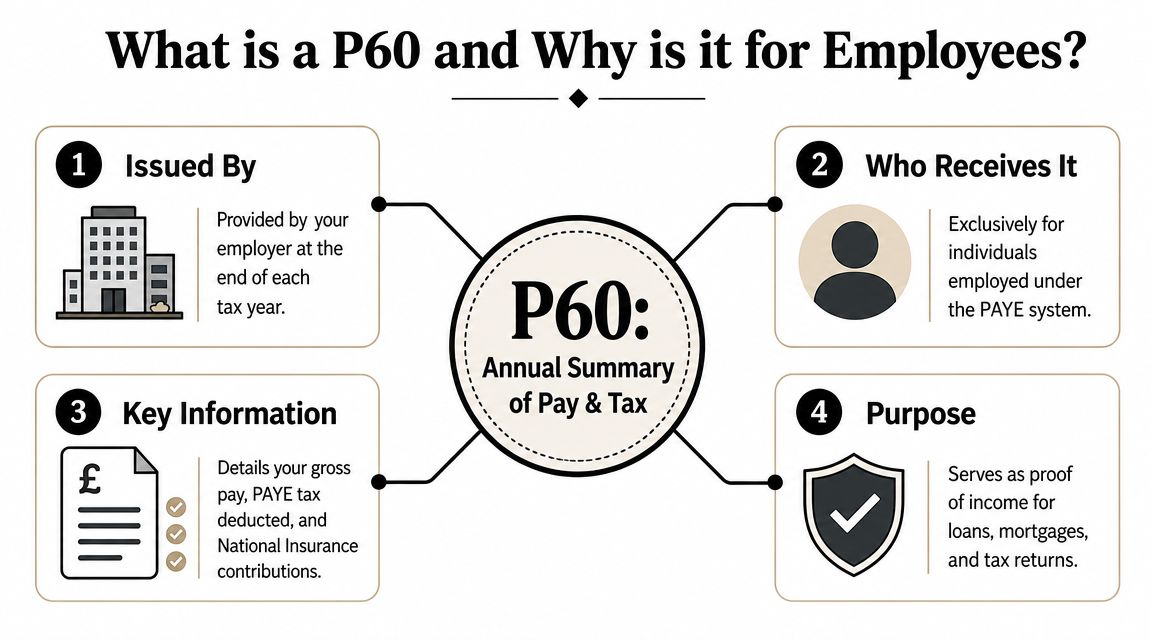
That narrow purpose is why the document causes confusion for contractors. People often use "P60" as shorthand for "proof of income", but a P60 only covers income paid through an employer's payroll. It belongs to the employee side of the tax system.
A simple way to read it is this. A payslip shows one payment at a time. A P60 rolls the tax year up into one annual payroll summary for one employment.
What the document is for
Employers issue a P60 to workers who are employed and still on that payroll at the end of the tax year. The document usually arrives after 5 April and should be provided by 31 May.
So why does that matter for someone searching for "p60 self employed"?
Because your tax position decides the paperwork. A sole trader can earn good money, file tax returns on time, and still never receive a P60 for that business income. An umbrella company contractor, by contrast, is usually paid as an employee of the umbrella, so a P60 often does exist for that umbrella income. This is also why IR35 questions can feel messy in real life. Two contractors doing similar client work can end up with different documents because they are taxed in different ways.
What information it summarises
A P60 pulls together the year-end totals from payroll records, such as:
- Gross pay for the tax year
- PAYE income tax deducted
- National Insurance
- Other deductions recorded through payroll
Those figures make it useful for practical checks. A lender might use it to confirm employed earnings. A landlord or referencing company may ask for it because it gives one annual summary instead of a stack of monthly payslips.
If you want a clearer explanation of the payroll language behind those figures, our guide to what PAYE means on a payslip helps connect the monthly terms to the year-end totals on a P60.
Why contractors get tripped up
The sticking point is usually the word self-employed. In everyday conversation, contractors use it to mean independent work. Tax documents are stricter. HMRC separates income by how it is paid and taxed.
That means a contractor can fall into one of several camps:
- A sole trader has no employer for that trading income, so no P60 for that work
- An umbrella company worker is usually an employee for PAYE purposes, so a P60 is normally part of the paperwork
- Someone with both freelance and employed income may need a P60 for one income stream and Self Assessment records for another
That distinction matters most when someone asks for documents quickly, such as during a mortgage application or a tenancy check. If you hand over the wrong record, the problem is not that your income is invalid. The problem is that the document does not match the way that income was taxed.
For readers comparing UK payroll documents with year-end tax certificates used elsewhere, Matil's Certificado Retenciones solution is a useful reference point. It does not replace a UK P60, but it shows the same broad idea of an employer-issued annual tax document.
One final point often helps clear up mixed-income situations. If you have more than one PAYE job, you can receive more than one P60, one for each employment that was active at the tax year end. That rule still only applies to payroll income. It does not convert sole trader profits into P60 income.
Proof of Income for the Genuinely Self-Employed
If you're a sole trader, the answer isn't to chase a P60. The answer is to use the records that match your tax position.
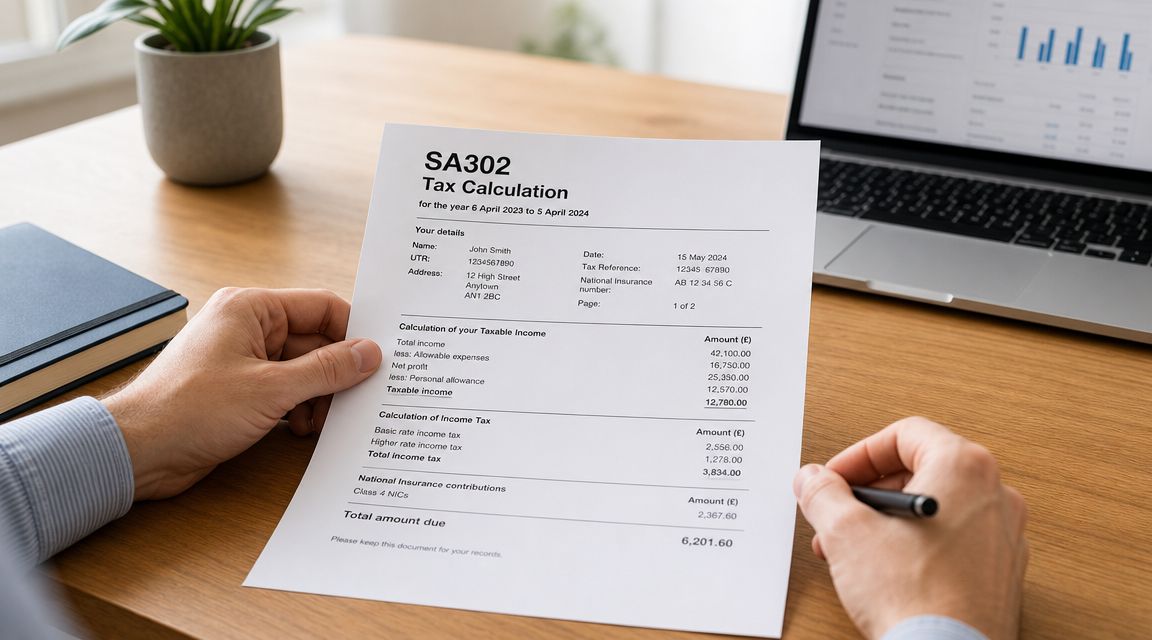
The two document names you usually need are:
- SA302 Tax Calculation
- Tax Year Overview
People often ask for "a P60" when they really mean "official proof of income". For a self-employed person, these HMRC records are the more appropriate fit.
What each document shows
The SA302 Tax Calculation shows the income information you've reported to HMRC through Self Assessment and the tax calculation based on that return.
The Tax Year Overview supports that by showing the position on your HMRC record for the relevant tax year.
Together, they give a clearer picture of self-employed income than a P60 ever could, because they relate to profits declared through Self Assessment rather than salary processed through payroll.
If you handle your own books, keeping your accounting records tidy makes this process much easier. Our guide to accounting for contractors is a useful starting point if you want your tax documents and underlying records to line up properly.
How to get them ready
When someone asks for proof of income, don't wait until the last minute to work out what they mean. Ask them directly whether they'll accept:
- Your SA302
- Your Tax Year Overview
- Supporting bank statements
- Accounts prepared by your accountant, if relevant
That one question can save a lot of back-and-forth.
A practical workflow looks like this:
- Sign in to your HMRC online account and check your submitted Self Assessment records.
- Download the relevant tax documents for the period being requested.
- Check names and tax years carefully before sending anything.
- Save copies as PDFs so you can reuse them for mortgage, tenancy, or finance applications.
- Keep matching records nearby, such as invoices or bookkeeping reports, in case the reviewer asks follow-up questions.
Here's a short explainer that can help if you prefer to see the process visually before you start gathering paperwork.
Where people get confused
The most common mix-up is assuming that because your income is "work income", it should produce the same document as an employee's income. It doesn't.
A sole trader's income is trading income. An employee's income is payroll income. Those routes lead to different evidence.
If you're self-employed and a lender asks for a P60, the best response is usually, "I don't receive a P60 because I'm not paid through PAYE for this work, but I can provide my Self Assessment documents."
That answer is clear, accurate, and familiar to people who regularly assess contractor applications.
How Umbrella Companies Handle P60s for Contractors
A common real-world scenario looks like this. You tell a lender you are a contractor, they ask for proof of income, and you are not sure whether to send Self Assessment records or employee documents.
The answer depends on how you were paid.
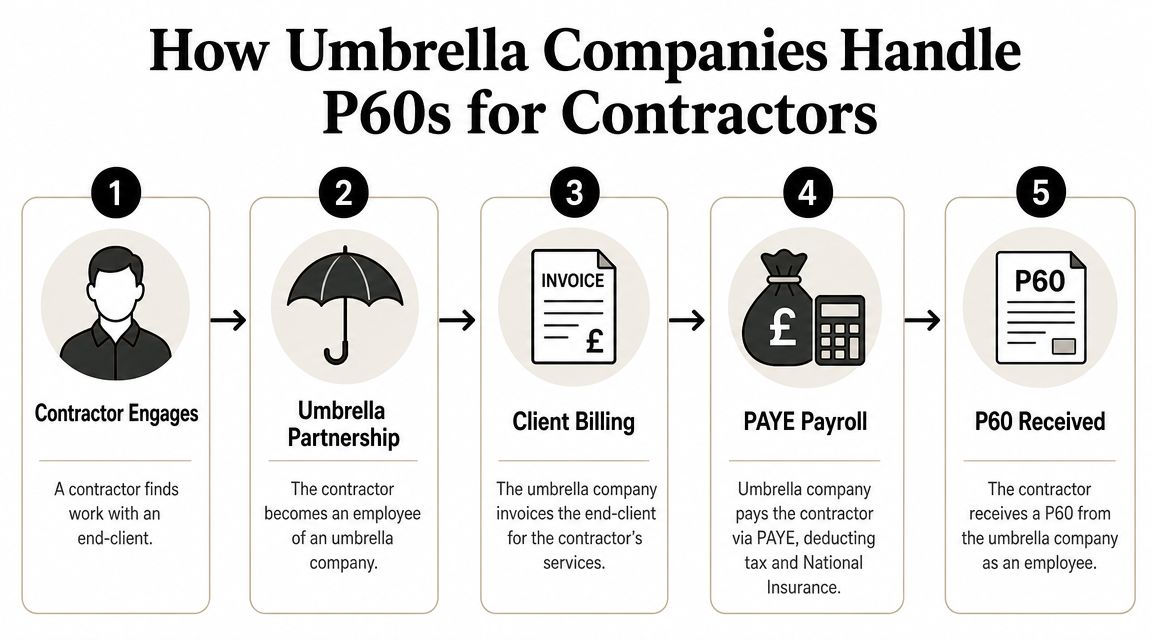
If you work through an umbrella company, the umbrella usually employs you and runs your pay through PAYE. That puts your income on the employee track for tax paperwork, even if your day-to-day work still feels like contracting. A useful way to picture it is this. Your client buys your services, but the umbrella handles your pay like an employer handles an employee's wages.
Why umbrella contractors receive a P60
A P60 exists because of the payroll relationship. The umbrella keeps a record of the pay and deductions processed through PAYE during the tax year, then gives you a year-end summary. That is why an umbrella contractor can receive a P60 while a sole trader cannot.
This point matters for IR35. If you are in an inside IR35 assignment and paid through an umbrella, your paperwork will usually look much closer to an employee's paperwork than a sole trader's records. That often clears up the confusion around the phrase p60 self employed. The work may be contract work, but the tax documents follow the payment method.
If you are new to that setup, our guide to PAYE and umbrella companies explains why the payroll relationship changes the documents you receive.
What to send in real life
For a mortgage application, tenancy check, or routine income review, an umbrella contractor will often be asked for documents such as:
- A recent payslip
- Your P60 for the most recent tax year
- An employment confirmation letter, if the reviewer asks for one
These are familiar PAYE documents, so lenders and referencing teams can usually review them more quickly than a bundle of invoices and accounts.
Supporting records can still help. If someone wants to see what landed in your account, tools for managing bank statements for operations can help you keep those records organised alongside your payroll documents.
Check for mixed working arrangements
Contractors can trip up in scenarios like this. You might spend part of the year as a sole trader, then switch to an umbrella for an inside IR35 contract, while also keeping a separate PAYE job.
In that case, you may need more than one set of documents. The umbrella income can be backed up with payslips and a P60. The sole trader income will usually need Self Assessment records instead. Sending the wrong document is a bit like bringing a train ticket to prove you paid for parking. It is still a payment record, but it does not match the question being asked.
If you're comparing providers for an inside IR35 role, Umbrella Company is one option for reviewing umbrella companies by contractor needs and working setup. Focus on whether the provider uses a compliant PAYE employment model and issues standard payroll documents at the right time.
Comparing Your Proof of Income Documents
When you put the documents side by side, the choice becomes much simpler. Your evidence follows your working status.
Income Evidence at a Glance
| Working Status | Primary Document | Issuer | How to Obtain |
|---|---|---|---|
| Employee or umbrella contractor | P60 | Employer or umbrella company | Provided through payroll at year end if you are employed under PAYE |
| Sole trader | SA302 Tax Calculation and Tax Year Overview | HMRC | Download through your HMRC online account after submitting Self Assessment |
A simple way to read that table is to ask one question first. Was this income paid to me through payroll, or did I report it as self-employed income?
If it went through payroll, look for employee-style documents. If it came from your own trade, use Self Assessment records.
Matching the document to the request
Different organisations review income evidence in different ways. A lender may want a clean annual summary. A letting agent might ask for recent records plus bank statements. If you're organising those records for internal checks or finance admin, practical tools for managing bank statements for operations can help you keep supporting evidence in a usable format alongside your main tax documents.
The document isn't "better" because it has a more familiar name. It's better if it accurately reflects how you were paid.
That's the main takeaway. The correct paperwork depends on structure, not on whether you call yourself freelance, contract, or self-employed in casual conversation.
Practical Tips for Using Your Income Documents
You usually find out whether your paperwork makes sense when someone asks for proof in a hurry. A mortgage adviser wants income evidence. A letting agent asks for a P60. An IR35 query means you need to show how you were paid and why.
At that point, the job is not to send every document you have. The job is to send the right ones for your working setup.
Mortgage and finance applications
Lenders want a clear story they can follow without filling in the gaps themselves. If you are a sole trader, your income story comes from Self Assessment. If you work through an umbrella company, it comes from PAYE records. If you have both in the same tax year, treat them as two separate streams.
A tidy application pack usually works better than a long explanation:
- Umbrella contractors: send your P60 and recent payslips.
- Sole traders: send your SA302 and Tax Year Overview.
- Mixed earners: group employed income separately from self-employed income, then label each file clearly.
That distinction matters in real life. A lender reviewing an umbrella contractor often expects employee-style evidence. A lender reviewing a sole trader expects tax-return evidence. If you send the wrong type first, the application can stall while they ask basic follow-up questions.
If your records are scattered across email, payroll portals, and accounting software, support with admin and bookkeeping services can help you pull everything into one usable set before you apply.
Renting and reference checks
Letting agents often use standard forms, so they may ask every applicant for a P60 whether it fits or not.
If you are self-employed, answer plainly and attach the replacement documents straight away. That saves time and shows that you understand your own records.
You can use wording like this:
I'm self-employed for this income, so I do not receive a P60. I've attached my Self Assessment documents and supporting records instead.
Short and clear usually works best.
Keep records ready before the request arrives
Income documents work like labels on boxes. If the label is clear, the person reviewing it knows where to look. If the label is missing or mixed up, they have to stop and ask questions.
Keep each tax year in one folder. Use file names that say exactly what the document is. Check the tax year before sending anything, especially if a mortgage, tenancy, or IR35 review is tied to a specific period.
One more practical check helps. Compare the figures on the document with your own records before you submit them. A small mismatch can lead to avoidable delays.
The simplest rule is this. Sole traders should have Self Assessment evidence ready. Umbrella contractors should have payroll evidence ready. If your income comes from both, keep both sets organised and separate.
If you are comparing umbrella providers, Umbrella Company offers a practical way to review options and understand how PAYE, IR35, and contractor payroll documents fit your situation.


