


Working outside IR35 is a game changer. It’s a green light from HMRC confirming you’re a genuine business, not just an employee in disguise. This single determination hands you the reins to your financial future, but true outside ir35 tax efficiency only kicks in when you start thinking like a business owner, not a staff member.
This guide will show you how to structure your company, claim expenses, and use advanced strategies to legally reduce your tax bill. It’s all about taking charge of your company's tax affairs, from Corporation Tax to how you pay yourself with dividends.
What Your Outside IR35 Status Really Means
When a contract is assessed as 'outside IR35', it fundamentally changes your financial and professional world. HMRC agrees that you are an independent business serving a client, which is a world away from being a 'disguised employee'. This distinction is the bedrock of any smart tax planning you will do as a contractor.
This shift means you leave the predictable world of PAYE (Pay As You Earn) behind. Instead of your client deducting tax and National Insurance before you even see your money, your limited company gets the full, gross payment for your services. From there, it’s up to you to manage those funds correctly.
Your New Financial Hat: Key Responsibilities
As the director of your own limited company, you are now juggling a few new responsibilities. The main ones are:
- Corporation Tax: Your company is responsible for paying Corporation Tax on its yearly profits.
- VAT (Value Added Tax): If your turnover hits the threshold, you will need to register for VAT and manage it properly.
- Director's Payroll: You will need to set up and run a payroll to pay yourself a director's salary.
- Dividend Distribution: The really flexible part, you get to decide when and how to pay out the company's post-tax profits as dividends.
This structure is what gives you so much control. If you need a refresher on the nuts and bolts, you can learn more about what IR35 is and how these decisions are made.
The real difference comes down to control and responsibility. An outside IR35 determination lets you structure your income and business expenses in ways that are completely off-limits to a typical employee or a contractor inside IR35.
To make the most of this, it helps to start with a clear picture of what this career path involves. A solid grasp of understanding contractor roles and the unique business-to-business relationship you have with clients really clarifies why these tax rules exist. With that foundation, we can start digging into the specific, practical strategies you can use.
Structuring Your Company for Optimal Tax Savings
When you are contracting outside IR35, your limited company is not just a business entity; it's your most powerful tool for smart tax planning. Getting the structure right from the start is the key to maximising what you take home. The most tried-and-tested method, for good reason, is to combine a low salary with dividends. This is the foundation of genuine outside ir35 tax efficiency.
Why does this work so well? It all comes down to National Insurance Contributions (NICs). Your salary is subject to NICs, but dividends are not. They are paid out of your company's post-tax profits. This simple distinction saves both you and your company a serious amount of cash over the year.
This breakdown shows you a typical way a contractor might set up their income to get the best tax outcome.
As you can see, it's a careful balancing act between your salary, legitimate business expenses, and dividends to legally reduce your overall tax bill.
Finding the Salary and Dividend Sweet Spot
The trick is to set your director's salary at a specific, strategic level. By paying yourself a salary up to the National Insurance Primary Threshold, you get a qualifying year towards your state pension without actually paying a penny in employee's NICs. While your company pays a small amount of employer's NICs, the salary itself is a business expense, which in turn reduces your Corporation Tax bill.
After that small salary is sorted, the rest of the profit in your company can be drawn down as dividends. The tax rates on dividends are significantly lower than the rates you would pay on an equivalent amount of salary. This salary-dividend mix is the cornerstone of tax-efficient profit extraction for contractors. For a more detailed breakdown, check our guide on how to structure your contractor income.
The core idea is brilliantly simple: pay just enough salary to keep your National Insurance record ticking over for your pension, then take the rest of your income through the much more tax-friendly dividend route.
A Note on IR35's Original Intent
It's ironic, really. This exact kind of tax planning is what HMRC was trying to stamp out when it first introduced IR35. The government’s 1999 impact assessment confidently predicted the rules would bring in an extra £300 million a year in tax and NICs.
The reality? It was a massive miscalculation. Official figures showed that between 2002 and 2008, IR35 raised only £9.2 million in total, a tiny fraction of what was forecast.
Bringing Family into the Picture
Another perfectly legitimate strategy to explore is income splitting. If your spouse or partner plays a real role in the business, you can appoint them as a shareholder and company secretary.
This move opens the door to paying them a salary and issuing dividends, making use of their own personal tax allowances and lower-rate tax bands. For instance, if your partner has an unused Personal Allowance or has not reached the higher-rate tax threshold, you can allocate dividends to them. This effectively spreads the family’s income across two people, which can lead to significant tax savings.
A word of caution, though: this must be a genuine arrangement reflecting their contribution. It's always a good idea to get professional advice to make sure everything is set up correctly and is fully compliant with HMRC rules.
Claiming Every Allowable Business Expense
When you are working outside IR35, one of the most powerful tools you have for boosting your take-home pay is managing your business expenses effectively. It’s a simple equation: every pound you claim as a legitimate expense reduces your company's profit, which in turn lowers your Corporation Tax bill.
The golden rule from HMRC is that any expense must be “wholly and exclusively” for business purposes. Getting a firm grip on this is not just about good bookkeeping, it's a core strategy for keeping more of your hard-earned money in your company, ready to be paid out as dividends.
Core Contractor Expenses You Should Be Claiming
Let’s start with the basics. These are the everyday costs that almost every contractor has. Forgetting to claim these is literally leaving cash on the table.
- Office Equipment and Software: Your work laptop, that second monitor you cannot live without, your printer, and any crucial software subscriptions like Microsoft 365 or Adobe Creative Cloud all count.
- Professional Training and Development: Any courses or certifications that keep your skills sharp for your current line of work are fully claimable. Think of it as investing in your biggest asset, you.
- Travel to a Temporary Workplace: If you are commuting to a client's site, you can claim for your travel, accommodation, and even food and drink costs.
- Business Insurance: Professional indemnity and public liability insurance are not just essential for protecting your business; the premiums are also a fully deductible expense.
These are the bread and butter of contractor expenses. Because they are directly tied to your ability to do the job, they are straightforward to claim.
Overlooked Expenses That Add Up
It's easy to remember the big-ticket items, but many contractors miss out on the smaller, recurring costs that can make a huge difference to their tax bill over a full year.
One of the most valuable, yet often forgotten, expenses is the cost of getting expert advice. Your accountant’s fees for handling your accounting for contractors are not just another bill; they are a tax-deductible investment into your company's financial health.
Other frequently missed expenses include:
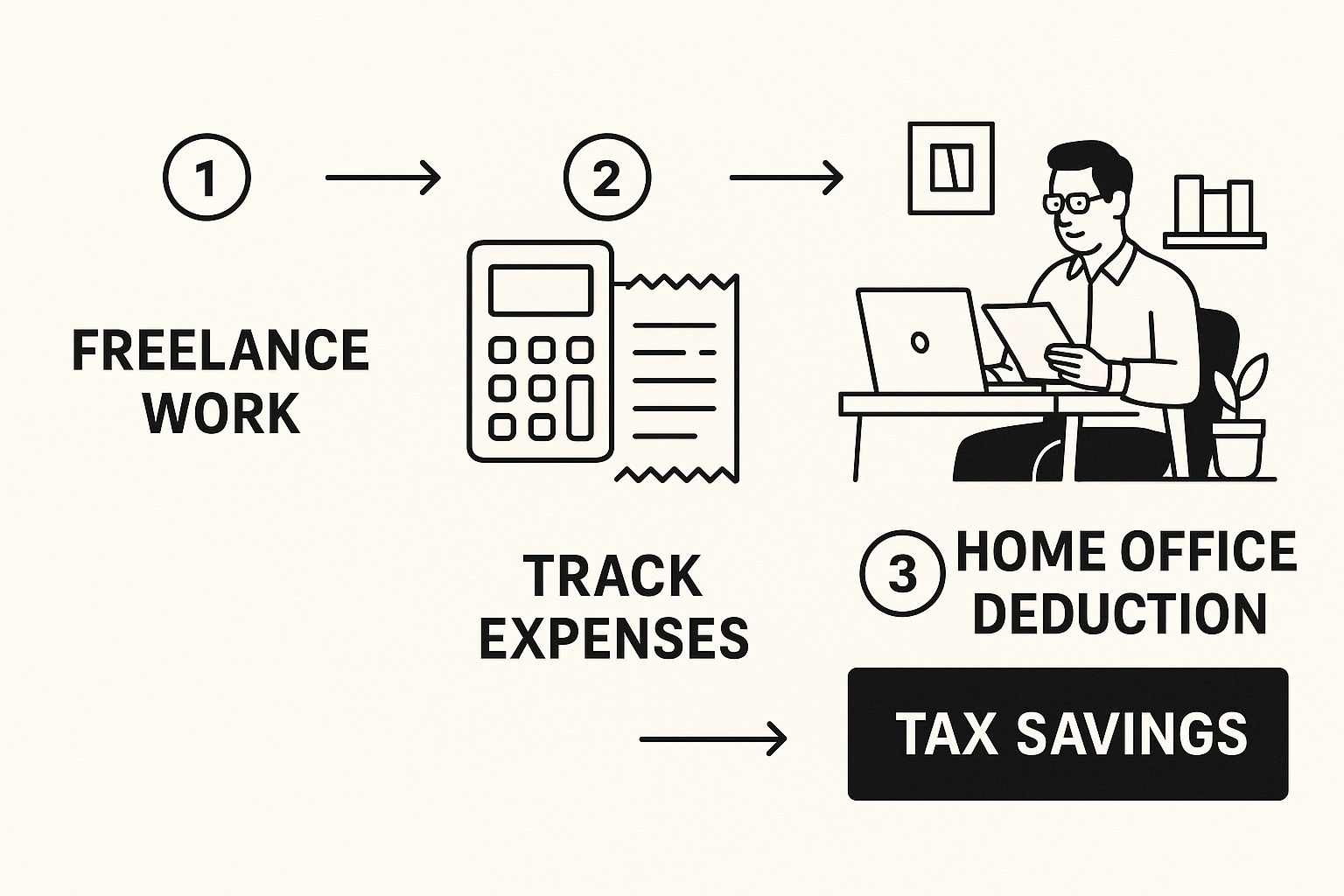
- Home Office Costs: You can claim a simple flat-rate allowance for using your home as an office. Alternatively, you can calculate a portion of your actual household bills, like heating, electricity, and broadband, which often works out better.
- Business Bank Charges: Those annoying monthly fees on your business bank account? They are an allowable expense.
- Professional Subscriptions: Your membership fees for relevant professional bodies, like the BCS for IT contractors, are claimable.
For many contractors, private health insurance is a major personal cost. It's well worth looking into the rules around claiming your self-employed health insurance deduction, as it can be a significant saving.
The real aim here is to build a complete and accurate picture of what it costs to run your business. Meticulous record-keeping is not just about compliance; it's your best defence in an HMRC enquiry and the only way to maximise every claim.
The table below breaks down some of the most common expense categories to help you get started.
Common Allowable Business Expenses for Contractors
| Expense Category | Description & Examples | Key Consideration |
|---|---|---|
| Office & Equipment | Laptops, monitors, printers, business software (e.g., Microsoft 365), stationery. | Must be primarily for business use. For personal use, a benefit-in-kind tax may apply. |
| Travel & Subsistence | Journeys to a temporary workplace (client site). Includes mileage, train fares, flights, hotels, and meals. | You cannot claim for your regular commute to a permanent workplace. |
| Training & Development | Courses, certifications, and conferences that enhance skills for your current contract. | Must be relevant to your existing business activities, not for starting a new venture. |
| Professional Fees | Accountant fees, legal advice, professional body subscriptions (e.g., BCS, IET). | The service must be for the benefit of your limited company. |
| Marketing & Advertising | Website hosting, business cards, LinkedIn Premium, professional networking events. | Must be for promoting your business, not for entertaining specific clients. |
| Insurance | Professional Indemnity, Public Liability, and Employers' Liability insurance. | These are essential protections and are fully tax-deductible. |
Remember, this is not an exhaustive list, but it covers the main areas where contractors can make legitimate claims.
Keeping Your Records Straight
Claiming an expense is one thing, but being able to prove it is what really matters. HMRC insists that you keep detailed records of all your business income and spending for at least six years after the end of the financial year they relate to.
This sounds more daunting than it is. Using modern accounting software can make this almost effortless. You can snap photos of receipts with your phone, automatically import transactions from your business bank account, and see your financial position in real-time.
Getting organised does not just keep you on the right side of HMRC; it puts you in control, allowing you to confidently claim every penny you are entitled to.
Advanced Tax Planning with Pensions and Investments
Once you have mastered balancing salary, dividends, and expenses, it’s time to look at some more powerful strategies for boosting your outside IR35 tax efficiency. Honestly, one of the single best moves any contractor can make is to pay into their pension directly from their limited company.
When your company makes a payment into your personal pension, it’s treated as an allowable business expense. This immediately shrinks your company's taxable profit, which in turn lowers your final Corporation Tax bill. It’s a brilliant way to build your retirement savings while getting an immediate tax break that you simply cannot get with salary or dividends.

Maximising Your Pension Contributions
Your limited company can put a hefty sum into your pension each tax year, up to the annual allowance. For the 2024/25 tax year, that figure is typically £60,000. This is an incredibly efficient way to extract profit because the money leaves your company before Corporation Tax is calculated, and you do not pay a penny of National Insurance or personal income tax on it.
Let's look at a quick example to see it in action:
- Imagine your company has made a profit of £60,000.
- Instead of paying Corporation Tax on that profit and then drawing the remainder as a dividend (which gets taxed again personally), your company pays the full £60,000 straight into your pension.
- The result? You have wiped out the Corporation Tax liability on that £60,000, and the entire amount is now in your pension pot, growing tax-free.
For any serious contractor, this approach is a cornerstone of smart, long-term financial planning. We dive deeper into this and other strategies in our guide on the best ways to reduce tax as a contractor in the UK.
The real beauty of company pension contributions is the double win. You are cutting today's tax bill while simultaneously building your wealth for tomorrow. It’s a perfect scenario for any contractor.
Grasping your tax position has never been more critical. The 2021 IR35 reforms expanded the off-payroll working rules, and a February 2025 HMRC report estimated this shake-up affected around 120,000 workers. This single reform led to an estimated £4.2 billion increase in tax revenue for the government between 2019 and 2023. It's a stark reminder of why contractors have to be proactive in managing their tax affairs. You can read more about the true cost behind HMRC’s windfall on Bauer and Cottrell.
Exploring Other Investment Avenues
Pensions are fantastic, but what if you have surplus funds in your company and want to explore other options? There are other long-term investment strategies out there. While they can offer some very attractive tax reliefs, they do tend to come with higher risk, so it’s always wise to chat with a financial adviser first.
Two government schemes worth looking into are:
- Enterprise Investment Scheme (EIS): This scheme is designed to encourage investment in smaller, higher-risk trading companies. In return for taking on that risk, you can get significant income tax relief and breaks on capital gains tax.
- Seed Enterprise Investment Scheme (SEIS): Think of this as the next level up. It’s aimed at even smaller, start-up companies and offers even more generous tax reliefs than EIS to compensate for the greater risk involved.
These schemes are not for everyone, but they represent a more forward-thinking way to plan your finances. You can use your company's success to support other UK businesses while potentially securing some substantial tax benefits for yourself.
Getting to Grips with VAT and Corporation Tax

When you are running your own limited company outside IR35, VAT and Corporation Tax are two of the biggest financial hurdles you will face. But with some forward planning, you can transform these obligations from a headache into a straightforward part of doing business. It’s a key part of your outside IR35 tax efficiency strategy.
Let’s start with VAT. A common misconception among new contractors is that you only need to think about VAT registration once you hit the mandatory turnover threshold. This is not always the case. In fact, registering voluntarily can be a savvy financial move, particularly if your clients are all VAT-registered businesses.
The Case for Voluntary VAT Registration
Once you are VAT-registered, you add VAT to your invoices. Your clients, being VAT-registered themselves, simply claim this back, so it does not actually make you more expensive to them.
The real win for you is on the other side of the equation: you can now reclaim the VAT on all your business purchases. Think about it, that new laptop, your software subscriptions, accountancy fees, even your phone bill. All that VAT you have paid out comes straight back to your company. It really does add up over the year.
It often boils down to a simple calculation. If the VAT you can reclaim on your expenses outweighs the admin time of filing your quarterly returns, it’s almost always a good idea to register.
A Quick Word on the VAT Flat Rate Scheme
You might have heard about the VAT Flat Rate Scheme, which was originally set up to make life simpler. The idea was you would pay HMRC a fixed percentage of your turnover instead of meticulously tracking the VAT on every single purchase.
However, the rules have changed over the years. For many contractors who do not have significant material costs (HMRC calls them 'limited cost traders'), the scheme has lost much of its appeal. You really need to run the numbers with your accountant to see if it still makes sense for your specific situation.
How to Prepare for Your Corporation Tax Bill
Corporation Tax is the tax your company pays on its annual profits, that’s what's left after you have paid all your expenses and your own salary. The trick here is not just about finding the money to pay the bill; it's about disciplined cash flow management all year round.
The best strategy is also the simplest: set aside money as you earn it.
A great rule of thumb is to move between 20% and 25% of every single payment you receive into a separate business savings account. Think of it as your "tax pot". When the payment deadline eventually arrives, the cash is sitting there waiting. No last-minute panic, no dipping into your operational funds.
This kind of proactive financial management is absolutely essential, especially in a tricky economic climate. Many contractors already feel squeezed by regulations like IR35, with some arguing it stifles the very entrepreneurial spirit it should support. You can read more about how IR35 reforms are viewed within the broader UK economy on grisanik.com. By keeping a firm grip on your tax liabilities, you are building resilience and maintaining control over your business's future.
Your Outside IR35 Tax Questions Answered
Getting your head around contractor tax can feel like a minefield, but it does not have to be. At UmbrellaCompany.com, we are often asked the same questions, so we have pulled together some straightforward answers to help you manage your company’s finances with more confidence.
What is the smartest way to pay myself?
For most contractors, the tried-and-tested route is taking a small salary and drawing the rest as dividends. It’s a classic for a reason.
By paying yourself a salary that’s just high enough to meet the National Insurance threshold, you will bank a qualifying year for your state pension without having to pay much, if any, NI. It’s a win-win.
You can then take the remaining profits as dividends. These are taxed at a much more friendly rate than salary income, and because your salary counts as a business expense, it also shaves a little off your final Corporation Tax bill.
Can I expense my daily trip to the client's office?
This is a big one, and the short answer is no. Your regular journey from home to a client's site is just considered a normal commute in HMRC’s eyes, so you cannot claim it.
What you can claim for is travel to what HMRC calls a temporary workplace. The key here is understanding the rules, especially the '24-month rule', which dictates when a workplace stops being temporary. Getting this wrong can lead to serious headaches, so it is worth getting familiar with the definitions.
Think of it this way: HMRC sees your long-term client site just like a permanent employee's office. The rules are there to stop you from claiming for a regular, predictable commute.
Is it worth registering for VAT if I am under the threshold?
It absolutely can be. If your clients are all VAT-registered themselves, they can simply reclaim the VAT you charge them, so it does not actually cost them anything extra.
The real advantage for you is that you can then reclaim the VAT on all your business purchases, think laptops, software subscriptions, accountancy fees, you name it. Those little bits of VAT really add up over a year, and it’s money straight back into your company’s pocket. It’s always best to have a quick chat with your accountant first, just to make sure it’s the right call for your specific situation.
How much should I put away for Corporation Tax?
As a rule of thumb, it’s a good habit to move 20-25% of everything you earn into a separate savings account. Think of it as your tax pot.
With the Corporation Tax rate sitting between 19% and 25% depending on your profits, this gives you a solid buffer. By regularly siphoning this money off, you will avoid that horrible shock when the tax bill finally lands. It’s just good financial discipline and makes managing your cash flow a whole lot less stressful.
We know that navigating IR35 and finding the right payment structure can be challenging. At UmbrellaCompany.com, we specialise in helping contractors compare compliant and trusted umbrella companies to find the perfect fit for their needs. If you're looking for support, visit us at https://umbrellacompany.com to get started.


