


Working as a contractor through your own limited company comes with many perks, but it also means you're in the driver's seat for your finances. One of the most common questions is: "What will I actually take home at the end of the month?" An outside IR35 calculator is the tool that answers that exact question.
This guide explains how the calculator works, what information you need, and how to use the results to make smarter financial decisions. It is designed to cut through the complexity and turn your gross day rate into a realistic net pay figure, giving you the clarity you need to plan your finances with confidence.
How to Forecast Your Contractor Take-Home Pay

When you operate through your Personal Service Company (PSC), figuring out your real earnings is not as simple as multiplying your day rate by the days you work. That’s where an outside IR35 calculator comes in. It is built specifically to give you a detailed financial forecast, breaking down exactly where your money goes after all the necessary deductions.
This guide will walk you through how to get the most out of this tool. The goal is to give you a clear, no-nonsense picture so you can make smarter financial decisions, from quoting for a new project to managing your personal budget.
What’s the Point of an Outside IR35 Calculator?
The main job of the calculator is to give you a solid estimate of your net pay. This is absolutely vital for contractors. When you are outside IR35, you are responsible for managing your company's finances, which includes handling all your taxes and business expenses.
A reliable calculation helps you:
- See what a contract is really worth after HMRC has taken its slice.
- Plan your personal and business finances by knowing what is likely to hit your bank account each month.
- Compare different contract offers with real numbers, not just the headline day rate.
How Does It Work in Practice?
Think of the calculator as a financial simulator for your contract. You start by entering the key details, primarily your daily contract rate and how many days you expect to work. Most contractors pencil in around 200 working days a year, which is a sensible way to account for holidays, sick days, and those inevitable gaps between projects.
From there, the tool gets to work, modelling the most tax-efficient structure for your earnings. It factors in things like Corporation Tax, salary, dividends, and expenses to arrive at a take-home figure.
Of course, not every contract falls outside IR35. If you find yourself taking on an 'inside' role, comparing your potential earnings is just as important. Our handy UK payroll calculator is perfect for this, as it shows you a clear picture of your take-home pay when working through an umbrella company, letting you see the two options side-by-side.
A reliable take-home pay forecast is the foundation of good financial management for any contractor. It removes the guesswork and empowers you to manage your business with confidence, ensuring no unwelcome surprises when it is time to pay taxes.
What You Need for an Accurate Calculation
An outside IR35 calculator is a fantastic planning tool, but it is only as good as the numbers you feed it. Think of it like a recipe: if you guess the ingredients, you will not get the cake you were expecting. To get a realistic projection of your take-home pay, you will need to pull together a few key financial details first.
Let's walk through exactly what you need to have on hand and why each piece of the puzzle is so important.
Your Core Contract Details
Everything starts with your earnings. These two figures are the bedrock of the entire forecast, so getting them right is the most important step.
- Contract Day Rate: This is the gross amount your limited company bills the client for each day you work. It is the starting point before any taxes or business costs are taken out.
- Working Days: You will need to estimate how many days you realistically expect to work in a year. A common benchmark is around 220 days, which accounts for weekends, bank holidays, and a decent chunk of unpaid leave. Do not be tempted to overestimate this, it will only give you a falsely optimistic take-home pay figure.
Before you start, it is worth gathering these details from your contract and business plan. The table below summarises the key inputs you will need.
Required Inputs for Your Outside IR35 Calculation
| Input Field | Description | Example |
|---|---|---|
| Contract Day Rate | The gross daily amount invoiced to the client. | £500 |
| Working Days Per Year | Your estimated number of billable days, minus holidays and sick leave. | 220 days |
| Annual Business Expenses | A realistic estimate of all allowable costs your company will incur. | £5,000 |
| Annual Pension Contribution | The total amount you plan to contribute to your pension via the company. | £10,000 |
Having these figures ready will make the process quick and ensure the result you get is a reliable guide for your financial planning.
Allowable Business Expenses
One of the big perks of working outside IR35 is that your limited company can claim tax relief on legitimate business costs. These expenses are deducted from your company's income before Corporation Tax is calculated, which means more profit is available for you to take home.
It is vital to have a realistic annual estimate for these costs. Common examples include:
- Accountancy fees
- Business insurance (like professional indemnity)
- Software subscriptions and essential IT gear
- Memberships to professional bodies
- Business-related travel and subsistence
A good grasp of these outgoings is not just useful for the calculator; it is essential for running your business properly. If you are ever unsure what counts as an allowable expense, it is always smart to check with your accountant.
Pension Contributions for Tax Efficiency
Making pension contributions through your limited company is one of the most powerful and tax-efficient moves a contractor can make. These contributions are typically treated as an allowable business expense, directly cutting your company's Corporation Tax bill.
Most calculators will ask for your planned annual pension contribution. Entering this gives a much clearer picture of your overall financial position and shows how proactive planning can significantly boost your net retention.
Remember, the calculator's job is to give you a projection based on the assumption your contract is genuinely outside IR35. The tool itself cannot determine your IR35 status. You can learn more by checking out our guide on how to tell if you are inside or outside IR35.
Understanding the Calculator's Assumptions
Finally, it is important to know that every outside IR35 calculator works on a set of standard assumptions. These are built-in rules based on current UK tax laws and the common ways contractors run their Personal Service Companies (PSCs).
These assumptions nearly always include:
- A Tax-Efficient Salary: The calculation will typically assume you pay yourself a small director's salary, often pegged to the National Insurance Secondary Threshold. This is a classic strategy for minimising PAYE tax and NICs.
- Current Tax Rates: It will use the latest rates for Corporation Tax, Dividend Tax, and National Insurance contributions for the current tax year.
- VAT Status: Most calculators assume you are not VAT registered unless you specify otherwise. If your business is VAT registered (especially under the Flat Rate Scheme), your take-home pay could be higher.
By understanding both your own inputs and these built-in assumptions, you can be confident that the final figure you see is a solid, trustworthy estimate to help with your financial planning.
Peeking Under the Hood: How the Calculation Works
An outside IR35 calculator is not a magic black box. It is a logical tool that follows the money, step-by-step, to work out your likely take-home pay. Let's trace that journey from the moment your company invoices your client, all the way down to the cash that hits your personal bank account. This will show you exactly how tax is structured when you run contracts through a Personal Service Company (PSC).
It all starts with three simple pieces of information: your day rate, how many days you expect to work, and a rough idea of your annual business expenses. These three numbers are the building blocks for the entire estimate.
This diagram shows how those basic inputs kick things off.
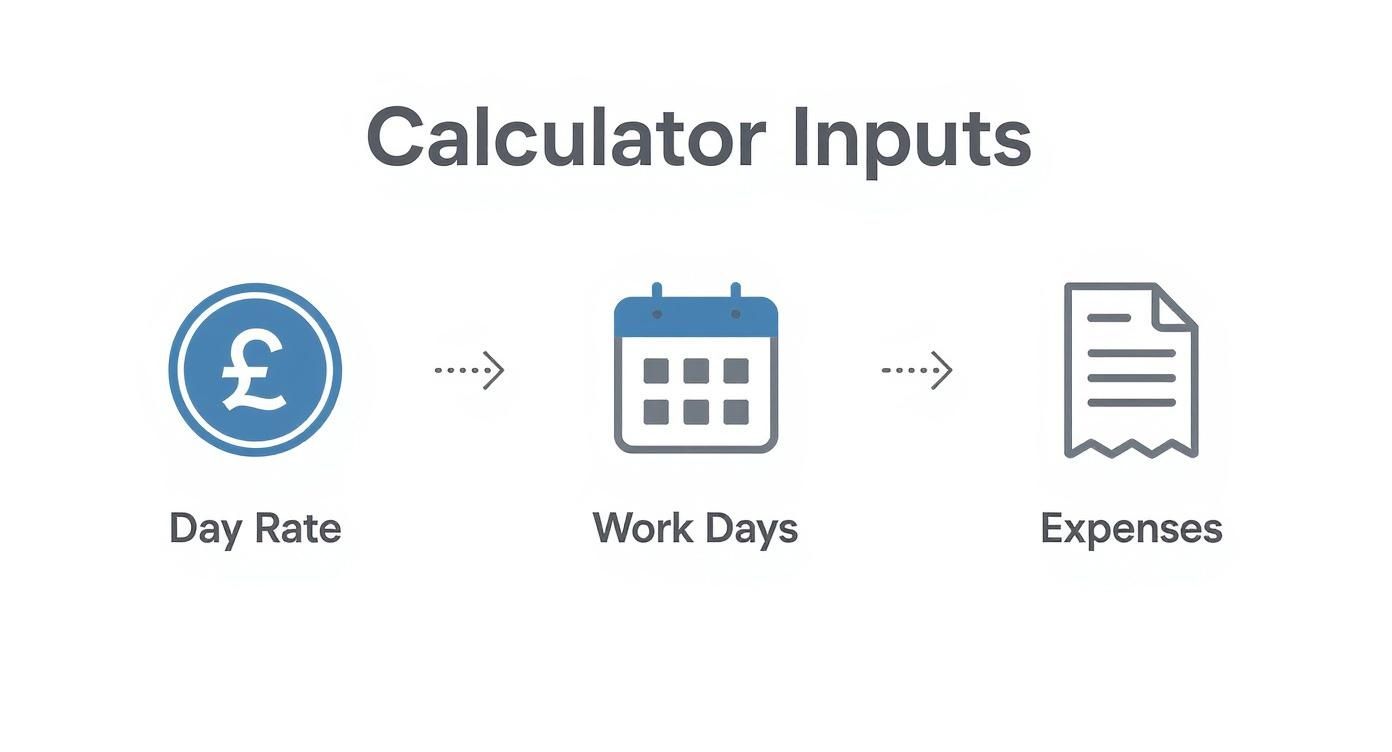
As you can see, the calculator multiplies your day rate by your working days to get your total turnover, before it even thinks about your expenses.
Step 1: Deducting Your Business Expenses
First things first, the simple part. Any allowable business expenses (think accountancy fees, professional insurance, software subscriptions) are subtracted straight from your company's total income. This is one of the big perks of operating outside IR35.
Doing this lowers your company's overall profit, which means you will pay less Corporation Tax. It is a vital first move to keep more of your hard-earned money available for you.
Step 2: Calculating Corporation Tax
With expenses out of the way, the figure left over is your company's taxable profit. The calculator then applies the current UK Corporation Tax rate to this number to work out what your company owes HMRC.
That amount is set aside for the tax authority. Whatever profit is left after Corporation Tax is what your company can then pay out to you, its director.
Step 3: Paying a Tax-Smart Director's Salary
Next up is paying yourself a salary as a director. Most contractors in this position take a very small, tax-efficient salary. This is not a dubious workaround; it is a standard, legitimate strategy that your accountant will almost certainly recommend.
Why do it this way? A small salary keeps you on the books for state benefits like the State Pension but is set low enough that you do not trigger much (if any) Income Tax or National Insurance Contributions (NICs). The calculator usually defaults to a salary around the National Insurance Secondary Threshold to hit this sweet spot.
The whole point of this salary and dividend mix is to keep your liabilities under the Pay As You Earn (PAYE) system to a bare minimum. This leaves the vast majority of your company's profits ready to be paid out in a much more tax-friendly way.
Step 4: Distributing the Rest as Dividends
So, we have paid the Corporation Tax and taken care of your small salary. Everything left in the pot is your company's post-tax profit. This is now free to be paid out to you, the shareholder, as dividends.
For most contractors working outside IR35, this is where the lion's share of their take-home pay comes from. The tax rules for dividends are different from salary, and that is the fundamental reason this structure is so much better for your bottom line.
Step 5: Calculating Your Personal Tax on Dividends
Finally, we get to your personal tax bill. Every taxpayer in the UK gets a tax-free dividend allowance each year. Any dividends you take that fall within this allowance cost you nothing in tax.
For anything you draw above that allowance, the calculator applies the relevant dividend tax rates. Which rate you pay depends on your total income and which tax band you fall into (basic, higher, or additional). Once this final deduction is made, the calculator produces your final net take-home pay. It gives you a clear, realistic forecast of what you can actually expect to pocket.
Comparing Your Earnings: Outside IR35 vs. Inside IR35

The financial gap between an 'inside' and an 'outside' IR35 determination is not just a small detail, it is a game-changer for your personal finances. For any contractor, getting to grips with this difference is vital, as it directly shapes your net take-home pay.
This is where a simple, side-by-side comparison really hits home. By crunching the numbers for the very same contract, you can see exactly how your IR35 status impacts your earnings. It all boils down to how your tax and National Insurance Contributions (NICs) are treated.
A Practical Scenario: Outside IR35
Let's walk through a realistic example. Imagine you are a contractor running your business through a Personal Service Company (PSC) and you have just landed a contract that has been correctly assessed as outside IR35.
Here are the key details:
- Day Rate: £500
- Working Days: 220 per year
- Annual Gross Income: £110,000
With a standard outside IR35 setup, you would pay yourself a small, tax-efficient salary and draw the rest of the company's profits as dividends. After accounting for legitimate business expenses and paying Corporation Tax, the majority of your earnings are taxed at much lower dividend rates.
The Same Contract, But Inside IR35
Now, let's rewind and imagine that same £110,000 contract has been deemed inside IR35. In this case, you cannot use your PSC to receive payment. The most common route is to work through an umbrella company.
The umbrella company effectively becomes your employer for tax purposes. This means your entire income is processed through the PAYE (Pay As You Earn) system, just like a permanent employee. Your earnings are subject to both employee's Income Tax and National Insurance.
On top of that, the umbrella company is legally required to pay employer's National Insurance and the Apprenticeship Levy. These costs are deducted from your assignment rate before your own gross pay is calculated, shrinking the pot of money you ultimately take home.
The core difference is stark. Outside IR35, you are a business owner, optimising your tax with a salary and dividend mix. Inside IR35, you are taxed like an employee, with every penny subject to PAYE deductions.
It is no secret that the gap in earnings is substantial. Contractors working outside IR35 often take home 70-75% of their gross contract value. In contrast, an inside IR35 determination can see that figure plummet to as low as 50-55%.
Side-by-Side Financial Breakdown
The numbers really do speak for themselves. Let’s look at a quick financial comparison for our £110,000 contract. This is exactly why an outside IR35 calculator is such a crucial tool for seeing what you could be earning.
Here’s a snapshot of how things could look.
Take-Home Pay Comparison Inside vs Outside IR35
| Financial Item | Outside IR35 (PSC) | Inside IR35 (Umbrella) |
|---|---|---|
| Gross Contract Value | £110,000 | £110,000 |
| Business Expenses | £4,000 (assumed) | Not applicable |
| Corporation Tax | ~£20,140 | Not applicable |
| PAYE Income Tax & NICs | Minimal (on small salary) | ~£35,000 |
| Dividend Tax | ~£6,500 | Not applicable |
| Estimated Net Pay | ~£77,000 | ~£60,000 |
Disclaimer: These figures are illustrative estimates and will change based on your personal tax circumstances, expenses, and current tax rates. Always use a dedicated calculator for an accurate projection.
The table makes it crystal clear that an outside IR35 engagement offers a massive financial advantage. Being able to manage your company's finances in a tax-efficient way leads to a much healthier net income.
This is precisely why getting a proper IR35 status assessment is one of the most important things you can do for your contracting career. To see how these numbers stack up for you, our inside vs outside IR35 calculator can give you a personalised comparison in minutes.
What Your Calculator Results Cannot Tell You
An outside IR35 calculator is a brilliant tool. It is fantastic for running the numbers, turning your day rate into a clear forecast of your take-home pay. This gives you the financial clarity to budget properly, weigh up different contract offers, and get a solid idea of your potential earnings through your limited company.
But it is crucial to understand what this tool is and what it is not. The figures it produces are a powerful guide, but they are not gospel. Think of the result as a forecast, not a fact. That is the key to using it responsibly and making smart business decisions.
An Estimate, Not a Guarantee
The single most important thing to remember is that any calculation is just an estimate. It is a projection based entirely on the information you provide and the tax rules in force right now. Tax rates, thresholds, and allowances can and often do change, usually following the government's annual Budget.
Your results are just a snapshot in time. A future tweak to Corporation Tax, a change to dividend allowances, or a shift in National Insurance could easily alter your final take-home pay. Because of this, it is a good habit to revisit the calculator from time to time, especially after any major fiscal announcements, just to keep your financial plans on track.
A calculator gives you a mathematical output based on your inputs. It does not offer legal or financial advice, and it certainly cannot confirm your IR35 status. It is a planning tool, not a compliance certificate.
The Critical Assumption It Makes
Every single outside IR35 calculator operates on one huge, fundamental assumption: that your contract and working practices are genuinely 'outside IR35'. This point cannot be stressed enough. The tool simply takes your word for it and crunches the numbers on that basis.
The calculator has no way of reading your contract, assessing your level of day-to-day control, or figuring out if you have a genuine right of substitution. In short, it cannot perform an IR35 status determination for you. That critical assessment falls squarely on your shoulders as a contractor and business owner. Getting your IR35 status wrong can lead to serious consequences, including demands for back taxes, interest, and penalties from HMRC.
Due Diligence Is Your Responsibility
Because the calculator cannot validate your IR35 status, you need to take proactive steps to make sure you are operating compliantly. Just relying on a tool like HMRC's own CEST is not always enough, as it has faced plenty of criticism for its unreliability in more complex, nuanced cases.
To use an outside IR35 calculator with any real confidence, you should always:
- Get a Professional Contract Review: Ask an IR35 specialist or a qualified legal professional to look over your contract and working practices. Their expert opinion gives you a much stronger defence if HMRC ever investigates.
- Keep Meticulous Records: Hold on to detailed records of your projects, client communications, and all your business activities. This paper trail helps prove you operate as a genuine business, not a 'disguised employee'.
- Understand Your Working Practices: Get to grips with the key IR35 status tests, like Control, Substitution, and Mutuality of Obligation. What you do day-to-day must match what is written in your contract.
At the end of the day, an outside IR35 calculator is an indispensable ally for financial planning. But to get the most out of it, you need to understand its limits. Pair its financial insights with proper professional advice and diligent record-keeping, and you will be able to manage your contracting career with foresight and confidence.
Making Your Take-Home Pay Projection Work for You
So, you have a realistic projection from an outside IR35 calculator. Fantastic. This is not just a number to glance at; it is a powerful tool that helps you move beyond guesswork and start making smart, strategic decisions for your contracting career. Think of it as your financial roadmap.
This figure gives you the clarity to properly size up new opportunities. You can finally see the real value of a contract, ensuring the day rate on offer actually lines up with your financial goals once all the tax deductions are accounted for. This kind of insight proves invaluable when you are deciding whether to accept, reject, or negotiate a contract.
Build a Realistic Personal Budget
One of the most immediate wins is the ability to build a rock-solid personal budget. When you know your likely net income, you can plan for everything from the monthly mortgage and bills to bigger goals like saving for a deposit or topping up your pension. It gives you a stable baseline for managing your finances.
This financial foresight lets you allocate your funds properly, making sure you can cover your short-term needs while still working towards your long-term ambitions without any nasty surprises.
Negotiate Day Rates with Confidence
Your take-home pay projection is also a brilliant asset to have in your back pocket during rate negotiations. When a potential client tables a day rate, you can quickly crunch the numbers to see how that translates into actual cash in your bank. If the final figure falls short of your target, you have a solid, data-backed reason to push for a higher rate.
This empowers you to explain your financial requirements with real authority. Suddenly, the conversation shifts from a vague day rate to the net income you need to make the engagement worthwhile. It turns negotiation from a hopeful punt into a proper business-led discussion. For more tips on this, check out our complete guide to take-home pay for contractors.
Your projected earnings are a key piece of business intelligence. Use them to validate that a potential contract is not just interesting, but financially viable for your limited company and your personal financial wellbeing.
Finally, your projection helps you compare different ways of working. By seeing your potential earnings outside IR35, you can make an informed choice about whether running your own PSC is the right path, or if working inside IR35 through an umbrella company makes more sense for a particular contract. This kind of strategic insight is absolutely essential for building a sustainable and profitable contracting career.
Burning Questions Answered
When you are navigating the world of contracting, the financial side of things can throw up a lot of questions. To cut through the confusion, we have tackled some of the most common queries we get from contractors about outside IR35 calculators and managing their money.
How Much Salary Should I Pay Myself Outside IR35?
This is easily the most popular question we hear, and the short answer is: it is all about tax efficiency. Most contractors running their own Personal Service Company (PSC) will pay themselves a small, tactical salary.
Typically, this salary is set right around a key HMRC threshold, like the National Insurance Lower Earnings Limit or the personal tax allowance for the year. The logic here is simple, it keeps your Income Tax and National Insurance Contributions (NICs) under the PAYE system to an absolute minimum.
By taking a modest salary, you leave the vast bulk of your company's profits available to be paid out as dividends. Dividends are taxed at a much friendlier rate than salary income, making this the standard, legitimate way to structure your earnings when you are genuinely operating outside IR35.
Can I Include VAT in the Calculator?
In a word, no. You should always leave Value Added Tax (VAT) out of your calculations. An outside IR35 calculator is there to work out your personal take-home pay from your company’s earnings, and VAT is never part of those earnings.
If your company is VAT registered, you are essentially acting as a collection agent for HMRC. You charge VAT to your clients, hold onto it for a period, and then pay it over to the tax authority with your quarterly VAT return. Since that money was never truly yours to begin with, it has no place in your income projections.
What Happens if My IR35 Status Is Wrong?
Getting your IR35 status wrong is a big deal, and the financial fallout can be severe. If HMRC decides to investigate your contract and concludes that it should have been classified as 'inside IR35', you will be liable for a hefty tax bill.
This is not just a small correction. We are talking about demands for back-paid Income Tax and National Insurance, plus interest and potentially significant penalties. This is exactly why just entering numbers into a calculator without doing your homework first is such a risky move.
An incorrect IR35 status determination can be financially devastating. It underscores the critical importance of seeking professional contract reviews and maintaining clear records to robustly defend your 'outside IR35' position should HMRC ever launch an enquiry.
Making sure your status is right from day one is the single best way to protect yourself and your business from a very expensive headache down the line.
Ready to compare your options and find a compliant, trustworthy umbrella company? The comparison portal from UmbrellaCompany.com makes it simple to find the perfect fit for your contracting needs. Find your ideal umbrella company today.


