


Deciding on the right business structure is a critical step in your contracting career. Are you ready to form your own limited company, or is the simpler route of an umbrella company a better fit? This is a significant decision, and getting it right from the start can save you a great deal of hassle.
Going limited is a major milestone. You transition from being a self-employed professional to a business owner. This comes with a certain prestige, better tax planning opportunities, and a legal shield between your business and personal assets. However, it also brings a dose of administration and legal duties.
This guide will walk you through the pros and cons, the registration process, and the ongoing responsibilities of opening a limited company, so you can make an informed choice.
Should You Start a Limited Company or Use an Umbrella?
For many long-term contractors, opening a limited company is the natural next step. It signals to clients, especially larger organisations, that you are a serious, established professional. More importantly, it separates your business finances from your personal ones, which is a crucial form of protection.
The main driver for most contractors is tax efficiency. By operating through a limited company, you can typically pay yourself a small, tax-efficient salary and take the remainder of your income as dividends. This structure often results in keeping more of your hard-earned money compared to being a sole trader or using an umbrella company.

The Appeal of Your Own Limited Company
Beyond the tax advantages, running your own company puts you firmly in control.
- Limited Liability: This is the key benefit. It means if the business runs into debt, your personal assets (like your house and savings) are protected. The company is a separate legal entity, and its debts are its own.
- Professional Credibility: A ‘Ltd’ at the end of your name looks more professional. Some clients, particularly in the public sector or finance, may even insist on it.
- Total Control: It's your business. You decide how to manage your cash flow, what expenses to claim, and the direction to take. This autonomy is a huge advantage for entrepreneurial-minded contractors.
The Flip Side: Director Responsibilities
Of course, all that control comes with responsibility. As a company director, you have legal duties you cannot ignore. This is not just a title; it is a legally binding role.
You are accountable for the company's actions. This means filing annual accounts and a confirmation statement with Companies House, keeping meticulous records, and ensuring all your taxes are paid correctly and on time.
This administrative load is significant, which is why many contractors hesitate. You will either spend time doing it yourself or pay an accountant to handle it for you. To get a clearer picture of how this compares to other structures, this Sole Trader Vs Limited Company Uk Guide is a great resource.
The Simpler Path: Using an Umbrella Company
The main alternative is to work through an umbrella company. It is a much simpler way to operate. The umbrella company effectively becomes your employer. You submit your timesheets, they invoice the client, and they pay you a salary after deducting all necessary tax and National Insurance through PAYE.
All the complex paperwork is handled for you. This makes it a fantastic option if you are new to contracting, on a short-term project, or know your contract falls 'inside IR35'. You trade the tax-planning flexibility of a limited company for a straightforward, hassle-free experience.
Limited Company vs Umbrella Company at a Glance
Here’s a quick-reference table to help you see the key differences.
| Feature | Limited Company | Umbrella Company |
|---|---|---|
| Control | Full control over business and finances. | No control; you are an employee of the umbrella. |
| Admin | High. Responsible for accounts, tax, and compliance. | Very low. The umbrella handles all admin and payroll. |
| Tax Efficiency | High. Can take salary and dividends to optimise tax. | Low. Paid via PAYE, similar to a permanent employee. |
| Liability | Limited liability protects personal assets. | No personal liability; you are an employee. |
| IR35 | Your responsibility to manage and determine status. | The umbrella handles IR35 compliance; ideal for inside IR35 roles. |
| Costs | Accountant fees, software, formation costs. | A weekly or monthly margin is deducted from your earnings. |
This table lays out the trade-offs clearly. One route offers more control and potential reward, while the other provides simplicity and peace of mind.
Ultimately, there is no single "best" answer. The right choice depends entirely on your attitude to risk, how much time you want to spend on admin, your contract rate, and your long-term career plans. For an even deeper dive, our complete guide on the umbrella company vs limited company debate covers all the finer details.
Your Essential Pre-Registration Checklist
Before you form your limited company, it pays to get your details in order. Nailing down a few key points now will make the registration process with Companies House much smoother and prevent future headaches.
Think of it as laying the groundwork. It is not just about picking a name; you need to sort out your company's official address, its structure, and how it will be classified.
Choosing a Unique Company Name
Your company name is more than just a label, it is your brand. It must also follow some strict rules. It cannot be the same as, or too similar to, an existing company on the Companies House register. It also cannot be offensive or use certain ‘sensitive’ words without official permission.
The first step is to run your ideas through the free Companies House name availability checker. It is smart to have a couple of backups ready, just in case your top choice is taken. And do not forget, your name must end with either ‘Limited’ or ‘Ltd.’.
Selecting Your SIC Code
Every single company in the UK must pick at least one Standard Industrial Classification (SIC) code. This code tells Companies House what your business does. For most contractors, it is usually something related to consultancy or professional services.
An IT contractor, for instance, might use codes like:
- 62020 – Information technology consultancy activities
- 70229 – Management consultancy activities other than financial management
You can have up to four SIC codes. Just make sure the main one accurately describes your primary business activity, as this information is public.
Getting the admin right first time is more important than ever. Recent figures show that just over 800,000 new companies were formed in the last year, a 10% drop. This is partly due to rising incorporation fees and new identity verification rules, which will make getting started more expensive and complex.
Appointing Directors and Shareholders
Even if it is just you, your company needs its roles formally assigned. As a contractor, you will almost certainly be both the sole director and the sole shareholder.
- Directors run the company day-to-day. You need at least one, and they must be over 16.
- Shareholders own the company. You will issue shares, and for a one-person company, you will typically own 100% of them.
You will have to provide personal details for all directors and any 'person with significant control' (PSC), which for most contractors, is just yourself.
Defining the Share Structure
When you set up the company, you also need to create a share structure. This simply means deciding how many shares exist and what their value is. For a solo contractor, keeping it simple is always the best approach.
A very common and straightforward setup is to issue 100 ordinary shares, each with a nominal value of £1. This makes managing ownership and paying dividends incredibly easy. If you plan to make a spouse or partner a shareholder for tax planning, you will need to decide on that share split from the beginning.
Establishing a Registered Office Address
Every limited company must have an official registered office address in the UK. This address is public information and is where all formal letters from Companies House and HMRC will be sent.
One crucial point: you cannot use a PO Box. It has to be a physical location where mail can be delivered and signed for. To keep their home address off the public record, many contractors use their accountant's office address or a virtual office service from a formation agent.
This list covers the key decisions you need to make upfront, but cost is also a factor. For a full rundown of the fees involved, you can check our guide on how much it costs to set up a limited company.
Getting Your Company Officially Registered
You have done the groundwork, and now it is time to make it official. This is where you formally register your business with Companies House and get set up with HMRC. It might sound like a lot of paperwork, but it is actually a straightforward process when you know what to expect.
Let's walk through it.
The first and most crucial step is to incorporate your company with Companies House. This is the legal act that brings your limited company into existence as its own entity. The quickest way to do this is through the government’s online service, which usually processes everything within 24 hours.
Your Application to Companies House
When you apply, you will need to provide all the details you have already prepared: your unique company name, registered office address, director and shareholder information, and your share structure.
During this online application, two important documents are created: the Memorandum of Association and the Articles of Association.
- Memorandum of Association: This is simply a legal statement from all the first shareholders, confirming they agree to form the company.
- Articles of Association: These are the internal rules for running the company. For most contractors, the standard ‘model’ articles provided by Companies House are perfectly fine.
The diagram below shows how the key decisions you have made feed directly into this application.
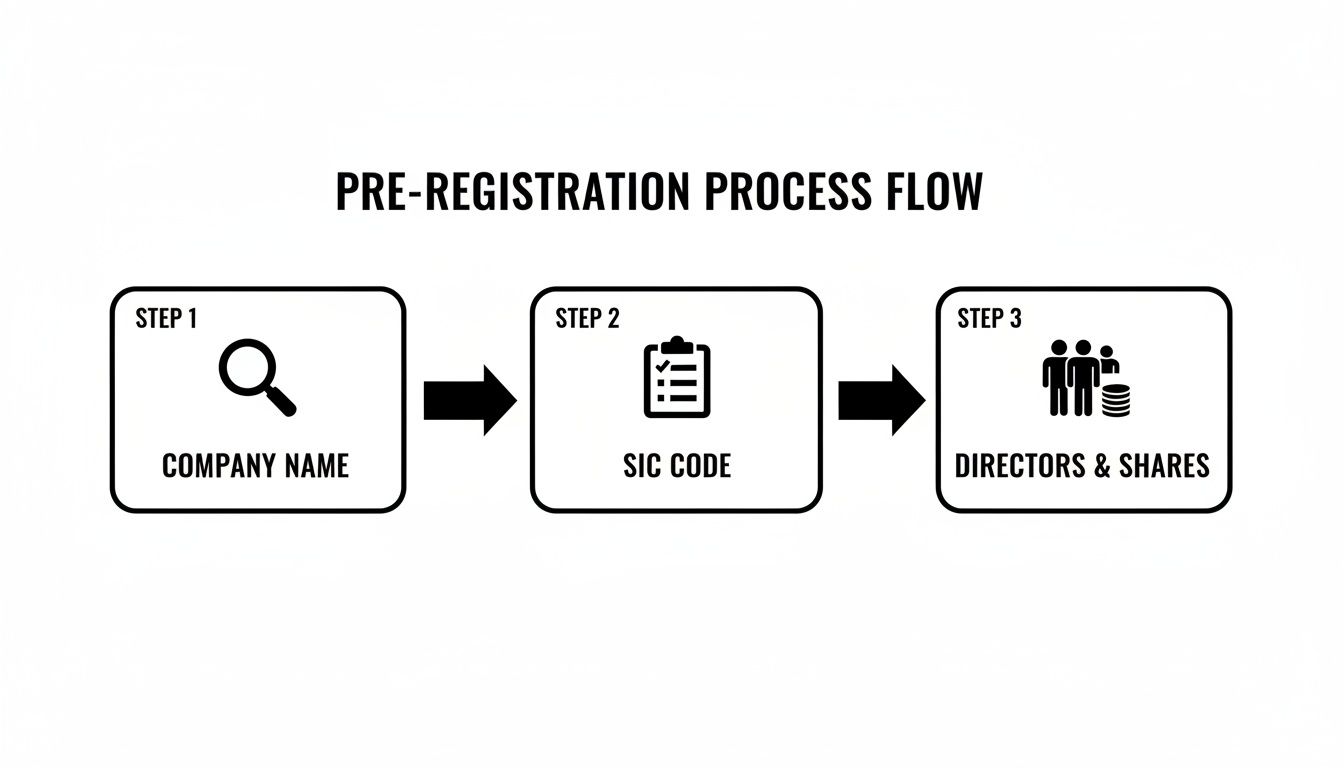
As you can see, finalising your company name, SIC code, and the director/shareholder setup are the foundations of your Companies House application.
New Identity Checks for Directors
One recent, major change is the introduction of mandatory identity verification for all new and existing company directors. This was brought in by the Economic Crime and Corporate Transparency Act (ECCTA) to boost transparency and clamp down on fraudulent activity.
When you register, you will have to verify your identity. This is typically a quick online process where you link a photo of your ID (like a passport or driving licence) with a live digital photo of yourself. It is a one-off check to make sure everyone on the public company register is genuinely who they claim to be.
As a director, you are not just registering a business name; you are taking on legal and financial responsibilities. These new identity checks formalise that accountability and are a key part of the government's effort to make UK company ownership more transparent.
Sorting Out Your HMRC Registrations
Incorporating with Companies House is only half the job. Once your company officially exists, you must register it with His Majesty's Revenue and Customs (HMRC) for the right taxes. This is not optional, and it is best to get it done straight away.
The good news is your company is automatically registered for Corporation Tax when you incorporate. A few weeks later, you will get a letter from HMRC with your company’s Unique Taxpayer Reference (UTR). Keep this safe; you will need it for everything tax-related.
Next, if you plan to pay yourself a salary (which nearly every contractor does), you need to register your company as an employer. This means setting up a PAYE (Pay As You Earn) scheme, which allows your company to handle Income Tax and National Insurance deductions from your salary correctly. If you need help with this, we cover the details in our guide on setting up a PAYE scheme.
Finally, there is Value Added Tax (VAT). You must register for VAT if your company's taxable turnover goes over the £90,000 threshold in any 12-month period (as of April 2024). However, many contractors choose to register voluntarily long before they hit this figure. It can make your business look more established to clients and allows you to reclaim the VAT on your business purchases.
Post-Registration: Managing Your Finances
Your company officially exists on paper at Companies House. Now comes the important part: making it work financially. Organising your money from day one is what separates the pros from the contractors who end up in a paperwork mess at year-end.
First, and this is a legal must-have, you need to open a dedicated business bank account. You cannot use your personal account for company business. Mixing your own cash with the company's is a huge red flag for HMRC and undermines the limited liability protection you just set up.

Choosing the Right Business Bank Account
Do not just look at the monthly fee. A good business account should integrate smoothly with your accounting software, have sensible transaction limits, and offer a decent online banking platform. Many newer "challenger" banks are great for new contractors, often with no monthly fees.
Introduction to Contractor Accounting
As a company director, you have two main ways to pay yourself: a salary and dividends. Getting this mix right is the key to tax efficiency.
Salary: Think of this as a small, regular wage you pay yourself through the company’s PAYE scheme. It’s a business expense, so it lowers your Corporation Tax bill. Most contractors set this at a tax-efficient level, usually around the National Insurance threshold, to avoid paying unnecessary NI.
Dividends: These are paid to shareholders (that’s you) from the company's profits after Corporation Tax has been paid. The main benefit is that dividends are not subject to National Insurance contributions.
This salary-and-dividend strategy is why so many contractors choose the limited company route. It absolutely requires careful planning, ideally with an accountant, to make sure you're taking home the maximum amount legally possible. For a more detailed breakdown, have a look at our guide on accounting for contractors.
Tracking Expenses and Staying Organised
Treat record-keeping as your most important administrative task. Every legitimate business expense, from software subscriptions to client lunches, reduces your company's profit, which in turn cuts your Corporation Tax bill.
Get into this habit from day one. We recommend you snap a photo of every receipt on your phone and upload it straight to your accounting software. Leaving a shoebox of crumpled receipts until your quarterly VAT return is due is a guaranteed way to miss claims and cause yourself a lot of stress.
A huge part of staying organised is choosing the right tools. There is some great best accounting software for startups out there, with platforms like FreeAgent and Xero being incredibly popular with contractors for good reason. They are built for this purpose.
This way of working is far from niche. Private limited companies make up over 95% of the 5.43 million businesses on the Companies House register. Interestingly, government data reveals that 44% of these are single-person companies, many of them contractors and freelancers just like you.
Whether you use software or hire a specialist contractor accountant, the key is consistency. Set aside half an hour each week to update your books and log expenses. That small bit of discipline will pay dividends later.
Staying Compliant: Your Ongoing Director Responsibilities
Setting up your limited company is the first major milestone. Now comes the day-to-day reality of keeping your company compliant with UK authorities. Your role as a director brings with it legal and financial duties you simply cannot afford to ignore.This is not a one-off checklist. Staying compliant means regular filings, meticulous records, and always being aware of rules like IR35. Let’s explore exactly what you need to manage to keep your business on the right side of the law.
Keeping Companies House in the Loop
As a director, you are legally responsible for keeping Companies House informed of your company's status. Failure to do so will result in penalties. There are two main annual filings you must handle.
First is the Confirmation Statement. Think of it as an annual check-in to confirm your company’s details (like the registered office, directors, and Persons with Significant Control) are correct. You file this every year, even if nothing has changed.
The second, more involved task, is filing your annual statutory accounts. This is a financial report card for your company. Most contractor businesses will file 'micro-entity' or 'small company' accounts, which are a simplified version.
Your core annual duties for Companies House are:
- Confirmation Statement: Confirms all your company information on the public register is still accurate. It’s a quick job online, but the deadline is firm.
- Annual Accounts: A financial breakdown of your company's trading for the year. You must file this within nine months of your company's financial year-end.
Falling behind on your accounts or confirmation statement is a bad idea. Companies House issues automatic fines for late accounts, and if you persistently fail to file, directors can face prosecution and the company may be forcibly closed.
Managing Your Tax Duties with HMRC
On top of your Companies House obligations, you have significant responsibilities to HMRC. Getting this right is non-negotiable if you want to avoid stressful investigations and penalties. The big three are usually Corporation Tax, PAYE, and VAT.
Every year, you need to file a Company Tax Return (CT600). This is where you declare your company's profits and calculate the Corporation Tax due. The deadline to pay your tax bill is nine months and one day after your year-end, but you have 12 months to file the return.
If you draw a salary from your company, you will be running a PAYE (Pay As You Earn) scheme. This means reporting payroll details to HMRC each time you pay yourself and remitting the correct Income Tax and National Insurance.
And if you are VAT registered, you will file regular VAT Returns (usually quarterly). You will report the VAT you have charged to clients, offset the VAT you have paid on business expenses, and then pay the difference to HMRC or claim a refund.
The Elephant in the Room: Navigating IR35
For any contractor operating through a limited company, IR35 (the off-payroll working rules) is the most critical piece of compliance to manage. These rules determine if you are a genuine business or a 'disguised employee' for tax purposes.
Getting an IR35 assessment wrong can have serious financial repercussions. If your client is a medium or large private-sector business or any public-sector body, the legal responsibility for deciding your IR35 status falls on them.
If a contract is deemed ‘inside IR35’, you are treated like an employee for tax on that specific job. The fee-payer (your client or agency) must deduct Income Tax and National Insurance from your invoices before paying the net amount into your company account. This removes the main tax benefit of taking dividends for that income.
If a contract is ‘outside IR35’, you are operating as a proper business-to-business service. You invoice for your work, the gross amount is paid to your company, and you can then distribute that income through a tax-efficient mix of a small salary and dividends.
Here is how it plays out in the real world:
Sarah, an IT contractor, lands a project with a major bank. The bank's assessment puts the role 'inside IR35'. When they pay her £5,000 invoice, they deduct tax and NI first, so her company receives the net payment.
Her next contract is with a small startup. As a small business, the startup is exempt from the rules, so the responsibility for IR35 rests with Sarah. After reviewing the contract and working practices, she determines it's 'outside IR35'. She invoices for £5,000, and her company gets the full amount to manage.
Understanding and correctly applying the IR35 rules for every single contract is fundamental. Keeping detailed records of your status determinations is not just good practice, it is essential for protecting your business long-term.
Common Questions from New Company Directors
Once you have set up your own limited company, a whole new set of practical questions will arise. We see these queries all the time from contractors taking their first steps, so let's get them answered.
Here, we will run through the real-world concerns you will have after incorporating, from the true costs and timelines to handling non-resident directors and 'inside IR35' contracts.
How Much Does It Cost to Open and Run a Limited Company?
The initial cost to get started is surprisingly low. As of May 2024, the Companies House incorporation fee is just £50 for a standard online application. That is the one-off payment to get your business on the official register.
The real costs are the ongoing ones you need to plan for. Your biggest ongoing expense will almost certainly be a specialist contractor accountant, with fees typically falling between £80 to £150+ per month. Think of this as a non-negotiable cost, as they handle your annual accounts, tax returns, and provide vital advice.
You will also need to budget for other regular outgoings:
- Business Banking Fees: While some newer digital banks offer free accounts, many high street banks will have a monthly charge.
- Professional Indemnity Insurance: This is essential for almost every contractor and protects you against claims of negligence.
- Software Subscriptions: This could include accounting software like FreeAgent or Xero if it is not bundled with your accountant's package.
It is a very different financial picture to the single, transparent margin you pay when using an umbrella company.
How Long Does the Company Formation Process Take?
The actual digital registration with Companies House is incredibly quick, often done in less than 24 hours. But do not mistake that for being ready to trade.
A more realistic timeline, from the moment you decide to start until you are fully set up to invoice a client, is usually one to three weeks. This gives you enough time for all the other crucial steps: picking a name, appointing directors, opening a business bank account (which can take days or even weeks), and getting all your HMRC registrations sorted.
Can I Be a Director If I Am Not a UK Resident?
Yes, you can. There is no legal requirement for a director of a UK limited company to be a UK resident or a British citizen.
The one absolute rule is that the company must have a registered office address in the UK. This needs to be a physical address where official mail from Companies House and HMRC can be sent, so a PO Box will not suffice.
Under the new Economic Crime and Corporate Transparency Act (ECCTA), all directors, including those overseas, must complete an identity verification process. It is a mandatory step designed to increase transparency, and you can complete it from abroad.
What Happens If My Contract Is Inside IR35?
If your client issues a Status Determination Statement (SDS) that places your contract 'inside IR35', it means you are classed as an employee for tax purposes for that specific job.
This directly changes how you get paid. The 'fee-payer' (usually the recruitment agency or the end client) is legally obligated to deduct Income Tax and employee's National Insurance from your invoice. The remaining net amount is then paid into your company's bank account. This is often called a 'deemed salary'.
For that portion of your income, this completely removes the tax efficiency you would normally get from taking dividends. If you find your work is consistently inside IR35, it is often far simpler and less hassle to use an umbrella company, as they are specifically set up to handle this PAYE payroll scenario.
At UmbrellaCompany.com, we specialise in helping contractors find the right path. Whether you are exploring the benefits of a limited company or need to find a compliant umbrella solution for an inside IR35 role, our comparison tools and expert guides are here to help. Visit UmbrellaCompany.com to compare your options and take the next step in your contracting career.


