


Welcome to our straightforward guide on contractor invoicing in the UK. As a contractor, you know that landing a great day rate is only half the battle. The real goal is keeping as much of that hard-earned income as you legally can. This guide is designed to cut through the jargon and give you clear, actionable advice on the most tax-efficient way to invoice.
Your Guide to Tax-Efficient Contractor Invoicing
We will walk you through the two main ways of working, as a limited company or through an umbrella company, and show you exactly how that choice shapes your take-home pay. You will learn the smartest ways to structure your payments and, crucially, which business expenses you can claim to lower your tax bill. For a closer look at streamlining your paperwork, it is also worth checking out tips for efficient invoice management for freelancers.

Here’s what we will cover:
- How game-changing legislation like IR35 really affects your tax obligations.
- The pros and cons of different business structures when it comes to tax efficiency.
- Practical, real-world steps for managing your invoices and expenses like a pro.
By the time you are done, you will have a solid grasp of your options, including how to structure your contractor income, and feel ready to choose the path that best secures your financial future.
Choosing Your Structure: Limited Company vs Umbrella
The business structure you pick is the very foundation of your contracting career. It dictates everything from your take-home pay and tax bill to the amount of admin on your plate. For most UK contractors, the path splits into two main options: setting up your own limited company or working through an umbrella company.
Essentially, the choice boils down to a trade-off. Are you after maximum tax efficiency, or is simplicity and peace of mind your main goal? Each route has a completely different way of handling your invoices and taxes, so it is vital to get your head around them before you jump in.
The Limited Company: A Path to Higher Tax Efficiency
Running your own limited company is widely seen as the most tax-efficient way to invoice as a contractor, especially if your work falls outside the scope of IR35. Why? Because it gives you strategic control over how you draw money from the business.
The real win comes from paying yourself a mix of a small salary and dividends. By keeping your salary low (say, up to the personal allowance threshold of £12,570) you can keep your National Insurance contributions to a minimum. You then take the rest of your earnings as dividends, which are taxed at a lower rate than salary and are not subject to NI at all.
Of course, this financial freedom comes with some serious legal responsibilities. As a company director, you are on the hook for:
- Filing annual accounts and a confirmation statement with Companies House.
- Calculating and paying Corporation Tax on company profits.
- Handling VAT returns if your company is VAT-registered.
- Making sure you hit every single statutory deadline to avoid fines.
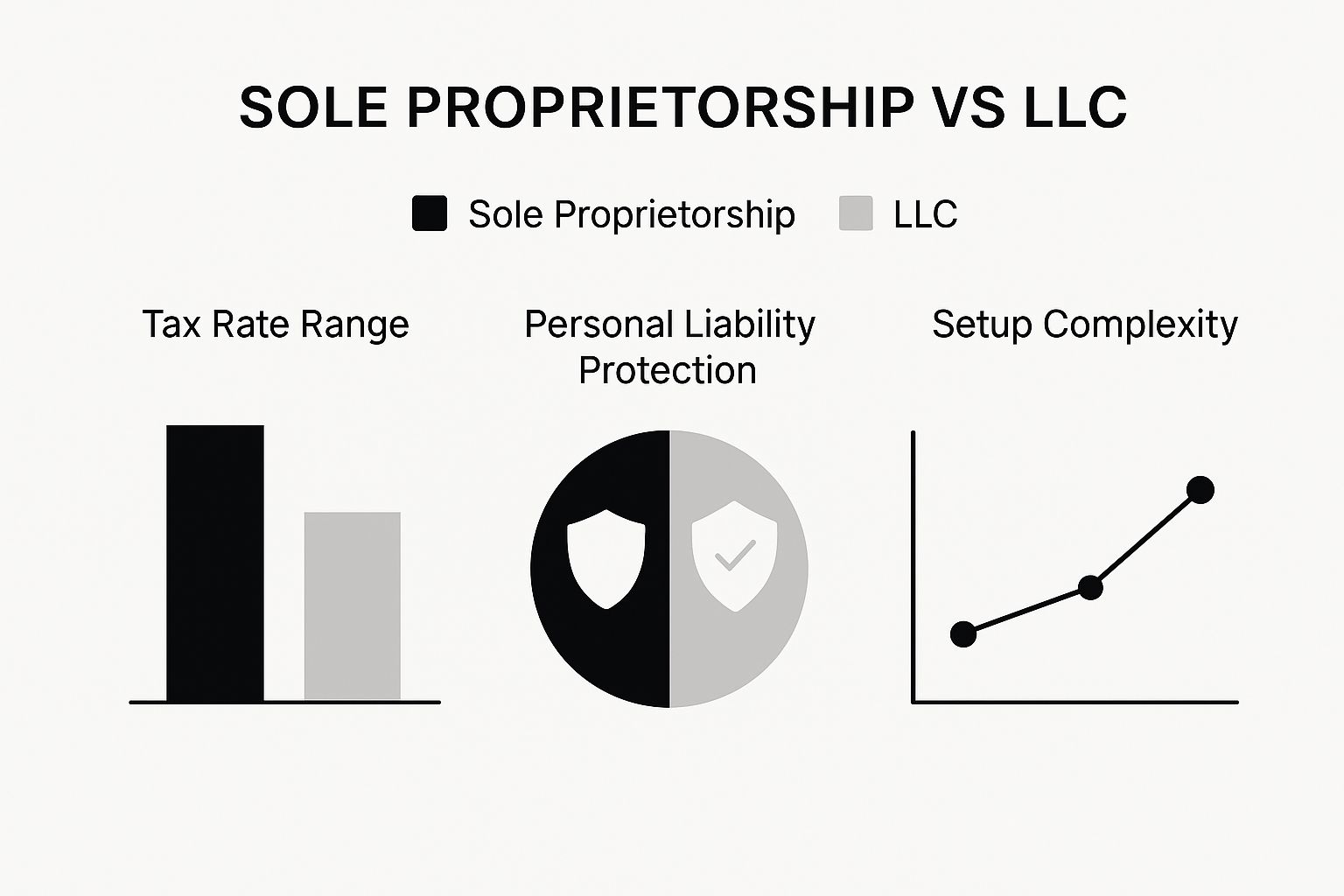
As you can see, it is a constant balancing act between how much control you want, the tax you will pay, and the admin you are prepared to take on.
The Umbrella Company: Simplicity and Security
Working through an umbrella company is a much more straightforward setup. In this model, the umbrella company acts as your employer for the duration of your contract, taking all the tax and admin headaches off your hands.
Your job is simple: submit your timesheets, and we handle the rest. We will invoice your client, and once the payment lands, we process your wages through the Pay As You Earn (PAYE) system. All the necessary Income Tax and National Insurance is deducted right at the source, just as it would be for any permanent employee.
The biggest advantage here is that you are completely free from the burdens of running a company. There is no Corporation Tax, no annual accounts, and no IR35 compliance worries – the umbrella company takes care of it all.
This approach also gives you a continuous record of employment and access to statutory rights like sick pay, holiday pay, and a workplace pension. It is the perfect solution for contractors whose work is inside IR35, or for anyone who just wants to focus on their work without the added stress of being a company director.
To help you weigh up the pros and cons, here is a quick side-by-side comparison.
Limited Company vs Umbrella Company At a Glance
| Feature | Limited Company | Umbrella Company |
|---|---|---|
| Control | Full control over business finances and decisions. | No control; you are an employee of the umbrella company. |
| Take-Home Pay | Potentially higher (outside IR35) through salary/dividend mix. | Lower, as all income is taxed via PAYE like a standard employee. |
| Tax Efficiency | High, with opportunities for tax planning and expense claims. | Low, as all earnings are subject to standard employee taxes. |
| Admin Burden | High: responsible for accounts, tax returns, and Companies House filings. | Very low: submit timesheets and the umbrella handles all payroll and tax. |
| IR35 Risk | You are responsible for determining IR35 status and carry the liability. | No personal IR35 risk; the umbrella company manages compliance. |
| Costs | Accountant fees (typically £80-£150+ per month), plus company formation costs. | A weekly or monthly margin is deducted from your earnings. |
| Employment Rights | None as a director, unless you set up a contract of employment with your own company. | Full statutory employment rights (sick pay, holiday pay, pension). |
Ultimately, there is no single "best" answer, it all depends on your individual circumstances.
Choosing the right structure is a massive decision for any contractor. For a much deeper dive into how each option could impact your bottom line, check out our comprehensive guide on umbrella company vs limited company. It gives you a detailed breakdown to help you make a smart choice that aligns with your personal and professional goals. The key is to find the right balance between the tax perks of a limited company and the simple, compliant solution an umbrella company offers.
How IR35 Rules Impact Your Tax Planning
If you are a contractor in the UK, getting your head around the IR35 rules is not just a box-ticking exercise, it is fundamental to your tax planning. This legislation is all about sniffing out 'disguised employment', and it can completely change how you get paid. It is the deciding factor on whether you are treated as a genuine business or, for tax purposes, just another employee.
The entire system boils down to one crucial question: is your contract 'inside' or 'outside' IR35? This is not something you get to choose. It is a legal verdict based on your actual working practices and the small print in your contract. Get it wrong, and the financial fallout can be serious.
Understanding Inside IR35
When a contract is determined to be 'inside IR35', it means HMRC sees your relationship with the client as employment in all but name. Even though you are invoicing through your own limited company, you will be taxed as if you were on their payroll.
This has a massive impact on your take-home pay. All your earnings from that contract get hit with PAYE Income Tax and National Insurance contributions, pretty much killing the tax benefits of using a limited company for that project. You can forget about paying yourself in tax-friendly dividends from this income; the tax has already been taken at source.
The Advantage of Being Outside IR35
On the flip side, operating 'outside IR35' is the goal. It confirms you are a proper, independent business providing a service, not a disguised employee. This is how you unlock the tax efficiencies that make contracting through a limited company so attractive.
When you are safely outside IR35, you can:
- Bill your client for the full contract amount without any tax being snipped off.
- Receive the gross payment straight into your business bank account.
- Strategically pay yourself with a combination of a small salary and larger dividends to keep National Insurance down.
- Claim a whole host of legitimate business expenses, which reduces your Corporation Tax bill.
This status keeps you in control of your company's finances and reaffirms that a limited company is the most tax-efficient way to operate for genuine contractors. For a complete deep dive, have a look at our guide that explains what IR35 is.
What Are the Off-Payroll Working Rules?
Things got a bit trickier with the introduction of the Off-Payroll Working rules. Now, for most contracts with medium and large private sector clients, the burden of deciding your IR35 status has shifted from you to them.
Your client now has to assess your working relationship and give you a Status Determination Statement (SDS). This document officially declares whether they believe the job is inside or outside IR35. If they decide it is inside, whoever pays your invoice (the client or your recruitment agency) is legally obliged to deduct tax and NI before the money even touches your company's bank account.
Key Takeaway: The Off-Payroll Working rules mean your client is in the driving seat for your IR35 status. It is vital you understand how they make their decision and have your own evidence ready to prove you should be 'outside IR35'.
Proving Your Status as a Genuine Contractor
To operate outside IR35 without worry, you need to show that your relationship with the client is a true business-to-business arrangement. HMRC looks at a few key things to figure this out.
The main factors are:
- Control: How much does your client dictate how, when, and where you do the work? The less control they have, the better.
- Substitution: Can you send someone else with the right skills to do the job in your place? A real right of substitution is a massive plus point for being a genuine business.
- Mutuality of Obligation (MOO): Is the client obliged to keep offering you work, and are you obliged to take it? A lack of this mutual obligation points towards a proper contractor relationship.
It all comes down to evidence. Both your contract and your day-to-day reality on the job must scream 'independent business'. You need to show you are taking financial risks and are in business on your own account. This is not something to be passive about; it is about actively protecting your ability to invoice tax-efficiently.
Claiming Allowable Expenses to Reduce Your Tax Bill
For any contractor running a limited company, getting a grip on your expenses is probably the single most powerful way to make your business more tax-efficient. Every pound you spend on a genuine business cost reduces your company’s taxable profit. The direct result? A lower Corporation Tax bill at the end of the year.
Think of it as HMRC giving you a tax break for investing back into your own business.

This simple principle is absolutely fundamental to finding the most tax efficient way to invoice as a contractor. Keeping a disciplined record of your expenses is not just about staying compliant; it actively increases the profit you can eventually take home. So, let us break down exactly what you can claim.
Common Allowable Expenses for Contractors
HMRC’s rule of thumb is that you can claim for costs that are ‘wholly and exclusively’ for your business. It sounds a bit strict, but in reality, it covers a huge range of the day-to-day operational costs most contractors face. The key, as always, is keeping meticulous records.
Here is a rundown of common expenses you should be tracking:
- Office Equipment and Software: This is the obvious stuff, your work laptop, monitors, printers, and any software subscriptions you need to do your job, like Microsoft 365 or Adobe Creative Cloud.
- Business Travel and Accommodation: You can claim for train tickets, fuel costs when using your personal car for business trips (based on HMRC’s approved mileage rates), and any hotel stays for work.
- Professional Development: Any courses, training programmes, or industry certifications that are directly relevant to your current contract and enhance your skills are generally allowable.
- Professional Subscriptions and Insurance: Your fees for memberships to professional bodies and essential business cover, like professional indemnity insurance, are fully deductible.
- Pension Contributions: This is a big one. Company contributions made from your business bank account directly into your personal pension are an incredibly efficient way to save for retirement and slash your Corporation Tax bill.
This is really just the tip of the iceberg. For a much more detailed look, you might find our guide on the best ways to reduce tax as a contractor in the UK useful, as we go into these areas in greater depth.
Claiming for Your Home Office
With so many contractors working from home these days, knowing what you can claim is vital. You basically have two choices here.
The easiest option is to claim HMRC’s flat rate, which is currently £6 per week. It is simple, requires no messy calculations, and you do not need to keep loads of receipts. Job done.
However, if your actual costs are higher, you can calculate a proportion of your real household bills. This means working out what percentage of your home is used for business, and for how much of the time.
For example, if you use one room in your five-room house as a dedicated office, that is 20% of your property. You could potentially claim 20% of your variable bills like electricity, heating, and broadband. Just be very careful not to claim a proportion of fixed costs like council tax or mortgage interest, doing so can create a Capital Gains Tax headache when you eventually sell your home.
The Contrast with Umbrella Companies
It is crucial to understand the massive difference in expense rules depending on how you operate. If you work through an umbrella company, your ability to claim expenses becomes far more limited.
Because of the rules around Supervision, Direction, or Control (SDC), the vast majority of umbrella company employees simply are not eligible to claim tax relief on travel and subsistence costs. While you might be able to claim some very specific, non-standard expenses, the broad range of deductions available to a limited company director just does not apply.
This distinction is one of the key reasons why the limited company structure can be so financially beneficial for contractors who are genuinely operating outside IR35. Keeping those organised records is the key that unlocks all these savings.
Getting to Grips with Digital Tax and Invoicing
The tax world is going digital, and for contractors, that is not something you can ignore. Keeping on top of your digital obligations is not just about ticking boxes for HMRC; it is a golden opportunity to make your entire financial life smoother and far more transparent.
This whole shift is being pushed by HMRC's Making Tax Digital (MTD) programme. In a nutshell, MTD means businesses have to keep digital records and use specific software to file their tax returns. For contractors, this has a real impact on both Corporation Tax and your personal Self Assessment.
What Making Tax Digital Actually Means for You
The big idea behind MTD is to make tax less painful and more accurate for everyone. If you are a limited company director, you are already using MTD-compatible software for your VAT returns. The next step on the horizon is MTD for Corporation Tax.
And for those of us who file a Self Assessment tax return (which will be mandatory for income over £50,000 from April 2026), MTD for Income Tax Self Assessment (ITSA) is coming. This will mean sending quarterly updates to HMRC showing your income and expenses, followed by a final end-of-year declaration.
This is not happening in a vacuum. It is part of a much wider government push for e-invoicing and tighter compliance. HMRC is looking at systems like PEPPOL, already used by NHS suppliers, to cut down on errors and late payments. They have also brought in tougher penalties for late tax, hitting you with 3% penalties after 15 and 30 days, plus a nasty 10% annual surcharge on whatever is left unpaid. You can read more about UK e-invoicing and compliance on causeway.com if you want the full picture.
Turning a Chore into an Advantage
Instead of groaning about more admin, think of this as a chance to drag your finances into the 21st century. The key is adopting modern accounting and invoicing software. It is how you turn a compliance headache into a genuine business asset.
These digital tools do so much more than just keep HMRC happy. They completely change how you handle your money.
- Look the part: Create and send polished, professional invoices in a few clicks.
- Know when you will get paid: Get live updates when your invoices are opened and paid.
- Ditch the shoebox of receipts: Link your business bank account to automatically log expenses as they happen.
When you embrace these tools, you are not just complying, you are building a rock-solid foundation for your business finances. This proactive approach does not just help you dodge penalties; it gives you a live, crystal-clear view of your company’s financial health.
How Digital Tools Make Tax Efficiency a Reality
At the end of the day, good digital systems make tax efficiency almost automatic. When your income and expenses are tracked accurately in real-time, you get a complete picture of your business's performance. You can literally watch your tax liabilities build up through the year, which means no horrible surprises when it is time to pay up.
That clarity lets you plan properly. You can set aside the right amount for tax and make smarter decisions about your spending and investments. It is the smart way to ensure the most tax efficient way to invoice as a contractor is also the most organised and compliant one.
Making the Right Choice for Your Contracting Career
So, what is the most tax-efficient way to invoice as a contractor? It really boils down to making a smart choice based on where you are in your career and then managing your finances properly. The right path for you will depend on your professional goals, how much risk you are comfortable with, and frankly, how much admin you can stomach.
For contractors who are confidently operating outside IR35, setting up a limited company almost always delivers the best financial result. This structure gives you the flexibility to draw a small, tax-efficient salary and take the rest in dividends, not to mention claiming a wider range of business expenses to lower your Corporation Tax bill. But, and it is a big but, this route means you are in the driver's seat for all the company admin and compliance that comes with it.
On the other hand, an umbrella company offers a refreshingly straightforward alternative. It is the perfect fit for anyone working inside IR35, or even just those who would rather trade a bit of tax optimisation for a whole lot less hassle. It completely removes the administrative headache from your plate and gives you the security of being an employee, with minimal fuss.
Your ideal choice hinges on your IR35 status, your appetite for managing paperwork, and your long-term plans. We always suggest getting professional advice that is tailored to your unique situation before you decide.
To make sure you are up to speed with the latest digital tax rules, it is well worth getting familiar with the Making Tax Digital for Self Assessment requirements. And if the security and simplicity of an accredited umbrella company sounds like the right move for you, we are here to offer a fully compliant and supportive service.
Frequently Asked Questions
When you are navigating contractor invoicing, tax rules, and business structures, a lot of questions come up. To help you get some clarity and make the best calls for your career, we have pulled together answers to the queries we hear most often from contractors around the UK.
Is a Limited Company Really More Tax-Efficient Than Being a Sole Trader?
For most contractors with a steady income, the answer is a resounding yes. Running your business through a limited company is almost always more tax-efficient than operating as a sole trader. This is a foundational point for any contractor.
When you are a sole trader, every penny of profit is treated as your personal income. That means it gets hit with both Income Tax and Class 4 National Insurance, which can easily push you into the higher tax bands as your business grows.
A limited company, on the other hand, is a completely separate legal entity. You pay Corporation Tax on the company's profits, which is currently lower than higher-rate income tax. Then, you can pay yourself a smart mix of a small salary and dividends. Dividends are not subject to National Insurance and are taxed at lower rates. It is more admin, for sure, but the tax savings usually make it a clear winner.
How Do Pension Contributions Actually Save Me Tax?
Pension contributions made through your limited company are hands down one of the most powerful tax-saving moves you can make. It is a fantastic way to build your retirement pot while cutting your tax bill right now.
Here is how it works: when your limited company makes an employer contribution to your personal pension, that payment is classed as an allowable business expense. This immediately reduces your company's profit, which in turn lowers your Corporation Tax bill.
The real magic is that the money goes straight from your company's pre-tax profits into your pension. It completely bypasses Corporation Tax, employer's NI, employee's NI, and your personal income tax. It is an incredibly efficient way to build your long-term wealth.
Can I Still Use My Limited Company for an Inside IR35 Contract?
Yes, you absolutely can, but you need to be clear on one thing: the tax advantages for that specific contract are pretty much wiped out.
If a contract is deemed 'inside IR35', the organisation paying you (your client or the agency) has a legal duty to deduct Income Tax and National Insurance via PAYE before the money even hits your company bank account. This is often called a 'deemed salary'.
Crucially, you cannot then take that income as a dividend to lower your tax bill, the tax has already been paid as if you were an employee. Your limited company can, however, continue to be used as normal for any other contracts you have that are genuinely 'outside IR35'.
What's the Best Way to Invoice to Get the Most Take-Home Pay?
To really maximise what you take home, you need to look beyond the invoice itself and focus on the business structure behind it. For any contractor working outside IR35, the winning formula is a limited company combined with a low salary/high dividend payment strategy.
This is the process in a nutshell:
- Invoice Properly: Your invoice needs to detail the services you provided and charge the full gross amount you agreed upon. If you are VAT registered, you add VAT on top.
- Receive the Gross Payment: Your client pays the full invoiced amount into your business bank account, with no tax taken off.
- Pay Yourself a Small Salary: You run a small, tax-efficient salary through your company payroll, usually set around the National Insurance Primary Threshold.
- Declare Dividends: After accounting for Corporation Tax, the remaining profit in the company can be paid out to you as dividends.
- Claim Every Expense: Be meticulous. Track and claim every single allowable business expense to lower your company’s profit and, by extension, its Corporation Tax bill.
This approach ensures you minimise your National Insurance contributions and take advantage of the lower tax rates on dividends, which directly boosts the amount of money that ends up in your pocket.
Is the VAT Flat Rate Scheme Still Worth it for Contractors?
For the vast majority of contractors these days, the VAT Flat Rate Scheme (FRS) just is not the great deal it used to be. The scheme was meant to make VAT simpler, but key changes have eroded most of the financial benefits.
The game-changer was the introduction of the 'limited cost business' category. A business is classed as this if its spending on goods (not services) is less than 2% of its VAT-inclusive turnover, or less than £1,000 a year. Since most contractors sell their time and expertise, they almost always fall into this bracket.
A limited cost business has to use a flat rate of a whopping 16.5%. When you apply this to your VAT-inclusive turnover, the amount you hand over to HMRC is often almost the same as, or sometimes even more than, the VAT you actually collected from your client. Because of this, standard VAT accounting, where you charge 20% and can reclaim VAT on your costs, is now the more sensible and tax-efficient option for most.
Should I Be Putting Money Aside for Tax From Every Invoice?
Absolutely. Setting money aside for tax is a non-negotiable habit for any contractor running a limited company. If you do not, you are setting yourself up for a massive cash flow headache when the tax bills land.
A good rule of thumb is to squirrel away between 25% to 35% of your gross invoice income. That should be a safe buffer to cover your Corporation Tax, VAT (if you are registered), and the personal tax you will owe on your dividends.
The smartest way to do this is to open a separate, interest-earning business savings account. The moment a client payment arrives, transfer your calculated tax provision straight into that savings pot. This ring-fences the tax money, stops you from accidentally spending it, and means you are always ready when HMRC comes knocking.
Choosing the right structure and managing your finances effectively is central to your success as a contractor. At UmbrellaCompany.com, we provide the tools and information to help you compare compliant, accredited umbrella companies, ensuring you find a service that fits your needs perfectly. Find your ideal umbrella company today!


