


Yes, you can absolutely get a mortgage as a limited company director. But if you have ever tried applying through a high-street bank, you have probably felt the frustration when their systems just do not grasp how you are paid.
The solution? Working with lenders who look beyond a basic salary to see the bigger picture, including your dividends and, crucially, any retained company profits.
A Director's Guide to Mortgages for Limited Company Directors

Getting a mortgage when you run your own limited company can feel like trying to fit a square peg in a round hole. Here at UmbrellaCompany.com, we have seen countless directors get knocked back by mainstream lenders who cannot look past a PAYE payslip. This guide will show you why that happens and how to find a much clearer path to getting that mortgage approved.
The main problem comes down to how lenders assess your income. Your accountant has likely advised you to operate in a tax-efficient way, which usually means taking a modest salary and drawing the rest of your income as dividends. You might even leave a healthy chunk of profit in the business for cash flow or future investment.
Why Standard Assessments Do Not Work
That smart business sense can become a real roadblock with standard mortgage lenders. Their automated affordability checks are built for employees on a fixed monthly salary. They are simply not designed to understand the variable, and often more complex, income streams of a company director.
Many high-street lenders will only consider your personal salary and dividends. They often completely ignore the profits you have purposefully left in your business, which can slash the amount you are able to borrow.
We are here to show you that with the right approach, your company's success is a major asset, not a hurdle. It is all about presenting your finances in a way that the right lenders will understand and trust.
A Clearer Path to Getting Approved
Getting the mortgage you deserve is not just about filling in an application; it is about smart preparation. As well as proving your income, it is wise for any director to look into effective strategies to reduce closing costs to make the most of the investment.
Here is what you need to do to get it right:
- Know the different lender types: Some lenders are simply better at this. You need to find the ones that specialise in assessing director incomes and are open to using your company’s net profit in their calculations.
- Get your paperwork in order: This is non-negotiable. Having your final accounts, SA302 tax calculations, and other financial records ready to go is vital. The right professional support makes all the difference, as we explain in our guide to finding the best accountant for limited company contractors.
- Present your income correctly: We will show you how to build a case that paints an accurate picture of what you can afford, moving far beyond just your basic salary.
With the right strategy for 2026, being a successful company director becomes a genuine strength in your mortgage application, not a weakness.
Why Lenders Struggle with Director Income
When you apply for a mortgage as a limited company director, you are not just showing a lender a payslip; you are asking them to understand the story of your business. The problem is, most high-street lenders are set up for the predictable world of monthly PAYE salaries. Your tax-efficient income structure, while brilliant for your business, simply does not fit their standard model.
Think about a lender’s automated system trying to compare a regular employee’s £50,000 salary with a director taking a £12,570 salary and £37,430 in dividends. The total income is the same, but the structure is worlds apart. This is often the first point of failure, as the lender's software is not built to interpret this kind of financial picture.
For many directors, this results in a frustrating "computer says no" moment. The system sees a low basic salary and is not programmed to correctly factor in dividend payments, let alone the profit you have sensibly kept in the business for growth.
The PAYE Mindset vs Director Reality
Most mainstream mortgage affordability checks operate on a PAYE mindset. Lenders love the simplicity of a fixed salary where tax and National Insurance are handled at source. It gives them a clean, consistent figure to plug into their spreadsheets.
As a director, your financial reality is far more dynamic. Your income is a mix of:
- A basic salary, often kept low for tax efficiency.
- Dividend payments, which are drawn from your company’s post-tax profits.
- Retained profit, the cash left in the business to manage cash flow or fund future projects.
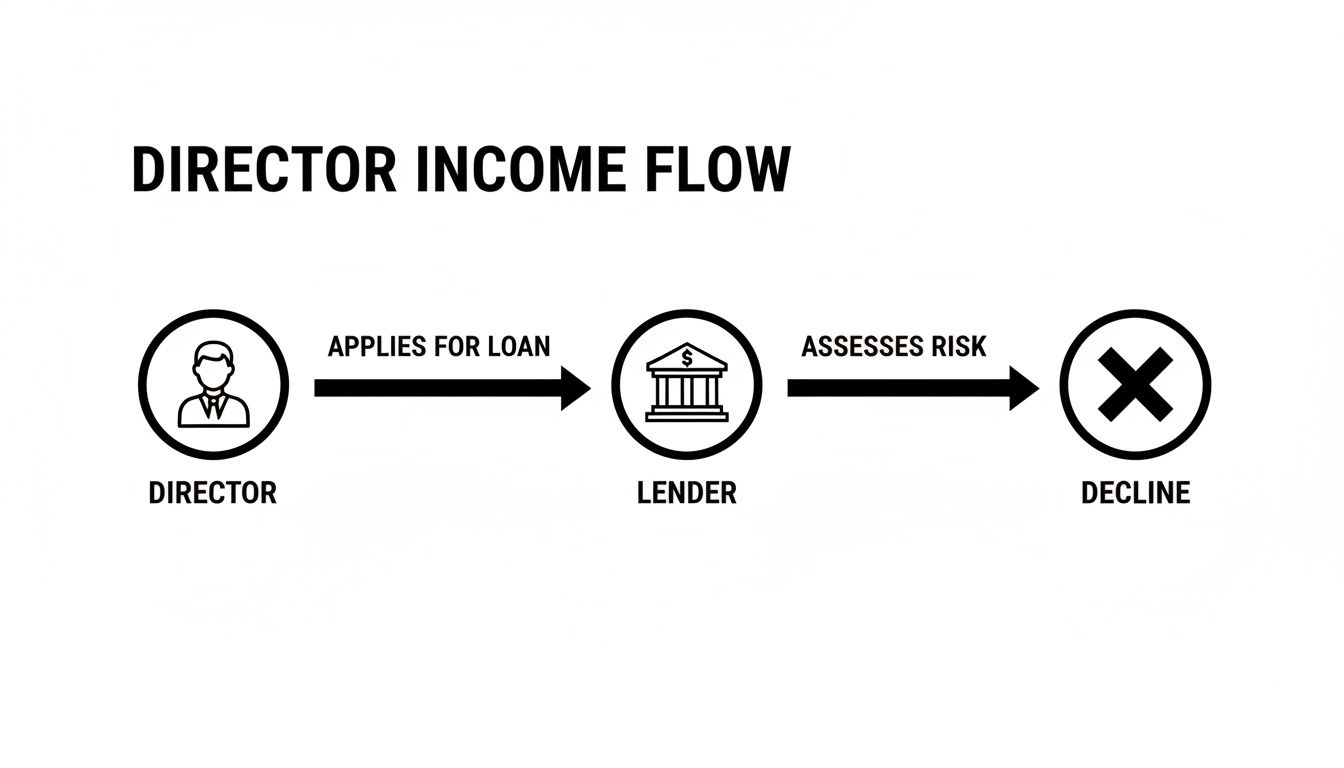
This kind of responsible financial management can, ironically, become your biggest hurdle. A lender’s automated system spots a low salary and variable dividends, flags it as inconsistent, and can reject the application without a person ever looking at it. They completely miss the profitable, stable business behind you.
The core problem is that lenders are assessing risk with a model that does not reflect how a successful modern UK business works. They are searching for payroll certainty, while you are demonstrating entrepreneurial success.
This mismatch is a huge reason why getting a mortgage as a limited company director is so tough. Data from specialist brokers shows that a high number of initial mortgage applications from directors are turned down by mainstream lenders simply because their systems cannot read company accounts properly. You can learn more about why director mortgage applications are often declined on wismortgages.co.uk.
Retained Profit: The Overlooked Asset
One of the biggest areas of misunderstanding is retained profit. Your accountant will advise you to leave surplus profit in the company. It is a tax-smart strategy that strengthens your business’s balance sheet and gives you a buffer for leaner times.
From a standard lender's point of view, however, that money is not yours, it belongs to the company. They often ignore it completely when working out what you can afford to borrow. They do not connect the dots between your company's success and your personal borrowing power.
The Dividend Dilemma
Even when lenders agree to consider dividends, they often apply strict rules. Many will want to see at least two years of consistent dividend payments before they feel comfortable. If your payments have been up and down, or you have only recently started drawing larger dividends, it can be another red flag for their automated systems.
How you structure your pay is critical, and knowing the trade-offs is key. For a detailed breakdown, it is worth reading up on choosing between a salary versus dividends. This insight will help you prepare for a lender's questions.
Ultimately, the challenge is not a reflection of your financial health; it is a limitation of an outdated lending system. The good news is that specialist lenders exist. Their underwriters are trained to look beyond automated checks, analyse company accounts, understand retained profits, and assess your true financial position. This provides a much clearer path to securing the mortgage you deserve.
How Lenders Calculate Your True Borrowing Power
When it comes to getting a mortgage as a limited company director, the single most important thing to grasp is how a lender actually assesses your income. It is not about how much cash your business is turning over, but what a lender is prepared to count towards your affordability.
Their chosen method can make a staggering difference to how much you can borrow.
Lots of directors get a nasty shock when a high-street bank takes one look at their income and comes back with a tiny offer, or worse, an outright rejection. This usually happens because their rigid, one-size-fits-all system just cannot make sense of a successful limited company's real financial picture.
This is a familiar story for directors who walk into a standard lender without realising there is more than one way to do the maths.
Let's break down the three main ways lenders calculate your income so you can see why this happens and, crucially, how to avoid it.
Approach 1: Salary and Dividends Only
This is the standard playbook for most high-street banks. They will ask for your last one or two years of tax calculations (your SA302s) and the matching tax year overviews from HMRC. From there, they simply add up your director's salary and the dividend income you declared.
It is straightforward, but for many directors, it is a deeply flawed approach. If your accountant has wisely advised you to retain profit in the business for tax efficiency or to fund future growth, that money is completely invisible to these lenders.
- Who it works for: Directors who consistently draw down almost all of their company’s profit as dividends each year.
- Who it penalises: Smart directors who leave money in their business for stability, tax planning, or reinvestment.
Approach 2: Salary Plus Your Share of Net Profit
This is where specialist lenders change the game. They are willing to look past your personal tax return and dig into your company’s finalised accounts. They calculate your affordability using your director's salary plus your share of the company's net profit before tax.
This makes a world of difference. It allows the lender to see the total profitability of your business and recognise that, as the owner, that profit is yours. It does not matter that you have not drawn it all out yet.
This method directly reflects your company's success. It acknowledges that the profit belongs to you as the owner and can be drawn upon, meaning it accurately represents your real financial capacity.
For instance, say you are the sole director of a company that made £100,000 net profit. You took a tax-efficient salary of £12,570. A specialist lender would assess your total income as £100,000. A high-street bank using the first approach might only see your salary plus whatever small dividend you paid yourself, giving them a much lower figure.
Approach 3: Salary Plus Retained Profits
Offered by a select few, truly forward-thinking lenders, this approach is the most flexible of all. It is similar to the second method but zeroes in on the profit left in the business year after year. These lenders will assess your salary and add your share of the retained profit from the latest accounts.
This can be a lifesaver if your annual net profit has its ups and downs but you consistently maintain a healthy pot of retained profits. It demonstrates stability and sensible financial management, two things these lenders value highly.
Getting a handle on your potential take-home pay is vital; you can model different scenarios with our limited company take-home calculator.
The gap between these methods can be enormous. Finding a lender that uses your company’s net or retained profit could easily double or even triple the mortgage you are offered compared to a bank that only cares about salary and dividends. As UK tax rules continue to shift through to 2026, proving your affordability through company profit will only become more essential.
Preparing Your Essential Mortgage Documents

A successful mortgage application all comes down to organised paperwork. For a limited company director, this is your chance to prove your financial stability and show a lender you are a safe bet. Getting your documents in order from the start removes any guesswork and presents a professional, easy-to-understand picture of your finances.
Think of it as building a case for yourself. Lenders are simply looking for solid proof of a reliable income and responsible financial habits. Your paperwork is the evidence that backs it all up.
Your Core Document Checklist
While the exact list can vary a little, especially between high-street banks and specialist lenders, there is a core set of documents you will almost certainly need. Having these ready will make the whole process much faster.
Here is the essential paperwork to start gathering:
- Company Accounts: You will need your last one to three years of finalised company accounts. These must have been prepared by a qualified accountant and clearly show your turnover, gross profit, and net profit.
- SA302s and Tax Year Overviews: These are your personal tax calculations direct from HMRC. The SA302 form shows the income you declared (both salary and dividends), and the Tax Year Overview proves the tax was actually paid. You can download these straight from your HMRC online account.
- Business Bank Statements: Be prepared to provide the last three to six months of statements for your business account. This lets the lender see the real-world cash flow and verify the turnover shown in your accounts.
- Personal Bank Statements: In the same way, you will need three to six months of personal bank statements. This is to confirm your declared income is landing in your personal account and to show how you manage your own finances.
- Accountant's Certificate/Reference: Many lenders, particularly specialists, will want a formal reference from your accountant. This is a signed document where your accountant confirms your company’s key figures, your salary, and the dividends you have taken. It adds an extra layer of professional validation.
Making Sure Your Paperwork Tells a Consistent Story
All your documents must line up. An underwriter will meticulously cross-reference your company accounts with your personal SA302s and bank statements. If the numbers do not match, it is an immediate red flag. For example, the dividends you declare on your tax return must be backed up by enough post-tax profit in your company accounts for that year.
A classic mistake is taking dividends that are higher than the available profit shown in that year's accounts. Lenders will spot this as an 'overdrawn director's loan account', which signals poor financial management and can derail an application.
It is absolutely vital that your accounts are professionally prepared and filed on time. Late filings or messy books can suggest you are disorganised, even if the business is profitable. This is where a good accountant is worth their weight in gold.
Make sure your accountant understands your mortgage goals. It is also wise to understand the typical limited company accountant fees so you can get the professional help you need. With clean, organised paperwork, you turn your application from a pile of numbers into a clear, trustworthy story of your success.
Navigating Buy-to-Let Mortgages as a Director
For many directors, using your limited company’s success to get into property investment feels like a logical next step. Buying a buy-to-let (BTL) property can be a brilliant way to build wealth, but the mortgage process has its own unique rulebook, quite different from getting a mortgage on your own home.
The BTL world has seen a huge shift. An explosion in limited company ownership has reshaped the UK’s private rental sector, with Companies House data showing there are now around 400,000 BTL businesses incorporated in England and Wales.
Together, these companies own about 680,000 properties, and that number climbs every year as more directors see the tax advantages. This means lenders are well-used to applications from directors, but it also means their checks are tougher than ever. Before diving in, it is worth getting a feel for the wider landscape of general property financing options to see where BTL fits.
Key Requirements for a Director's Buy-to-Let Mortgage
When you apply, lenders look at two things: you as a credible borrower and the property as a sound investment. The criteria are strict and hinge almost entirely on the rent the property is expected to bring in.
Here is what you will need to have in order:
- A Larger Deposit: Forget the 5-10% deposits of residential mortgages. For a BTL, you will need at least 25% of the property’s value, putting you at a 75% loan-to-value (LTV) ratio. Some lenders will insist on as much as 40%.
- Personal Guarantees: When your limited company takes out the mortgage, the lender will almost certainly demand a personal guarantee from you and any other directors. This is a standard part of the deal. It means if the company cannot make the payments, you are personally on the hook for the debt, effectively bypassing your limited liability for this loan.
- Experience as a Landlord: This is not always a deal-breaker, but having a track record as a landlord will make your application much stronger. First-timers can still get BTL mortgages, but you might find the criteria are tighter or the required deposit is bigger.
Understanding the Interest Coverage Ratio (ICR)
The single most important calculation in any BTL application is the Interest Coverage Ratio, or ICR. It is the stress test lenders use to check if the rental income can comfortably cover the mortgage, even if interest rates shoot up.
The ICR is the bedrock of BTL affordability. Lenders will insist that the expected monthly rent is between 125% and 145% of the monthly mortgage payment. Crucially, they calculate this payment using a “stressed” interest rate of around 5.5% or higher, not the actual rate you will be offered.
Let's break that down. If your monthly mortgage payment at that higher, stressed rate was £1,000, the property would need to generate at least £1,250 to £1,450 in monthly rent to pass the test.
This buffer is there for a reason, it protects both you and the lender from void periods or a sudden, costly boiler repair. Getting your ICR sums right is not just important; it is the key to getting your application over the line.
Common Pitfalls and How to Avoid Them
Getting a mortgage as a director can feel like navigating a minefield. It is easy to make a small misstep that brings the whole application grinding to a halt. The frustrating part? These "mistakes" are often just normal parts of running a business.
A lender’s underwriter, however, is not looking at your business the way you do. They are trained to spot specific red flags that signal "risk". Knowing what they are looking for ahead of time is your best defence. Let’s walk through the most common traps and how you can steer clear of them.
Recently Formed Company
This is probably the biggest hurdle we see. If your business is brand new, lenders get nervous. They have nothing to go on when trying to figure out if your income is stable for the long haul.
Most high-street lenders, and even many specialists, want to see a trading history of at least two to three years. Without that track record, it is much harder for them to get comfortable with your application.
- The common mistake: Applying for a mortgage when your company has been trading for less than two years. Lenders simply do not have enough data to feel confident.
- How to handle it: The ideal scenario is to wait until you have two full years of finalised accounts before you apply. If you cannot wait that long, some specialist lenders might consider just one year's accounts, but only if you have a long and provable history of working in the same industry.
Inconsistent Income and Fluctuating Profits
Let's be realistic, company profits rarely move in a perfect, straight line. You might have a tough year, make a big investment, or see the market shift. It is all part of the game.
But to a lender, inconsistency looks like instability. They much prefer to see a clear pattern of profits that are either stable or, even better, growing year-on-year. This also applies if you have been jumping between your limited company and PAYE contracts (perhaps via an umbrella company). A patchy income stream, no matter how high it is overall, can make underwriters wary.
A sudden, significant drop in profit in your most recent year of accounts is a major red flag for an underwriter. It immediately raises questions about the health and stability of your business going forward.
If you know you have had a weaker year, it is often smarter to hold off on your application until you have a stronger set of accounts to show. Another good tactic is to provide a letter from your accountant. They can add crucial context and explain exactly why profits dipped, which can make all the difference.
Complex Financial Structures
When it comes to your accounts, lenders love simplicity. The more complicated your finances are, the harder it is for an underwriter to give you a quick "yes".
Things like multiple businesses with loans between them or significant director's loans can really muddy the waters. An overdrawn director's loan account is particularly damaging, as it signals to a lender that your personal finances might not be managed well.
- The common mistake: Presenting a messy financial picture that is difficult for an underwriter to decipher quickly.
- How to handle it: Your best bet is to work with your accountant to simplify everything well before you even think about applying. Try to clear any outstanding director’s loans and make sure your accounts paint a straightforward picture of your main company's profitability. This is where a specialist mortgage adviser is worth their weight in gold, they know how to frame your financial story in a language lenders understand and approve.
Frequently Asked Director Mortgage Questions
As a limited company director, getting a mortgage often throws up a few tricky questions. We get asked the same things all the time, so here are some straight answers to help you get your application sorted with less fuss.
How Many Years of Accounts Do I Need?
Most high-street lenders want to see two to three years of finalised company accounts. It gives them a solid picture of your trading history and shows your business is on stable ground.
That said, some specialist lenders are a lot more pragmatic. If you have a strong track record in your industry, they might consider you with just one full year of accounts. Having your accountant prepare some professional projections for the current financial year can make a real difference, too.
Will Using an Umbrella Company Affect My Application?
Working through an umbrella company can make things a bit more complicated, but it is definitely not a deal-breaker. The trick is to show a lender the complete story of your earnings, combining the PAYE income from the umbrella with any work done through your limited company.
This is where a specialist adviser really earns their keep. They know exactly how to package your application to prove you have a consistent income, no matter how it has been paid. Just be transparent and get all your paperwork in order.
Can I Get a Mortgage with Significant Retained Profit?
Yes, absolutely. For a lot of directors, using retained profit is the key that unlocks the mortgage they are after. While mainstream banks tend to ignore it, specialist lenders who properly understand director finances are different. They will often base their affordability calculations on your share of the net profit before it is retained.
This approach means the lender sees the true strength and profitability of your business, not just what you have drawn out as salary and dividends. It recognises that keeping profit in the company is a sign of good management, and that directly boosts how much you can borrow.
What Is a Personal Guarantee for a Mortgage?
A personal guarantee is a pretty standard request when a mortgage is given to a limited company, especially for buy-to-let properties. It is simply an agreement where you, the director, personally agree to cover the mortgage payments if your company cannot.
It just gives the lender an extra layer of security. It is a normal part of the process and not something to worry about, but you do need to understand the commitment you are making. As the market changes, being ready for these kinds of requirements is key. For example, UK Finance predicts a modest recovery in the UK mortgage market for 2026, but affordability challenges mean limited company directors need to present the strongest possible case.
At UmbrellaCompany.com, we specialise in helping contractors and freelancers make sense of their financial options. Our comparison tools and expert guides are designed to give you the clarity needed to navigate complex topics like mortgages with confidence.


