


Staring at a contractor payslip can feel like trying to decipher a secret code. All those terms, figures, and deductions can be genuinely overwhelming. This guide is here to unravel the mystery, showing you exactly how your gross contract rate becomes the money that actually lands in your bank account each month.
Our aim is simple: to give you the financial clarity every UK contractor deserves.
What Is Monthly Take Home Pay?

Your monthly take home pay, often called net pay, is what is left after all the deductions have been taken from your gross earnings. For contractors, this is not just a simple subtraction. It is the final number after a journey that starts with your agreed assignment rate and ends with the funds hitting your account.
Getting your head around this journey from gross to net is absolutely vital for planning your finances properly. It lets you budget with confidence, accurately compare different contract offers, and spot any errors in how you are being paid. We will walk you through every single component, from tax and National Insurance to umbrella fees, so you can see precisely where every penny of your hard-earned money goes.
Why It Matters For UK Contractors
For contractors in the UK, especially if you are working through an umbrella company, understanding your pay calculation is not just useful, it is essential. The numbers can be significant. To put it in perspective, the mean average salary for a full-time UK worker was recently pegged at £48,512 a year, which works out to about £4,043 a month before any deductions.
Since many contractors earn rates well above this, the deductions have an even bigger impact on your final take-home figure. You can explore more UK salary data to see how your own earnings stack up.
Here at UmbrellaCompany.com, we firmly believe every contractor should be able to read their payslip without feeling confused. This guide is designed to make that a reality by giving you a completely transparent view of your earnings.
We are going to cover:
- The key deductions you will always see on your payslip.
- How an umbrella company works out your pay.
- The crucial differences between your gross pay and your assignment rate.
By the end of this, you will have a solid grasp of how deductions are handled through the PAYE (Pay As You Earn) system and be in a much better position to forecast your income with real precision.
Breaking Down The Deductions On Your Payslip
To get a real grip on your monthly take home pay, you first need to understand what gets taken out of your contract rate before it even gets close to your bank account. That headline figure you agree with your agency, often called the assignment rate, is the total amount invoiced for your work. But it is not what you will be taxed on.
Think of the assignment rate as the all-in cost for the client to bring you on board. This single figure covers not just your earnings, but also all the mandatory employment costs that have to be paid. These costs are deducted before your personal tax is even calculated.
Statutory Deductions Everyone Pays
These are the non-negotiable deductions that HMRC requires. Every single employee in the UK, including contractors working through an umbrella company, will see these on their payslip. They are the main reason your net pay is always less than your gross pay.
The two big ones are:
- Income Tax (PAYE): A direct tax on what you earn. The amount you pay is worked out based on the UK's tax bands, so it goes up as your earnings do.
- Employee’s National Insurance Contributions (NICs): These contributions go towards funding state benefits like the State Pension, Jobseeker's Allowance, and statutory maternity pay. The rate you pay depends on how much you earn.
Umbrella Company Specific Deductions
Here is a crucial point that often catches people out. When you work through an umbrella company, you are legally their employee. This means the umbrella company is responsible for all the employer costs, which are funded directly from the assignment rate they receive from your agency.
These specific deductions include:
- Employer’s National Insurance Contributions: Just like you pay Employee's NICs, there is an employer's portion that must be paid, too. For umbrella contractors, this is covered from the assignment rate.
- Apprenticeship Levy: A UK tax that applies to employers with a pay bill over £3 million a year. It is calculated as 0.5% of the annual pay bill and helps to fund apprenticeship training.
- Umbrella Company Margin: This is the fee the umbrella company charges for its services. It covers everything from processing your payroll and managing compliance to providing you with employment rights.
- Holiday Pay: As an employee, you are entitled to paid time off. This is typically calculated at 12.07% of your gross taxable pay. The money is either set aside for when you take a holiday or paid out with each payslip.
By law, all employment costs must be covered before your personal tax is calculated. Compliant umbrella companies show these deductions transparently on your payslip, ensuring all legal obligations are met and giving you a clear breakdown of where your money goes.
It is really helpful to see these deductions clearly itemised. You can get a better handle on this by checking out our guide on how to read a UK payslip.
Other Common Deductions
Beyond the standard taxes and employment costs, a few other deductions might pop up on your payslip depending on your personal circumstances. These are usually things you have arranged yourself.
A couple of common examples include:
- Student Loan Repayments: If you have a student loan, your repayments are automatically taken through the PAYE system once your earnings cross a certain threshold.
- Pension Contributions: If you have opted into a workplace pension, your contributions will be deducted straight from your pay, often alongside a contribution from your employer (the umbrella company).
Understanding all this is not just an accounting exercise; it is essential for your financial planning. Real wage growth has become a massive talking point for contractors trying to gauge their purchasing power. While your nominal pay might go up, its value can easily be eaten away by inflation. The Office for National Statistics recently noted that while total pay grew by 4.7%, real pay growth, once adjusted for inflation, was only 1.0%. This really drives home why focusing on your final monthly take home pay is what truly matters for budgeting. You can find more insights on UK earnings and working hours on the ONS website.
How Umbrella Companies Calculate Your Pay
When you work through an umbrella company, the way your pay is worked out follows a very specific, regulated path. It is not quite the same as being a direct employee of your client, so getting your head around the numbers is the first step to mastering your finances. Let us walk through a completely transparent, step-by-step breakdown of how your contract earnings become your monthly take home pay.
One of the first things that trips up new contractors is the difference between the ‘assignment rate’ and ‘gross pay’. The assignment rate is the total amount your agency pays the umbrella company for the work you do. Think of this as the full project cost, which has to cover all the necessary employment costs.
Your gross pay, on the other hand, is what is left after those employment costs are dealt with. This is the figure that HMRC uses to calculate your personal taxes.
This flowchart shows the journey from that top-line assignment rate down to the final net pay that lands in your bank account.
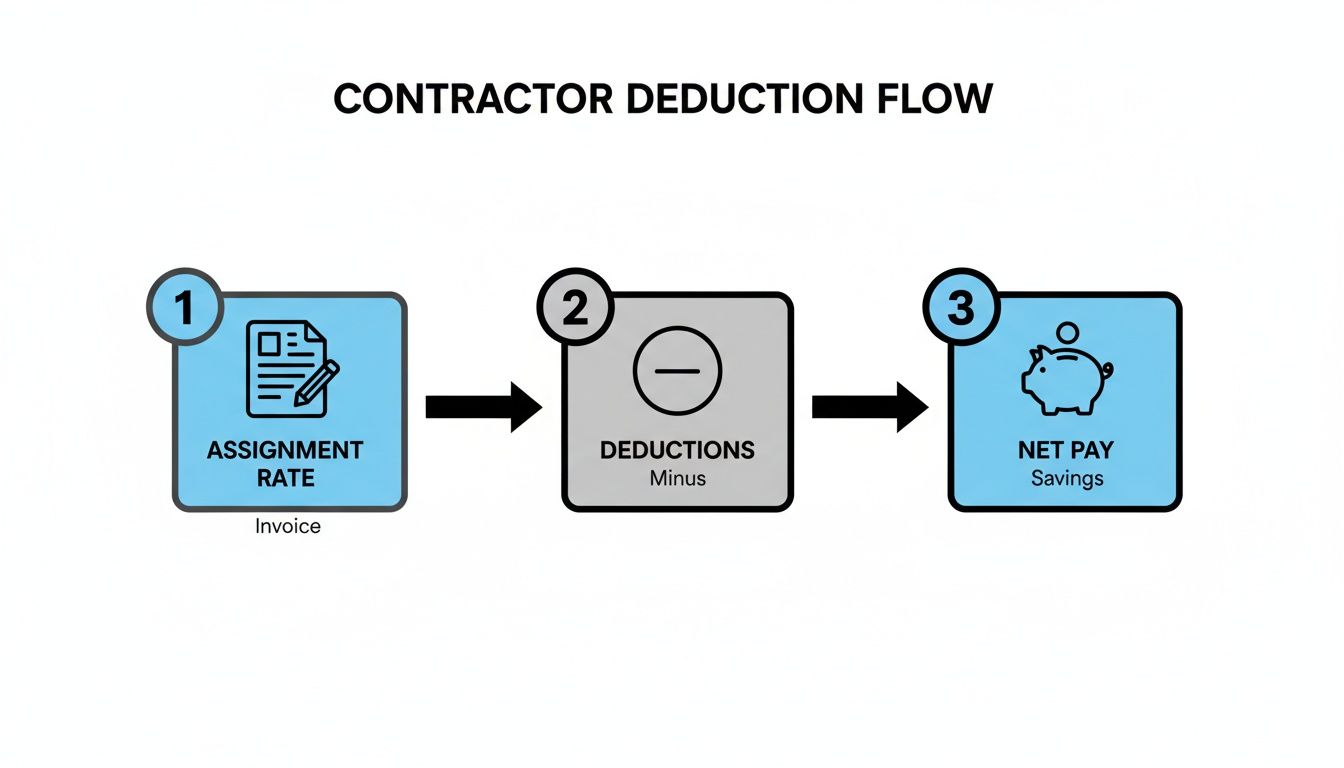
As you can see, it is a sequence of compliant deductions that takes the high-level project rate and turns it into your actual earnings.
The First Deductions From The Assignment Rate
Before your personal tax can even be touched, the umbrella company has to cover all the costs that come with being your legal employer. These are taken directly from the assignment rate.
These initial deductions are:
- Employer’s National Insurance Contributions (NICs): This is a mandatory tax every UK employer has to pay on their employees' earnings. Since the umbrella is your employer, they are responsible for this, and it is funded from the assignment rate.
- The Apprenticeship Levy: This is a UK tax on larger employers that helps fund apprenticeship schemes. It is calculated as 0.5% of the total payroll and is another cost covered by the assignment rate.
- The Umbrella Company’s Margin: This is the fee the umbrella company keeps for its services. It is what pays for their payroll admin, compliance checks, insurance, and providing you with statutory employment rights. This margin is the only income the umbrella company actually makes from the whole process.
By law, all employment costs must be deducted from the assignment rate before your taxable gross pay is calculated. This is a critical feature of a compliant umbrella company, ensuring all tax obligations are met correctly.
Calculating Your Taxable Gross Pay
Once those employment costs are out of the way, the amount left over is your gross pay for tax purposes. This is the number you will see on your payslip and the one HMRC uses to work out your personal tax and National Insurance.
From this taxable gross pay, the standard PAYE (Pay As You Earn) deductions are made. These are exactly the same deductions any permanent employee in the UK would see on their payslip.
These deductions include:
- Income Tax: Calculated based on your personal tax code and the current UK tax bands.
- Employee’s National Insurance Contributions: This is your personal contribution towards state benefits.
- Pension Contributions: If you have been auto-enrolled into a workplace pension scheme.
- Student Loan Repayments: If you have an outstanding student loan.
After these final deductions, what is left is your net pay, your final monthly take-home. To get a better feel for the mechanics behind this, you can learn more about how an umbrella company works in our detailed guide.
Managing Your Holiday Pay
As an employee of an umbrella company, you are legally entitled to 28 days of paid holiday each year (on a pro-rata basis). This entitlement is worked out at 12.07% of your gross taxable earnings.
A compliant umbrella company will handle this in one of two ways.
The first option is for your holiday pay to be accrued. This means the money is set aside each time you are paid and then paid out to you when you actually take time off. The second option is to have it advanced, where the holiday pay is simply added to your payslip each month. While advancing it gives you a bit more cash in hand each month, it does mean you will not receive any payment when you are actually on holiday.
Real-World Examples Of Contractor Pay

The theory behind pay calculations is one thing, but seeing the numbers in action is where it all clicks. Let us walk through a few practical examples to show you exactly how a day rate translates into your actual monthly take home pay.
These scenarios will help you see the process from start to finish. We will look at a typical umbrella company calculation and then contrast it with a limited company model to see how different setups can really change the final figure in your bank account.
Umbrella Contractor Inside IR35 Calculation
Let us start with a contractor we will call Alex. Alex is working on a contract that has been deemed inside IR35 and has agreed to a day rate of £400. In a typical month, Alex works 21 days and has a standard tax code (1257L for 2024/25).
Here is a step-by-step look at how Alex’s pay is worked out:
Calculate Total Assignment Rate: First, we work out the total amount invoiced for the month. It is simply the day rate multiplied by the days worked: £400 x 21 days = £8,400. Crucially, this is the assignment rate, not Alex's personal earnings.
Deduct Employment Costs: The umbrella company deducts its margin and all the mandatory employment costs from this assignment rate. Let us assume a weekly margin of £25, making it £100 for the month.
- Umbrella Margin: £100.00
- Employer’s National Insurance: £1,008.38
- Apprenticeship Levy: £41.50
- Total Employment Costs: £1,149.88
Determine Gross Pay for Tax: We subtract those employment costs from the assignment rate to find Alex's gross pay for tax purposes: £8,400 – £1,149.88 = £7,250.12. This is the figure that HMRC is interested in.
Apply Personal Deductions: Now, the usual PAYE deductions are taken from that gross pay.
- Income Tax: £1,720.02
- Employee’s National Insurance: £145.00
- Total Personal Deductions: £1,865.02
Final Monthly Take-Home Pay: After all those deductions, Alex's net pay is calculated: £7,250.12 – £1,865.02 = £5,385.10.
This example shows exactly how the initial assignment rate is whittled down by both employment costs and personal taxes to arrive at the final take-home figure.
Limited Company Contractor Outside IR35
Now let us meet Ben. He operates through his own limited company, and his contract is outside IR35. Ben has the same day rate of £400 and also works 21 days a month, but the calculation is completely different because he is in the driver's seat of his own finances.
Ben's limited company invoices the client for £8,400, and this full amount lands in his company's bank account. From there, he has the flexibility to pay himself through a combination of a small, tax-efficient salary and dividends.
- Tax-Efficient Salary: Ben might pay himself a small salary just below the National Insurance threshold, say £12,570 per year (£1,047.50 per month). This salary is a tax-deductible expense for his business.
- Dividends: After deducting the salary, any other business expenses, and Corporation Tax (19%), the remaining profit can be drawn as dividends. Dividends have their own tax-free allowance and are taxed at lower rates than salary income.
While this structure can be far more tax-efficient, it comes with a lot more responsibility. Ben has to manage company accounts, file annual returns, pay Corporation Tax, and handle his personal tax through Self Assessment. The admin burden is significantly higher.
Understanding the broader UK income landscape helps put contractor earnings into context. Recent data shows that 30% of UK households earn £1,000 or more per week before tax (around £4,333 monthly). A contractor like Alex, earning over £5,300 take-home pay, is positioned well above the median household income, highlighting the strong earning potential in contracting. You can discover more about these income distribution patterns from the UK government.
The Impact Of Pensions And Student Loans
What happens if Alex, our umbrella contractor, decides to contribute to a pension or has a student loan to pay off? These deductions are taken from the gross pay, which will naturally affect the final amount.
Let us imagine Alex contributes 5% of their gross pay into a workplace pension.
- Gross Pay: £7,250.12
- Pension Contribution (5%): £362.51
- New Taxable Pay: £6,887.61
This pension contribution shrinks Alex's taxable income, which means less Income Tax and National Insurance are due. The take-home pay will be lower, but Alex is saving for retirement in a tax-efficient way. If you are keen to run your own numbers, you can use a payroll calculator to estimate your take home pay with different variables.
Similarly, if Alex had a Plan 2 Student Loan, repayments would be deducted at 9% on any earnings above the monthly threshold (£2,274). This would reduce the final net pay even further. As you can see, every payslip is a personal story.
Choosing An Umbrella Company That Protects Your Pay
Picking the right umbrella company is one of the most critical financial decisions you will make as a contractor. A solid, trustworthy provider makes sure your monthly take home pay is calculated correctly and, just as importantly, compliantly. Making a poor choice, on the other hand, can expose you to some serious financial risk and even a future tax bill from HMRC.
The company you partner with has a direct impact on the stability and accuracy of your earnings. At UmbrellaCompany.com, we specialise in connecting contractors with trusted, accredited partners to make this choice simple and safe. This section will walk you through what to look for, what to avoid, and how to keep your income secure.
Why Accreditation Is Non-Negotiable
When you are weighing up different umbrella companies, the single most important thing to check for is accreditation. You want to see providers who are audited and approved by either the FCSA (Freelancer & Contractor Services Association) or Professional Passport. These organisations are the gold standard for compliance in the UK contracting industry.
Choosing an accredited umbrella gives you peace of mind. It means their processes have been independently checked against HMRC rules and UK employment law. This is your best line of defence against accidentally getting tangled up in a tax avoidance scheme, which can lead to major headaches down the road.
An accredited provider guarantees:
- Full Compliance: All deductions for tax, National Insurance, and the Apprenticeship Levy are correctly calculated and paid over to HMRC for you.
- Transparency: You get clear, easy-to-understand payslips that show exactly how your pay is worked out, with no hidden fees or confusing jargon.
- Security: Your money is handled ethically, and you are covered by robust internal processes and comprehensive insurance.
Comparing Margins And Services Fairly
The umbrella company’s margin is simply the fee they charge for running your payroll. It is usually a fixed weekly or monthly amount taken from your assignment rate before tax. While it is tempting to just go for the provider with the lowest margin, this can often be a false economy.
Instead of focusing only on the price tag, think about the value you are getting for that fee. A compliant umbrella company’s margin should cover a whole range of essential services.
What to expect for their fee:
- Full PAYE Payroll Processing: They handle all your tax and National Insurance contributions.
- Statutory Employment Rights: This includes things like holiday pay, sick pay, and pension contributions.
- Comprehensive Insurance: Policies like Professional Indemnity and Public Liability insurance should be included.
- Dedicated Support: You should have access to a knowledgeable team who can answer any questions you have about your pay.
When you are comparing providers, make sure you are comparing like-for-like. A slightly higher margin might be well worth it if it comes with better insurance cover or a more responsive support team.
Here is a key principle to remember: all compliant umbrella companies operate under the exact same HMRC tax rules. This means for any given contract rate, your monthly take home pay should be almost identical between any two accredited providers. The only real difference should be their margin.
Red Flags That Signal A Non-Compliant Scheme
Unfortunately, the contracting market has its share of dodgy operators promoting non-compliant payment models. These schemes often dress themselves up as legitimate umbrella companies, making promises that are simply too good to be true. Getting involved with them, even by accident, can leave you personally liable for unpaid taxes.
Be extremely wary if a company is promising unusually high take-home pay, like 85% or 90% of your contract value. This is a massive red flag. It almost always indicates a disguised remuneration scheme, such as a loan scheme, which HMRC is actively cracking down on.
Other warning signs to watch out for include:
- Vague or confusing explanations about how they calculate your pay.
- Your payments being split, with some of the money arriving from a different company, often one based offshore.
- A lack of FCSA or Professional Passport accreditation.
- Any suggestion that you can claim tax relief on general travel and subsistence expenses, which has not been possible for most umbrella contractors for years.
Ultimately, protecting your earnings starts with choosing a partner you can trust. By prioritising accreditation and keeping an eye out for these warning signs, you can make sure your contracting career is built on a secure and compliant foundation.
Wrapping It Up: Your Path to Financial Clarity
We have travelled from the basic building blocks of your pay all the way through to the nitty-gritty calculations that define what you actually earn as a contractor. The main takeaway is refreshingly simple: understanding your monthly take home pay is your superpower.
This knowledge turns a confusing payslip into a practical tool for managing your money. It lets you budget properly, catch any potential mistakes, and plan for the future with real confidence.
Taking the Reins of Your Finances
When you get to grips with how your earnings are structured, you can size up new contract offers with a sharp eye and pick the working setup that truly fits your career ambitions. Whether you are weighing up different umbrella providers or thinking about going the limited company route, this understanding is the bedrock for making smart choices.
We really hope you use this knowledge to take full control of your contracting career. When you feel confident about your finances, you are free to concentrate on what you do best: delivering brilliant work for your clients.
Your financial clarity is the end goal. By understanding every deduction and every calculation, you stop being a passenger on your financial journey and get firmly in the driver's seat, steering your career toward its full potential.
Finding the Right Partner for Your Journey
Choosing a compliant and reliable partner is a massive step in securing your financial wellbeing. The right umbrella company will not just process your pay correctly; they will also give you the support and transparency you need to feel secure.
If you are on the hunt for a trusted provider, UmbrellaCompany.com can help. We specialise in helping contractors find and compare fully accredited umbrella companies that are committed to protecting your earnings. Use our free comparison tool to find a partner that helps you maximise your monthly take home pay while keeping you safe and compliant.
Contractor Pay FAQs: Your Questions Answered
Diving into the world of contracting can throw up a lot of questions about how your pay is handled. It is completely normal. To help you get your head around it, we have put together some clear, no-nonsense answers to the questions we hear most often from UK contractors.
Why Is My Umbrella Gross Pay Lower Than My Contract Rate?
This is probably the single most common question we get, and it is a crucial one to understand. The rate you agree with your agency or client is known as the assignment rate. Think of this as the total pot of money the client pays for your services.
But that pot has to cover more than just your wages. It also has to pay for all the legally required employment costs, like Employer's National Insurance and the Apprenticeship Levy, plus the umbrella company's margin for handling all the admin. These are all deducted from the assignment rate before your own pay is calculated.
What is left after those deductions is your gross pay for tax purposes. This is the figure that HMRC is interested in, and it is what your personal Income Tax and Employee's NI contributions are calculated on. It might seem confusing at first, but this is the standard, compliant way every legitimate umbrella company operates.
Can I Claim Expenses to Bump Up My Take-Home Pay?
The rules on expenses for umbrella contractors are pretty tight these days. Following changes to the Supervision, Direction, or Control (SDC) rules, the vast majority of contractors working inside IR35 simply cannot claim tax relief on things like their daily commute or lunch.
Be very, very wary of any umbrella scheme that dangles the promise of boosting your take-home pay by claiming a whole host of expenses. This is a massive red flag. It almost always points to a non-compliant tax avoidance scheme that could land you in hot water with HMRC down the line. It is just not worth the risk.
How Does Holiday Pay Work With an Umbrella Company?
One of the perks of being an employee of an umbrella company is that you get statutory holiday pay. You are entitled to 28 days of paid leave per year (on a pro-rata basis, of course). This is calculated as 12.07% of your gross taxable earnings, a figure set by law.
Generally, compliant umbrella companies will give you two options for how this is handled:
- Accrued Holiday Pay: The 12.07% is set aside from your pay each month and kept in a separate pot for you. When you want to take a holiday, you just ask for the funds to be paid out. It is a great way to make sure you still have money coming in when you take a break.
- Advanced Holiday Pay: Alternatively, the 12.07% can be paid out to you directly with each payslip. This gives you a bit more cash in your pocket each month, but it does mean you will not get a separate payment when you actually stop working for a week or two.
What Is the Difference Between FCSA and Professional Passport Accreditation?
Think of the FCSA (Freelancer & Contractor Services Association) and Professional Passport as the industry's gold standard watchdogs. They are independent bodies that put umbrella companies through rigorous audits to make sure they are playing by the rules and following all HMRC regulations and employment laws.
Their job is to give you, the contractor, peace of mind. While their audit processes might have minor differences, seeing either an FCSA or Professional Passport seal of approval is a very good sign. It tells you the provider is transparent, ethical, and financially stable. Honestly, we cannot stress this enough: only ever work with an accredited provider. It is the best way to protect yourself and your hard-earned money.
Finding the right partner to manage your pay is a huge part of a successful contracting career. At UmbrellaCompany.com, we make it easy to compare trusted, accredited umbrella companies that put your financial security first. Find the perfect compliant provider for your needs today.


