


If you've just set up a limited company, your first tax question usually isn't about legislation. It's much simpler. How much of the money you invoice do you keep?
That's where many new contractors get tripped up. A search for the Ltd company tax rate often returns one headline figure, but your real outcome depends on several layers. Company profit, Corporation Tax, how you pay yourself, and whether your contract belongs in a limited company at all all affect what lands in your bank account.
The practical point is this. A limited company can still be tax-efficient, but only when you understand the moving parts and use them properly.
Your Guide to Contractor Take Home Pay in 2026
A lot of confusion starts with the phrase Ltd company tax rate itself. It sounds like there should be one neat answer. In practice, there isn't.
For UK contractors, the company tax picture has multiple bands. One source of confusion is that many online guides present a single rate, even though the UK system includes a 25% main rate for profits over £250,000, a 19% small profits rate for profits up to £50,000, and marginal relief between those levels according to LendingTree's overview of small business tax rates. That matters because many contractor companies sit somewhere in the middle rather than at the extremes.
Your take-home pay also doesn't stop at Corporation Tax. You then have to decide how to extract money from the company. That usually means some combination of salary and dividends, and each route carries different tax consequences.
The headline company tax rate is only the first deduction. What matters to most contractors is the combined effect of company tax and personal tax.
That's why rough online calculators can mislead if they only show one layer. A better starting point is to compare legal structures before you even look at drawings. If you're still deciding whether a company is right for your circumstances, this free sole trader vs company calculator can help you sense-check the direction before you go deeper into contractor-specific planning.
What usually works best
For many outside IR35 contractors, the sensible process is:
- Work out expected company profit first, not just turnover.
- Check which Corporation Tax band you fall into, rather than assuming one flat rate.
- Plan drawings second, because salary and dividends behave differently.
- Review the whole setup against IR35, since the best tax plan on paper can be the wrong commercial structure for the contract.
What tends not to work
New directors often make the same mistakes:
- Focusing only on the Corporation Tax rate, while ignoring personal tax.
- Taking ad hoc withdrawals, without recording whether they are salary, dividends, or director's loan entries.
- Assuming a limited company always beats an umbrella company, which is not true for every contract.
Understanding UK Corporation Tax Rates
Before you think about paying yourself, your company has to deal with tax on its profits. That's the starting line.
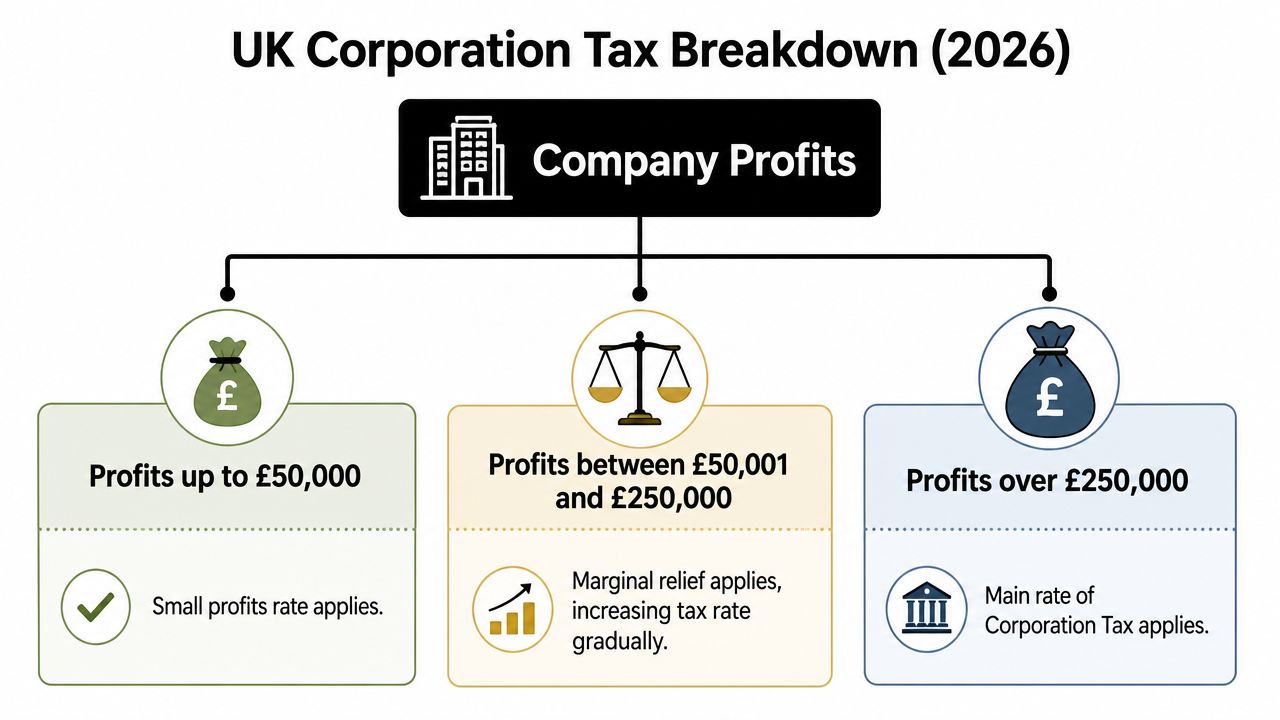
The UK system isn't a single flat rate in practice. The main rate of Corporation Tax is 25% from 1 April 2023, while a 19% small profits rate applies for profits up to £50,000, with marginal relief tapering between £50,000 and £250,000 according to Trading Economics' corporation tax summary.
The three profit zones
It operates like tiered pricing.
- Up to £50,000 of taxable profit. Your company is in the small profits band.
- Between £50,000 and £250,000. Marginal relief applies, so the effective rate increases gradually.
- Above £250,000. The main rate applies.
For a lot of contractors, that middle band is where the core planning sits. You might not be a very small company, but you may not be near the top band either. If someone gives you a single percentage without asking about profit, they're probably oversimplifying.
Why contractors need to be careful
Profit is not the same as turnover. If your company invoices clients throughout the year, that top-line income is only the start. Business expenses reduce taxable profit, and so can certain planning decisions made properly.
There's another wrinkle. The thresholds can change in practical terms when there are associated companies, or when accounting periods don't line up neatly. The Association of Taxation Technicians notes that from 1 April 2023 the rates are 19% at or below £50,000 and 25% above £250,000, with marginal relief in between, and the threshold band is reduced for associated companies in its Corporation Tax rates and associated companies FAQs. If you have linked entities, the answer may be less favourable than a basic online summary suggests.
Practical rule: Don't ask, “What's the Ltd company tax rate?” Ask, “What will my company's taxable profit be for the accounting period?”
A simple way to think about it
Use this order:
- Start with turnover
- Deduct allowable business costs
- Arrive at taxable profit
- Check which Corporation Tax band applies
- Then plan how to extract what remains
If you're still weighing whether a company is even the right vehicle, this guide for choosing a business structure is a useful broad primer before getting into contractor-specific tax planning. For more ideas on legal planning once the structure is in place, see this guide on how to pay less tax as a limited company.
Getting Paid Salary versus Dividends
Once the company has made a profit, the next decision is how you get money out. At this stage, the practical implications of the Ltd company tax rate become personal.
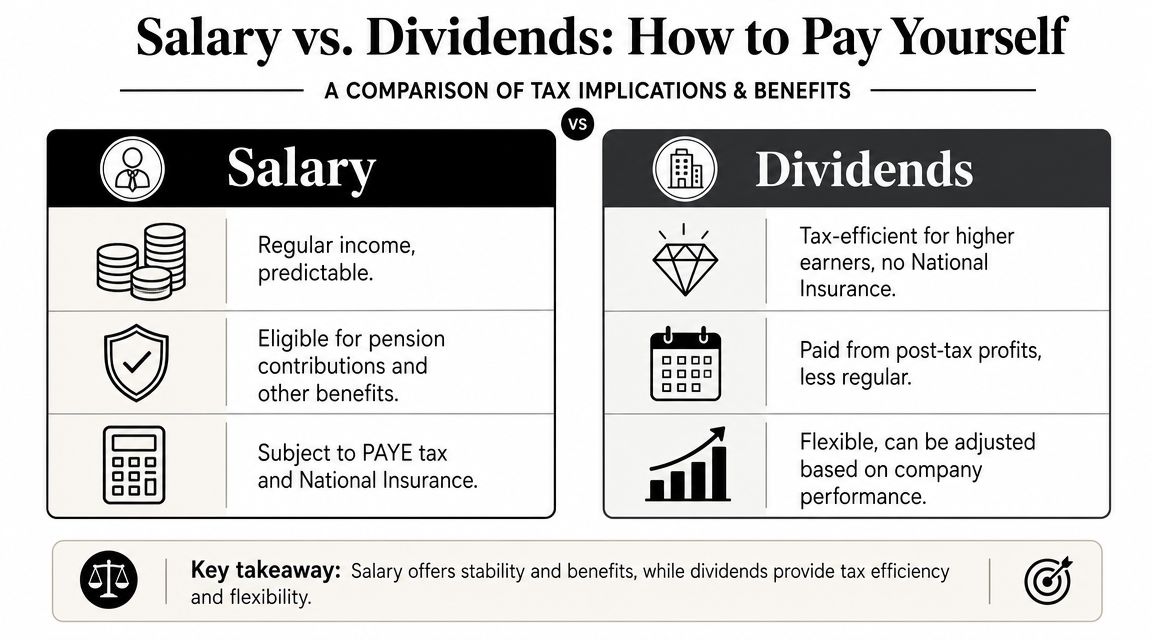
Most contractor directors use a mix of salary and dividends rather than relying on only one method. That's because salary and dividends are taxed in different ways, and they affect the company differently too.
What salary does well
Salary gives you regular income and clean payroll records. It can also support things like mortgage applications because lenders often understand salary more easily than irregular drawings.
But salary creates payroll obligations. It goes through PAYE, and once the right thresholds are crossed it can bring Income Tax and National Insurance into play. On the company side, salary is also a business cost, which can reduce taxable profit.
The balance changed again recently. The total tax paid by a contractor's company depends heavily on the extraction strategy, not just the headline Corporation Tax rate, and the main Employers' National Insurance rate increased to 15% from 6 April 2025 with the secondary threshold falling to £5,000 according to Anderson Advisors' business tax Q&A. Even though that source is not a UK technical manual, the practical point is still clear for planning. Salary now needs closer review because employer cost can rise faster than many contractors expect.
What dividends do well
Dividends are paid from post-tax profits. That means the company pays Corporation Tax first, and dividends are only available out of remaining profits.
Their main attraction is flexibility. Directors can vary dividend timing and amounts, provided the company has sufficient retained profit and the paperwork is done properly. Dividends also don't carry employer National Insurance in the same way salary does, which is why they often form part of a tax-efficient mix for outside IR35 contractors.
That said, dividends are not a free-money button.
Dividends only work when there are real profits, board minutes, and dividend vouchers behind them. If the paperwork is weak, the planning is weak.
Side-by-side trade-offs
| Method | Usually helpful when | Main drawback |
|---|---|---|
| Salary | You want regular income, payroll history, and a deductible company cost | It can trigger PAYE and employer cost |
| Dividends | The company has profits and you want flexibility | They come after Corporation Tax and must be documented properly |
What usually works in practice
For many contractor companies, the most efficient arrangement is not “all salary” or “all dividends”. It's a balanced approach that considers:
- Company profit level, because that affects Corporation Tax first
- Employer cost, especially where salary rises
- Personal cash needs, because regular monthly bills still matter
- Admin discipline, since dividends need proper records
If you want a deeper explanation of the pros and cons, this guide on salary versus dividends is worth reviewing before you lock in a pay strategy.
Worked Examples Contractor Take Home Pay
This is the point where many articles overpromise and then start inventing precision. We won't do that.
A genuine take-home pay example for a contractor needs more than a day rate. It also needs working days, expenses, pension approach, salary level, dividend timing, personal tax position, and whether the engagement is outside IR35 in practice rather than just in theory. Without those details, an exact “you'll take home X” figure is not reliable.
Two common outside IR35 scenarios
The examples below use the day rates requested, but they deliberately stop short of fabricated net pay figures. That's the honest way to approach it.
| Calculation Step | Example 1 (£400/day) | Example 2 (£600/day) |
|---|---|---|
| Contract income basis | Day rate of £400 | Day rate of £600 |
| Business expenses | Deduct actual allowable costs | Deduct actual allowable costs |
| Director salary | Deduct planned salary through payroll | Deduct planned salary through payroll |
| Taxable company profit | Revenue less allowable costs and salary | Revenue less allowable costs and salary |
| Corporation Tax position | Check profit against small profits, marginal relief, or main rate band | Check profit against small profits, marginal relief, or main rate band |
| Post-tax profit available | Balance left after Corporation Tax | Balance left after Corporation Tax |
| Dividend decision | Draw some or all retained post-tax profit as dividends | Draw some or all retained post-tax profit as dividends |
| Personal tax outcome | Depends on your wider income and dividend position | Depends on your wider income and dividend position |
| Final take-home pay | Case-specific | Case-specific |
Example 1 at £400 per day
A contractor at this level often sits in the area where details matter more than headline rates. If expenses are modest and drawings are handled carefully, a limited company can still work well for an outside IR35 engagement.
The key pressure points are usually:
- Whether profit stays within the lower company tax band or moves into marginal relief
- How much salary is taken, because salary changes company profit and payroll cost
- Whether profits are all extracted immediately, or partly retained for future use
A common mistake at this rate is to copy a “standard” salary and dividend template from another contractor. That can work, but it can also produce the wrong answer if your expenses or personal income differ.
Example 2 at £600 per day
At a higher day rate, the company may move more quickly through the lower profit band and into the middle range where marginal relief becomes more relevant. The tax cost often becomes less about one headline rate and more about sequencing.
Here, contractors usually benefit from asking:
- Do I need all available cash personally this year?
- Should I retain some profit in the company for future gaps, equipment, or pension planning?
- Would a heavier salary create unnecessary employer cost compared with a dividend-led approach?
Higher turnover doesn't automatically mean a better extraction strategy. It often means mistakes become more expensive.
For a more precise estimate, use a proper limited company take home calculator and then sense-check the result against your own expenses, IR35 position, and payment mix.
How This Compares to an Umbrella Company
A limited company isn't the only route. For many contractors, especially on inside IR35 contracts, an umbrella company is the cleaner option.
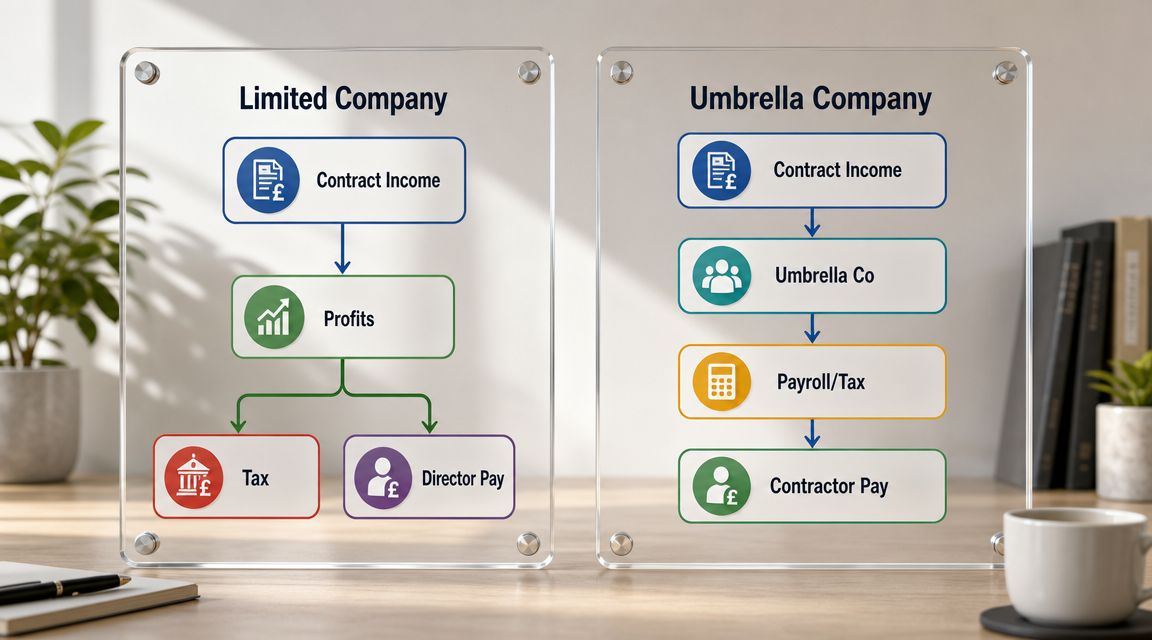
The reason is structural. Under an umbrella, your income is treated as employment income through PAYE. That usually means less flexibility in how money is extracted, but also less responsibility for company admin, dividend paperwork, and Corporation Tax planning.
The practical difference
With a limited company, you're running a business. You invoice the client, record costs, handle accounts, and decide how to pay yourself. That can create better flexibility on the right contract.
With an umbrella company, you're effectively an employee of the umbrella. The umbrella processes payroll and pays you under PAYE. The tax treatment is simpler, but there is less room to optimise via salary and dividends because that route doesn't exist in the same way.
Why final pay can differ
The difference usually comes down to these issues:
- A limited company can separate company profit and personal extraction
- An umbrella company treats earnings as employment income
- Inside IR35 contracts usually reduce the advantage of a limited company
- Admin and compliance sit in different places under each model
That's why the right question isn't “Which one pays more?” It's “Which one fits the contract status and risk profile?”
For a visual explanation of how the two routes differ in practice, this short video is useful.
A sensible decision rule
Choose a limited company when the contract is suitable for that structure, the admin burden is acceptable, and the commercial reality supports it.
Choose an umbrella when the engagement sits inside IR35, the client insists on that route, or you want simplicity over extraction flexibility.
If you're deciding between the two, this comparison of umbrella company vs limited company will help frame the trade-offs without relying on one-size-fits-all assumptions.
Practical Tips for Tax Efficiency
Once the basics are in place, tax efficiency is mostly about good habits. Not gimmicks.
The strongest planning usually comes from getting the fundamentals right every month rather than trying to fix everything at year end.
Actions that usually help
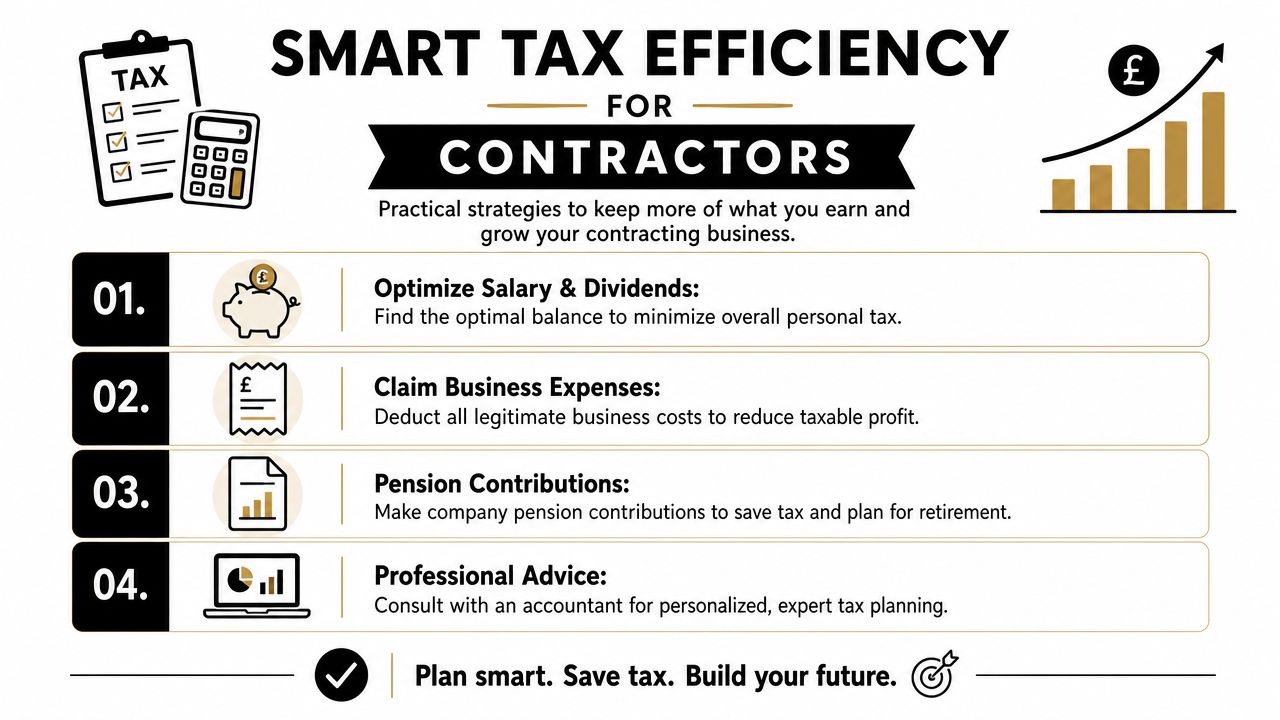
Claim allowable business expenses properly. If a cost is for the company, record it clearly and keep evidence. Poor record-keeping is one of the easiest ways to lose legitimate relief.
Use salary and dividends deliberately. Don't drift into random transfers from the company account. Decide what is salary, what is dividend, and what should stay in the business.
Consider company pension contributions. For many contractors, pension funding through the company can be one of the cleaner ways to move profit into long-term personal value while reducing taxable profit, subject to proper advice and limits.
Retain profit when it serves a purpose. You don't always need to extract every available pound immediately. Keeping funds in the company can support cash flow, gaps between contracts, or future investment.
Habits that save trouble later
Some steps don't feel glamorous, but they protect the planning:
- Run payroll consistently, even if the salary is modest.
- Prepare dividend paperwork at the time, not months later.
- Separate personal and company spending, because mixed accounts create bookkeeping mess.
- Review profit before year end, while there is still time to act.
Good tax planning is usually boring. Clean records, timely decisions, and proper paperwork beat clever shortcuts.
Professional advice matters most when your situation stops being standard, for example where there are multiple income sources, associated companies, or changing IR35 determinations.
Frequently Asked Contractor Tax Questions
What happens if my contract is inside IR35
If a contract falls inside IR35, the tax logic changes sharply. The scope for using the limited company as a classic salary-and-dividends vehicle is much narrower, because the engagement is treated more like employment for tax purposes.
In practice, that often pushes contractors towards an umbrella company or a more cautious limited company review. The mistake is to assume your company structure alone determines tax treatment. It doesn't. The contract status does a lot of the heavy lifting.
Should I retain profits in the company or draw everything out
That depends on what the money is for.
Retaining profit can make sense when you want a buffer for quieter months, future business costs, or longer-term planning. Drawing everything out can make sense if you need the money personally and the tax cost is acceptable. What doesn't work well is extracting funds by habit without considering the company's future cash needs.
A retained profit strategy also needs discipline. If cash stays in the company, there should be a reason for it.
When do I pay Corporation Tax
The exact payment date depends on your company's accounting period and filing timetable, so this is one area where you should rely on your company records and HMRC deadlines rather than memory.
The practical rule is simple. Don't wait until the accounts are finalised to think about the tax bill. Set money aside as the year progresses, review profit regularly, and treat Corporation Tax as a known future liability rather than an unpleasant surprise.
Late planning usually means fewer good options. Early planning gives you choices.
If you're weighing up whether a limited company or umbrella route makes more sense for your next contract, Umbrella Company helps contractors compare options quickly and choose a setup that fits their IR35 position, pay rate, and working style.


