


Choosing your business structure is one of the biggest decisions you will make as a UK contractor. Getting to grips with the ltd company advantages and disadvantages is the first step. A limited company can be incredibly tax-efficient and offers a layer of legal protection, but it comes with more administration and real costs. It is the classic trade-off: more control, but more responsibility.
This guide will explain the key benefits and drawbacks of operating through a limited company. By the end, you will have a clear understanding of what is involved, helping you decide if it is the right path for your contracting career.
Is a Limited Company the Right Choice for You?
For many long-term contractors, setting up your own limited company is a natural progression. It is a clear signal to clients that you are a serious, professional business, and it opens up significant financial upsides.

Here is a simple way to think about it. Running a limited company is like owning your own car. You have total control over where you go and how you get there, and it is often more cost-effective in the long run. The catch? You are on the hook for all the maintenance, insurance, and legal paperwork.
Working through an umbrella company, on the other hand, is more like using a taxi service. It gets you where you need to be with zero fuss because the driver handles all the tricky stuff like tax and payroll. It is convenient, for sure, but you have less say in the journey and you pay a fee for the service.
To help you decide which route is best, here is a quick overview of how the two structures stack up.
Limited Company vs Umbrella Company: Quick Comparison
| Feature | Limited Company | Umbrella Company |
|---|---|---|
| Legal Status | You are the Director of your own company. | You are an Employee of the umbrella company. |
| Tax Efficiency | High potential through salary and dividends. | Lower; taxed like a standard employee (PAYE). |
| Administration & Paperwork | You are responsible for all company administration. | Minimal; the umbrella company handles it. |
| Control | Full control over business and finances. | No control over the umbrella's operations. |
| Costs | Accountancy fees, software, setup costs. | A weekly or monthly margin is deducted from your pay. |
| Liability | Personal assets are protected from business debts. | No personal business liability. |
This table gives you the headlines, but the devil is always in the detail. Let us dig a bit deeper into what running a limited company really means for you.
Weighing Your Options
Before you go any further, ask yourself a few honest questions:
- Are you planning to contract for the long term (more than six months)?
- Do you expect your annual profit to be over £30,000?
- Are you prepared to take on the legal responsibilities of being a company director?
- Do you want to build and promote your own business name and brand?
If you found yourself nodding 'yes' to most of those, a limited company is probably a very strong contender. As the director, you and your company become separate legal entities. This is a crucial concept called limited liability, and it is one of the biggest draws of this structure. It means if the business runs into debt, your personal assets (like your house or savings) are protected.
This is just the starting point. We will now get into the nitty-gritty of what running a limited company involves, from the tax perks and added credibility to the day-to-day administration and navigating rules like IR35. By the end, you will have a much clearer idea of which path is right for your contracting career.
Why Go Limited? The Main Advantages for Contractors
Deciding to run your business through a limited company is a big step for any contractor, but it is a move that brings some serious benefits. The upsides usually boil down to better financial protection, smarter tax planning, and a more professional image. Let us dig into why so many seasoned contractors find this setup so attractive.

It is no surprise that forming a limited company is more popular than ever. As of March 2024, there were 5.33 million private sector companies in the UK, making it the most common business structure. We can position ourselves as a credible authority by providing insights based on official data and our experience in the sector.
Create a Legal Firewall with Limited Liability
The single biggest perk of a limited company is limited liability. This concept builds a legal wall between you, the person, and your business. The law sees your company as its own ‘legal person’, able to sign contracts, own things, and run up debts completely separately from you.
So, what does that really mean for you? If your business ever runs into money trouble or faces a legal claim, your personal assets (your house, car, and savings) are safe. Your own financial risk is usually just limited to the value of your shares in the company, which for most contractors is a tiny, nominal sum.
This legal separation is a vital safety net. It gives you the confidence to take on bigger projects and make calculated business moves without putting your personal financial security on the line.
Maximise Your Take-Home Pay with Smart Tax Planning
One of the main reasons contractors choose the limited company route is the potential for much better tax efficiency. As a sole trader, all your profits get hit with Income Tax and National Insurance. A limited company, however, gives you more control over how you draw your income.
As the company director, you can pay yourself through a mix of a small salary and dividends.
- A Low Salary: By taking a salary up to the National Insurance Primary Threshold (£12,570 for 2024/25), you build up qualifying years for your State Pension without actually paying any National Insurance Contributions (NICs). This salary is also a business expense, which lowers your company’s Corporation Tax bill.
- Dividend Payments: You can then draw the rest of your income as dividends from the company's post-tax profits. Critically, dividends do not attract National Insurance, and they come with their own tax-free allowance and lower tax rates compared to standard income tax.
This salary-plus-dividend approach can lead to significant tax savings across the year, often boosting your take-home pay far more than other ways of working. You can check out our guide on how to best structure your salary versus dividends.
Boost Your Professional Credibility
Having ‘Ltd’ after your business name instantly makes you look more professional. It sends a clear signal to clients, recruiters, and partners that you are running a serious, stable, and properly established business.
This added credibility can open doors that might otherwise be shut. Many larger organisations and public sector bodies, for instance, have rules that only allow them to hire incorporated businesses, as they see them as a lower-risk partner.
Gain More Financial Flexibility
Beyond the immediate tax wins, running a limited company gives you more options for long-term financial planning.
- Wider Range of Expenses: You can claim a much broader list of allowable business expenses compared to a sole trader. This includes things like your accountancy fees, certain training courses, and even employer pension contributions.
- Pension Planning: Your company can make contributions directly into your personal pension, and this counts as an allowable business expense. It is a double win: you lower your Corporation Tax bill while building up your retirement savings in a highly tax-efficient manner.
- Retaining Profits: You do not have to take all the profit out each year. You can leave money in the company and draw it down in a future tax year, which is great for managing your personal tax bill or for reinvesting in the business, like buying new equipment or paying for professional development.
The Downsides of a Limited Company: What You Need to Know
Going limited is not all tax savings and dividends. While the financial perks are attractive, they come with a significant trade-off, and it is crucial to go in with your eyes wide open. Running your own company means you are the one in charge, and that responsibility can be a real hurdle for many contractors.

This is not just about a bit of extra paperwork; it is about legal accountability. As a director, the buck stops with you. Let us look at what these disadvantages really mean in practice so you can weigh them against the benefits.
The Weight of Administrative Responsibility
The biggest shock for many new directors is the sheer weight of administrative responsibility. When you become a director, you take on legal duties to both HMRC and Companies House. This is a world away from just sending off a timesheet to an umbrella company.
These obligations are not optional. They come with strict deadlines and hefty penalties if you miss them. And even if you hire a great accountant to handle the details, you are still the one legally on the hook for getting everything right.
Your key administrative tasks will include:
- Filing Annual Accounts: Submitting a formal report on your company's financial activity to Companies House every year.
- Submitting a Confirmation Statement: Annually verifying that the details Companies House holds for your company (like your address and director info) are still correct.
- Managing Corporation Tax: Calculating your profit, filing a Company Tax Return (CT600) with HMRC, and paying the tax you owe.
- Running a Payroll (PAYE): If you take a salary, you must operate a payroll and make regular reports to HMRC.
- Handling VAT: Once your turnover hits the VAT threshold, you have to register for, charge, and report Value Added Tax.
Ongoing Costs and Financial Outlay
While a limited company can be more tax-efficient, it certainly is not free to run. There are several ongoing costs to factor in, which can quickly chip away at the financial upside, especially if your contracting income is on the lower side.
You will have a small incorporation fee to get started, but the biggest recurring cost will almost certainly be accountancy fees. A good contractor accountant is pretty much essential for navigating the complex rules, and their services typically cost from £80 to £150+ per month.
These administrative burdens are not just theoretical; they have real-world consequences. Recent government figures show that while many companies are formed, a significant number are also dissolved each year, highlighting the pressures of compliance.
For example, in the first quarter of 2024, there were over 135,000 company dissolutions in the UK. This demonstrates the challenges new directors face and makes the simplicity of an umbrella company an attractive, lower-risk alternative for many contractors.
Loss of Financial Privacy
Another factor that many contractors overlook is the loss of privacy. When you set up a limited company, certain details about you and your business become public information, easily searchable on the Companies House register.
This includes:
- Your full name, date of birth, and correspondence address as a director.
- The company’s registered office address.
- Your company's financial accounts, showing turnover and profit.
If you would rather keep your financial affairs to yourself, this level of public transparency can be a major downside compared to the confidentiality you get when working through an umbrella company.
The Complexities of IR35
Finally, and perhaps most importantly, you have to contend with the IR35 off-payroll working rules. These rules are HMRC’s tool for identifying ‘disguised employees’, who are contractors that work in a similar way to permanent staff but use their company to reduce their tax bill.
If your contract is judged to be 'inside IR35', the tax benefits of operating as a limited company almost completely disappear. Your client or agency will tax your income at source like an employee, yet you will still be stuck with all the costs and administration of running the company. It really is the worst of both worlds.
For a deeper dive into this tricky area, have a read of our complete guide on how IR35 affects contractors.
How to Set Up and Run Your Limited Company
Knowing the pros and cons of a limited company is the first step. But what is actually involved in setting one up and running it day-to-day? While it is certainly more hands-on than using an umbrella company, the process is far from impossible when you break it down.
With a clear plan, you can take full control of your contracting career. Let us walk through the essential stages of getting incorporated and the ongoing duties you will have as a company director.
The Incorporation Process Step by Step
Forming your company is the first major milestone. This process, known as incorporation, officially registers your business with Companies House (the UK’s registrar of companies) and makes it a separate legal entity.
Choose a Unique Company Name: Your company name cannot be too similar to any other on the UK register. You can check if your preferred name is free using the Companies House name checker. It also cannot contain any sensitive or offensive words.
Appoint Directors and Shareholders: At a minimum, you need one director to manage the company. As a contractor, you will almost certainly be the sole director and shareholder. You will also decide on the share structure, which typically just means issuing one share to yourself.
Establish Official Addresses: You must provide a registered office address for all official mail from Companies House and HMRC. This address is public, so many contractors use their accountant’s address or a virtual office service to protect their privacy. A service address is also required for each director.
Register with Companies House: The final part is to make it all official. You can register your company online directly with Companies House, which is the fastest and cheapest option. Alternatively, a formation agent or your accountant can handle the paperwork for you.
Your Responsibilities as a Company Director
Once incorporated, you officially become a company director, which comes with legal responsibilities for running the company properly.
One of the very first things you must do is open a separate business bank account. All your company’s income must be paid into this account, and all business expenses must be paid from it. Mixing your personal and business finances is a recipe for an accounting nightmare.
Keeping meticulous records is not just good business sense; it is a legal requirement. You need to track all money coming in and going out, which means invoices, expense receipts, and bank statements. Your accountant will rely on this information to prepare your accounts and tax returns accurately.
As a director, you are responsible for ensuring your company has the right documentation in place. You can explore tools for creating essential legal documents to make sure you are compliant from day one.
Finding a Good Accountant
While you can go it alone, partnering with a specialist contractor accountant is one of the smartest investments you can make. They do far more than just file your taxes; they act as a key financial adviser for your business. For a better sense of the setup costs, take a look at our guide on how much it costs to set up a limited company.
A good accountant will:
- Make sure you never miss a deadline with HMRC or Companies House.
- Advise on the most tax-efficient salary and dividend structure.
- Help you claim every allowable business expense you are entitled to.
- Provide support on VAT, payroll, and long-term tax planning.
- Save you countless hours of administration and stress.
By understanding these steps and getting the right support in place, running your own limited company becomes a straightforward and rewarding part of your contracting career.
When an Umbrella Company Is the Smarter Choice
Running a limited company has its perks, but it is not the right path for every contractor. After weighing the pros and cons, you might decide the administration and legal responsibilities just are not worth it for your situation. In these cases, an umbrella company often stands out as the far more practical, stress-free choice.
An umbrella company essentially acts as your employer for the duration of your contract. Instead of you shouldering the burden of running a business, they handle all the complex bits like PAYE tax and National Insurance deductions. This leaves you free to concentrate on your client work, not on HMRC deadlines.
The Simplicity of Being an Employee
The single biggest draw of an umbrella company is its simplicity. Your main administrative duty is submitting a timesheet. From there, the umbrella company takes over: they invoice the client, process your payment, deduct all the necessary taxes, and pay you a net salary. You get a clear payslip each time with everything broken down.
This straightforward approach is a perfect fit for a few common contracting scenarios:
- Short-Term Contracts: If you are only contracting for a few months, the expense and hassle of setting up and then closing a limited company often does not make sense. An umbrella lets you get started straight away with almost no setup.
- Lower Contract Income: For contractors earning less than around £30,000 per year, the tax efficiencies of a limited company are usually wiped out by accountancy fees. An umbrella can be much more cost-effective.
- First-Time Contracting: If you are just starting out, an umbrella company is a safe and simple way to dip your toes in the water. It gives you a feel for contracting life without the commitment and legal duties of a company director.
The diagram below shows the key steps in setting up a limited company, all of which are handled for you by an umbrella service.
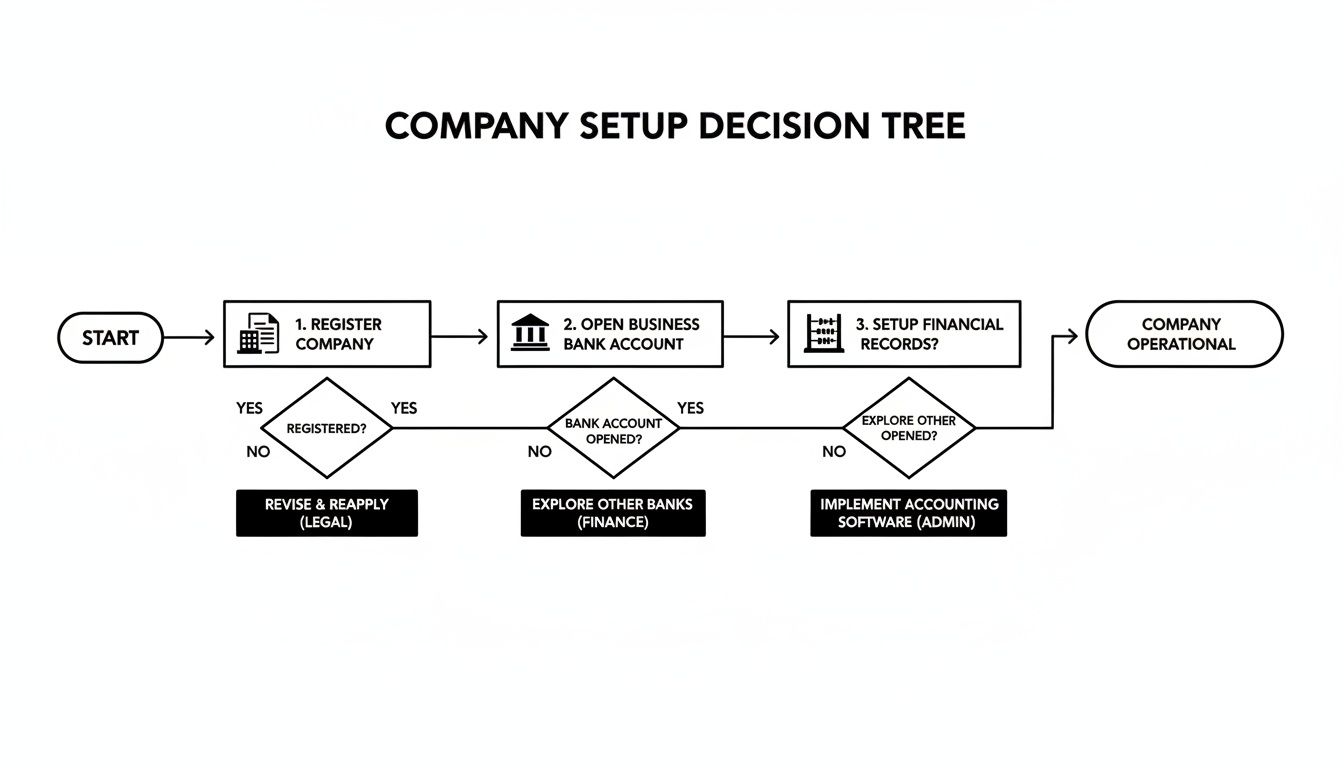
As you can see, a director has to manage company registration, banking, and financial records. With an umbrella, all this is taken care of.
Decision Checklist: Limited Company or Umbrella Company?
Making the right choice depends entirely on your personal circumstances. Use this quick checklist to see which structure aligns best with your contracting goals and situation.
| Consideration | Choose Limited Company If… | Choose Umbrella Company If… |
|---|---|---|
| Contract Income | You expect to earn over £30,000 per year. | Your earnings are likely to be under £30,000 per year. |
| Contract Length | You have a long-term contract or a steady stream of work lined up. | You are on a short-term contract (under 3-6 months). |
| IR35 Status | Your contracts are consistently determined as 'outside IR35'. | Your contract is 'inside IR35', or you want to avoid IR35 risk entirely. |
| Admin Effort | You are happy to manage director duties, accounts, and tax returns. | You want a simple, 'plug-and-play' solution with minimal paperwork. |
| Career Plans | You see contracting as your long-term career and want to build a business. | You are new to contracting or unsure if it is a long-term path for you. |
This table provides a high-level guide. The more checks you have in one column, the clearer your decision should be.
Navigating IR35 with Confidence
The off-payroll working rules, commonly known as IR35, are a massive factor in this decision. If your contract is determined to be ‘inside IR35’, it means you are treated as an employee for tax purposes anyway. The tax efficiencies of a limited company are almost completely nullified, leaving you with all the administration but none of the financial upside.
In an 'inside IR35' scenario, an umbrella company is almost always the smarter choice. It ensures full compliance by treating you as an employee for tax, removing any risk of an HMRC investigation into your employment status.
By working through an umbrella, you also receive full employment rights, just like a permanent member of staff. This includes statutory sick pay, holiday pay, and access to a workplace pension scheme, a valuable safety net that a limited company director goes without.
For a more detailed comparison of these two structures, have a look at our complete guide on the umbrella company vs limited company decision. Ultimately, if simplicity, low risk, and getting started quickly are your priorities, an umbrella company is a reliable and straightforward way to contract.
Making the Right Choice for Your Contracting Career
So, what is the final verdict: limited company or umbrella? As we have seen, the best answer really depends on your own circumstances and where you see your contracting career heading.
Getting the structure right from day one is a big decision. If you are just starting out, thinking about how to start freelancing successfully will help you put these choices into perspective and align them with your long-term goals.
Your Path Forward
A limited company is the way to go if you are serious about building a business. It is the best route for tax planning, offers you protection if things go wrong, and gives you a professional brand. This is the path for contractors who want full control and are playing the long game.
On the other hand, if you just want to get paid with minimum fuss, an umbrella company is a brilliant, straightforward option. It is perfect for shorter contracts or if your work is inside IR35, taking all the administration and compliance headaches off your plate while giving you standard employment rights.
There is no one-size-fits-all answer. The right choice for you will come down to your contract rate, how long you will be contracting, your attitude to risk, and how much paperwork you are prepared to handle.
Hopefully, this guide has given you the clarity needed to choose the structure that works for you. Whether you go for the entrepreneurial freedom of a limited company or the simplicity of an umbrella, making an informed choice is what matters.
If you would like to talk through your options with an expert, our team at UmbrellaCompany.com is always here to help you figure out the next steps.
Common Questions About Running a Limited Company
Let us tackle some of the common questions we hear from contractors weighing up their options. Getting these answers straight can make it much clearer whether a limited company or an umbrella company is the right fit for you.
What is the minimum I need to earn to make a limited company worthwhile?
There is no official magic number, but a good rule of thumb most accountants use is an annual profit of around £30,000.
If you are earning less than that, the extra accountancy fees and administrative costs of running a company can easily wipe out any tax savings you might have made. For lower or less predictable contract income, an umbrella company often makes more financial sense.
Can I switch from an umbrella to a limited company later on?
Absolutely. This is a well-trodden path for many contractors. It is common to start out with an umbrella company for your first contract or two. It is simple, quick, and lets you dip your toe in the water without any real commitment.
Then, if you land a longer-term, higher-value contract that is clearly outside IR35, you can form your limited company when you are ready. It is a great way to ease into contracting with minimal risk before you take on the full responsibilities of a company director.
Moving from an umbrella to a limited company is a natural step for many successful contractors. It lets your business structure evolve as your income and career grow, so you are always using the most suitable setup.
How does IR35 affect the decision?
IR35 is a massive factor; for many, it is the deciding one. If your contract is deemed 'inside IR35', HMRC will treat you as an employee for tax purposes, even if you are operating through your own company.
This pretty much cancels out the main tax advantages, as your income will be hit with standard PAYE tax and National Insurance. The catch is, you still have all the costs and legal duties of running the company. In almost every inside-IR35 scenario, using an umbrella company is the simpler and more sensible route.
How much administration is actually involved?
Do not underestimate it. As a director, you are legally on the hook for a fair bit of paperwork. This includes keeping accurate financial records, filing your annual accounts and a confirmation statement with Companies House, and submitting various tax returns to HMRC.
Depending on how you operate, you might also have to deal with VAT and running a payroll. A good accountant is essential and will handle the technical filings, but you are still responsible for giving them the correct information and signing off on everything. It is a significant step up in personal responsibility compared to just sending a timesheet to an umbrella company.
At UmbrellaCompany.com, our entire focus is on helping contractors find the right way of working. Whether you have decided a limited company is for you or you would rather stick with the simplicity of an umbrella, our comparison tools make the choice easy.
Find your ideal, compliant umbrella company in minutes with our expert guidance.


