


Most UK contractors running a limited company pay £60 to £200 a month for an accountant, which works out at roughly £720 to £2,400 a year. That’s the normal starting range for a bundled service, not just a bill for year-end paperwork, and it usually covers core compliance work rather than ad hoc advice every time you ask a question.
If you're setting up a company, or you've just landed your first contract and are trying to budget properly, this is usually one of the first costs that feels oddly vague. One firm says “from” a low monthly number. Another quotes more but includes payroll, software and support. The gap can look arbitrary until you understand what accountants are pricing.
For contractors, the useful question isn't just “what's the cheapest fee?”. It's whether the service keeps you compliant, saves admin time, and matches the way you want to work. A lean one-director consultancy needs something different from a contractor with staff, regular payroll changes, or more hands-on support needs.
How Much Should a Contractor Pay for an Accountant
A contractor lands a decent day rate, sets up a limited company, then starts comparing accountant quotes and sees monthly fees that range from modest to surprisingly high. The mistake is treating that quote as a pure overhead. For a contractor, accountant cost is part of the operating model. It affects compliance risk, how much admin lands on your desk, and whether running a company still leaves you better off than working through an umbrella.
For most one-director contractor companies, a sensible budget usually sits somewhere between a basic compliance package and a fuller monthly service with payroll, software and regular support. The right figure depends less on the company label and more on what you need the accountant to do through the year.
What a sensible budget looks like
The practical way to judge ltd company accountant cost is to compare three things at the same time. What is included, what still sits with you, and what mistakes or delays become more likely if the service is too thin.
A lower fee can be fine if your affairs are simple and you are happy to stay on top of records, invoicing and bookkeeping. A higher fee often makes sense where you want more hand-holding, cleaner monthly numbers, faster answers on tax and expenses, or support that reduces the time you spend acting as your own finance admin.
That trade-off matters early. If you are still costing up the first year, this guide on how much it costs to set up a limited company helps put the accounting fee alongside formation and other start-up costs.
Practical rule: Judge the fee against the work removed from your plate and the risk removed from the business, not against the cheapest quote in a search result.
Why quotes vary so much
Two firms can both say they handle limited company accounting and be offering very different levels of service. One may cover only statutory accounts, corporation tax and the minimum filings. Another may include payroll, bookkeeping software, dividend guidance, VAT support, deadline reminders and access to someone who answers questions before a problem turns into a correction.
That difference is why contractors should compare accountant fees against the all-in alternative of an umbrella company, not in isolation. Under an umbrella, payroll, tax deductions and administration are wrapped into one service, but you give up control and some planning options. With a limited company, the accountant fee buys support for a structure that can be more efficient and more flexible, provided the service is good enough to keep the company running properly.
If you want another view on how service scope changes accounting fees, Jumpstart Partners on accounting is a useful reference point.
Understanding Accountant Pricing Models
The pricing model changes how the fee feels in practice. Two accountants may cost a similar amount over a year, but one gives you predictable support and the other gives you a pile of separate bills.

Monthly fixed fee
This is the most familiar model for contractors. You pay a set amount each month, usually by direct debit, and the accountant bundles routine compliance work into that retainer.
For many limited company contractors, this works best because cash flow is predictable and the service usually matches the recurring nature of your obligations. You know your accountant is there through the year, not just at year end.
What works well:
- Stable budgeting: You can treat accounting like any other recurring business cost.
- Bundled compliance: Routine company obligations are often rolled into one package.
- Less hesitation: Clients are more likely to ask questions early when they don't think every contact will be billed separately.
What doesn't work so well:
- Package boundaries matter: Some retainers include support calls and software. Others don't.
- Scope creep causes friction: If your business becomes more complex, the fee may be reviewed.
Annual fixed fee
Some firms charge a single annual amount, either paid upfront or split into instalments. This usually suits businesses that want year-end compliance handled but don't need much support during the year.
That can be fine for a very simple contractor setup. It can also be a false economy if your records need tidying or you want regular advice but haven't paid for it.
A contractor should ask:
- What exactly is covered
- Whether the fee includes filings only or ongoing support
- How extra work is priced
Hourly billing
Hourly charging still appears for one-off advice, cleanup work, unusual tax questions, or rescue jobs where records are incomplete.
This model is useful when the work is outside a normal package. It is less attractive for everyday contractor support because it creates uncertainty. Many directors delay asking sensible questions when they don't know what the invoice will look like.
A cheap-looking quote can become expensive if it leaves too much outside the agreed scope.
If you're trying to understand how pricing differs when work becomes more advisory and planning-led, Numeric's page on the cost of scenario planning for businesses is a useful example of how specialist finance support is often priced separately from routine compliance.
For contractors who want support with the ongoing mechanics of company accounting, accounting for contractors is where the practical service questions usually start.
What's Included in a Typical Accountant Package
The phrase “accountant package” hides a lot of variation. One package is a filing service. Another is close to an outsourced finance function for a small company.
If you want to compare quotes properly, ignore the sales label and look at the actual work included.
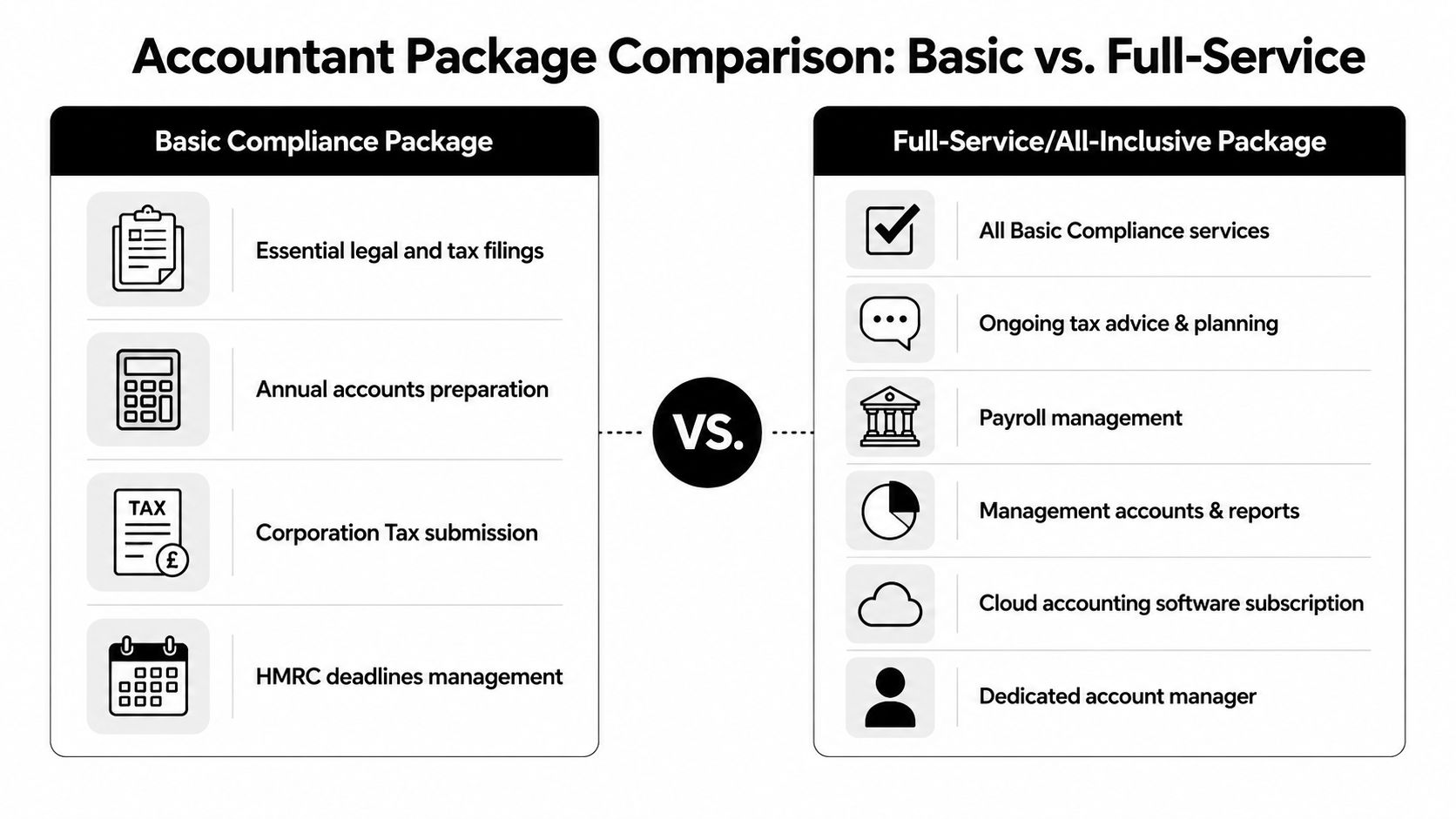
Basic compliance package
This is the minimum level many contractors start with. It focuses on the legal and tax submissions the company has to make.
A basic package often includes:
- Year-end accounts preparation: The accountant prepares the company accounts for filing.
- Corporation tax work: This usually covers calculation and submission of the company tax return.
- Deadline management: A decent firm tracks key filing dates and prompts you when information is needed.
- Basic HMRC and Companies House handling: Routine correspondence may be included.
This level works best when the director keeps clean records, has low transaction volume and doesn't expect regular advice through the year.
Full-service package
A fuller package usually wraps day-to-day finance admin into the monthly fee. That’s where the value can be much better for a busy contractor, even if the monthly number is higher.
A broader service may include:
- Bookkeeping support: Transactions are reviewed or processed regularly, not left as a year-end tidy-up exercise.
- Payroll administration: Salary runs, PAYE submissions and payslip handling are taken care of.
- Software integration: Some firms include or support tools such as Xero, FreeAgent or QuickBooks.
- Regular reporting: Management information helps you keep an eye on cash, tax and drawings.
- Ongoing tax guidance: Questions are dealt with as they arise rather than stored up for year end.
- Named contact: You know who to speak to when something changes.
What tends to create confusion
Most disputes over ltd company accountant cost don't come from the fee itself. They come from assumptions.
Common examples include:
- Bookkeeping assumed, but not included
- Director tax return treated as an extra
- Payroll included for one person only
- Software licence charged separately
- Advisory calls billed outside the package
That’s why the best question isn't “what do you charge?”. It's “what will you do for that fee, and what will trigger an extra bill?”
If your records need better structure before they ever reach the accountant, tools and workflows that streamline your company's financial records can make a real difference to how much cleanup work builds up over the year.
The best-value package is the one that matches the way your company really operates, not the one with the lowest monthly headline.
Key Factors That Influence Your Accountant Costs
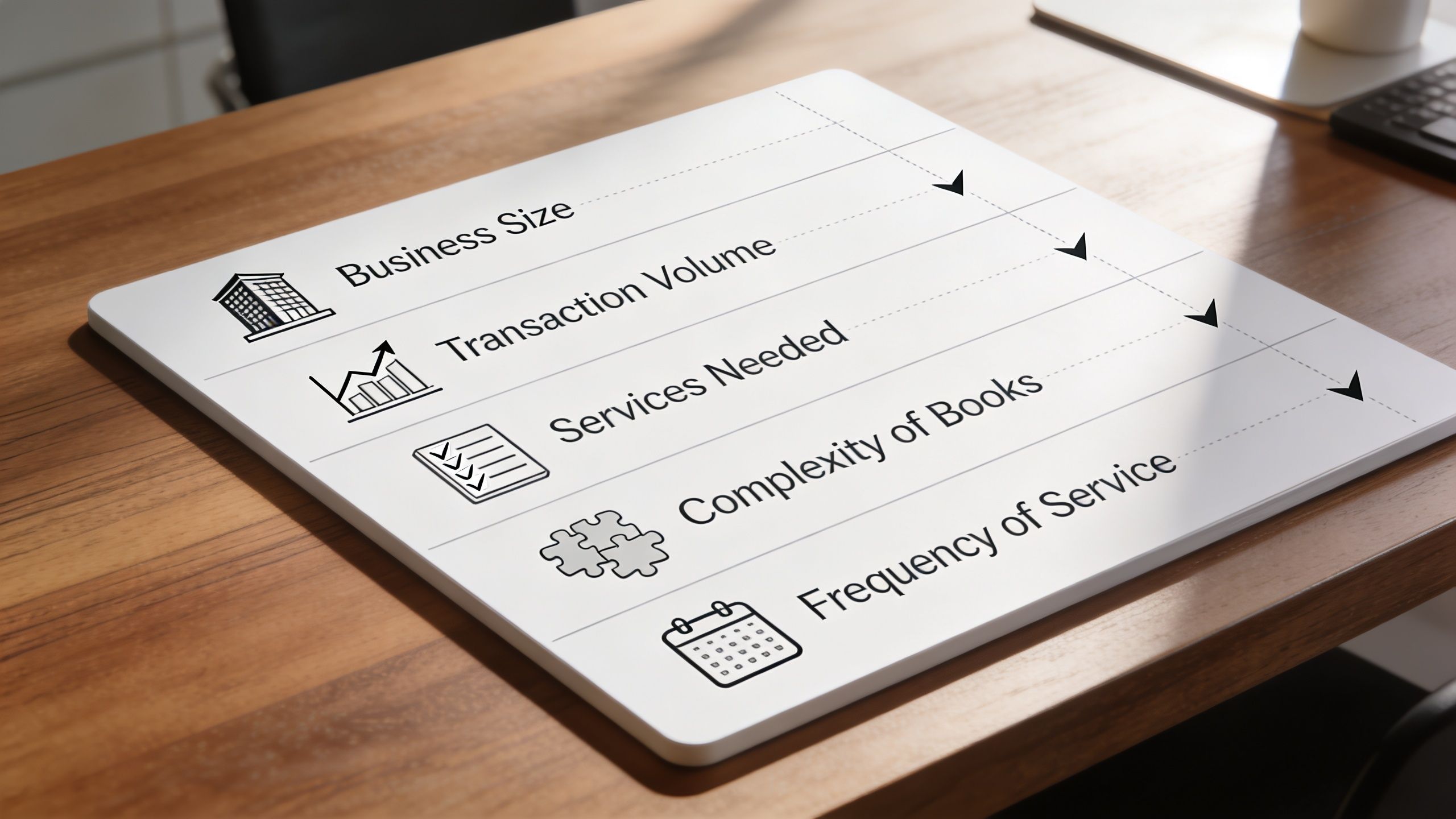
A contractor with one client, tidy records and no staff will usually sit at the simpler end of the fee range already mentioned earlier. A contractor with irregular payroll, VAT, CIS, lots of card spend, or weak bookkeeping will not. That difference is what you are paying for.
The useful question is not just "what does an accountant cost?" It is "what level of compliance work, clean-up, and judgement does my company create each month, and how does that compare with the all-in admin cost of staying limited versus using an umbrella?" If you are weighing that trade-off, a limited company take home calculator helps put the accountancy fee in the wider decision rather than treating it as an isolated bill.
Transaction volume
Transaction count is one of the biggest fee drivers because it creates recurring work all year.
A straightforward contractor company might have one or two invoices a month, a salary entry, software subscriptions, and a small number of expenses. That is quick to reconcile and easy to review. A company with frequent travel, equipment purchases, mixed-use spending, several payment platforms, and lots of bank movements takes longer to process and creates more room for errors.
It is rarely the raw number of transactions alone. The primary issue is how much checking each one needs.
If receipts are missing, personal and business spending are mixed, or bank feeds are full of uncoded items, the accountant is no longer just handling compliance. They are repairing records. That pushes the fee up fast.
Payroll and staffing
Payroll starts off looking simple. Then it stops being simple.
One director on a standard salary is routine. Add employees, variable pay, pension duties, sick pay, parental leave, or irregular bonuses, and the admin load changes. Each payroll run has filing deadlines, record-keeping requirements, and knock-on effects for bookkeeping and year-end reporting.
This is also where the umbrella comparison becomes more practical. Under an umbrella, payroll administration sits with the umbrella provider and is folded into their margin. Under a limited company, you either handle that burden yourself or pay your accountant to run it properly. The cheaper-looking company route can stop looking cheap if your setup now includes staff or changing pay patterns.
A short explainer on the admin side of this is worth watching here:
Service scope
Two firms can quote very different fees for the same company because they are selling different levels of involvement.
One may cover statutory accounts, corporation tax, Companies House filing, and little else. Another may include software, regular reviews, VAT returns, payroll support, tax planning, dividend guidance, and quick answers when something changes mid-year. The second package costs more because it removes more admin from the director and reduces the chance of mistakes.
That extra support has value if you use it. If your company is stable and you rarely need advice, a leaner package may be enough. If you want help with drawings, IR35 concerns, VAT questions, or staying organised during the year, paying for support usually saves time and avoids expensive errors.
Business structure details that raise complexity
Some fee drivers only become visible once the accountant asks better questions.
- VAT registration: Returns, reconciliations, and scheme choices create regular work.
- Construction Industry Scheme involvement: CIS brings specialist processing and tighter reporting discipline.
- IR35 exposure: Contract reviews and status-related planning often mean more advisory input.
- Messy records: Late bookkeeping, missing paperwork, and unclear director transactions turn a simple company into a clean-up job.
The practical takeaway is straightforward. Lower fees usually come from reducing complexity, keeping records clean, and choosing a package that fits how the company operates. Cutting the fee without changing the workload usually just means paying later through extras, delays, or mistakes.
Worked Examples of Contractor Accountant Fees
The easiest way to judge ltd company accountant cost is to match it to real contractor situations. The monthly fee only makes sense when you look at the workload behind it.
These examples use the verified market range as the frame, then place each contractor where they would commonly sit within that range based on complexity.
Sample monthly accountant fee estimates
| Contractor Profile | Key Complexities | Estimated Monthly Fee |
|---|---|---|
| IT contractor | Single director, low transaction volume, simple records | £60 to £200 |
| Marketing consultant | More expenses, regular bookkeeping attention, broader support needs | £60 to £200 |
| Small building firm | Payroll, more moving parts, wider compliance workload | £60 to £200 |
IT contractor
This is the classic straightforward setup. One director, one main client at a time, software subscriptions, a few travel or home office costs, and very little payroll complexity beyond the director's own salary arrangement.
In practice, this type of contractor is usually easier for an accountant to manage. If records are tidy and the director keeps business spending separate, the company is often well suited to a standard monthly package.
The important point isn't that the fee will be at a precise low number. It's that simplicity gives you options.
Marketing consultant
This company still has one director, but the admin is less tidy. There may be more recurring software costs, more reimbursable expenses, regular ad spend, and a greater need to keep bookkeeping current rather than sorting everything at year end.
That doesn't necessarily make the company difficult. It does make it more active.
A contractor in this position often benefits from paying for a fuller package because otherwise the “extra bits” tend to appear as separate charges or create a lot of DIY admin pressure.
Small building firm
The workload begins to change shape. There may be employees, subcontractor issues, more supplier transactions, and more moving parts in general.
Even if the company is still small, the accountant is handling more than end-of-year compliance. Payroll alone can change the service requirement materially, and construction businesses often need someone who understands operational admin as well as tax submissions.
If you're modelling how these running costs affect your overall income, a limited company take home calculator helps put the accountancy fee in context with the rest of your company decisions.
A contractor doesn't need the cheapest accountant. They need the cheapest setup that still fits the real complexity of the business.
DIY Accounting Versus Hiring a Professional
A contractor with one client, a regular monthly invoice and tidy records can keep a lot in-house. A contractor who leaves bookkeeping until January usually finds that "saving the fee" turns into lost evenings, avoidable errors and expensive clean-up work.
That is the decision to make here. Not whether software exists, but whether your company is simple enough, and whether you are consistent enough, to rely on it without creating tax or filing problems later.
When DIY can work
DIY works best for a contractor whose company is predictable and well controlled.
Typical signs are:
- Low transaction volume: Fewer entries means less chance of coding mistakes and fewer reconciliation issues.
- Director-only payroll: Once payroll becomes more involved, admin time and compliance risk both increase.
- Clean separation between company and personal spending: Mixed transactions are one of the fastest ways to create confusion.
- Regular bookkeeping habits: Monthly review matters more than good intentions at year end.
- Confidence with accounting software: The director knows how to post income, expenses and bank movements properly.
In that setup, a sensible model is often to handle the day-to-day bookkeeping yourself and pay an accountant for year-end accounts, Corporation Tax, confirmation statement support and ad hoc advice.
Where DIY starts costing more than it saves
The pressure point is rarely data entry. It is judgement.
Software will record a transaction. It will not take responsibility for whether an expense is allowable, whether a dividend is supported properly, or whether payroll has been run the right way. That is where contractors get caught out.
DIY starts to become poor value when you are spending too much time on:
- Checking how to treat unusual expenses
- Fixing bookkeeping errors after the event
- Working out dividends, salary and director transactions
- Trying to reconcile accounts that no longer make sense
- Worrying about deadlines rather than running the contract
That time has a cost. So does getting it wrong.
What you are paying a professional for
A good accountant does more than submit forms. They reduce decision risk, keep deadlines under control and stop small bookkeeping issues turning into year-end problems.
For a contractor, that matters because the comparison is not just "accountant fee versus no accountant fee". It is the all-in cost of running a limited company properly versus using an umbrella, where much of the payroll and tax admin sits elsewhere. If you are still weighing those models up, this guide to umbrella company vs limited company working is a useful reference point.
The practical question is simple. Do you want to own the admin and buy targeted help, or do you want an accountant to carry more of the compliance load so the limited company remains worth the effort?
A balanced setup is common and often sensible:
- Use software for daily visibility and record capture
- Keep bookkeeping current throughout the year
- Use an accountant for filings, tax judgement and problem areas
That gives you control without pretending you need to become your own accountant. For many contractors, that is the point where the fee stops looking like overhead and starts looking like part of the cost of running the company well.
Limited Company vs Umbrella Company A Cost and Service Comparison
Many contractors need to zoom out. Accountant fees matter, but they are only one part of the total admin burden of running a limited company.
A limited company gives you control. It also gives you responsibility. You are running a company, not just receiving income.
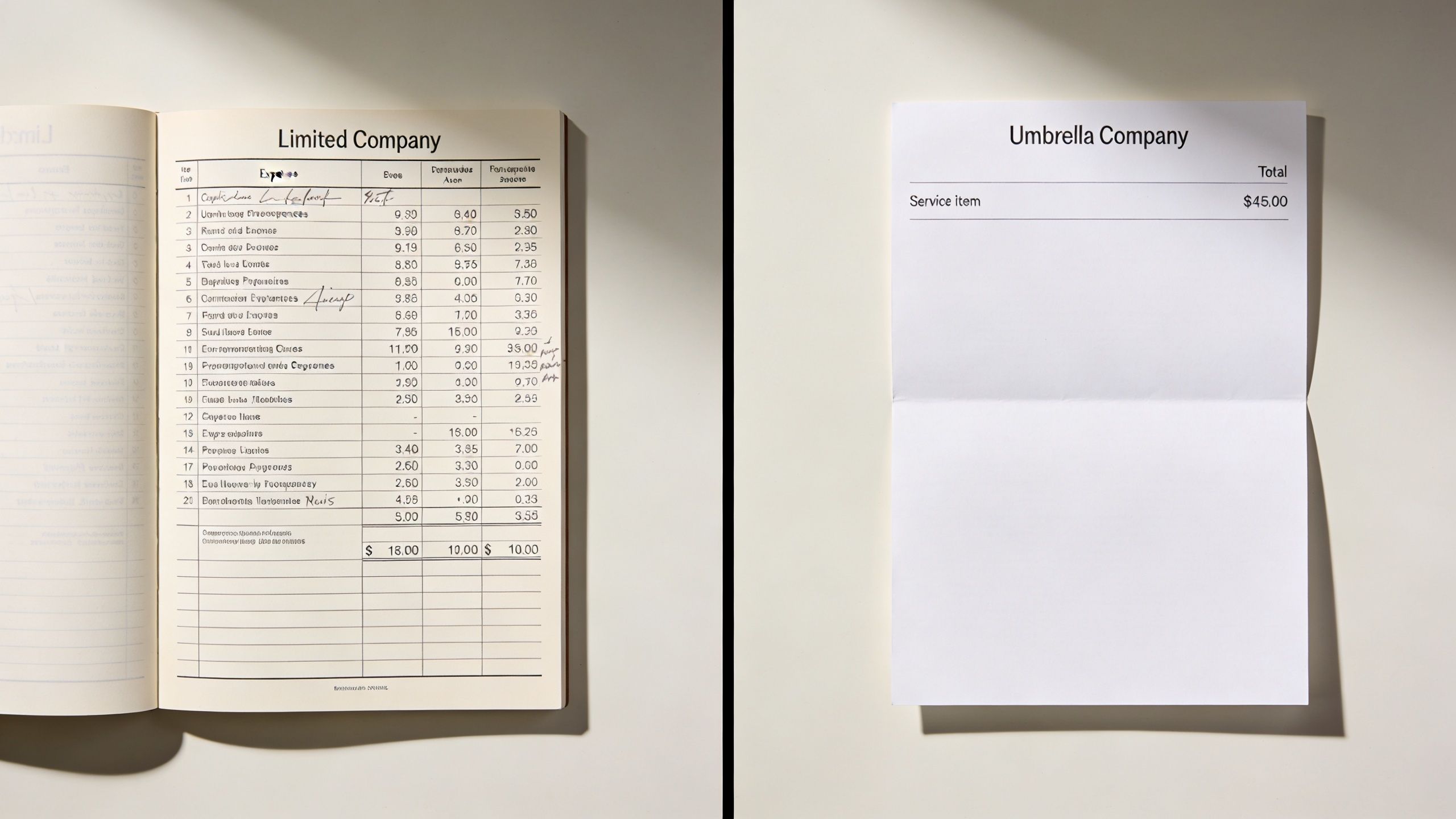
What a limited company involves
When you trade through a limited company, the accounting fee sits alongside several other practical demands:
- Company administration: Records, filings and director responsibilities don't disappear because you hired an accountant.
- Payroll and tax processes: Even where outsourced, you still need to provide information and review what is being done.
- Bookkeeping discipline: Clean books reduce stress. Poor books create year-round drag.
- Decision-making: You need to understand enough to run the company properly.
That can suit experienced contractors who want more control over how the business operates.
What an umbrella company changes
An umbrella company usually removes most of the company admin from your side. Payroll is processed through the umbrella. Tax is handled through PAYE. Payslips show deductions. You work, submit timesheets or hours where required, and get paid through an employment model.
That simplicity is the appeal.
It doesn't mean one structure is always better. It means the trade-off is clear:
- Limited company: More control, more administration
- Umbrella company: Less administration, less operational involvement
For contractors working inside off-payroll rules, or for anyone who doesn't want the burden of company admin, that simplicity can be worth a great deal. If you're comparing the two working models directly, umbrella company vs limited company is the right place to look at the broader trade-offs.
The practical comparison
A lot of contractors make the mistake of comparing only the accountant fee with an umbrella margin. That is too narrow.
You should also weigh:
- Your time spent on administration
- Your tolerance for compliance responsibility
- Whether payroll complexity will grow
- How much ongoing support you want
- Whether you desire to run a company
The best structure isn't the one with the lowest visible fee. It's the one you can operate confidently and compliantly.
Making the Right Choice for Your Contracting Business
For most contractors, ltd company accountant cost sits in the £60 to £200 monthly range, but the useful number is the one attached to your real setup. Transaction volume, payroll, bookkeeping quality and service scope all shape the final fee.
A good accountant isn't just a cost line. They're part of your compliance process and part of how much admin lands back on your desk. If that burden feels too high, an umbrella arrangement may be the better fit.
If you're deciding between running a limited company and using an umbrella, Umbrella Company helps you compare compliant options and choose the setup that fits your contract, working style and appetite for admin.


