


Deciding how to set up your business is one of the biggest calls you will make as a UK contractor. Going down the limited company route has some serious upsides, mainly because it draws a clear legal line between your money and the business’s money. This creates a financial buffer, opens up smarter ways to handle tax, and generally makes you look more professional to clients.
This guide explains the key limited liability company advantages, helping you understand how this structure protects your personal assets, improves tax efficiency, and boosts your professional credibility.
Why Go Limited? A Contractor's Guide to the Perks
When you are a contractor or freelancer in the UK, you have a few options for your business structure, but setting up a limited company is a hugely popular and often very strategic choice. For most, it is not just about adding ‘Ltd’ to their business name. It is a calculated decision to protect their personal finances and manage their earnings more effectively.
The numbers speak for themselves. The UK's company register is always growing, hitting a massive 5,443,776 companies by June 2025. With 209,798 new companies formed in that quarter alone, it is clear the advantages of a limited company strike a chord with a lot of UK professionals. You can dive into the full government statistics on company incorporations if you want the finer details.
What's in It for Contractors?
The real appeal of a limited company is how it tackles the specific challenges and risks independent professionals face day-to-day. It gives you a solid foundation for handling your money, your legal liability, and your reputation in the market.
So, what are the headline benefits?
- Protecting Your Personal Assets: This is the big one. Your home, your car, your personal savings, they are all legally separate from the business. If the company runs into debt, creditors cannot come after your personal possessions. This protection is called limited liability.
- Smarter Tax Planning: A limited company lets you pay yourself with a mix of a small salary and dividends. This combination can often lead to a much lower overall tax and National Insurance bill compared to being a sole trader.
- Boosting Your Credibility: Perception matters. Many big companies and recruitment agencies simply prefer working with contractors who operate through a limited company. It is often seen as a sign of a more serious, stable, and professional organisation.
- Better Pension Opportunities: You can make employer contributions from your company straight into your personal pension. This is a very tax-efficient way to save for retirement, and it often means you can put away much more than you could as an individual.
To give you a clearer picture, let’s put the limited company head-to-head with its main alternative, the sole trader.
Quick Overview: Limited Company vs Sole Trader for Contractors
| Feature | Limited Company | Sole Trader |
|---|---|---|
| Legal Status | A separate legal entity from you, the owner. | You and the business are legally the same. |
| Liability | Limited liability. Your personal assets are protected. | Unlimited liability. You are personally responsible for all business debts. |
| Taxation | Pays Corporation Tax. You take a salary & dividends. Often more tax-efficient. | Pay Income Tax & NI on all profits via Self Assessment. |
| Credibility | Higher perceived professionalism. Preferred by many large clients and agencies. | Can be seen as less professional for larger contracts. |
| Admin | More complex. Requires annual accounts, confirmation statement, and a director. | Simpler. Just need to register for Self Assessment with HMRC. |
| Pension | Company can make tax-efficient employer contributions to your pension. | You make personal contributions from your post-tax income. |
This table lays out the core differences. As your contracting career takes off, the protections and tax benefits of a limited company often start to look very attractive.
Making the leap from a sole trader footing is a natural step for many growing contractors. If you are wondering what that involves, you might find our guide on changing from a sole trader to a limited company helpful. It is all about accessing these benefits to build a stronger, more resilient business for the long haul.
Building a Financial Fortress Around Your Personal Assets
Of all the reasons to set up a limited company, one benefit towers above the rest: the legal shield it puts around your personal life. Think of it as building a solid brick wall around your home, car, and savings, while your business operates safely on the other side. This is the power of limited liability.
When you incorporate your business, you are creating something entirely new, a separate legal entity. This is not just jargon; it is a fundamental change in how the law, your clients, and HMRC see your business. From that moment on, your company can sign contracts, own equipment, and take on debt, all in its own name.
This separation is your single greatest defence. If the business ever runs into trouble, for example, if it cannot pay a supplier or struggles with a loan, those debts belong to the company. Creditors can claim against the business's assets, but they cannot come after your personal possessions.
How Limited Liability Works in the Real World
Let's make this practical. Imagine you are an IT contractor hired to handle a crucial system upgrade. A mistake in your work causes a major server outage, costing your client a small fortune in lost revenue. They decide to sue to recover their losses.
Here is how that scenario plays out depending on your business structure.
As a Sole Trader: There is no legal difference between you and your business. You are the business. This means you are personally on the hook for the entire amount. If your business insurance or cash reserves cannot cover it, the claim can bleed into your personal bank accounts, your house, and anything else you own. Your entire financial world is at risk.
As a Limited Company: The client’s lawsuit is against your limited company, not you. The liability stops at the company's door, capped at the value of its assets. Your personal finances remain safely behind that protective wall, completely untouched by the dispute.
Key Takeaway: Limited liability creates a legal firewall between your business and personal finances. This means that if your company faces debts or legal claims, your personal assets are shielded from risk.
The Real Value of Peace of Mind
This protection gives you an incredible sense of security. It is what allows you to take calculated risks, invest in new software, and push for bigger contracts without that nagging fear of losing everything if a project goes south.
It shifts your mindset from defensive and anxious to confident and strategic. This is the absolute cornerstone of the limited company structure and the main reason so many successful UK contractors go down this route. It is not just a box-ticking exercise; it is the most powerful risk management tool you have.
By drawing this clear legal line in the sand, you ensure that even in a worst-case scenario for the business, your personal financial wellbeing (and that of your family) remains intact. It is the foundation for a resilient, long-term contracting career.
Squeezing More Out of Your Earnings: Tax and Pension Perks

While the safety net of limited liability is a huge relief, let's be honest: one of the biggest draws of going limited is the chance to be smarter with your money. Operating through your own company opens up far more efficient ways to manage your income, claim expenses, and plan for the future.
Get this right, and you can genuinely increase what you take home at the end of the month. The secret lies in moving away from a traditional salary and adopting a more strategic approach to paying yourself.
The Smart Way to Pay Yourself: Salary and Dividends
For most contractors, the go-to method is paying yourself a small, tax-efficient salary and taking the rest of your income as dividends. Why? Because dividends, which are your share of the company's profits after tax, are not subject to National Insurance Contributions (NICs).
This is a game-changer. A typical salary gets hit with both Income Tax and NICs, but by splitting your income, you can legally and significantly reduce your overall National Insurance bill.
The trick is to set your salary at a level that is high enough to qualify for state benefits, like the State Pension, but low enough to avoid paying much (or any) National Insurance. A common strategy is to pay a salary up to the National Insurance Primary Threshold, which means you build up your qualifying years for the State Pension without actually paying any employee’s NICs on it.
Anything you earn above that can be paid out as dividends, which are taxed at lower rates than an equivalent salary would be. For a more detailed look at the numbers, check out our guide on the salary versus dividends model.
A well-structured salary and dividend plan is the cornerstone of tax efficiency for limited company directors. It directly reduces your National Insurance liability, leaving more of your hard-earned money in your pocket.
Making Business Expenses Work for You
Another major perk is the ability to claim a much wider range of business expenses. As a separate legal entity, your company can pay for legitimate business costs before it pays Corporation Tax. This reduces your company's taxable profit, which in turn lowers your tax bill.
These are not just freebies; they are genuine costs you incur "wholly and exclusively" for your business. Knowing what you can and cannot claim is essential for running an efficient operation.
Some of the most common allowable expenses for contractors include:
- Business Travel and Accommodation: Any trips to client sites, including mileage claims, train fares, and hotel stays.
- Office Kit and Software: Your work laptop, software subscriptions, a proper office chair, the tools of your trade.
- Professional Development: Training courses to sharpen your skills or subscriptions to industry journals.
- Accountancy Fees: The cost of hiring a good accountant is itself a tax-deductible expense.
By carefully logging and claiming every legitimate expense, you ensure you are only paying tax on your actual profits.
Supercharge Your Pension Pot
Saving for retirement is a big deal when you are self-employed, and a limited company gives you a massive advantage here. Your company can make employer pension contributions directly into your personal pension scheme.
This is far more tax-efficient than paying into a pension from your personal, post-tax bank account. Company contributions are usually treated as an allowable business expense, which means the money comes out of your business before Corporation Tax is calculated.
Think about it: if you contribute personally, that money has already been taxed. But when your company pays in, it uses pre-tax funds. This gives your business a tax break and allows you to build your pension fund much, much faster. It is easily one of the most valuable long-term financial benefits a limited company can offer.
Winning Bigger Contracts and Enhancing Your Credibility

Long before you even submit a proposal, the way your business is set up sends a powerful signal to potential clients. Operating as a limited company massively boosts your professional standing. It shows you are serious about your contracting career, not just dipping your toe in the water.
For many large organisations and recruitment agencies, this is not just a preference, it is a non-negotiable requirement. Their procurement policies often block them from engaging sole traders due to what they see as a higher risk. Adding 'Ltd' after your name instantly removes that barrier, opening up doors that would otherwise stay firmly shut.
This professional gloss is one of the most underrated limited liability company advantages. It builds instant trust and can be the very thing that gets your CV moved to the top of the pile for more lucrative, high-calibre contracts.
Projecting a Professional and Stable Image
A registered limited company is not just a legal checkbox; it is a strategic asset. It tells clients you have a formal, organised structure in place, reassuring them that you operate with professionalism and are in it for the long term. This perception of stability is absolutely crucial when you are pitching for large-scale or business-critical projects.
Clients who are about to invest a significant amount of money need to feel confident that their contractors are reliable and built on a solid foundation. A limited company delivers that assurance in a few key ways:
- It implies permanence: A registered company suggests you are in business for the long haul, not just for a one-off project.
- It shows financial separation: Clients know your business finances are handled separately from your personal ones, which points to a more professional approach to managing money.
- It simplifies their due diligence: A company registered with Companies House is a verifiable entity, making their background checks far simpler and more transparent.
It is for these reasons that many contractors find that incorporating their business is the key step to levelling up their career and landing the kind of work they really want.
Accessing More Opportunities
The UK’s business landscape is built on formal company structures. In fact, small and medium-sized enterprises (SMEs) with limited company status account for a staggering 99.9% of all private sector businesses. This dominance cements the structure as the professional standard. You can see the full picture by exploring the government's statistics on business populations.
By aligning with this standard, you are positioning yourself to work with a much wider range of clients. Some organisations, especially in the public sector or financial services, have strict supplier lists that only feature incorporated businesses. Operating as a limited company is your ticket in.
A limited company structure is not just about legal protection; it is a powerful marketing tool that enhances your credibility and aligns you with the professional expectations of the UK's biggest clients.
Of course, running a company means carefully managing your finances and statutory duties. This is where partnering with the right professionals makes all the difference. If you need support, our guide on finding the best accountant for limited company contractors can point you towards an expert who gets the unique needs of independent professionals. That support lets you focus on growth, knowing the compliance is handled.
Understanding Your Responsibilities as a Company Director
While the perks of running a limited company are clear, they do come with a set of straightforward responsibilities. When you become a company director, you take on legal duties that you need to uphold. It is important to be honest about these obligations from the start.
These duties are not meant to be a roadblock. Think of them as the routine maintenance needed to keep your business engine running smoothly. They ensure your company operates legally and transparently, which is crucial for maintaining that professional image we discussed earlier.
Your Core Statutory Duties
As a director, you are legally on the hook for managing the company's affairs correctly. This means keeping accurate records and filing the right information with government bodies on time. Get this wrong, and you could face penalties, so staying organised is non-negotiable.
The two main organisations you will get to know are Companies House, which handles all the company registration and public records, and HMRC, which looks after everything tax-related.
To help you get a handle on what is required, here is a summary of the main annual tasks every limited company director needs to manage.
Annual Responsibilities for a Limited Company Director
| Task | Responsible Body | Typical Deadline |
|---|---|---|
| Confirmation Statement | Companies House | Annually, within 14 days of your company's anniversary |
| Annual Accounts | Companies House | 9 months after your company's financial year-end |
| Company Tax Return (CT600) | HMRC | 12 months after your accounting period for tax ends |
| Corporation Tax Payment | HMRC | 9 months and 1 day after your accounting period for tax ends |
| Self Assessment Tax Return | HMRC | 31st January following the tax year |
Keeping on top of these dates is crucial, but with a good system, or a good accountant, it quickly becomes a manageable part of your annual routine.
The Costs of Staying Compliant
Running a limited company is not free, but the costs are predictable and should be seen as an investment in your business's legal protection and structure.
You will have a small one-off company formation fee to get registered with Companies House. After that, your main ongoing cost will be for professional support, especially accountancy fees. The good news is these fees are a tax-deductible business expense, which softens the blow.
While the admin can seem daunting at first, it is a completely manageable part of running a professional, compliant business. A great accountant can turn these tasks from a chore into a simple background process.
The Value of Professional Support
Here is the thing: you do not have to tackle this alone. In fact, one of the best decisions you can make is to bring a specialist contractor accountant on board. They will manage the deadlines, prepare your accounts, and make sure your tax returns are filed correctly and on time.
But a good accountant does more than just paperwork. They provide invaluable advice on tax planning, helping you make the most of the limited liability company advantages. To see how the right support can make all the difference, check out our guide on accounting for contractors. This leaves you free to focus on what you actually do best: delivering fantastic work for your clients.
Grappling with IR35 as a Limited Company Contractor
If you are a contractor in the UK, you cannot escape IR35. These are the off-payroll working rules, and getting your head around them is non-negotiable. At its core, this legislation decides your employment status for tax, and it is tied directly to how you operate your limited company.
A huge misconception we see all the time is the belief that setting up a limited company is a golden ticket to being 'outside IR35'. It is just not that simple. Think of your limited company as the car you drive; it is essential for the journey, but it does not decide the destination. What really matters are your working practices, the day-to-day reality of your relationship with your client.
Inside or Outside: What's the Real Difference?
HMRC has a habit of looking right through your contract to see what is actually going on. Are you a genuine, independent business, or are you what they call a ‘deemed employee’? If your working arrangement looks and feels just like a permanent employee's, you will almost certainly be deemed ‘inside IR35’. That means you are on the hook for income tax and National Insurance, just like any other staff member.
To stay ‘outside IR35’, you have got to prove you are running a proper business. HMRC focuses on a few key areas, and it is critical that both your contract and your daily work reflect your independence.
These are the main areas they look for:
- Substitution: Can you send someone else to do the job? A genuine business should have the right to send a qualified substitute. If the client insists it has to be you and only you, that is a red flag for employment.
- Control: Who calls the shots? You should have significant control over how, when, and where you get the work done. If the client is dictating your 9-to-5 schedule and micromanaging your methods, it starts to look a lot like an employer-employee dynamic.
- Mutuality of Obligation (MOO): Is there an unspoken expectation of more work? In a true business-to-business relationship, the client does not have to offer you more work, and you do not have to take it. Each contract should be a distinct project with a clear start and end.
What if a Contract Lands Inside IR35?
Do not panic. Getting a contract that is 'inside IR35' does not suddenly make your limited company useless. Plenty of contractors find themselves working on a mix of projects throughout the year, some inside, some out.
Your limited company structure is still a massive asset:
- It keeps your professional business identity intact, ready for the next outside-IR35 gig.
- You still get the rock-solid protection of limited liability, which keeps a wall between your business debts and your personal assets.
- Your company can continue to make tax-efficient employer contributions into your pension.
Operating through a limited company is the only way to unlock the tax benefits of an outside-IR35 determination. But remember, it is your working practices that truly secure that status, not just the company name on an invoice.
Staying Compliant and Prepared
Navigating IR35 is not a one-off task; it requires ongoing attention. You need to scrutinise every contract and make sure your on-the-ground reality matches your claim of being an independent business. It might feel like a chore, but this proactive stance is your best defence against a potential HMRC headache and a bill for back-taxes.
This brings you to a key decision: do you hire a specialist accountant or go it alone with your director duties? The flowchart below lays out this exact crossroads.
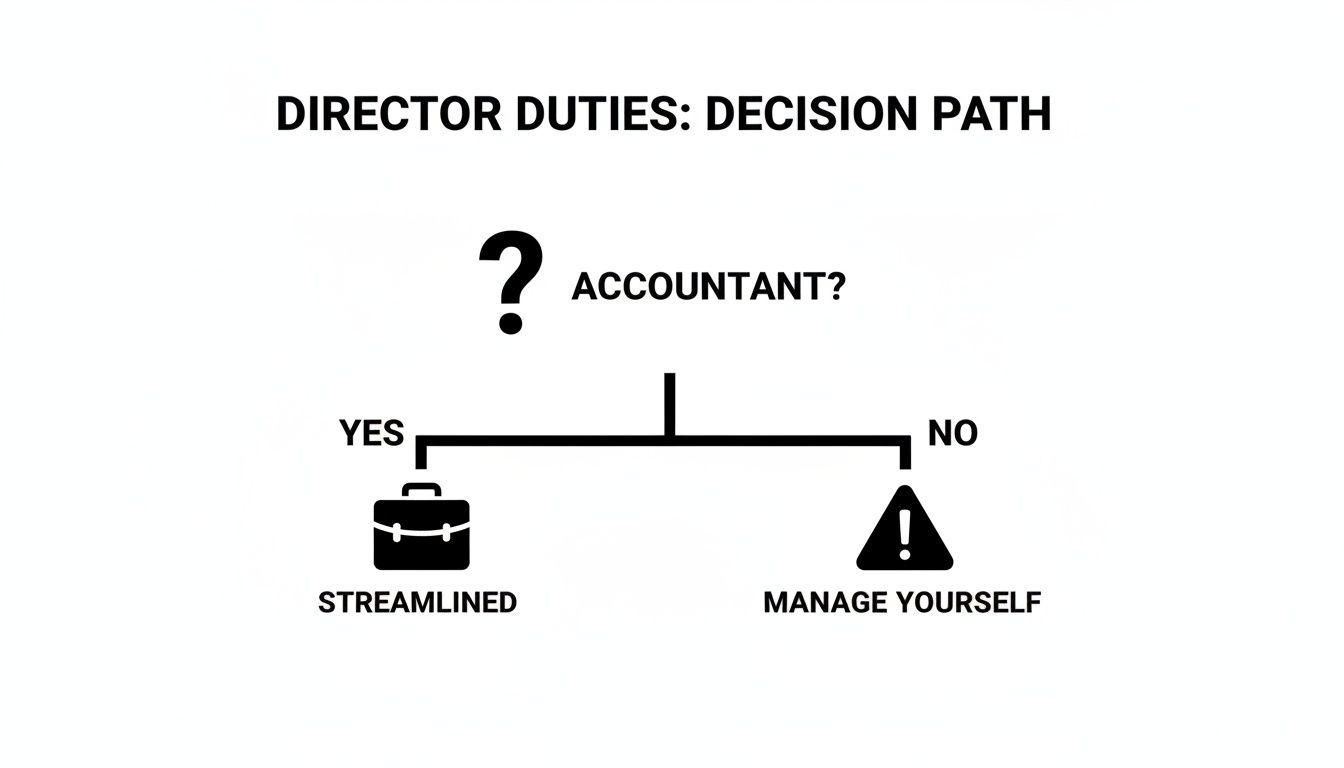
As you can see, bringing in a professional can take a lot of the administrative weight and risk off your shoulders, whereas the DIY route means you are personally responsible for getting every detail right.
The rules can feel daunting, but a solid understanding of IR35 is empowering. It lets you operate your limited company with confidence, knowing you are making smart choices about the contracts you take and how you work, all while enjoying the significant limited liability company advantages you set it up for in the first place.
Your Questions Answered
Choosing the right business structure is a big decision, so it is natural to have a few questions. To help you get clear on the details, here are some straight answers to the queries we hear most often from contractors weighing up the limited company route.
Is a Limited Company Still Worthwhile if My Contract Is Inside IR35?
This is a really common question. While the main tax benefits of dividends disappear for contracts caught inside IR35, running a limited company can still make sense. It maintains your professional identity, keeping the door open for future outside-IR35 work, and it lets you make tax-efficient employer contributions into your pension.
That said, if you expect all your projects to be inside IR35 for the foreseeable future, many contractors find an umbrella company is a simpler, more direct solution. They handle all the tax and NI for you, freeing you from the legal duties of being a company director.
How Much Does It Cost to Run a Limited Company?
The costs are not huge, but you do need to budget for them. First, there is a small, one-off fee to get set up with Companies House, usually somewhere between £12 and £50.
Your main ongoing cost will be your accountant. Depending on the support you need, this can range from £80 to £150+ per month. These fees cover essential work like your annual accounts, tax returns, and payroll, and the good news is they count as a tax-deductible business expense. It is all about weighing these costs against the potential tax savings and other perks.
Can I Switch From Being a Sole Trader to a Limited Company?
Absolutely. It is a well-trodden path for contractors and freelancers. The process is straightforward: you register a new limited company and then let HMRC know you are stopping your sole trader activities.
Getting an accountant on board to help is a smart move. They can give you vital advice on things like transferring business assets and making sure the switch is seamless. Contractors often make this change when their earnings increase or when they start landing contracts with bigger corporate clients who often prefer to engage with limited companies.
What Is the Main Difference Between a Salary and Dividends?
Think of it this way: a director's salary is what the company pays you for doing your job as an employee. It is treated just like any other employment income, meaning it is subject to both Income Tax and National Insurance Contributions (NICs).
Dividends, on the other hand, are a way of distributing the company's profits to its shareholders (which, in most cases, is just you). The crucial difference is that dividends are not subject to NICs. This is what makes them so tax-efficient. A common strategy is to pay yourself a small salary that stays below the NIC threshold and then take the rest of your income as dividends.
Making these choices is a fundamental part of building a successful contracting career. Here at UmbrellaCompany.com, our job is to give you the clear comparisons and tools you need to make the right call for you. If you decide that an umbrella company better suits your needs, we are here to help you find a compliant and trustworthy provider.


