


When you run your own limited company, a take-home pay calculator is an essential piece of kit. It helps you get a real-world estimate of your net pay by showing how salary, dividends, and taxes all fit together.
The calculator takes your company’s revenue, deducts business expenses and Corporation Tax, and then works out the personal tax on the salary and dividends you draw. The result is a much clearer picture of what you actually get to keep.
Understanding Your Take-Home Pay as a Director
Figuring out what you'll actually bank as a limited company director isn't as simple as just looking at your invoices. It’s all about getting the right blend of salary and dividends, and each has its own tax rules. Unlike a standard PAYE job, your remuneration isn’t one single figure; it’s the end result of several moving parts.
This guide is here to untangle all of that. We’ll walk you through the key elements that determine what you ultimately take home, so you can manage your finances with more confidence.
The Key Financial Levers
Your take-home pay really comes down to how you structure your income. If you get your head around these elements, you can start making smart decisions that line up with your financial goals.
- Director's Salary: Most directors set this at a tax-efficient level. This usually means drawing a salary up to the National Insurance threshold to keep tax low while still making it a deductible business expense.
- Dividends: This is how you take your share of the company's post-tax profits. They're taxed at a lower rate than salary, which is why they’re such a popular way to top up your earnings.
- Business Taxes: Before you can even think about dividends, your company must pay its Corporation Tax bill on all its profits. There is no getting around that.
- Personal Taxes: You’ll also need to pay personal tax on your dividends, which you declare through your annual Self Assessment tax return.
At UmbrellaCompany.com, we know that getting the payment structure right is make-or-break. Running a limited company gives you fantastic control and the potential for real tax efficiency, but it absolutely requires careful planning to make the most of your earnings.
This structure is a world away from other ways of working, like using an umbrella company. To see how different payroll solutions can affect what you keep, take a look at our guide on which option gives you the highest take home pay. Each route has its pros and cons, and the best choice really depends on your contracts, your circumstances, and how much admin you're willing to take on. Our job is to give you the information you need to choose wisely.
The Core Elements: Salary, Dividends, and Tax
When you're trying to figure out your take-home pay from a limited company, you're essentially juggling three key figures: your director's salary, the dividends you can draw, and the taxes your business owes. Striking the right balance here is the secret to maximising your personal earnings while keeping everything above board with HMRC.
Think of them as interconnected cogs in a machine. The salary you pay yourself directly impacts your company's profit. That profit figure then dictates how much is left for dividends and how much Corporation Tax you’ll have to pay.
The Optimal Director's Salary
You'll find most savvy contractors pay themselves a relatively small salary. The go-to strategy is to set it at, or just slightly below, the National Insurance threshold. For the 2024/25 tax year, that magic number is £12,570.
There's a good reason this is so common. A salary counts as a tax-deductible business expense, which shaves down your company's profit and, in turn, its Corporation Tax bill. By staying within the NI threshold, you typically won't pay any National Insurance contributions, but you still get the credit for a qualifying year towards your state pension. It’s a classic win-win situation.
Understanding Dividends
After your company has paid all its costs (including your salary and any other expenses) and settled its Corporation Tax, the profit that remains can be paid out to shareholders as dividends. For most one-person contractors, you're the sole shareholder, so all that distributable profit is yours for the taking.
Dividends have a different tax treatment to salary and, crucially, they do not attract National Insurance. Everyone also gets a dividend allowance each year, which is a certain amount you can receive completely tax-free. For a deeper dive into making this work for you, our detailed guide on how to structure dividends for tax saving in the UK is a must-read.
The Non-Negotiable Business Taxes
Lastly, we come to the taxes your company is responsible for. The big one is Corporation Tax, which is charged on your company's taxable profits. It’s absolutely vital to remember that this gets paid before you can touch a penny of dividends.
Recent statistics from HMRC show just how significant this tax is, with UK liabilities hitting a massive £83.2 billion for 2023/24. This jump was partly down to the main rate rising to 25%. Because dividends aren't a deductible expense, this tax has a direct and unavoidable impact on the pot of cash available for your personal take-home pay.
Juggling these components effectively is the key to both compliance and financial efficiency. For many directors, having the right tools makes all the difference. A good overview of HR software for small businesses can point you towards systems that help track salaries, dividend paperwork, and tax deadlines accurately.
Calculating Your Company's Corporation Tax
Before you can think about paying yourself dividends, your company has to settle up with HMRC. Paying Corporation Tax isn't optional, and it's a critical step in any limited company take home calculator because it directly shrinks the pot of money available for you to distribute.
The first job is to figure out your company's taxable profit. It's a simple formula: take your total revenue for the year and subtract all your allowable business expenses. To do this properly and get a true picture of your company's health, it’s worth getting comfortable with reading company financial statements.
This diagram breaks down the process visually.
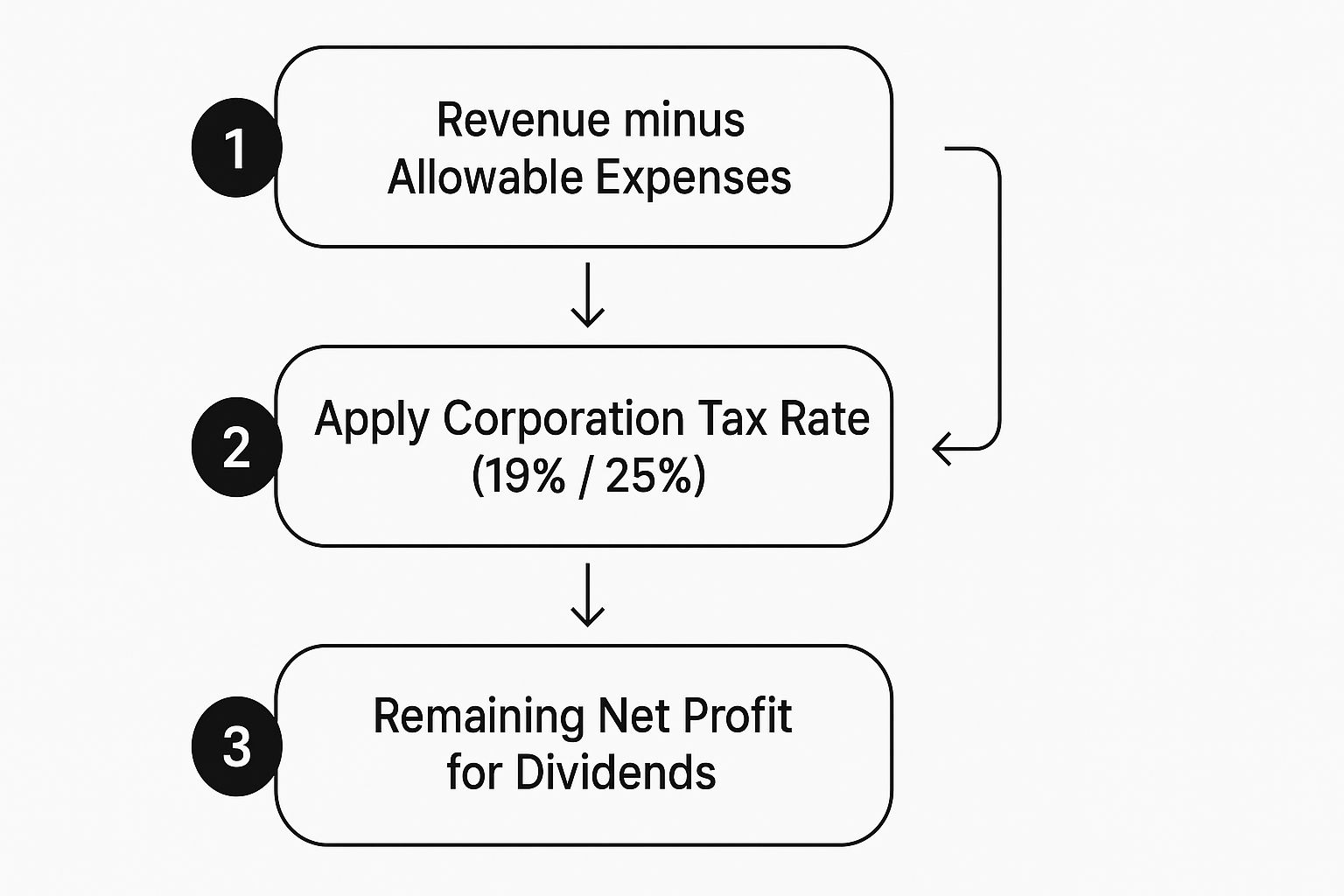
As you can see, Corporation Tax is the bridge between what your company earns and what you can personally take home.
Understanding The Current Tax Rates
Once you have that taxable profit figure, you need to apply the right Corporation Tax rate. For the 2025/26 tax year, the government has set two main rates, which is a change from the old flat-rate system.
Here's a quick look at how the rates break down.
UK Corporation Tax Rates at a Glance
This table summarises the current UK Corporation Tax bands, helping you see which rate applies to your company's profits.
| Company Profits | Corporation Tax Rate |
|---|---|
| Up to £50,000 | 19% (Small Profits Rate) |
| Over £250,000 | 25% (Main Rate) |
| Between £50,000 and £250,000 | A tapered rate via Marginal Relief |
This structure means the tax you pay scales with your company's success.
If your profits land somewhere between £50,000 and £250,000, things get a bit more complex. You do not just jump from 19% to 25%. Instead, HMRC uses something called marginal relief, which effectively creates a sliding scale, gradually increasing your tax rate as your profits climb towards the upper threshold.
For contractors who'd rather not get bogged down in these calculations, our specialist accounting for contractors service can handle all of this for you.
This tiered system is a big shift from the previous flat rate of 19% and has a real impact on how much you can take home. For instance, a company pulling in £300,000 in profit could now be looking at a tax bill over 31% higher than under the old rules. That's a significant chunk of cash that's no longer available for dividends.
Accurately calculating Corporation Tax isn't just a box-ticking exercise. It’s the foundation of your entire take-home pay strategy, determining the real value you can extract from your hard work. Getting this right is crucial for financial stability.
Let's Run the Numbers: A Real-World Take-Home Pay Example
Theory is one thing, but let's make this tangible. We'll walk through a realistic scenario to see how all the pieces fit together and what you're actually left with at the end of the day.
Let’s imagine a contractor, Alex. Her limited company, ‘Alex Designs Ltd’, has a good year and brings in £85,000 in revenue.
First things first, we need to account for the costs of doing business. Alex has tallied up her allowable expenses for the year (things like software subscriptions, insurance, and travel) which come to a neat £5,000. This immediately reduces the company's profit before we even think about salary.
Figuring Out Salary and Corporation Tax
Alex, like many savvy contractors, decides to pay herself a tax-efficient director's salary. She sets it right at the National Insurance Primary Threshold, which is £12,570. This is a smart move because the salary is a deductible business expense, lowering the company's taxable profit even further.
So, here’s our starting point:
- Revenue: £85,000
- Less Expenses: £5,000
- Less Director's Salary: £12,570
- Taxable Profit: £67,430
Now for the taxman's share. With a profit of £67,430, the company falls into the marginal relief band for Corporation Tax. It's not as simple as applying a flat 19% or 25%; a specific calculation is needed. This works out to a Corporation Tax bill of roughly £14,249.
Working Out Dividends and the Final Take-Home Pay
Once the tax is paid, we can see what's left in the pot for Alex to take as dividends.
- Taxable Profit: £67,430
- Less Corporation Tax: £14,249
- Profit Available for Dividends: £53,181
Alex decides to draw all of this as dividends. But we're not done yet. Now we have to calculate the personal tax Alex owes on this income.
Here's a crucial point: For personal tax, Alex's total income is her salary (£12,570) plus her dividends (£53,181), which comes to £65,751. This total income pushes her firmly into the higher-rate tax bracket.
After accounting for the tax-free dividend allowance, the personal tax she'll owe on her dividends is about £8,459.
So, what does Alex actually pocket?
It's the salary plus the dividends, minus that final slice of personal tax: £12,570 (salary) + £53,181 (dividends) – £8,459 (tax) = £57,292.
This breaks down to a monthly take-home pay of approximately £4,774.
Getting your head around these numbers is so important for financial planning. If you have a target income in mind, for example, you can work backwards using a contractor daily rate calculator to figure out the revenue you'll need to generate to hit your goal after all these deductions. As you can see, every single cost, tax, and allowance plays a part in what you finally take home.
Common Financial Mistakes and How to Avoid Them
Running your own limited company puts you firmly in the driver's seat, but that financial freedom comes with responsibility. It is all too easy to make a few simple missteps that can lead to a lot of unnecessary stress and, worse, unwanted attention from HMRC.
Knowing the common pitfalls is half the battle. One of the biggest traps we see directors fall into is failing to put money aside for tax. Your company bank account might look healthy, but it's crucial to remember that a slice of that isn't really yours, it belongs to the taxman. Ignoring future Corporation Tax and VAT bills can cause a nasty cash flow crunch down the line.
Protecting Your Profits
Another serious, and surprisingly common, error is taking illegal dividends. This happens when you pay yourself more in dividends than the company has available in post-tax profits. It's an easy mistake to make if your bookkeeping isn't completely up to date, but the consequences can be severe if HMRC decides to investigate.
To keep your company finances healthy and compliant, here’s what you need to do:
- Ring-fence your tax money: As soon as you're paid, get into the habit of moving a percentage into a separate savings account. This is your tax pot. Treat it as untouchable.
- Keep your books current: Do not let your bookkeeping slide. You need a clear, real-time picture of your company's profitability before you even think about declaring a dividend.
- Get your expenses right: Be strict about what you claim. Misclassifying personal spending as a business cost is a massive red flag for HMRC. Expenses must be "wholly and exclusively" for the business.
Forgetting to use all the tools at your disposal is another missed opportunity. Pension contributions made by your company are a superb way to extract value tax-efficiently, as they are typically an allowable business expense and do not attract National Insurance.
By sidestepping these common mistakes, you ensure that any figure you get from a limited company take home calculator actually reflects what you can safely withdraw. Proper financial management isn't just about ticking boxes for HMRC; it’s about building a resilient, profitable business for the long haul.
Director Pay: Your Questions Answered
When you're running your own limited company, figuring out the best way to pay yourself often throws up a few questions. To give you some clarity, we've pulled together the queries we hear most often from directors trying to get their pay structure right.
Think of this as a quick reference guide to help clear up any confusion and make you feel more confident about your financial choices.
What’s the Sweet Spot for a Director's Salary?
For the 2024/25 tax year, the most tax-efficient salary usually sits right at the National Insurance Primary Threshold of £12,570. By paying yourself this amount, you typically will not pay any National Insurance contributions, but you'll still build up a qualifying year towards your state pension.
The real win here is that this salary is a legitimate business expense. That means it reduces your company's profit, which in turn lowers your Corporation Tax bill. It’s a classic win-win situation.
How Do Student Loans Factor into My Take-Home Pay?
This is a big one. Your student loan repayments are calculated on your total income, which is a combination of both your salary and any dividends you take.
When you file your Self Assessment tax return, HMRC crunches the numbers based on your specific loan plan and its repayment threshold. The amount you owe is then deducted from your overall earnings, so it's absolutely crucial to factor this in when you're mapping out your finances for the year.
Do not forget, company pension contributions are another fantastic tool in your arsenal. Any money your company pays into your pension is generally a tax-deductible expense, cutting your Corporation Tax bill. Better yet, these contributions are usually free from National Insurance for both you and the company.
When Am I Actually Allowed to Take Dividends?
You can only pay yourself dividends when your company has enough ‘distributable profits’. In simple terms, this is the cash left over after you’ve settled all your business expenses, liabilities, and paid your Corporation Tax.
It's absolutely vital to have accurate, up-to-date accounts to prove the company is profitable before you make a dividend payment. If you take out more money than is available, it’s classed as an ‘illegal dividend’. That can land you in hot water with HMRC and the money will have to be repaid.
Using a solid UmbrellaCompany.com calculator is a great start, but staying compliant day-to-day is just as important. For expert support built for contractors like you, take a look at our services.


