


You're a sole-director IT contractor. Your company pays you a modest salary, the rest of your income arrives as dividends, and your family relies on the money you bring home. If you died, they'd need personal financial support, while your clients might also need the business to continue without you. That's where limited company life insurance becomes a practical planning decision rather than a vague tax perk.
The difficulty is that “company-paid life cover” can mean three different products: relevant life insurance, key person insurance, or shareholder protection. Each has a different purpose, beneficiary, and tax treatment. The right choice depends on whether you're protecting your family, your company's trading position, or the ownership of the business.
Why Limited Company Life Insurance Matters for UK Directors
A limited company director often sits at the centre of several financial relationships. Your household may depend on your income, clients may depend on your availability, and the company may hold contracts, cash, equipment, or borrowing that would be difficult to manage after your death.
Life cover can address those risks, but it isn't automatically a contractual requirement. The sensible starting point is to identify who needs the money and why. If the payout should support your family, relevant life cover may be appropriate. If the company would lose trading income when you die, key person insurance may be the better fit. If another shareholder needs funds to buy your shares, shareholder protection serves a different purpose.
Contractors often start with a question about tax and miss the more important question about purpose. A policy designed for the wrong recipient can leave your family without the intended support, or leave the company unable to deal with an ownership problem.
Your company structure matters too. A director operating through a one-person limited company should first confirm the basics through its records, including whether the director is a genuine salaried employee and how remuneration is documented. Our guide to the limited company director role can help clarify the wider responsibilities that sit alongside this decision.
For broader context, contractors comparing protection options may also find this guide to cover for UK business owners useful, particularly when personal and business risks overlap.
Practical rule: Decide who the policy protects before asking whether the company can pay the premium.
The UK framework gives eligible small companies a formal route to provide life cover through the business. Relevant life insurance is a company-paid death-in-service arrangement for an eligible employee or salaried director, rather than a normal personal policy. That distinction drives everything that follows.
The Three Main Policy Types Explained
The three products solve separate problems. Treating them as interchangeable is the fastest way to arrange unsuitable cover.
| Policy Type | Who Pays Premium | Who Is Insured | Who Receives Payout | Main Purpose |
|---|---|---|---|---|
| Relevant life insurance | The limited company | An eligible employee or salaried director | Trustees distribute the benefit to chosen beneficiaries | Family protection as a death-in-service style benefit |
| Key person insurance | The limited company | A person whose death could damage trading income | The company | Replace lost trading income caused by losing a key individual |
| Shareholder protection | Usually the company or shareholders, depending on the arrangement | A shareholder | The relevant shareholder or business participants | Fund the purchase of shares after a shareholder's death |
Relevant life insurance is usually the natural starting point for a contractor-director who wants company-funded family protection. The policy is normally written under a discretionary trust, has no investment element, and is designed to provide protection rather than build a cash value. Industry explanations of the product, including this guide to relevant life insurance explained, can help you understand the trust and eligibility mechanics before speaking to an adviser.
Key person insurance protects the company, not the director's family directly. HMRC guidance describes business life insurance used for a trade purpose as term insurance, covering the risk that an insured person dies during the policy term, with no additional benefits. The business purpose must relate to lost trading income from the loss of a key person's services, rather than a capital loss. You can explore the contractor context in our guide to life insurance for contractors.
Shareholder protection deals with ownership. If a shareholder dies, the surviving owners may need funds to purchase the shares, while the deceased's estate may want a fair buyer. The policy supports that buy-and-sell arrangement, usually alongside a legal agreement governing the transfer.
The same individual can be insured under more than one policy. For example, a director may have relevant life cover for family support and key person cover for the company. The arrangements still need a genuine purpose, appropriate ownership, and properly drafted trust or shareholder documentation.
Who Can Actually Be Covered Through the Company
Relevant life cover has eligibility rules that contractors need to check before applying. The key issue is whether the person insured is a UK-resident employee or salaried director of the company.
A one-person limited company can often arrange cover for its director, but the director must also be an employee receiving genuine PAYE earnings. Being listed as a director or holding shares isn't enough by itself. HMRC-linked guidance also distinguishes between a salaried director and a non-salaried director, while an equity shareholder who isn't an employee generally won't qualify for relevant life cover.
Check the payroll position first
Before approaching an adviser, review the company's payroll records:
- Confirm employment status. The insured person should have a genuine employment relationship with the company.
- Check PAYE earnings. The director should receive salary through payroll, not only dividends.
- Review the policy purpose. Relevant life cover should form part of remuneration and provide pure life protection.
- Confirm the trust structure. The policy should normally sit in a discretionary trust for beneficiaries other than the director.
- Check the provider's terms. Relevant life plans are generally capped at age 75 and are protection-only arrangements with no surrender value.
The trust isn't a decorative extra. It helps determine who receives the proceeds and supports the intended tax treatment. The policy should be arranged and documented correctly from the outset, rather than transferred into a trust casually after the application.
Key person and shareholder protection work differently. Key person cover can insure an employee whose contribution matters to the company, including someone who isn't a director. Shareholder protection can cover a shareholder who isn't an employee because its purpose is ownership continuity, not employee remuneration.
Check the payslip, not just the share register. A director with shares but no salary may fail the relevant life eligibility test even if the company is profitable.
IR35 status doesn't automatically disqualify a contractor from company-paid cover. IR35 concerns the tax treatment of the engagement and the relationship with the client. The relevant life question is whether the contractor is employed and salaried by the limited company under the policy conditions.
If your remuneration records need tidying, our guidance on how to pay yourself from a limited company provides useful context. An accountant or regulated adviser should confirm the position before the policy starts.
Tax and Corporation Treatment of Company-Paid Cover
The tax result follows the policy's purpose and structure. Company payment alone doesn't make a premium deductible or guarantee that a benefit will be tax-free.
For relevant life insurance, the company may usually treat premiums as a business expense where the arrangement meets HMRC conditions. The policy should be pure life cover, written under a discretionary trust, and form part of the employee's remuneration. HMRC's employment income guidance confirms that a payment from a relevant life policy is excluded from the normal employer-financed retirement benefits charge under the relevant life rules, as explained in HMRC's EIM15045 manual.
Key person treatment is narrower. HMRC's BIM45525 guidance says a deduction generally depends on the policy being annual or short-term, the insured person being an employee, and the purpose being replacement of lost trading profits. A policy with a capital investment element is treated as capital expenditure rather than an allowable revenue expense.
The main corporation tax rate provides a useful working illustration. On a £1,200 annual premium, a company paying tax at 25% could have a potential tax saving of £300, leaving a net cost of £900, assuming the premium is fully deductible and the company has sufficient taxable profits. The rate and example are discussed in this corporation tax guidance. That calculation is not a guarantee. The company must still satisfy the relevant conditions.
| Policy type | Premium deductible by company? | Tax treatment of payout | Beneficiary |
|---|---|---|---|
| Relevant life insurance | Often, where HMRC conditions are met | Relevant life payments are generally outside the employee's estate for inheritance tax and aren't treated as ordinary employment income in the usual way | Trustees distribute to selected beneficiaries |
| Key person insurance | Usually only where the policy protects trading profits and meets the revenue conditions | The proceeds belong to the company and form part of its taxable business receipts | The company |
| Shareholder protection | Generally not, where the policy protects the capital value of shares | Treatment depends on the structure and transaction | Relevant shareholders or the ownership arrangement |
Shareholder protection is usually difficult to deduct because the policy protects a capital asset, the shares, rather than trading income. A commercial purpose must be recorded, and the company should not assume that the same treatment applies across all three products.
Deductibility can also fail where the policy includes investment content, serves a capital purpose, or covers a director who has no genuine PAYE earnings. Ask your accountant to review the policy wording, trust deed, premium invoice, and board records together.
Paying Yourself in Salary and Dividends
Your remuneration mix often determines whether relevant life cover is practical. A contractor-director who takes a salary through PAYE has a clearer route than someone who takes no salary and relies entirely on dividends.
Consider two straightforward examples:
- £12,570 salary and £40,000 dividends: The director is paid through PAYE and also receives dividends. Relevant life cover can be a usable route for family protection, subject to the policy and trust conditions.
- £0 salary and £60,000 dividends: The director has no PAYE earnings. Relevant life cover may not be available on the intended basis, so the director should consider restarting a genuine salary arrangement or using a personal policy.
Dividends aren't salary. They represent distributions to shareholders, so they don't replace the salaried-director condition for relevant life insurance. A company shouldn't create a token arrangement purely to obtain a tax result without considering employment records, remuneration policy, and the advice of its accountant.
For a broader explanation of the salary and dividend decision, this guide from Chern & Co on salary versus dividends offers useful background, although UK directors should apply UK tax rules and obtain UK-specific advice.
Where IR35 fits
IR35 doesn't decide whether your family needs protection. It may affect the company's profits and therefore the value of any corporation tax deduction, but it doesn't turn relevant life into key person cover or shareholder protection.
The policy choice remains functional:
- Use relevant life cover when the director is an eligible salaried employee and the family should benefit.
- Use key person cover when the company needs protection against lost trading income.
- Use shareholder protection when another owner needs funds to deal with the shares.
Shareholder protection rarely adds value for a genuine sole shareholder because there isn't another owner to buy the shares. It becomes relevant as soon as a spouse, business partner, or fellow contractor owns a meaningful stake and the parties need a funded transfer plan.
Practical Steps to Arrange the Right Cover
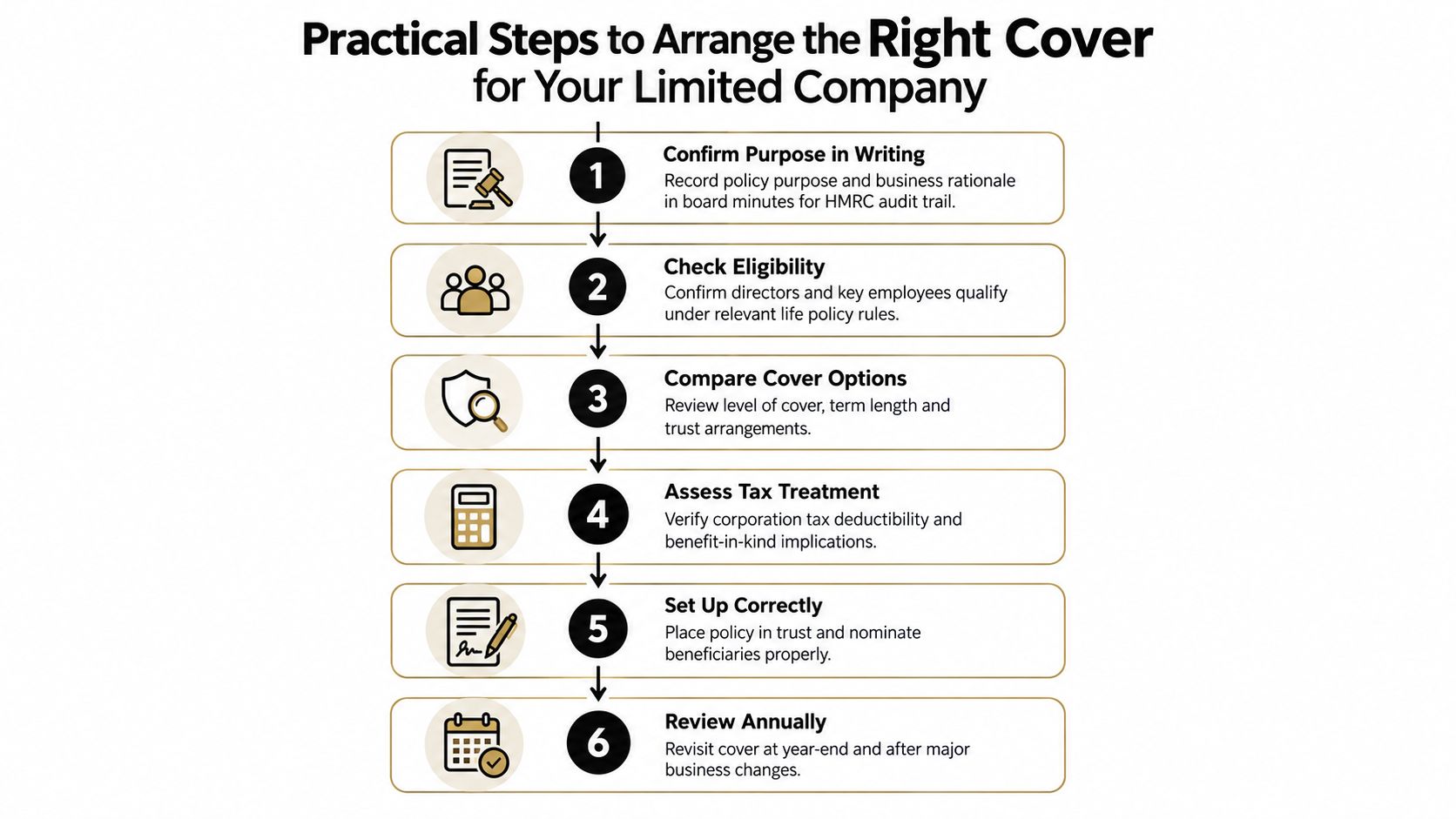
Good governance matters as much as the policy application. Set the purpose out before the company pays a premium.
1. Record the business purpose
Pass a board minute explaining why the company is arranging cover, who is insured, who should receive the money, and whether the purpose is family protection, trading-income protection, or share ownership continuity. Clear records help your accountant assess the expense and give the company an audit trail.
2. Confirm eligibility
Check the director's employment contract, payroll records, and salary arrangements. Relevant life cover requires more care than ordinary personal cover, particularly where the director is also a shareholder.
3. Compare the three products
Ask a regulated adviser to compare relevant life, key person insurance, and shareholder protection separately. Discuss the level of cover, policy term, beneficiaries, premiums, and whether the company or trustees should own the arrangement.
Don't use a generic personal life policy and assume it can be converted into a company benefit later. Choose a provider and adviser familiar with the relevant product from the beginning.
4. Set the trust and legal documents
Relevant life insurance and shareholder protection may require trust or legal documentation. A solicitor should draft or review the discretionary trust deed and any shareholder agreement, then ensure the insurer records the correct owner and beneficiaries before the policy starts.
5. Check the tax treatment
Give the full proposal to your accountant. They should assess whether premiums are wholly and exclusively for the business, whether a Benefit in Kind issue arises, and whether the policy protects revenue or capital.
6. Review after business changes
Review the arrangement after a change in salary, share ownership, business borrowing, family circumstances, or the company's trading model. Keep beneficiary letters and board records current.
A regulated adviser can also help you test the cover against the company's real exposure. Don't choose a cover level because it is the maximum available. Match it to family needs, salary, business dependency, borrowing, and the ownership agreement.
Common Mistakes and When a Personal Policy Wins
Company-paid cover isn't automatically cheaper. The tax saving only helps when the premium qualifies for relief, the company has taxable profits against which to claim it, and the policy structure sends the payout to the intended recipient.
A £600 annual premium at the 25% main corporation tax rate creates a potential £150 tax saving, leaving a company cost of £450 if the premium is fully deductible. That comparison must be made against the cost of a personal policy paid from post-tax income, not against the headline premium alone.
Common failures include:
- Wrong beneficiary: Key person cover should protect the company, not accidentally direct proceeds to a director's estate.
- Poor evidence: The company should document its commercial purpose and retain the policy paperwork.
- Non-qualifying employees: Bringing staff into an arrangement without checking the rules can create employment tax complications, including a possible P11D issue.
- Capital purpose: Shareholder protection protects shares, so don't assume its premiums receive the same deduction as profit-protection cover.
- No co-owner review: Shareholder protection can be relevant even in a small firm where ownership is shared with a spouse or partner.
| Factor | Company cover wins | Personal cover wins |
|---|---|---|
| Family protection | Eligible salaried director using a properly structured relevant life plan | Director has no salary or cannot meet relevant life conditions |
| Business continuity | The company faces a clear risk of lost trading income after losing a key person | The business has little reliance on the insured person |
| Ownership planning | Shareholders need funds to support a documented buy-and-sell arrangement | There are no co-shareholders or no realistic share transfer need |
| Tax administration | The company has profits and can evidence a deductible business purpose | The company has low profits or the expected saving doesn't justify administration |
| Personal flexibility | The director wants trustees to distribute a relevant life benefit to family beneficiaries | The director wants a policy independent of the company |
| Borrowing and protection priorities | Business risks and family needs can be separated across suitable policies | The director has a small loan balance or prioritises personal control of the policy |
A personal policy is usually the cleaner answer for dividend-only remuneration, limited business exposure, or a director who wants cover to remain independent of the company. Company cover generally makes more sense for an eligible salaried director or a clearly documented key person risk.
Umbrella Company helps contractors compare umbrella companies and find guidance relevant to limited company and umbrella arrangements, including questions around IR35 and contractor benefits. Visit Umbrella Company to compare your working options, then speak to a regulated adviser and accountant before putting life cover through your company.


