


You've probably hit the same decision point most new contractors do.
A client wants to engage you, someone mentions setting up a limited company, and suddenly you're comparing tax efficiency, IR35, payroll, Companies House filings, dividends, and accountant fees. On paper, becoming a limited company director can look like the grown-up contractor option. In practice, it gives you more control, but it also gives you more legal responsibility and more admin.
That trade-off matters more now than it used to. For some contractors, a limited company still makes commercial sense. For others, especially those working inside IR35 or taking shorter, lower-value, or part-time contracts, the extra work can wipe out the upside.
Introduction Is a Limited Company Right for You
A limited company director isn't just someone who runs invoices through a business bank account. It's a formal legal role inside a company structure governed by the Companies Act 2006. Every company must have at least one director, and for private companies that director must be a natural person. Companies House also makes clear that companies can appoint more than one director, and those appointments must be reported through statutory filings. That makes the role foundational, not optional, for anyone trading through a company.
For contractors, that's where the decision starts. A limited company can offer flexibility over how you run the business, how you document decisions, and how you take income. But it also puts compliance, governance, and record-keeping directly on your desk.
Boards in private companies are usually small. A recent governance survey found a typical board size of five to eight directors, with a median of seven, and the median increased by one director from the prior survey, according to private company board governance findings from CAP Partners. In a contractor company, the board is often just you, or you and one other person. That means the responsibility is highly concentrated.
If you're still deciding how to trade, it helps to compare the main routes side by side before you commit. Our guide to choosing the right business structure is a sensible starting point.
A limited company can be right for a contractor. It just isn't automatically right for every contractor.
The useful question isn't “Can I be a director?” It's “Does the extra control leave me better off after tax, admin time, accountancy costs, and IR35 risk?”
Your Core Role and Legal Duties as a Director
Being a director is a legal appointment, not a vanity title. If you're the sole contractor in the business, you still carry the same core duties as a director of a larger company. The law doesn't treat a one-person company as casual just because the structure is small.
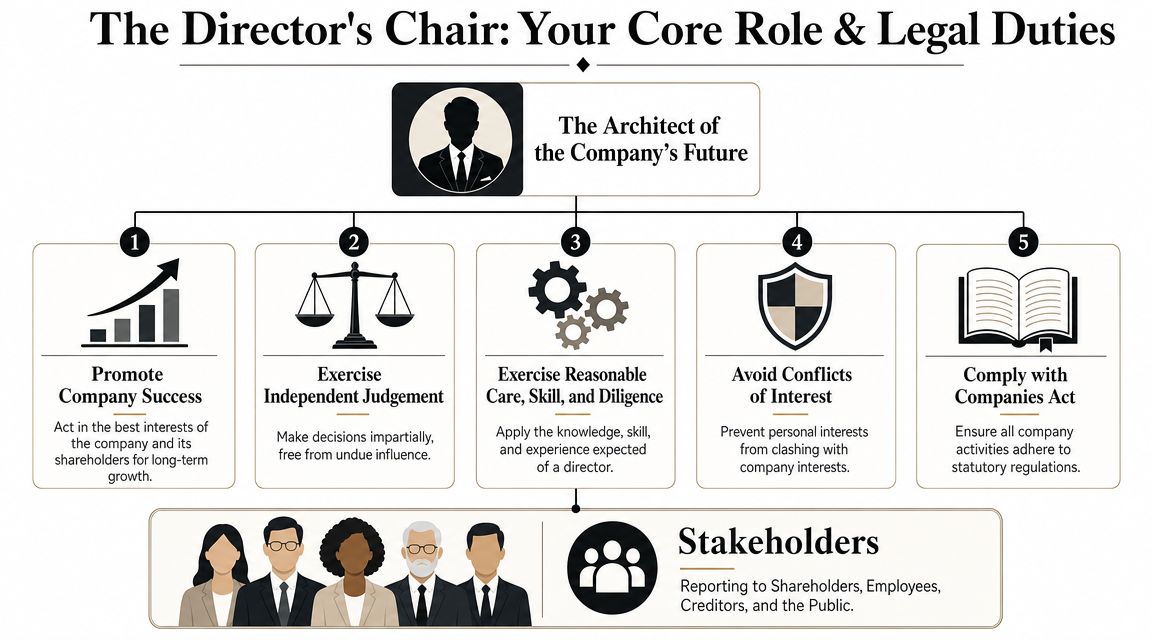
The director role is closer to a legal guardian
A practical way to think about the job is this. You are the company's legal guardian.
You make decisions on its behalf, but you also have to make sure those decisions sit within the company's powers and serve the company properly. Under the Companies Act 2006, a limited company director has seven codified duties, including acting within powers, promoting the success of the company, exercising independent judgment, and using reasonable care, skill and diligence. Breaches can lead to personal liability, even for single-director companies, as outlined in this guide to the role of a limited company director.
What those duties mean in real contractor life
The legal wording sounds formal, but the day-to-day meaning is straightforward.
- Act within your powers means you follow the company's rules and don't treat the company as your personal wallet.
- Promote the success of the company means decisions should support the company's interests, not just your immediate convenience.
- Exercise independent judgment means you don't blindly do what an agency, client, spouse, or adviser suggests if it isn't right for the company.
- Use reasonable care, skill and diligence means you're expected to understand the basics of what you're running.
- Avoid conflicts of interest means personal interests shouldn't cut across company interests.
- Don't accept benefits from third parties means gifts or incentives that influence decision-making can become a problem.
- Declare interests in transactions means if there's a personal interest in a company arrangement, it should be recorded properly.
Practical rule: If you wouldn't be comfortable explaining a decision to HMRC, Companies House, your accountant, and your future self in writing, stop and document it properly before acting.
Where contractors often get this wrong
The most common mistake is assuming a small company means light-touch governance. It doesn't.
Directors often slip when they:
- Mix personal and company spending without clear records
- Take money informally and try to sort the paperwork later
- Ignore company documents because they're the only shareholder and director
- Treat filing duties as an accountant's problem rather than their own legal responsibility
That last point matters. An accountant helps, but the legal duty remains with the director. If something isn't filed, filed late, or filed inaccurately, you can't outsource the responsibility away.
Managing Your Finances Salary Dividends and Tax
Most contractors start with one simple question. How do I pay myself?
The cleanest way to understand it is to separate your money into two buckets. There's the company pot, which is money earned by the business, and your personal pot, which is money you've legally taken out for yourself. Trouble starts when directors blur the line between the two.
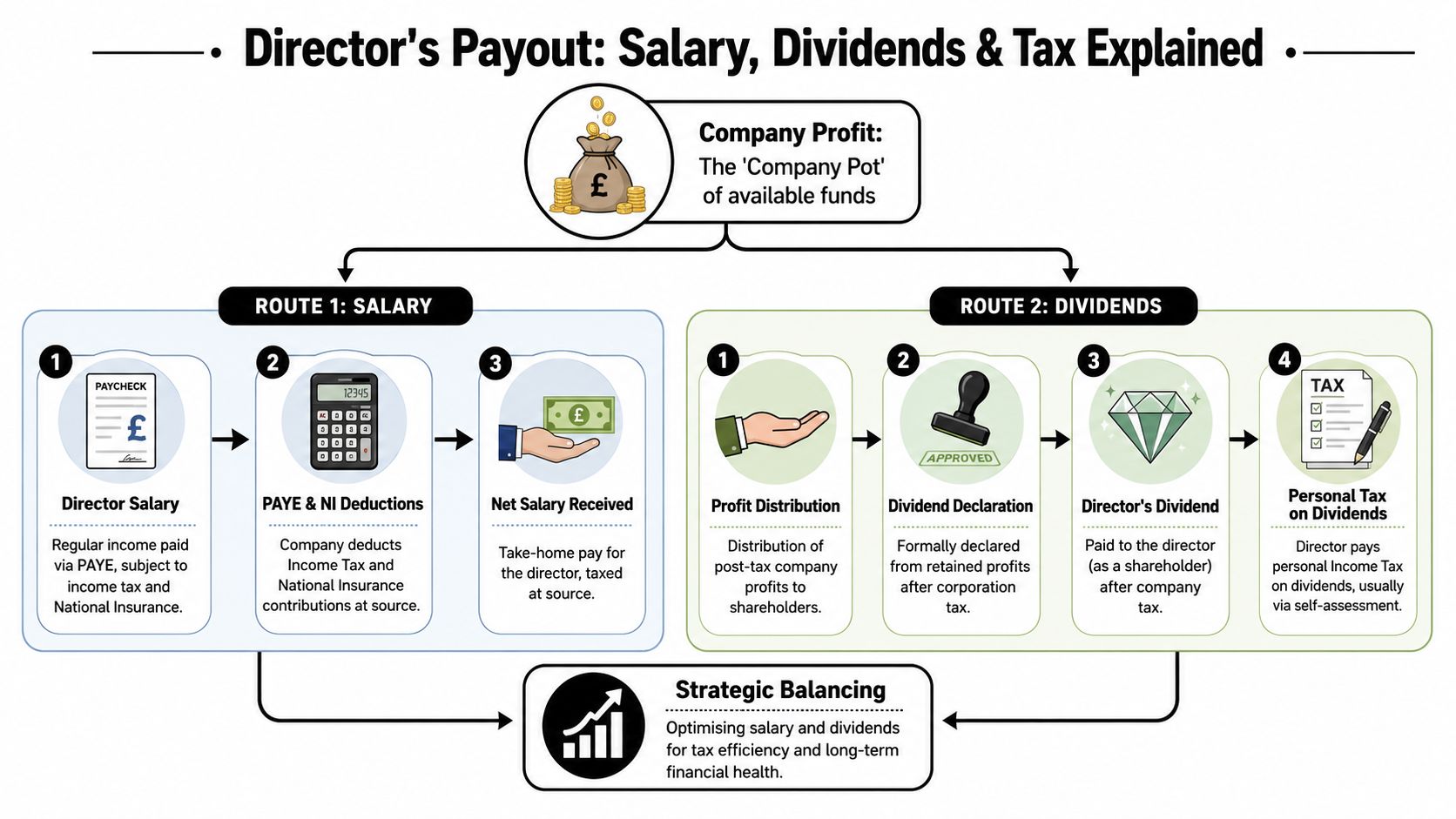
Salary and dividends do different jobs
A salary is paid through PAYE. That means the company runs payroll, records deductions, and pays you as an employee or office holder of the business.
A dividend is different. It's a distribution of post-tax profit to shareholders. You can't just label any withdrawal a dividend because it sounds tax-efficient. The company has to have distributable profit, and the payment needs to be declared and documented correctly.
For contractors who want a fuller explanation of the trade-off, our guide to salary versus dividends breaks down the practical differences.
A short visual explainer helps here:
The money flow that matters
In practice, the sequence usually looks like this:
- The company gets paid by the client or agency.
- Business costs are paid from the company account.
- The company accounts for tax obligations based on how it operates.
- You extract income through salary, dividends, or a mixture, with the right records in place.
This sounds tidy, but directors often run into problems when they take cash first and ask bookkeeping questions later. That approach usually creates confusion around director's loans, unsupported dividends, or missed payroll reporting.
Keep your company bank account and personal account separate from day one. It makes bookkeeping cleaner, tax treatment easier to defend, and year-end work far less painful.
What works and what doesn't
What works:
- Regular payroll processing if you're taking salary
- Proper dividend paperwork if you're taking dividends
- Monthly bookkeeping rather than a year-end scramble
- A clear view of profit before withdrawals
What doesn't:
- Guessing what you can withdraw
- Calling all drawings dividends
- Leaving receipts, invoices, and bank coding until year-end
- Assuming tax efficiency always beats admin cost
This is the point many contractors miss. A limited company can be efficient, but only when the company has enough genuine commercial value to justify the extra compliance. If your contract profile is inconsistent, inside IR35, or relatively modest, the admin drag can cancel the benefit quickly.
Understanding Your IR35 Obligations as a Director
IR35 is where many contractor company structures become awkward.
If you're trading through a limited company, you can't treat IR35 as a side issue. It affects whether the engagement is really a business-to-business arrangement or whether, for tax purposes, it resembles employment. That distinction changes the value of the company structure dramatically.
Inside and outside IR35 in practical terms
If a contract sits outside IR35, the limited company structure may still be commercially workable because the engagement supports a genuine independent business model.
If a contract sits inside IR35, much of the tax advantage people associate with a limited company tends to narrow. You still keep the company admin, but the income is treated more like employment income for tax purposes. That's why many contractors on inside-IR35 assignments move to umbrella arrangements instead of carrying company compliance for little practical gain.
Our guide to IR35 for contractors gives a broader view of how the rules affect different working setups.
Why record-keeping matters more than people think
A director must maintain statutory records, including registers of directors and accounting records. Good record-keeping is essential because it creates auditable evidence of control and decision-making, which can reduce the risk of incorrect tax treatment or compliance failures during an HMRC review, especially concerning IR35 status, according to GOV.UK guidance on running a limited company.
For IR35, that matters because status disputes often come down to evidence, not intention.
Useful evidence includes:
- Contracts and contract variations
- Invoices and project scopes
- Records of substituted work or delegated tasks, where relevant
- Emails showing independence in delivery
- Board minutes or company notes on decisions
- Accounting records that support how income was treated
If you want to defend an outside-IR35 position, you need more than a contract with the right wording. You need records that show how the engagement worked in real life.
When an umbrella becomes the practical answer
For contractors who are consistently inside IR35, the limited company often becomes a compliance-heavy wrapper around income that's already being taxed in an employment-style way.
That's usually the tipping point. If the role is inside IR35 and likely to stay there, the umbrella model often wins on simplicity, cleaner payroll handling, and reduced administrative exposure.
Limited Company vs Umbrella Company A Head-to-Head Comparison
A contractor finishes the month with a decent headline rate, then loses time to bookkeeping, payroll questions, dividend planning, and director admin. That is usually the point where the decision becomes commercial, not ideological. After recent tax changes, a limited company only pays if the contract profile still supports the extra work and cost.
A limited company gives you control over billing, timing, and how the company is run. An umbrella gives you PAYE simplicity and pushes most of the admin off your desk. The better option depends on where your contracts sit on IR35, how steady your income is, and whether the extra margin from a company still outweighs accountant fees, software costs, and your own time.
The commercial trade-off contractors actually face
Many contractors still ask whether going limited is worth it. The answer is yes for some, no for others, and the break point is usually clearer than people expect.
If you are regularly outside IR35, earning enough to make tax planning worthwhile, and prepared to run the company properly, a limited company can still make commercial sense. If you are mainly inside IR35, working part-time, between contracts often, or operating at rates where every overhead matters, the company can become an expensive wrapper around income already taxed much like employment income.
That is why blanket advice fails. The right structure is the one that leaves you with more net value after costs, admin, and risk are taken into account.
Limited Company vs. Umbrella Company at a Glance
| Factor | Limited Company Director | Umbrella Company Employee |
|---|---|---|
| Control | You control the company, invoicing, and how money is managed | The umbrella handles payroll and employment administration |
| Admin load | Higher. You deal with filings, bookkeeping, accounts, tax admin, and director duties | Lower. Most routine admin sits with the umbrella |
| IR35 suitability | Usually better where contracts are genuinely outside IR35 | Usually more practical for inside-IR35 work |
| Personal liability | You carry director responsibilities and the consequences of getting them wrong | Lower governance burden for the contractor |
| Payment structure | Usually a mix of salary, dividends, and retained company funds | PAYE salary through the umbrella |
| Best fit | Contractors with the right income level, contract profile, and tolerance for admin | Contractors who want simpler pay, fewer moving parts, and less compliance involvement |
For a fuller side-by-side breakdown, compare umbrella and limited company options for contractors.
When limited usually works better
A limited company tends to work better for contractors who:
- Spend a meaningful amount of time on outside-IR35 contracts
- Have stable income rather than stop-start earnings
- Want control over invoicing, timing, and company cash
- Are willing to keep proper records and follow company formalities
- Can justify the ongoing cost of accountant support and software
This is not just about tax. It is also about having enough margin to make the admin worth it.
When umbrella usually works better
An umbrella often becomes the more sensible option if you:
- Work mainly or entirely inside IR35
- Want straightforward PAYE pay without running a company
- Do not want to deal with payroll, accounts, filings, and director paperwork
- Move between short contracts or have gaps between assignments
- Value simplicity more than control
That is the tipping point many contractors miss. Once most of your income is taxed in an employment-style way, the limited company often stops being the efficient choice and starts becoming an extra layer of admin.
Some contractors switch between models as their contract mix changes. That can work well, provided the decision is driven by current assignments and current tax treatment, not by habit or old contractor rules that no longer fit the market.
The best setup is the one that leaves you with the strongest net return for the least avoidable admin and risk. Sometimes that is a limited company. For many inside-IR35 contractors, it is an umbrella.
Your Practical Checklist for the First Year as a Director
The first year catches people out because the work arrives before the admin routine does. Directors tend to focus on the contract, then discover later that deadlines were running from incorporation, not from when the company felt “active”.
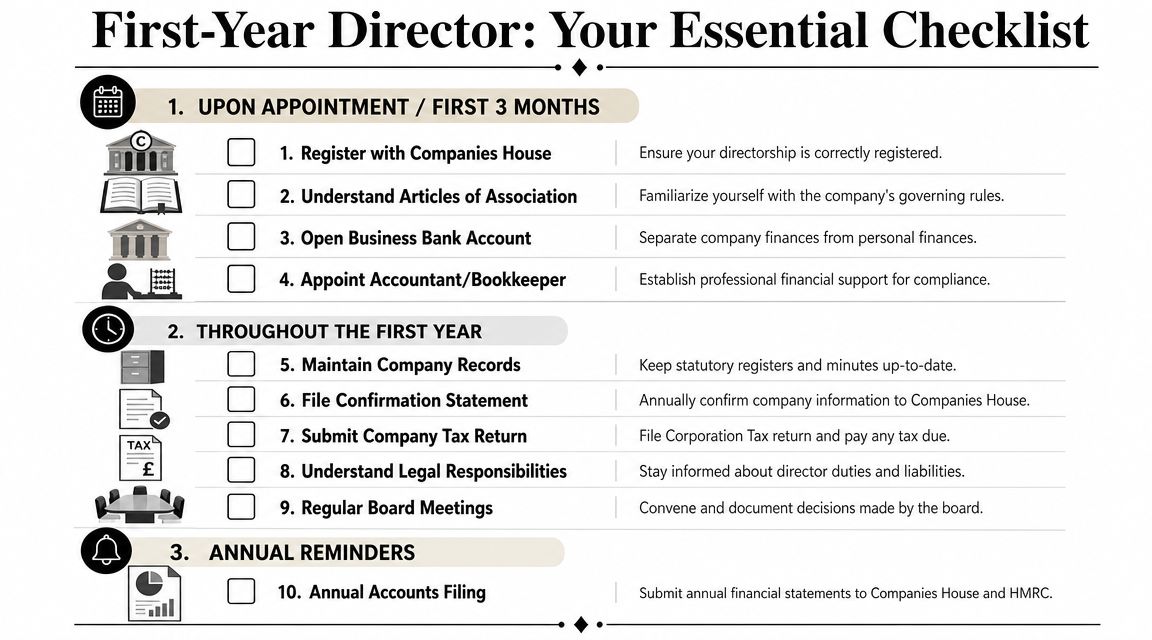
Month one and the early setup stage
Get the basics right immediately.
- Confirm the directorship properly so the company records and Companies House filings reflect who is appointed.
- Open a business bank account and keep it separate from personal spending.
- Read the company documents so you know how the company is supposed to operate.
- Decide how you'll keep records. Accounting software and a regular bookkeeping routine help more than a box of receipts.
- Speak to an accountant early if you're unsure how to handle payroll, dividends, or tax registration.
The first trading months
Compliance gains practical importance. New directors face significant compliance risk in the first year. They must manage confirmation statements, annual accounts, Corporation Tax registration, and PAYE filings. Missing these deadlines can lead to penalties and increased scrutiny from Companies House and HMRC.
A useful operating checklist is:
- Register for Corporation Tax once the company starts trading
- Set up PAYE if the company will pay you a salary
- Keep invoices and costs organised as you go
- Record decisions properly when taking dividends or making formal company choices
- Track filing dates in a calendar, accounting system, or task manager
Missed deadlines rarely happen because the rules are impossible. They happen because directors think they'll “sort it next week” and then client work takes over.
Before year-end and after
The year-end is easier when you've done the work monthly.
Make sure you've got:
- Up-to-date bookkeeping
- Bank accounts reconciled
- Payroll records complete
- Dividend paperwork in order
- Statutory registers maintained
- Accounts and tax information ready for filing
If you're the only employee and director, the routine is simpler than in a larger business, but the obligation doesn't go away. If you later hire staff, add VAT registration, or take on more than one contract arrangement, the compliance burden rises fast.
Conclusion Making the Right Choice for Your Career
A limited company director has direct control over how the business is run and how money is taken out. For some contractors, that still makes commercial sense. For others, recent tax changes and tighter IR35 rules have narrowed the benefit enough that the extra administration is hard to justify.
The decision usually comes down to a tipping point. If you are working outside IR35, earning enough to make tax planning worthwhile, and willing to keep on top of company admin, a limited company can still be a good structure. If most of your work sits inside IR35, or you want to spend your time on contracts rather than filings, payroll and record-keeping, an umbrella setup is often the cleaner option.
Many contractors only see that after they have incorporated and discovered that control also means personal responsibility for getting things right.
Choose the setup that leaves you better off after tax, fees, and admin time. A limited company suits contractors who can use that structure properly. An umbrella suits contractors who value simplicity, predictable pay, and less compliance risk landing on their desk.
If you're deciding between a limited company and an umbrella setup, Umbrella Company can help you compare the practical trade-offs based on your contract profile, IR35 position, and tolerance for admin.


