


Trying to get a handle on limited company accountant fees can feel like a bit of a minefield, but it does not have to be. For most UK contractors, a typical monthly package will set you back somewhere between £80 and £150. This is not just a cost; it is an investment in keeping your business compliant, tax-efficient, and running smoothly.
Understanding Your Accountant Fees as a Contractor
This guide is here to cut through the jargon and give you a clear picture of what to expect. We will break down what you should be paying, what services that fee actually covers, and how to spot a good deal from a bad one. After all, when you are running a Personal Service Company (PSC), every penny counts.
Think of your accountant as more than just a number-cruncher. They are a strategic partner who keeps you on the right side of HMRC and Companies House, a massive weight off your shoulders when you are the one in charge.
Why Clear Fees Matter
Knowing exactly what you are paying for from day one is crucial. A transparent, fixed-fee structure means no nasty surprises down the line, so you can budget properly and feel confident picking up the phone for advice without the meter running. Your accountant should be there to support you, not to send you unexpected bills.
This clarity empowers you to find a financial partner who is genuinely invested in your success. As we cover in our guide to accounting for contractors, having the right person in your corner makes all the difference.
Over the next few sections, we will explore:
- The typical price bands for contractor accountants.
- The core services that should always be part of your package.
- The key factors that can push the final cost up or down.
Our goal is simple: to give you the knowledge you need to choose an accountant who will genuinely champion your contracting career, leaving you in complete control of your company's finances.
What Services Are Included in Your Accountant's Fees

So, what are you actually paying for when you hire an accountant? It is a fair question. A quality firm does far more than just file your accounts once a year. Their fee should cover a whole suite of services designed to keep your limited company compliant, tax-efficient, and financially healthy.
Think of them as a financial co-pilot for your business. Their job is to navigate the complex admin and tax rules, freeing you up to focus on what you do best: delivering great work for your clients. Understanding what is included is the key to comparing quotes and making sure you are getting real value for your money.
Core Compliance and Reporting
First and foremost, your accountant's fee covers the absolute non-negotiables, the legal and financial duties of running a limited company. These are the essential tasks that keep you on the right side of both HMRC and Companies House, steering you clear of penalties and investigations.
A standard package for any contractor should always include:
- Annual Accounts: Preparing and filing your company's statutory accounts with Companies House.
- Corporation Tax Return (CT600): Calculating and submitting your company's Corporation Tax return to HMRC.
- Confirmation Statement: Filing the annual statement that confirms your company's details are correct on the public record.
- Director's Self-Assessment Tax Return: Managing and filing your personal tax return to report your salary and dividends.
These four pillars are the bedrock of your company's compliance. Get them wrong, and you risk significant fines and a whole lot of stress.
Your accountant’s role is to provide peace of mind. By managing these critical deadlines and submissions, they protect your business from costly errors and allow you to concentrate on your contract work.
Essential Business Operations
Beyond the big annual filings, a good accountant will handle the regular financial tasks that keep your business ticking over smoothly. For most contractors, this day-to-day support is just as important as the year-end compliance. It ensures your cash flow is managed correctly and your tax liabilities are planned for, not just reacted to.
Monthly or quarterly services you should expect to see are:
- VAT Returns: If you are VAT registered, they will prepare and submit your quarterly returns, ensuring you comply with Making Tax Digital (MTD) rules.
- Payroll (PAYE): Running payroll for you as the director, processing your salary, and making sure the correct tax and National Insurance are paid.
- Bookkeeping Support: This usually involves providing guidance and support with cloud accounting software like Xero or FreeAgent.
Strategic Advice and Support
Here is where a specialist contractor accountant really earns their fee. The real value lies in their proactive advice. They should offer much more than just box-ticking compliance; they should be a source of strategic guidance to help you run your business in the most tax-efficient way possible. This is what separates a basic service from a premium one.
Look for a package that includes unlimited expert advice on key contractor issues. This could be guidance on the best timing for dividends, what expenses you can legitimately claim, and crucial IR35 status assessments. Having an expert you can call without watching the clock is invaluable.
With average annual accountant costs for small limited companies ranging from £720 to £5,000, monthly packages of £60–£450 make this level of support much more manageable for contractors. For further details on what these costs cover, explore these insights on UK accountant fees.
What Drives Your Accountant's Fees?
Ever wondered why quotes from different accountants can be worlds apart? It is simple, really: no two businesses are the same, and neither is the work required to keep their books in order. Getting to grips with the factors that shape the final price tag will help you weigh up quotes and find a fee that actually matches what you need.
Think of it as a bespoke suit versus one off the rack. The more complex your financial situation, the more time and skill your accountant needs to put in, and that is reflected in the cost.
Your Business Turnover and Transaction Volume
One of the biggest drivers is your business turnover. A contractor bringing in £50,000 a year has a much simpler financial picture than a consultant turning over £250,000. Higher turnover usually means more invoices to chase, more complex contracts to navigate, and, frankly, a bit more attention from HMRC.
The sheer volume of transactions also plays a massive part. An accountant’s time is directly tied to the number of sales invoices, expense claims, and bank payments they have to process or check each month. A freelancer with just 10 transactions a month is going to pay less than a busy consultant with 100. It is a straightforward case of time and effort.
VAT Registration and Payroll Complexity
Deciding to become VAT registered instantly adds another job to your accountant’s to-do list. They will need to prepare and file your quarterly VAT returns, which means keeping meticulous records to stay on the right side of Making Tax Digital rules. This service is a common reason for a bump in your monthly fee.
Running a payroll also changes the game. While paying yourself as a sole director is usually straightforward, the cost can creep up if you start adding employees or have a more complicated salary structure. We get into the details of these costs in our guide on what employer National Insurance contributions are.
The Level of Support and Expertise Required
The final piece of the puzzle is what you actually expect from your accountant. Are you just after the basics to keep HMRC happy, or do you want a proper partner who can offer strategic advice on tax planning?
- Compliance-Only Package: This is your bread-and-butter service. It covers the essentials like year-end accounts and tax returns and is the most affordable option.
- Full Advisory Service: This is the premium choice. It often includes regular financial check-ins, IR35 contract reviews, and ongoing advice to make sure you are running as tax-efficiently as possible.
A specialist contractor accountant might have a higher price tag than a generalist high street firm, but their in-depth knowledge of things like IR35 and contractor-specific tax rules could save you a small fortune in the long run.
Recent industry figures show just how much size and specialism matter. In 2023, the median fees per fee earner in UK accountancy firms hit £95,000, an 8% jump from the year before. The bigger firms averaged £108,000 per earner, often because they are handling the trickier, higher-value work like complex IR35 compliance for contractors. You can dig into more of these trends in these UK accounting statistics.
Comparing Accountant Types and Pricing Models
Picking the right accountant is not just about crunching numbers; it is about finding a partner who gets how you work. For contractors, the choice usually boils down to two main camps: the traditional high-street firm or a modern online accountant. Each has its own rhythm, and understanding the difference is the first step to making a smart decision.
Your local high-street accountant offers that personal, face-to-face connection. There is a certain comfort in being able to pop in for a chat, which some contractors really value. The flip side is that this traditional model often comes with higher overheads, and those costs can find their way into your fees.
On the other hand, online accountants are built for efficiency. By using smart, cloud-based software and slick digital processes, they can offer seriously competitive pricing while still providing the specialist advice contractors need.
Finding the Right Pricing Structure
Once you have thought about the type of firm, you need to look at how they charge. The way an accountant bills you can make a huge difference to your cash flow and whether you feel you can pick up the phone for advice. Predictability is everything for a contractor, so some pricing models are a much better fit than others.
You will generally come across three common ways accountants charge:
- Fixed Monthly Fees: This is, by far, the most popular option for contractors. You pay a set amount each month for a clearly defined package of services. It means no nasty surprise bills, and you can call your accountant for advice without the clock ticking.
- Annual Packages: Some accountants prefer to charge a single fee for the whole year. This can make budgeting simple, but it can also be a hefty chunk of cash to part with in one go, especially if you are just starting out.
- Hourly Rates: The classic "pay-as-you-go" method. While it might sound flexible, it is usually the least cost-effective route for contractors. Costs can quickly add up, and worse, it might stop you from seeking proactive advice when you really need it.
This diagram breaks down the key things that will influence the final price tag, no matter which model you choose.
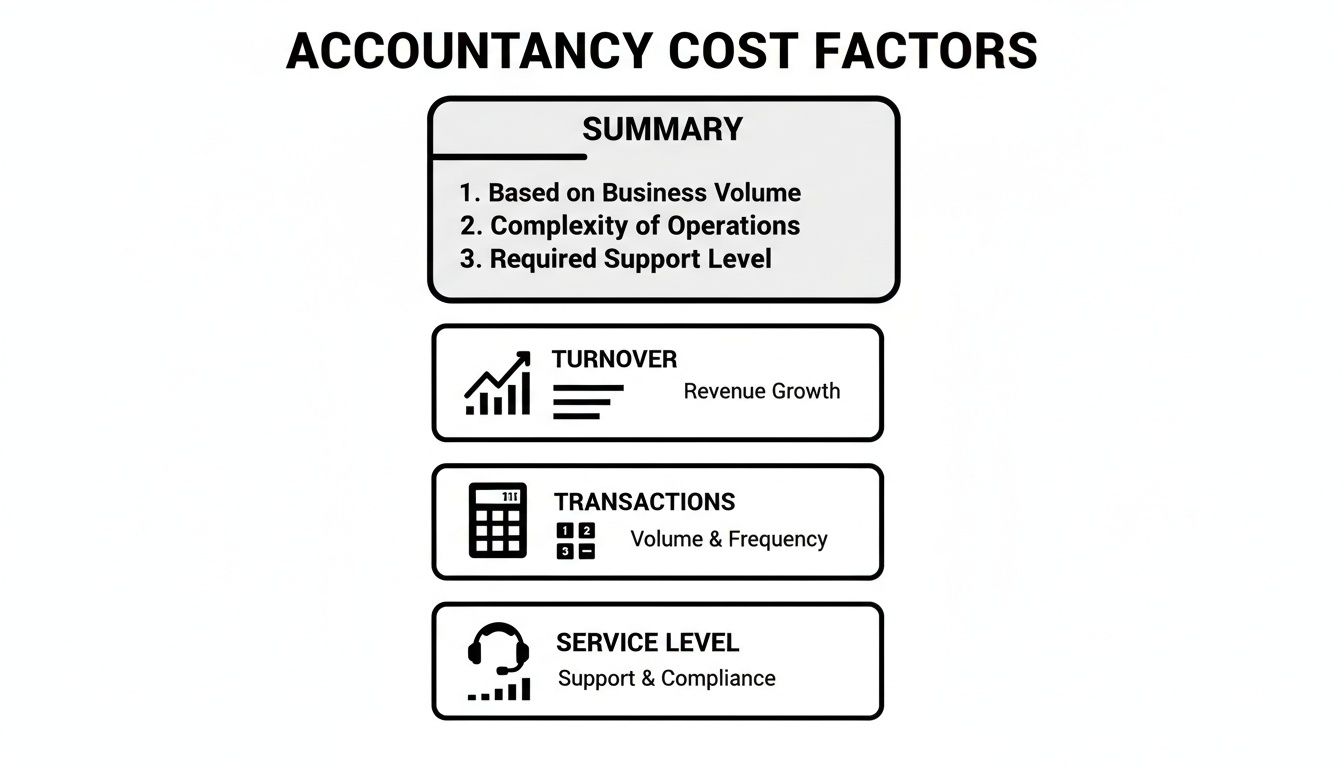
As you can see, it is your turnover, the number of transactions you process, and the level of support you need that really drive the cost.
Accountant Type Comparison for Contractors
So, how do you weigh up the pros and cons of a traditional firm versus an online specialist? This table breaks down the key differences to help you decide which is the best fit for your contracting business.
| Feature | Traditional High-Street Accountant | Online Accountant |
|---|---|---|
| Communication | Primarily face-to-face meetings, phone calls, and email. | Primarily email, video calls, and dedicated client portals. |
| Technology | May use a mix of desktop and cloud software. Processes can be more manual. | Built around cloud accounting software like FreeAgent or Xero. |
| Cost | Generally higher fees due to overheads like rent and local staffing. | More competitive, often fixed-fee pricing due to lower overheads and tech efficiency. |
| Accessibility | Limited to standard office hours (e.g., 9-to-5, Mon-Fri). | Often more flexible, with online portals accessible 24/7 and extended support hours. |
| Specialism | May be generalists serving a wide range of local businesses. | Often specialists who focus specifically on contractors and freelancers. |
| Best For… | Contractors who value in-person relationships and prefer a traditional approach. | Tech-savvy contractors looking for efficiency, value, and specialist expertise. |
Ultimately, the best choice depends on your personal preference. If you value efficiency and digital tools, an online accountant is likely the clear winner. If you prefer building a local, in-person relationship, a high-street firm might feel more comfortable.
The Shift Towards Online Efficiency
The accounting world has been turned on its head in the last decade. Back in 2015, most limited company contractors were paying between £500 and £1,200 a year for a traditional service. Then cloud software came along and completely changed the game, making everything more efficient and bringing prices down. You can read more about how accountant fees have evolved in the UK here.
For most contractors, a fixed-fee monthly package with a specialist online accountant offers the best of both worlds: expert advice, predictable costs, and the digital tools needed to run your business efficiently. It fosters a true partnership where your accountant is incentivised to support your growth, not just bill for their time. This model aligns perfectly with the dynamic nature of contracting.
How to Choose the Right Accountant for Your Company
Choosing an accountant is one of the most critical decisions you will make for your limited company. This is not just about handing over a shoebox of receipts once a year. It is about finding a long-term partner, a financial expert who genuinely understands the world of contracting and can help you navigate it successfully.
A great accountant saves you more than just tax. They save you time, stress, and the headache of costly mistakes. Think of them as your financial co-pilot, guiding you through the turbulence of complex regulations and helping you make smarter business decisions. Taking the time to properly vet candidates will pay for itself many times over, keeping your company compliant and financially healthy for years to come.
Check Their Credentials and Specialisms
First things first, verify any potential accountant’s qualifications. You want to see memberships from recognised UK accounting bodies, which are a clear mark of quality and a commitment to high professional standards.
Key accreditations to look for include:
- ACCA (Association of Chartered Certified Accountants)
- ICAEW (Institute of Chartered Accountants in England and Wales)
- CIMA (Chartered Institute of Management Accountants)
Just as important is their experience. A general high-street accountant might be great for a local cafe, but they often do not grasp the specific challenges contractors face. You need a specialist contractor accountant, someone who lives and breathes issues like IR35 legislation, optimal dividend planning, and the nuances of allowable business expenses for PSCs.
Vet Their Reputation and Ask the Right Questions
Online reviews and testimonials are a brilliant starting point. Look for feedback from other limited company contractors to see if their experience lines up with what you need. Do not be shy about asking a potential firm for references from current clients in your field.
Once you have a shortlist, it is interview time. This is your chance to really dig in and see if they are the right fit. Go in prepared with a checklist of questions so you can compare their answers and approach fairly. This whole process is about setting clear expectations from the get-go to avoid any nasty surprises down the line.
Your relationship with your accountant has to be built on trust and clear communication. Asking direct questions about their fees, the software they use, and their IR35 experience is not being difficult, it is essential for finding a partner who will genuinely champion your business goals.
Your Essential Accountant Vetting Checklist
To make sure you cover all the important bases, here are some critical questions to ask every single candidate:
- Experience: How many contractor clients do you currently have on your books? Can you share some examples of how you have helped them?
- IR35: What is your experience with IR35? Do you offer contract reviews and support with status determinations?
- Fees: Could you give me a complete breakdown of your fees? Are there any hidden charges for things like Self-Assessment returns or IR35 advice?
- Services: What, precisely, is included in your standard monthly package?
- Software: What accounting software do you use (e.g., FreeAgent, Xero)? Is the software licence included in my fee?
- Communication: Who will be my dedicated point of contact? And what is your typical response time when I have a query?
Finding the right professional takes a bit of effort, but it is one of the best investments you can make in your business.
Comparing Limited Company Costs and Umbrella Simplicity
For a lot of contractors, the first big decision is not about choosing an accountant, it is choosing how to operate in the first place. You are typically weighing up two main paths: running your own limited company or using an umbrella service. The choice really boils down to how much control you want versus how much admin you are prepared to handle.
Going down the limited company route gives you significant control and, often, more opportunities for tax planning. You are the director, you call the shots. But that freedom comes with a hefty dose of responsibility, from statutory filings to managing accounts and staying compliant. This is where your limited company accountant fees come into play.
On the flip side, working through an umbrella company is a far simpler, more hands-off experience. Here at UmbrellaCompany.com, we effectively handle all the complex financial admin for you.
Limited Company Realities
When you operate a limited company, you are legally on the hook for its financial and administrative affairs. We are talking about everything from filing your annual accounts and confirmation statements to managing VAT and payroll. While a good accountant does the heavy lifting, the buck always stops with you as the director.
These duties demand a real investment of both your time and money. It is a structure that works brilliantly for contractors who are comfortable with the business side of things and whose earnings justify the extra costs.
The Umbrella Alternative
By contrast, an umbrella company acts as your employer for the duration of your contract. We manage all the tax and National Insurance contributions through PAYE, taking care of every deduction before the money hits your account. You just submit your timesheets, and we handle the rest for a straightforward, transparent margin.
This approach completely removes the need to hire your own accountant and takes away the administrative headaches that come with running a company. For a really detailed breakdown, have a look at our guide on the differences between an umbrella company vs a limited company.
An umbrella solution provides genuine peace of mind, especially for contractors worried about IR35 legislation. By becoming our employee, your tax status is crystal clear, removing the compliance risks that can come with operating a Personal Service Company (PSC).
Ultimately, the right choice really depends on what you prioritise. A limited company can offer greater tax efficiency and control, but an umbrella company delivers simplicity and security, letting you focus purely on your work.
A Few Final Questions Answered
Let's quickly tackle some of the most common questions that pop up when contractors are weighing up their accountant options. Getting these straight is often the final piece of the puzzle.
Can I claim my accountant fees as a business expense?
Yes, you absolutely can. The fees you pay your accountant are a legitimate business running cost.
This means the full amount can be deducted from your company's profits before you work out your Corporation Tax bill, which directly reduces how much tax you owe. It is a standard, and very sensible, business expense.
How much should a contractor accountant cost per month?
For a specialist contractor accountant in the UK, you should expect to pay somewhere between £80 and £150 per month.
Where you fall in that range really depends on a few things, like your annual turnover, how many transactions you make, and whether you need extras like payroll or VAT returns. Always ask for a detailed quote that breaks down exactly what is included so there are no surprises.
This price reflects the specialist expertise needed to navigate contractor-specific challenges like IR35 compliance and dividend planning, skills a general high-street accountant might not have.
I use accounting software, so do I still need an accountant?
This is a great question. While software like Xero or QuickBooks is fantastic for keeping your day-to-day books in order, it cannot replace the strategic thinking of a qualified accountant.
An accountant does more than just tally numbers. They provide tax planning advice, make sure you are compliant with ever-changing rules (especially IR35), and help you make bigger financial decisions for your business's health.
Think of it like this:
- Software is the tool, it organises all your financial data beautifully.
- An accountant is the expert pilot, they interpret that data, spot opportunities, and steer you clear of trouble.
Using both gives you the best of both worlds. You get the efficiency of modern software combined with the priceless peace of mind that comes from having a human expert in your corner.
At UmbrellaCompany.com, we make it simple to compare trusted, accredited umbrella companies, giving you a straightforward alternative to managing your own limited company. Find the right fit for your contracting career in minutes.


