


If you're a contractor, you've probably had this thought at some point. The work is going well, invoices are being paid, and then a quieter question appears in the background. If something happened to you, what would happen to the people who rely on your income?
That question lands differently when you're self-employed, inside IR35, moving between agencies, or working through an umbrella company. Permanent staff often expect workplace benefits to cushion the blow. Contractors usually can't make that assumption.
Life insurance for contractors isn't just about picking a policy. It's about building protection that keeps working when your contracts, income pattern, and working arrangements change.
Securing Your Future as a Contractor
A lot of contractors are in a strong earning phase, but they're also carrying more personal responsibility than they did in permanent employment. Mortgage payments still leave the account. Childcare still needs covering. Household bills don't pause because an assignment ends, and they certainly don't disappear if the main earner dies.
That's why personal protection matters so much in contracting. You may have freedom over who you work with and how you structure your career, but you also need to replace the safety net that many employees receive through work.

Why contractors often need to arrange cover themselves
The gap is real. The Office for National Statistics reported that in 2025 only 42% of private industry workers in establishments with fewer than 100 workers had access to a life insurance plan, according to this employment benefits release. For contractors working through smaller structures, that means life cover often isn't built into the job at all.
If you work through different umbrellas, take direct assignments, or have gaps between projects, it makes even less sense to rely on benefits that may change with each engagement. A personal policy stays with you.
Practical rule: If your income supports other people, life cover should be treated as part of your financial infrastructure, not an optional extra.
Protection that follows you between contracts
Contractors often spend plenty of time thinking about indemnity cover, liability, or protecting your independent contractor business. Personal life cover deserves the same attention.
A good policy doesn't belong to your agency, client, or umbrella company. It belongs to you. That's what makes it useful when your working setup changes.
The most important shift is mental. Instead of asking, “Do I get life insurance through work?” ask, “What would my family need if my work stopped permanently?” That question leads to better decisions.
Understanding Your Core Life Insurance Options
There isn't one single “best” policy for every contractor. The right choice depends on the problem you're trying to solve.
Some people want cover that lasts for the years their children are financially dependent. Others want a policy designed to clear a mortgage. Some want protection if illness stops them from working long before death becomes the issue.
The wider market shows this isn't a niche concern. The Association of British Insurers reported that in 2024 the UK life insurance and annuity market paid out nearly £200 billion in benefits in 2021, showing how mainstream these products are for family protection, according to this industry fact book reference.
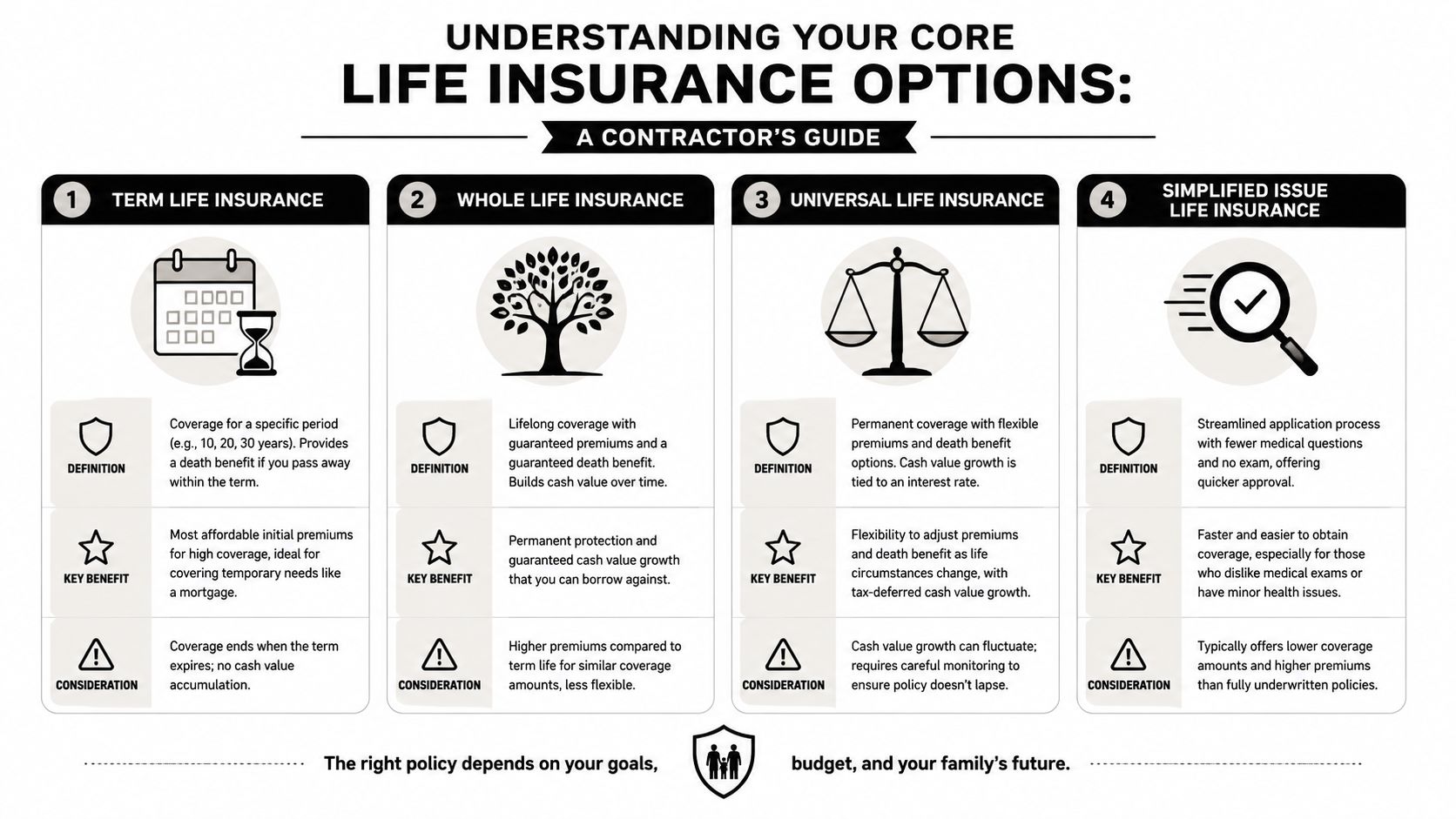
Four policy types contractors usually compare
Term life insurance is usually the easiest starting point. It functions as protection rented for a set period. You choose a term, such as the years until the mortgage is paid or the children are grown. If you die during that term, the policy pays out.
Whole of life insurance is permanent cover. It's built to stay in place for life rather than for a defined window. People often consider it when they want a guaranteed payout whenever death occurs, provided the policy stays active.
Critical illness cover is different because it isn't standard life insurance. It pays if you're diagnosed with a covered serious illness that matches the policy definitions. Contractors often look at it because a serious illness can be just as financially disruptive as death, sometimes more so in the short term.
Income protection also solves a different problem. It's designed to pay a regular income if illness or injury stops you working. For contractors, that can be especially relevant because contracts can end quickly when you can't deliver the work.
Contractor Insurance Policies at a Glance
| Policy Type | What It Covers | When It Pays Out | Best For |
|---|---|---|---|
| Term life insurance | Your life for a fixed period | If you die during the term | Mortgage protection, dependent children, temporary financial responsibilities |
| Whole of life insurance | Your life on a permanent basis | When you die, whenever that happens, if the policy remains in force | Long-term family protection, estate planning intentions |
| Critical illness cover | Specified serious illnesses | If you're diagnosed with a condition covered by the policy wording | Covering a major health shock while you're still alive |
| Income protection | Your earnings if you can't work | After the policy's waiting period, if illness or injury stops you working | Replacing income during recovery and protecting monthly cash flow |
How to choose the right type
A simple way to decide is to ask which risk worries you most.
- If your family would struggle financially after your death, term life is often the clearest fit.
- If you want lifelong cover, whole of life may be worth exploring.
- If your bigger concern is surviving a serious illness but losing earning power, critical illness cover may matter more.
- If missing several months of work would put pressure on your finances, income protection can be just as important as life cover.
Many contractors don't need one product. They need a combination that protects both long-term family security and short-term income.
If you want a broader overview of the overall protection around self-employment and umbrella working, this guide to contractor insurance in the UK is a useful companion.
How Contracting Affects Your Insurance Application
The application process often feels straightforward until income comes up. That's where contractors usually hit more questions than permanent employees.
Insurers want to know whether the cover amount is sensible and affordable. If your income moves around from contract to contract, they won't just look at your best month or your highest day rate. They want a stable picture.
Why insurers focus on consistency
Insurers stress-test affordability for contractors with variable income, often using the lower end of recent earnings for underwriting. This means evidencing consistent gross taxable pay is more important than quoting a peak day rate, as outlined in this consumer explanation of life insurance underwriting.
That catches many contractors off guard. Someone might say, “I earn a strong day rate,” but the insurer is more interested in what reaches your payslip or what your accounts show over time.
If you're paid through an umbrella company, that usually means your paperwork matters more than your verbal description of your contract. Payslips, contract history, and regular taxable income all help paint a clearer picture.
What happens when you switch umbrellas or agencies
This is one of the biggest points of confusion. A personal life insurance policy is normally portable. It doesn't belong to the umbrella company. It doesn't sit with the agency. It doesn't disappear because one assignment ends and another begins.
What can change is your ability to keep paying for it comfortably during gaps in work. That's the practical risk.
Keep premiums on a personal bank account and review them before a planned contract break. That reduces the chance of a missed payment causing an avoidable lapse.
If you move from one umbrella to another, your insurer usually doesn't need to replace the policy just because your payroll provider changed. But if your income pattern changes sharply, or if you want to increase cover, a fresh underwriting assessment may apply.
IR35 and fluctuating pay
Inside IR35 work can create a mismatch between headline contract value and personal take-home pay. Outside IR35 work can create a different mismatch between company revenue and your own drawings.
That's one reason contractors benefit from understanding how employment and self-employment paperwork shape affordability decisions. While the tax system discussed in US-focused material is different, the broader lesson in understanding 1099 vs W4 taxes is still useful. The way income is classified and evidenced affects how financial institutions assess you.
For contractors dealing with off-payroll rules, this overview of IR35 insurance and related considerations helps frame the wider risk picture.
Key Factors That Determine Your Policy Cost
Price matters, especially when your monthly income isn't identical all year round. Contractors usually want cover that's strong enough to protect the household, but stable enough to budget for during slower periods.

The contractor workforce is also highly fluid. The Office for National Statistics reported 4.2 million self-employed people in Q1 2025, a reminder that many workers move between different forms of self-employment and contract arrangements, as noted in this contractor life insurance discussion. That fluidity is one reason personal, portable cover matters.
The main pricing drivers
Some cost factors are personal. Some are policy choices.
- Your age: Insurers generally see lower age as lower risk, so applying earlier can help.
- Your health history: Existing conditions, medication, and family medical history may affect underwriting.
- Smoking status: Tobacco use is commonly treated as a higher risk factor.
- The cover amount: More cover usually means a higher premium.
- The policy length: A longer term can affect cost because the insurer is covering you for more years.
- The product type: Term life is usually priced differently from permanent cover or policies with extra features.
What contractors can control
You can't change your age, and you can't rewrite your medical history. You can still make better decisions around the parts you do control.
Choose a cover amount based on need, not guesswork. Pick a premium structure you can sustain if work goes quiet. If you want predictable monthly budgeting, a level-term setup may feel easier to manage than something more complex.
A clear business setup also helps. If you're unsure whether your current arrangement is helping or complicating your finances, it's worth reviewing your type of business structure.
This short video gives a helpful overview of how insurers think about pricing and cover choices.
Worth remembering: The cheapest quote isn't always the best fit. A policy only helps if you can keep it in force and if the cover actually matches your household needs.
Your Step-by-Step Contractor Application Checklist
Applying for life insurance for contractors is much easier when your paperwork is ready before you ask for quotes. Most delays happen because the insurer needs clarity on income, identity, or existing commitments.

Before you apply
Start with the financial reason for the policy. The aim isn't to pick a random number that sounds sensible. The aim is to work out what your household would need.
- List your dependants: Note who relies on your income now, and for how long that dependence is likely to continue.
- Add up major debts: Mortgage, loans, and any other liabilities that wouldn't disappear if you died.
- Review monthly essentials: Focus on the bills your family would still need to pay.
- Think about contract gaps: If your income pattern is uneven, build that reality into your planning rather than ignoring it.
Gather the documents insurers often ask for
Contractors usually need to evidence income more carefully than salaried employees. The exact list varies, but these are common requests:
- Recent payslips: Particularly useful if you work through an umbrella company.
- Contract documentation: This helps show current work arrangements and expected income.
- Bank statements: These may support affordability checks.
- Proof of identity and address: Standard for most financial products.
- Medical information: You may need to declare conditions, medication, or treatment history.
- Company accounts or tax records: More relevant if you trade through your own limited company.
Make the application smoother
A few small habits can save a lot of back and forth.
- Be consistent across documents. If your earnings are described differently on your form, payslips, and bank statements, expect questions.
- Disclose accurately. It's better to explain irregular income clearly than to present it as more stable than it is.
- Set up premiums carefully. Use an account you monitor closely, especially if you expect a break between assignments.
- Check beneficiary details. Out-of-date nominations can create problems later.
A clean application tells a simple story. Who depends on you, what you earn in practice, and what level of cover your household would need.
Example Scenarios and Tax Considerations
Real-life decisions usually make more sense than abstract product descriptions. Contractors at different stages often need very different forms of protection.
Three common contractor situations
An IT contractor working inside IR35 with a young family might prioritise term life cover to protect the mortgage and provide a lump sum for dependants if he dies during the years his income matters most. Because his pay is processed through payroll, he'd want the cover amount to reflect real taxable earnings and household costs, not just the contract headline.
A freelance designer with variable projects and no children might care less about a large death benefit and more about keeping essential costs manageable. In that case, a modest life policy combined with stronger income protection could make more sense than buying the biggest possible lump sum.
An experienced engineering contractor planning for later life may look at more permanent cover if the goal includes leaving money behind or supporting wider estate planning. At that stage, the question often shifts from “How do I protect income?” to “What legacy do I want this policy to create?”
A practical benchmark for sizing cover
A useful benchmark for contractors is to size cover to at least clear outstanding debt plus several years of net household expenditure, and to review that regularly when day rate, contract length, or IR35 status changes, as explained in this life insurance facts resource.
That won't produce the same answer for everyone. A contractor with a large mortgage and young children will land on a different figure from someone with fewer dependants and lower fixed costs.
Tax points contractors should understand
Life insurance is often attractive because the payout to beneficiaries is generally tax-free. That makes it a straightforward tool for family protection.
The more complicated question is whether premiums can be treated as a business cost. That depends on the policy type, who owns it, and why it exists. Personal family life cover and business protection policies are not the same thing. If you're weighing up how you take income and how that affects your wider planning, it helps to review salary versus dividends alongside any insurance decision.
Common Questions and Your Next Steps
Some questions come up repeatedly because contractor life isn't neat or fixed. Cover has to work through changes, not just during a perfect run of assignments.
Quick answers to common contractor questions
Is my policy tied to my umbrella company
Usually no, if it's a personal policy that you took out yourself. That kind of cover normally stays with you when you move umbrella companies, switch agencies, or take a break from contracting.
What's the biggest risk during a gap in work
The biggest practical risk is missing premium payments. If income pauses, the policy can lapse if payments aren't maintained. That's why affordability matters just as much as headline cover.
Should I choose life insurance or income protection
They solve different problems. Life insurance supports the people you leave behind if you die. Income protection helps if illness or injury stops you working while you're still alive. Many contractors need to think about both.
Can my cover become out of date
Yes. If your mortgage changes, your family grows, your contract pattern shifts, or your IR35 position changes, the original cover amount may no longer fit your needs.
Review your policy when your working life changes, not only when the renewal reminder appears.
The main takeaways
- Personal cover is usually more reliable for contractors because it follows you between jobs and payroll arrangements.
- Insurers care about evidenced income, not just your highest day rate.
- Different products solve different risks, so don't assume life cover alone fixes everything.
- Affordability is part of protection, because an unaffordable policy is hard to keep in force.
- Regular reviews matter, especially when contracts, dependants, debts, or working structures change.
Good life insurance for contractors should feel boring in the best possible way. It should sit in the background, remain affordable, and still be there when your working arrangement changes again.
If you're comparing umbrella options and want a clearer picture of how your working setup affects benefits, pay, and compliance, Umbrella Company helps contractors and freelancers compare providers that fit their situation.


