


Most umbrella fees sit between roughly £15 and £35 per week, but that weekly margin is only one slice of the total cost a contractor absorbs inside IR35. The bigger question is what remains after the umbrella fee, employer National Insurance, the Apprenticeship Levy, pension contributions and PAYE deductions have all been dealt with.
You may be looking at a contract, an agency rate and a choice of umbrella providers, trying to work out which company will leave you with the most money. The provider quoting the lowest margin can look like the obvious choice. In practice, a clear payslip and a complete deduction calculation matter more than a small difference in the headline fee.
This guide explains IR35 umbrella company fees in plain English. We'll separate the umbrella's commercial margin from statutory payroll costs, show how the payment chain works, compare fee structures and set out a practical way to check providers before you sign.
What IR35 Umbrella Company Fees Actually Are
An umbrella company fee is the margin charged by the umbrella for employing you and processing your pay. It's usually a fixed weekly or monthly amount, although some providers use a percentage or a hybrid structure. For many UK contractors, the commonly reported range is roughly £15 to £35 per week (GOV.UK umbrella company guidance).
That margin isn't the same as tax. HMRC says the umbrella fee should be visible on your payslip or reconciliation statement, and the fee itself doesn't contribute to tax or National Insurance (HMRC payslip guidance). The important detail is where it appears in the calculation. The margin is taken from the assignment income before your gross pay is calculated, so it affects the amount that then goes through PAYE.
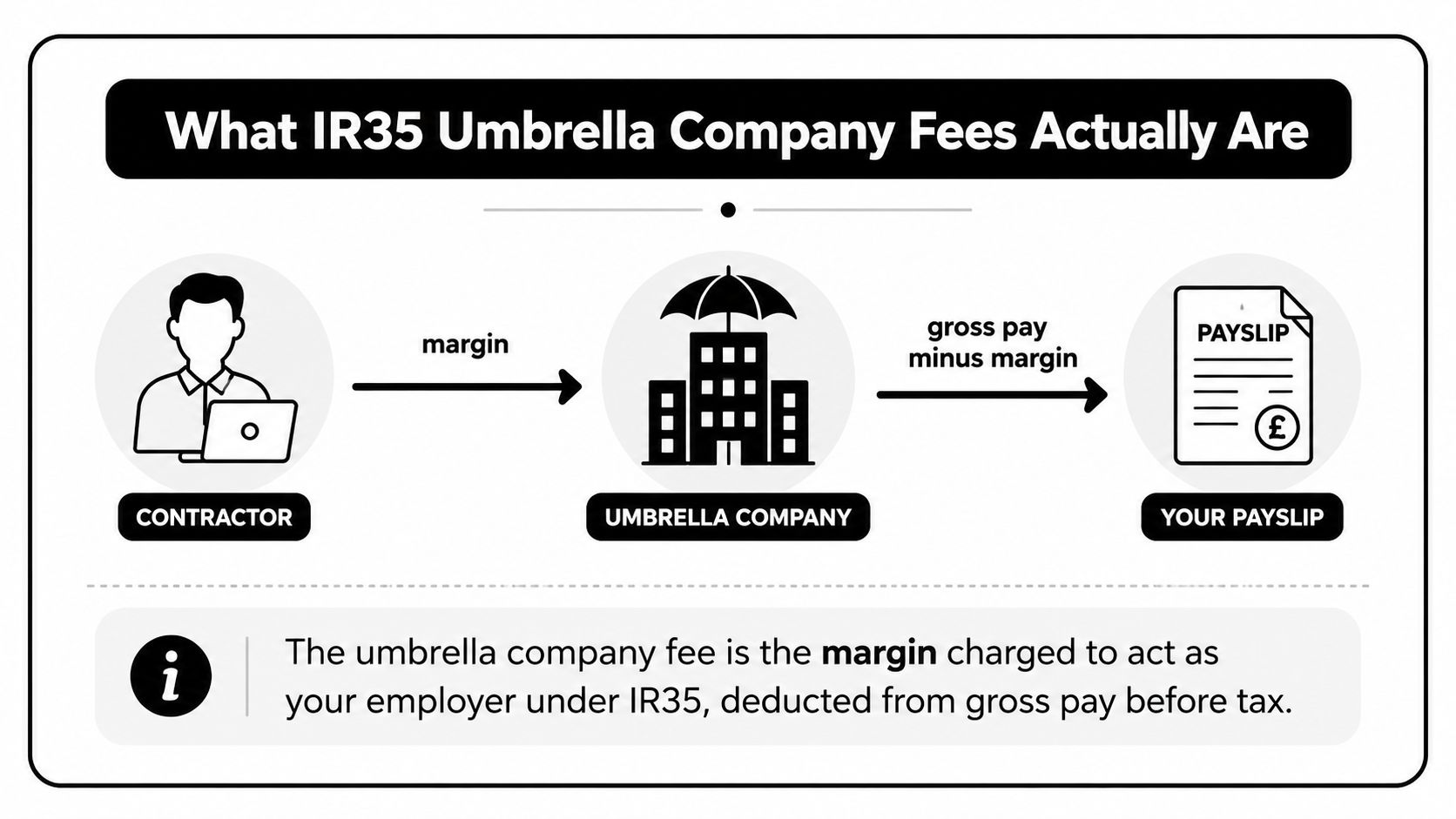
The margin is only the first deduction
Your actual cost inside IR35 is wider than the commercial fee. The assignment rate must also account for employer-side payroll liabilities and, depending on your arrangements, pension costs. The principal items are:
- Umbrella margin: The provider's charge for employment, payroll administration and related support.
- Employer National Insurance: A statutory employer cost that may be reflected in the assignment-rate calculation.
- Apprenticeship Levy: A statutory payroll cost that can apply to umbrella payroll arrangements.
- Workplace pension: Contributions may affect the amount available for salary, depending on your pension position and enrolment.
- PAYE deductions: Income Tax and employee National Insurance come off the gross pay that remains.
A contractor focused only on the margin can therefore compare the wrong number. A £15 weekly fee may look attractive, but it doesn't prove that the provider produces the best net pay. You need to compare the whole calculation using the same rate, working pattern, pension assumption and tax position.
Practical rule: Treat the umbrella margin as a service price, then inspect every other line that changes your take-home pay.
The choice is also about risk and administration. An umbrella can simplify payroll and give you an employment relationship, but you still need to understand what you're paying for. Ask for a sample payslip before signing and check that the margin is named clearly rather than hidden inside a vague administration charge.
How an Umbrella Works Inside IR35
Inside IR35 means the engagement is treated as employment for tax purposes. Under the off-payroll rules, the deemed employer must deduct Income Tax and employee National Insurance, while employer National Insurance and, where relevant, the Apprenticeship Levy are paid to HMRC (HMRC's off-payroll working guidance).
An umbrella company usually becomes your employer for PAYE purposes. HMRC explains that, where you work through an umbrella, the off-payroll rules are unlikely to apply in the same way because the umbrella is normally your employer for PAYE purposes (GOV.UK guidance on working through an umbrella company).
The payment chain
The flow is straightforward, although the terminology often causes confusion:
- You complete the assignment and submit an approved timesheet.
- The end client pays the recruitment agency under the commercial arrangement.
- The agency pays the umbrella company the agreed assignment income.
- The umbrella calculates payroll, allowing for its margin and employment-related costs.
- The umbrella pays you through PAYE, showing tax, employee National Insurance and other deductions on your payslip.
The advertised assignment rate isn't your salary. It's the amount available to cover several costs before your gross taxable pay is established. That's why a day rate can look generous at first glance but produce a lower weekly salary than a contractor expects.
Why the PSC route may not solve an inside-IR35 assignment
A personal service company can still exist, but using it doesn't turn an inside-IR35 engagement into an outside-IR35 one. If the assignment is inside IR35, the tax outcome is intended to reflect employment income. An umbrella is often chosen because it provides a direct PAYE route without requiring you to run company accounts, manage dividends or administer payroll through your own company.
The umbrella margin is a commercial charge, not an additional tax. It sits within the calculation before the salary figure reaches PAYE. For a line-by-line explanation, see our guide to the umbrella company payslip explained.
Common Umbrella Fee Structures Compared
Umbrella providers don't all charge in the same way. The four structures you'll commonly encounter are fixed weekly fees, fixed monthly fees, percentage fees and hybrid arrangements.
| Fee Model | Typical Charge | Best For | Worst For |
|---|---|---|---|
| Fixed weekly | Roughly £15 to £35 per week | Contractors who want a predictable cost | Very short assignments or weeks with little income |
| Fixed monthly | Roughly £80 to £150 per month | Contractors paid monthly or working consistently | Contractors with irregular working patterns |
| Percentage of pay | A stated percentage of the assignment or salary calculation | Lower-value or variable assignments, depending on the terms | Higher-rate contractors, because the charge rises with pay |
| Hybrid | A low fixed margin plus a percentage element | Contractors who want a mixed pricing model | Anyone comparing only the fixed headline margin |
The figures above reflect commonly reported UK fee ranges for umbrella arrangements (ContractorUK's umbrella fee guide). A fixed weekly fee is easy to understand. If you work a full pattern over a longer contract, the cost remains stable rather than rising with your day rate.
A monthly fee works in much the same way, but check how the provider treats partial months, gaps between assignments and changes to your payroll frequency. The headline amount can be reasonable for consistent work but less suitable if your income stops and starts.
Percentage pricing needs closer scrutiny
Percentage fees deserve more attention from higher earners. Because the charge rises with the value of the pay calculation, a percentage model can cost materially more as your day rate increases. A contractor on a modest rate may find the structure acceptable, while a contractor on a higher rate could pay more than expected for the same payroll service.
Hybrid pricing can look competitive because the fixed margin is low. The percentage element may recover the difference, so ask the provider to calculate the actual cash charge using your own assignment rate. Don't compare a fixed margin from one company with only the fixed part of a hybrid model from another.
Compare like with like: Use the same day rate, working days, pay frequency, pension choice and holiday-pay treatment for every provider.
Some contractors also confuse an umbrella margin with other forms of recurring business charge. The term “retainer fee”, for example, can describe a separate commercial arrangement, so check the wording rather than assuming two providers mean the same thing. Our explanation of what a retainer fee means can help separate those concepts.
How Fees Affect Your Take-Home Pay
A £450 day rate can look strong until the full umbrella deduction stack reaches your payslip. Five days produces £2,250 of weekly assignment income, but the margin is only one line. Employer National Insurance, the Apprenticeship Levy, pension, PAYE and employee National Insurance all affect what reaches your bank account.
This illustration uses 15% employer NIC above a £285 weekly secondary threshold, with no employer allowance applied, and a 0.5% Apprenticeship Levy where applicable, based on the stated UK contractor guidance (IR35 employer-cost guidance). It assumes a 5% pension contribution, standard PAYE treatment for the 2025/26 tax year, and employee National Insurance calculated using the applicable bands.
| Day Rate | Umbrella Margin | Employer NIC | Apprenticeship Levy | Pension (5%) | PAYE | Employee NIC | Weekly Take-Home |
|---|---|---|---|---|---|---|---|
| £450 | £25 | £291.00 | £11.25 | £96.44 | £371.25 | £85.00 | £1,370.06 |
| £450 | £15 | £292.50 | £11.25 | £96.94 | £373.50 | £85.50 | £1,375.31 |
| £450 | £25 | £216.00 | £8.75 | £77.69 | £284.00 | £65.00 | £1,273.56 |
| £450 | £25 | £366.00 | £13.75 | £115.19 | £458.50 | £105.00 | £1,471.56 |
The first two rows isolate a £10 weekly margin difference. The take-home increase is £5.25 in this simplified model because the lower margin changes the amount available for employer costs and taxable pay. The other rows show how the same £25 margin behaves at different assignment values. A fixed fee takes a larger share of lower assignment income, even though its cash amount stays unchanged.
For the first row, the calculation reconciles as follows: £2,250 − £25 − £291 − £11.25 − £96.44 − £371.25 − £85 = £1,370.06. This is the check to apply to any provider illustration.
Employer costs can outweigh the umbrella margin. Guidance for umbrella contractors distinguishes the margin from employer National Insurance and other employment costs (independent UK umbrella cost guidance). Ask for every deduction, not just the advertised weekly fee.
What this calculation leaves out
Your tax code, student loan, pension arrangement and holiday-pay choice can alter the result. A day-rate increase can improve take-home pay, while pension contributions reduce immediate cash in exchange for a longer-term employment benefit.
Use a calculator that displays each deduction. The umbrella take-home pay calculator lets you test your own rate and assumptions before comparing providers.
How to Compare Umbrella Providers Fairly
Start with the payslip. A reputable provider should show the assignment income, umbrella margin, employer costs, gross pay, PAYE deductions and net pay in a way you can follow. If the document contains one large “admin” amount with no explanation, stop and ask for a full reconciliation.
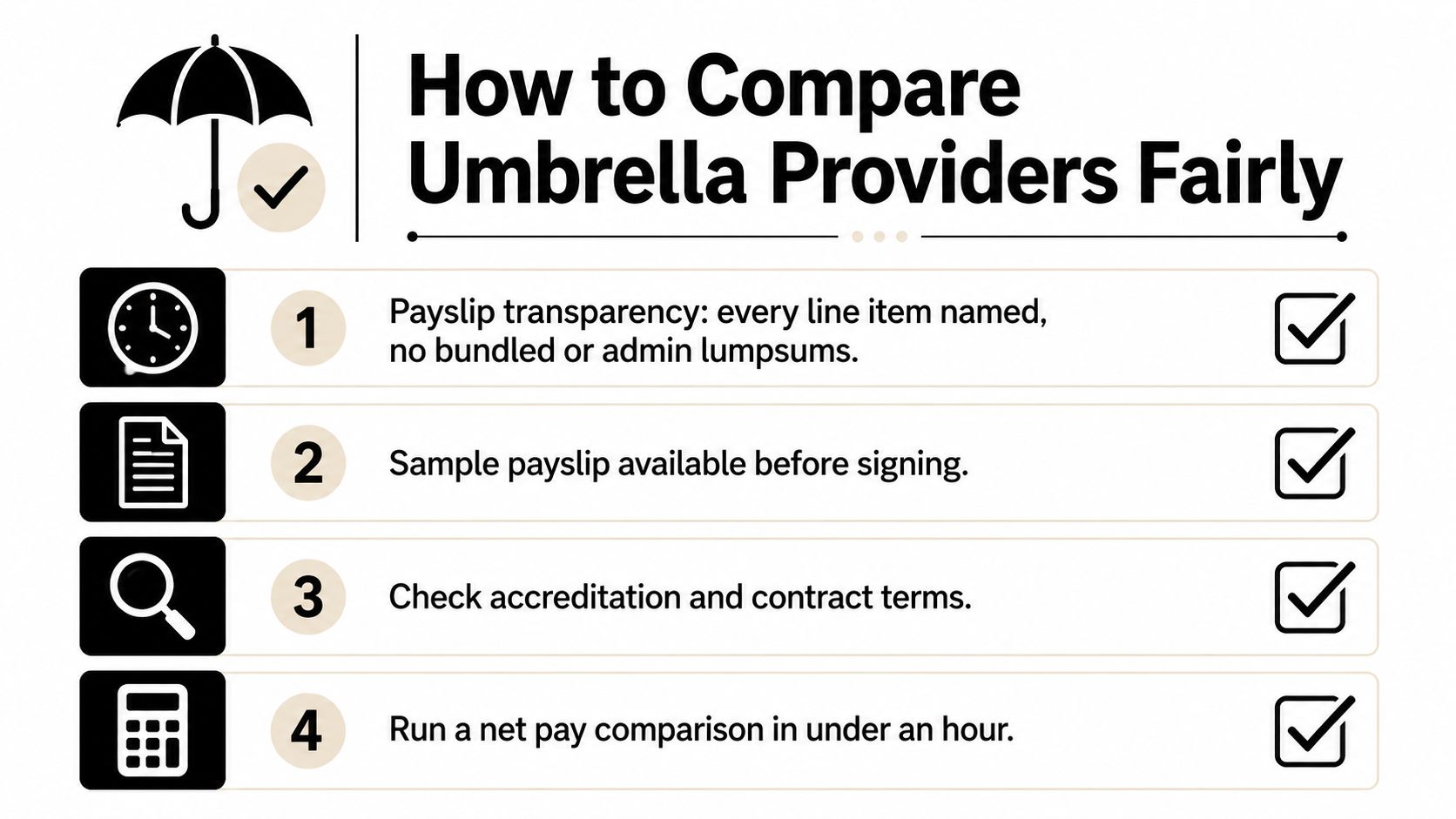
Run the checks before you join
Use this short checklist when you have an offer in front of you:
- Request a sample payslip: Ask for a worked example using your day rate, payment frequency and pension position.
- Name every deduction: Confirm which lines are the umbrella margin, employer NIC, Apprenticeship Levy, pension, PAYE and employee National Insurance.
- Check accreditation: Look for recognised standards associated with bodies such as the Freelancer and Contractor Services Association and Professional Passport. Accreditation can support confidence in governance and compliance, but it doesn't remove your responsibility to read the calculation.
- Read the employment contract: Check who employs you, how holiday pay works, whether there are restrictive covenants and whether any exclusivity wording could affect other assignments.
- Review expenses carefully: Ask how expenses are handled and whether the proposed treatment remains compliant with the PAYE rules due to change on 6 April 2026, as set out in HMRC's labour supply chain guidance (HMRC PAYE reform guidance).
- Check financial products separately: If a provider offers insurance, loans or another financial product, verify the relevant FCA authorisation status rather than assuming it forms part of the umbrella service.
The 2026 changes matter because HMRC guidance says new PAYE rules for labour supply chains that include umbrella companies are due from 6 April 2026. That makes clear records and an understandable payslip even more important as you choose a provider.
Compare the same calculation
Prepare one set of assumptions and send it to two or three providers. Keep the day rate, working days, pay frequency, pension contribution and holiday-pay approach identical. Then compare the resulting gross pay and net pay, not just the quoted margin.
Contractors also need to separate the umbrella decision from the search for their next assignment. If you're still looking for suitable work, a low-competition job board can be a useful additional resource, particularly when you want to widen your search beyond the agency that introduced your current contract.
Use a comparison service only if it gives you enough detail to verify the result. Our umbrella company comparison service can sit alongside your own checks, but the final decision should rest on transparent deductions, workable contract terms and compliant payroll.
Common Misconceptions About Umbrella Fees
The most expensive mistake is assuming the lowest margin automatically gives you the best deal. It doesn't. A cheap headline fee may sit alongside an unclear pension calculation, slow payroll support or an expense arrangement that HMRC later rejects.
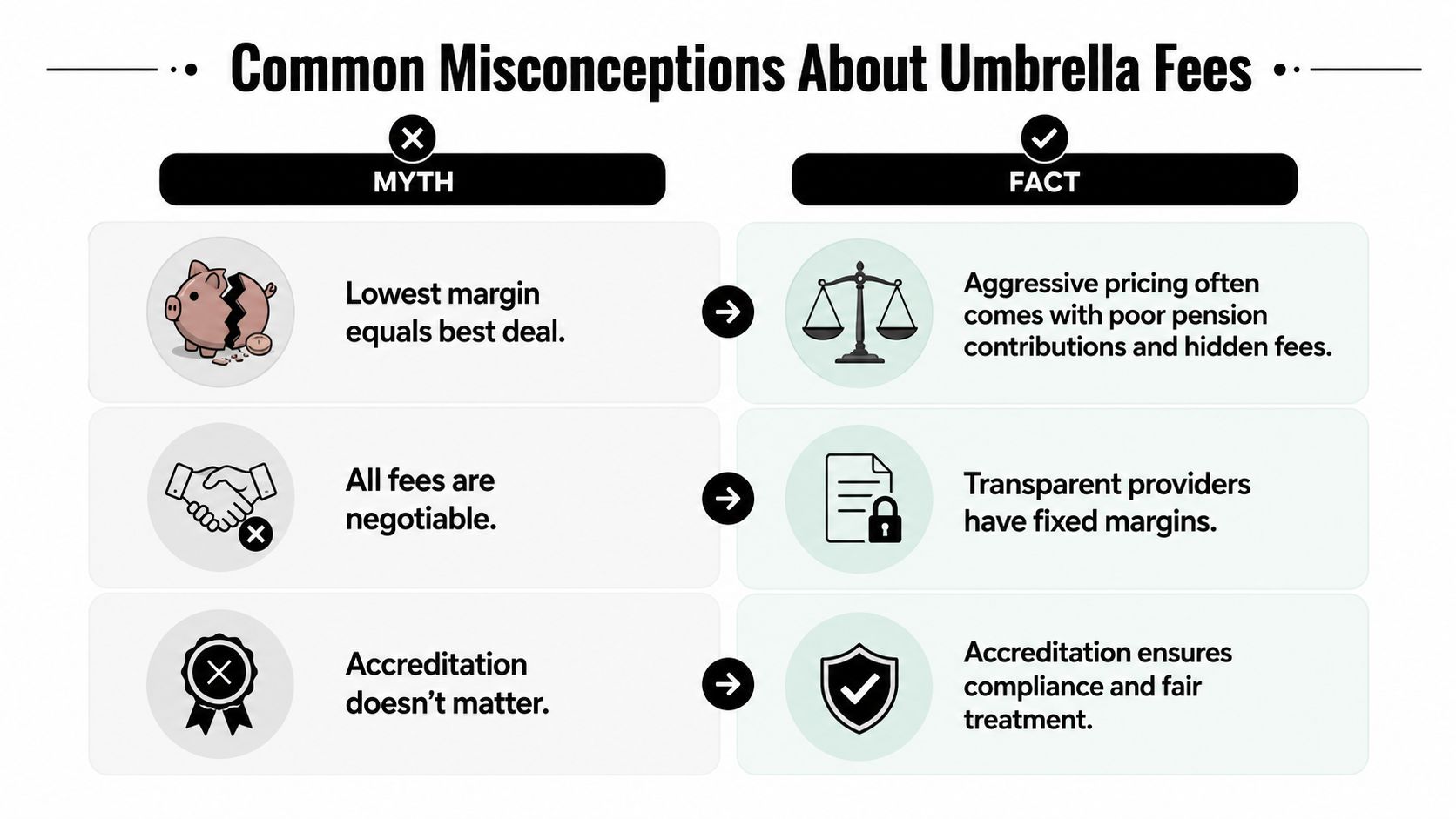
The myths that cause trouble
Myth: an umbrella and a PSC are interchangeable inside IR35.
They can produce an employment-style tax result for an inside-IR35 assignment, but the administration and risk profile differ. An umbrella becomes your employer and runs PAYE. A PSC leaves you responsible for company administration and the relevant off-payroll process.
Myth: an umbrella is just a tax service.
The umbrella is also an employer. That relationship carries employment responsibilities and rights, including matters such as statutory sick pay, maternity arrangements and dismissal law. Read the employment contract, not just the fee sheet.
Myth: accreditation makes every provider identical.
Accreditation can indicate that a provider has met an external standard, but providers still differ in payroll systems, communication, contract wording and how clearly they explain deductions. Ask questions and judge the answers.
Myth: every fee is negotiable.
A transparent provider may use a published fixed margin rather than bargaining with each contractor. That isn't a weakness. Predictability makes comparisons easier, provided the provider discloses the wider deduction stack.
Myth: unusual take-home promises are harmless.
They're a warning sign. Be cautious about disguised remuneration, loans or complex payment structures that claim to produce more cash while avoiding normal PAYE. The immediate figure matters less than whether the calculation can withstand HMRC scrutiny.
A provider that explains the payslip line by line is more useful than one that quotes a low margin. You're buying payroll and employment administration, not a clever-looking number.
Key Takeaways and What to Do Next
The decision becomes simpler once you focus on the right four points.
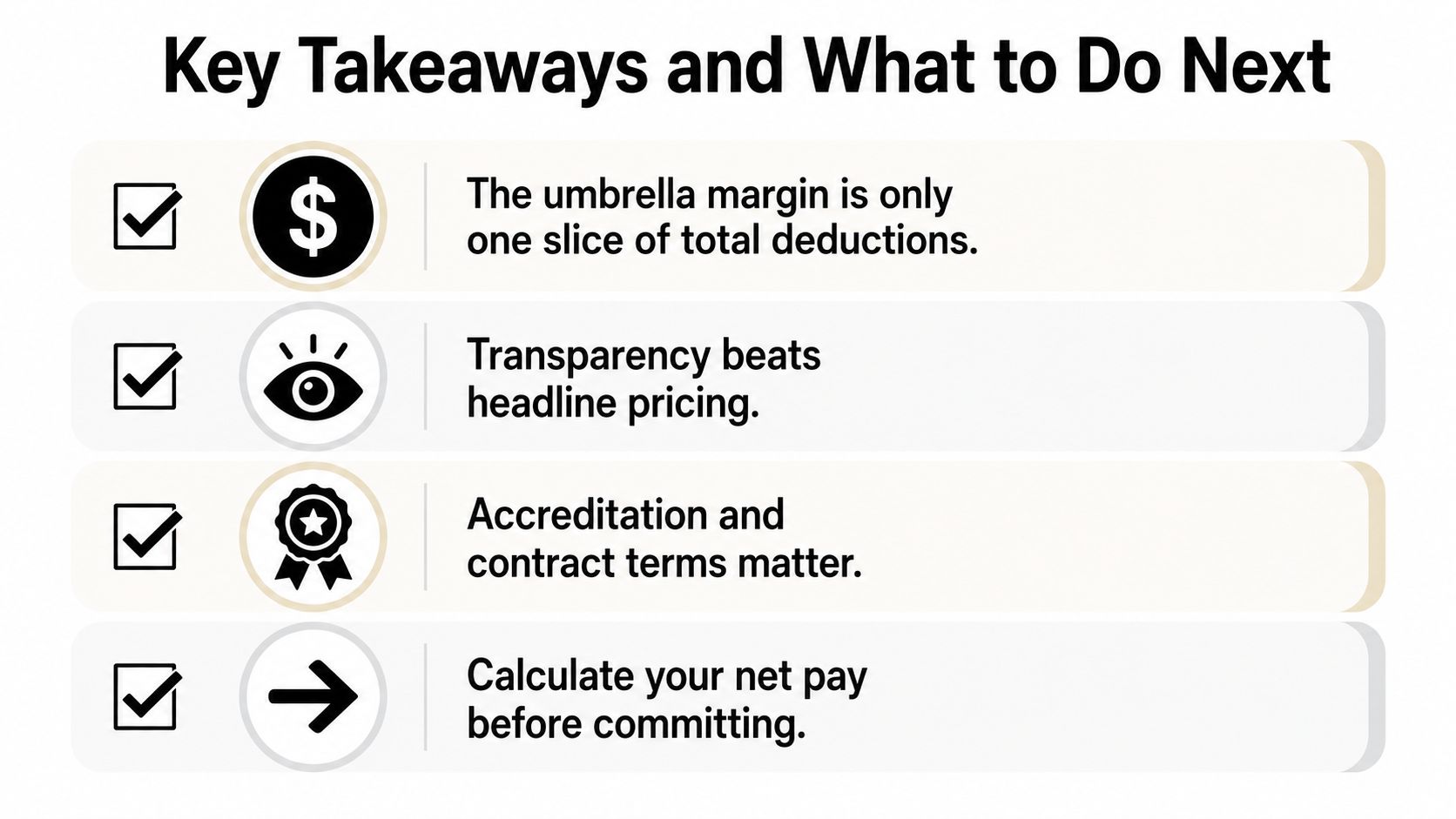
First, the umbrella margin is only one slice of the deduction stack. Employer National Insurance, the Apprenticeship Levy, pension treatment and PAYE can have a greater effect on the money that reaches your bank account. Second, transparency beats headline pricing. You need to see how the assignment rate turns into gross pay and then into net pay.
Third, accreditation and contract wording are essential checks. Look for recognised standards, but don't treat a badge as a substitute for reading the employment contract. Confirm who employs you, how holiday pay is handled, how expenses are treated and whether restrictive or exclusivity clauses affect your plans.
Fourth, small weekly differences accumulate over time. A modest margin difference matters, but only after you've compared the full calculation on identical assumptions. A provider with a slightly higher margin may still produce a clearer and more suitable arrangement if its wider deductions are properly disclosed.
The 2026 context
HMRC's new PAYE rules for labour supply chains that include umbrella companies are due from 6 April 2026 (GOV.UK umbrella company guidance). The reform direction follows HM Treasury's 2023 consultation on tackling non-compliance in the umbrella company market (HM Treasury consultation reference). For contractors, the practical response is clear: choose a provider that can show a compliant calculation and explain every line.
Before you accept an umbrella recommendation, shortlist two or three providers. Give each one the same day rate, working pattern, pension assumption and holiday-pay preference. Request a complete sample payslip, compare total deductions side by side and ignore any quote that only gives you the weekly margin.
Umbrella Company helps contractors compare umbrella providers and review how fees and payroll deductions affect take-home pay. Visit Umbrella Company to compare suitable options, test your figures and approach your next contract with a full deduction breakdown rather than a headline margin alone.


