


A Status Determination Statement (SDS) is the official verdict on your IR35 status for a specific contract. It is the legally required document from your end-client that spells out whether you are ‘inside’ or ‘outside’ IR35. That decision directly shapes how you get paid and how much tax you owe.
This guide explains what an SDS is, who is responsible for it, and what you should do when you receive one.
Understanding the IR35 Status Determination Statement
Think of the Status Determination Statement, or SDS, as the single most important document you will see when it comes to IR35. Its whole purpose is to bring much-needed clarity and accountability to the off-payroll working rules. It is there to make sure there is absolutely no grey area about your employment status for tax.
This is not just a bit of administration or a box-ticking exercise; the SDS represents a fundamental change in the way IR35 is handled. Not so long ago, the burden of figuring out your IR35 status fell squarely on your shoulders as the contractor. This left many people operating through their own limited companies feeling uncertain and exposed.
The Shift in Responsibility
The SDS was born out of the major IR35 reforms that flipped this responsibility from the contractor over to the end-client. This first happened in the public sector back on 6 April 2017, and the private sector followed for medium and large companies in April 2021. Now, it is the client's job to assess the working relationship and issue their formal statement.
This statement acts as the official record of the client's decision and, crucially, the logic behind it. They must pass the SDS down to you and anyone else in the supply chain, like a recruitment agency.
The Importance of 'Reasonable Care'
A critical legal concept is tied to every SDS: ‘reasonable care’. This puts a duty on your client to carry out a thorough and fair assessment before they issue their determination. They cannot just make a blanket decision for all contractors or rely on a flawed, automated tool.
To prove they have taken reasonable care, a client must:
- Properly assess both your contract and your actual day-to-day working practices.
- Consider all the key IR35 status tests, such as control, the right of substitution, and mutuality of obligation (MOO).
- Provide clear and detailed reasoning for their conclusion within the SDS itself.
If a client gets it wrong because they failed to take reasonable care, the liability for any unpaid tax and National Insurance can bounce right back to them. This is a huge incentive for them to get it right, and it is designed to protect you from lazy or unfair assessments. For any contractor, getting to grips with the SDS is the first step in making sure your IR35 status is decided correctly. You can get the full picture by checking out our guide on IR35 for contractors.
Who Is Responsible for Issuing Your SDS?
Knowing who is legally on the hook for issuing your Status Determination Statement (SDS) is absolutely critical. Under the off-payroll working rules, that responsibility now lands squarely with the end-client, the organisation you are ultimately doing the work for. It is a huge shift from the old days when contractors were left to figure out their own status.
These rules cover nearly all public sector bodies and most medium to large private sector businesses. This was the whole point of the IR35 reforms, which rolled out to the public sector in April 2017 before expanding to the private sector in April 2021. The idea was to create a fairer system by making the client, who has the clearest view of the working relationship, responsible for the determination. You can get the full story on the history of IR35 and its impact to see how we got here.
The Small Company Exemption
There is one major exception to be aware of in the private sector: the ‘small company’ exemption. If your end-client is officially a small business, the responsibility for determining your IR35 status flips back to you, the contractor.
So, what counts as 'small'? According to the Companies Act 2006, a company gets this tag if it meets at least two of these three criteria in a financial year:
- Annual turnover of no more than £10.2 million
- A balance sheet total of no more than £5.1 million
- An average of no more than 50 employees
Figuring out if your client falls into this bracket is crucial. It dictates who needs to do the assessment and issue the paperwork. If they are small, they simply are not required to provide you with an SDS.
Key Takeaway: For any public sector role, or any contract with a medium or large private business, it is the end-client’s legal duty to assess your IR35 status and give you a valid SDS.
How the SDS is Passed Down the Supply Chain
Once the client makes their decision, they must pass the SDS down the entire supply chain. Think of it like a baton in a relay race, it has to be handed off correctly to ensure everyone involved has the same official information on your tax status.
This flowchart gives a simple visual of how the statement travels from the client all the way to you.
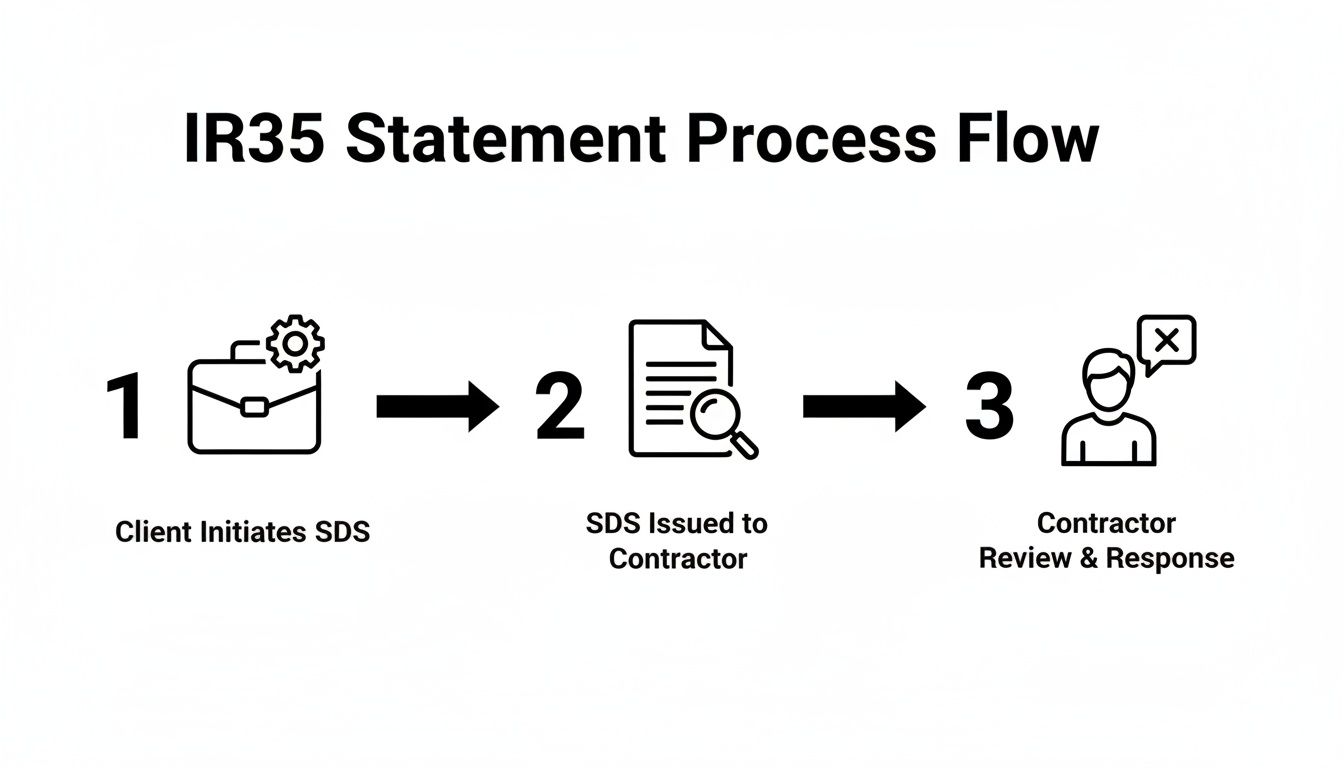
As you can see, the process has to start with the end-client. They must pass the SDS directly to you, the contractor, and also to the first link in the chain they deal with, which is usually a recruitment agency.
From there, the agency must pass it to the next party, and so on, until it reaches the organisation that actually pays your invoices, known as the fee-payer. This chain of communication is a legal requirement, designed to maintain full transparency and stop anyone from being left in the dark.
What a Compliant SDS Must Contain
Not all documents are created equal, and when it comes to IR35, a quick email declaring your status just will not do. To be legally sound, an IR35 Status Determination Statement (SDS) has to meet specific criteria laid out by HMRC. It is best to think of it as a formal record that needs to stand up to proper scrutiny if called upon.
A compliant SDS really has two main jobs. First, it must clearly state the final decision, whether your engagement is considered ‘inside’ or ‘outside’ IR35. Second, and this is just as vital, it has to provide the detailed reasoning that led to that conclusion.
It is this second part where many clients often fall short. The reasoning is the proof that they have fulfilled their legal duty of taking ‘reasonable care’ when making the assessment. It shows they have genuinely looked at how you work, rather than just applying a blanket policy or making a rushed call.

Key Status Tests Your SDS Should Reference
To properly justify their decision, the client must weigh up your contract and day-to-day working reality against the key employment status tests. A solid SDS will reference these factors directly, explaining exactly how they apply to your specific situation.
The three core pillars of IR35 status are:
- Control: This looks at the level of control the client has over how, when, and where you do your work. A genuinely self-employed contractor will almost always have significant autonomy.
- Substitution: This considers whether you have a genuine right to send a substitute to carry out the work in your place. If you personally have to provide the service, it points towards an employee-like relationship.
- Mutuality of Obligation (MOO): This is about whether the client is obliged to offer you work and if you are obliged to accept it. In a true business-to-business arrangement, this kind of mutual obligation does not exist beyond the current project.
A well-reasoned SDS will not just list these terms. It will give concrete examples from your engagement that back up the client's view on each test. For instance, it might highlight a specific clause in your contract about substitution or describe your freedom to set your own working hours.
Crucial Point: The reasoning is not optional. An SDS without a detailed justification explaining how the client reached their conclusion is not a valid document, and you have every right to question it.
Valid SDS vs Invalid SDS Checklist
It can be tough to spot a non-compliant document just by glancing at it. You can use this table as a quick checklist to see what a valid SDS should look like versus the common mistakes that make it invalid.
| Component | What a Valid SDS Includes | What Makes an SDS Invalid |
|---|---|---|
| Clear Determination | Explicitly states the outcome as 'inside IR35' or 'outside IR35'. There is no ambiguity. | Uses vague language, fails to give a clear decision, or states the role is 'IR35-neutral'. |
| Detailed Reasoning | Explains why the determination was made, referencing status tests like Control and Substitution. | Provides no justification at all or just says "based on a CEST tool assessment" without details. |
| Client Identity | Clearly identifies the end-client organisation that has made the determination. | Fails to name the client, or the statement is issued by an agency instead of the client. |
| Worker Identification | Specifies the contractor and the engagement the SDS applies to. | Is a generic or 'blanket' statement issued to multiple contractors without individual assessment. |
| Evidence of Care | Shows that the client has considered both the contract and the actual working practices. | Appears to be based solely on the job title or is a pre-determined decision for all contractors. |
Learning to spot an invalid SDS is your first line of defence. It gives you the power to challenge the determination from a position of knowledge, making sure your client meets their legal obligations. If your contract itself is a bit hazy, our guide on creating a solid freelance contract template for the UK can help you set clearer terms right from the start.
How to Act on Your SDS Determination
Once that Status Determination Statement (SDS) lands in your inbox, it is time to take a breath and figure out your next move. This is not just a bit of administration; it is the document that dictates exactly how you will be paid and taxed for the entire contract. Getting your head around the real-world consequences is absolutely essential.
Receiving your SDS basically sends you down one of two paths, depending on whether your client has decided the work is 'inside' or 'outside' IR35. Your first job is to understand what that actually means for your bank account and to pick apart the client’s reasoning.
If You Are Determined 'Inside IR35'
An ‘inside IR35’ determination means your client sees you as an employee for tax purposes on this particular project. This is the big one, as it completely changes how your invoices get paid.
The fee-payer, which is usually the client or your recruitment agency, is now legally obliged to deduct Income Tax and National Insurance Contributions (NICs) at source, through PAYE, before you see a penny. For all intents and purposes, you are treated just like a permanent employee on their payroll for the duration of the contract.
This is where a compliant, accredited umbrella company can be a lifesaver. Rather than getting tangled up in complex payroll setups with an agency, an umbrella company simply employs you for the contract. We handle all the PAYE deductions correctly, give you a proper payslip, and make sure you get statutory rights like holiday and sick pay. It is a clean, compliant, and straightforward solution.
Key Consideration: An 'inside IR35' status means your take-home pay will be calculated very differently. It is crucial you understand these deductions to get your budget straight from day one.
If You Are Determined 'Outside IR35'
Getting an ‘outside IR35’ determination is usually the result contractors are hoping for, especially those running their own limited company (a Personal Service Company, or PSC). This decision confirms your client agrees that they are engaging with you as a genuine business-to-business service provider.
When you are deemed outside IR35, you can carry on invoicing for your gross day rate, and the money gets paid straight into your limited company’s bank account. No PAYE deductions are taken at source by the fee-payer.
It is then up to you to manage your company's finances and pay the right taxes, like Corporation Tax, VAT, and any personal tax on salary or dividends. This status gives you the tax efficiency and flexibility that contracting is famous for. But remember, it is vital to keep meticulous records, because HMRC can still decide to investigate your status down the line. You can explore the differences and see what your potential earnings might look like with our inside vs outside IR35 calculator.
Scrutinising the Client's Reasoning
Whatever the outcome, your first job after reading the determination is to carefully analyse the reasoning your client has provided. A compliant SDS must explain why they made the decision, and this is your chance to make sure it is fair and, most importantly, accurate.
As you go through their justification, ask yourself these questions:
- Does it reflect reality? Does the client's description of the role match up with what you actually do day-to-day? A determination based on a generic job spec rather than your real-life working practices is a huge red flag.
- Is the reasoning sound? Have they referenced the key status tests like Control, Substitution, and Mutuality of Obligation? A vague explanation or one that just says "we used a tool" simply is not good enough.
- Have they missed key evidence? Maybe they have completely ignored a crucial clause in your contract or a specific working arrangement that proves your independence.
Taking the time to do this is vital. A well-reasoned, accurate SDS protects both you and your client if HMRC ever comes knocking. If the reasoning feels flimsy or does not line up with the reality of your engagement, you have a legal right to challenge it.
Challenging an Incorrect IR35 Determination
Getting a Status Determination Statement (SDS) that you feel is just plain wrong can be a gut punch. But it is absolutely not the final word. The off-payroll working rules have a formal, client-led disagreement process built right in, giving you the legal right to push back on a decision you think is mistaken. This is your chance to set the record straight and make sure the final call reflects how you actually work.
Winning a challenge is not about getting emotional; it is all about the evidence. Your job is to build a rock-solid, factual case that shows exactly where the client's reasoning went off track. That means digging up concrete proof that you operate as a genuine business, not a disguised employee.
Building Your Case with Evidence
Before you fire off a formal challenge, you need to get your ducks in a row. A compelling argument is one that is backed up by documents and real-world examples that directly counter the client's assessment.
Here is the kind of evidence you should be hunting for:
- Your Contract: Comb through your contract for the classic hallmarks of self-employment. Look for a clear right of substitution, a lack of mutuality of obligation (MOO), and clauses confirming you are on the hook for fixing your own mistakes at your own cost.
- Email Trails: Your inbox can be a goldmine. Sift through emails for conversations that prove your autonomy, such as you setting your own hours, deciding how to get a task done, or working from a location you chose.
- Business Reality: Pull together everything that screams "I run a proper business". This means your business insurance policies, a company website, marketing materials, and, crucially, proof you are working for other clients at the same time.
- Witness Statements: If it makes sense for your situation, getting a statement from a manager or colleague who can back up your claims about your working practices can be incredibly powerful.
The more hard evidence you can stack up, the stronger your position will be when you present your case.
Submitting Your Formal Challenge
Once you have organised your evidence, it is time to submit your challenge in writing. Keep it professional, clear, and methodical. Go through the client's original reasoning point by point, explaining why you disagree and presenting your counter-evidence for each one.
Important: Your client is legally required to respond to your challenge within 45 days of receiving it. They cannot just ignore you. Their response must either be a new SDS with a different outcome or a detailed explanation of why they are sticking with their original decision.
This 45-day window is there to protect you from being left in limbo and forces the client to genuinely reconsider their position. The history of IR35 enforcement has been notoriously inconsistent. For instance, data once showed HMRC’s capacity to handle cases was so limited that it made these client-led processes even more vital for getting the right answer. You can read more about the turbulent history of IR35 on ContractorCalculator.co.uk.
Knowing this process inside and out gives you the power to fight your corner effectively. It helps ensure you are not unfairly penalised by a determination that does not match the reality of your work. If you need a refresher on the key status indicators, check out our detailed guide on being inside or outside IR35.
Navigating Your Contracting Career with Confidence
For any contractor working in the UK today, getting to grips with the off-payroll working rules is not just a good idea, it is essential. At the very heart of this is the Status Determination Statement (SDS), the single most important document that officially sets out your tax status for a particular contract.
When you understand who needs to issue an SDS, exactly what it should say, and how to push back if you think it is wrong, you put yourself in the driver's seat. Suddenly, IR35 stops being this looming source of stress and becomes just another part of running your business. That frees you up to do what you do best: delivering outstanding work for your clients.
Taking Control of Your IR35 Journey
Hopefully, you now feel ready to deal with an SDS when it lands in your inbox. You know that the responsibility for getting it right sits with your end-client (unless they are a small company) and that for it to be legally valid, it must be backed up with clear, specific reasons.
More importantly, you know the two very different paths an SDS determination can lead you down:
- Outside IR35: You are recognised as a genuine business. You invoice for your services and handle your own tax affairs through your limited company, just as you would expect.
- Inside IR35: You are considered an employee for tax purposes only. This means Income Tax and National Insurance contributions must be deducted at source through PAYE before you get paid.
This clarity gives you the power to properly examine any determination you are given. If a client's reasoning just does not match up with how you actually work day-to-day, you now have the right and the know-how to launch a formal, evidence-backed challenge.
Your Next Step for Inside IR35 Roles
For many contractors who are handed an ‘inside IR35’ determination, the simplest and most practical next step is often to partner with an accredited umbrella company. It is a straightforward, compliant route that takes the administrative headache away from both you and your recruitment agency.
At UmbrellaCompany.com, our entire focus is on giving you the clarity and support needed to succeed in the UK's contracting market. We believe that with the right information, you can manage your IR35 responsibilities without worry, leaving you feeling empowered and firmly in control of your career.
If you are on the hunt for a compliant and supportive payroll partner for your next inside IR35 contract, we are here to help you compare your options and find the perfect fit.
Common SDS Questions Answered
Getting to grips with a Status Determination Statement can feel like navigating a maze, but once you understand the rules, you are in a much stronger position. We have pulled together some clear, no-nonsense answers to the questions contractors ask us most often about the whole SDS process.
Think of this as your quick guide to cutting through the jargon. It is the essential information you need to handle your determination with confidence and protect your interests.
What Happens If My Client Fails to Issue an SDS?
If your end-client (and they are not exempt as a ‘small company’) does not give you a valid Status Determination Statement, the legal responsibility for tax and National Insurance lands squarely on their shoulders. They basically become the fee-payer by default until they provide a compliant SDS.
This rule is a powerful incentive for clients to get their act together and follow the proper procedure. If you have not received an SDS for a contract that clearly needs one, you should put your request in writing.
Can a Recruitment Agency Create the SDS?
Absolutely not. The legal duty to figure out your IR35 status and issue the Status Determination Statement belongs only to the end-client, the organisation you are actually doing the work for. The recruitment agency's job is just to pass that SDS down the chain.
If an agency tries to make the determination themselves, they are not playing by the rules. The decision must come from the client, as they are the ones who have first-hand knowledge of your working practices.
Key Takeaway: The end-client is the only party responsible for making the IR35 determination. An agency can pass the SDS along, but they cannot create it.
Does an Inside IR35 SDS Mean I Must Use an Umbrella Company?
Not always, but it is often the simplest and most compliant path to take. An ‘inside IR35’ determination means you must be taxed like an employee, with all deductions made at source through PAYE.
While some agencies might be willing to put you on their own payroll, many do not want the extra administrative headache and potential liability. That is where a good, accredited umbrella company comes in. We employ you for the contract and take care of all the necessary PAYE deductions correctly, making sure everyone in the supply chain stays fully compliant.
How Long Does a Client Have to Respond to My SDS Challenge?
Once you have formally challenged your determination, the end-client is legally required to respond within 45 calendar days.
Their response must be one of two things: either a brand-new SDS with a different outcome, or a detailed explanation sticking by their original decision. If they miss that 45-day deadline, the tax liability can shift back to them, which gives them a very good reason to take your concerns seriously and reply promptly.
At UmbrellaCompany.com, we provide the tools and support to make your contracting journey simpler and more secure. We can help you compare FCSA-accredited providers to find the perfect payroll solution for your next inside IR35 role. Learn more at UmbrellaCompany.com.


