


Let's get straight to the point: the IR35 legislation does not technically apply to sole traders.
This can feel like a get-out-of-jail-free card, but it is not quite that simple. The rules, often called the 'off-payroll working rules', were specifically built to stop 'disguised employment' through an intermediary, like a contractor's own limited company.
Does IR35 Really Apply to Sole Traders?
While you will not hear HMRC talk about an "IR35 sole trader", you are not completely off their radar. The taxman uses almost identical tests to figure out if a sole trader is genuinely self-employed or if they should really be classed as an 'employee for tax purposes'.
Think of it this way: the label is different, but the headache is the same.
If HMRC looks into your contract and decides it smells more like employment than a true business-to-business service, the consequences are pretty much the same as being found 'inside IR35'. It’s a risk many freelancers completely miss.
Understanding the Key Distinction
So, what is the actual difference? It all comes down to the number of parties involved.
IR35 was created for a three-party chain: the contractor, their limited company (the go-between), and the end client. As a sole trader, you work directly with your client. It’s a simple two-party relationship, so the off-payroll rules do not fit.
However, the questions HMRC asks to check your status are pulled from the very same playbook as IR35. They will be digging into the reality of your working relationship, focusing on classic status tests like:
- Control: Does the client tell you how, when, and where to do the work? An employee is told; a business is not.
- Substitution: Can you genuinely send someone else to do the job in your place? If you cannot, you look a lot more like an employee.
- Mutuality of Obligation (MOO): Does the client feel obliged to offer you more work, and do you feel you have to accept it? This ongoing expectation is a hallmark of employment.
To help clarify, here is a quick comparison of how the rules apply in each scenario.
IR35 Rules vs Sole Trader Employment Status
| Aspect | IR35 (For Limited Company Contractors) | Employment Status (For Sole Traders) |
|---|---|---|
| Primary Legislation | Off-Payroll Working Rules (Chapters 8 & 10, ITEPA 2003) | General employment status law, based on case law precedent |
| Applies To | Contractors working through an intermediary (e.g., a limited company) | Individuals working directly for a client on a self-employed basis |
| Key Question | "If the intermediary did not exist, would the contractor be an employee?" | "Is the individual in business on their own account, or are they an employee?" |
| Consequence of 'Failure' | Contractor is deemed an employee for tax purposes ('Inside IR35') | Sole trader is reclassified as an employee for tax purposes |
| Tax Liability | PAYE tax and National Insurance must be deducted from fees paid to the limited company | Client becomes liable for deducting PAYE tax and National Insurance from payments |
As you can see, while the official rules and terminology differ, the core principles and the financial outcomes are strikingly similar. Getting this wrong can be a very expensive mistake.
A misunderstanding here can be costly. Even without an intermediary, if your working practices mirror those of an employee, HMRC can reclassify your status. This would make your client liable for deducting PAYE tax and National Insurance from your payments.
Ultimately, whether the verdict is 'inside IR35' for a limited company contractor or 'employed for tax purposes' for a sole trader, the hit to your income is almost identical.
For a deeper dive into the basics, you can learn more about IR35 in our comprehensive guide.
How HMRC Decides if You Are Genuinely Self-Employed
Forget what is written in your contract for a moment. When it comes to your employment status, HMRC is interested in the reality of your day-to-day working relationship with a client. They will look right past the paperwork to figure out what is really going on.
To do this, they lean on a set of core principles hammered out over decades of employment law cases. These are the exact same tests that underpin IR35 assessments for limited company contractors, so getting your head around them is vital for any IR35 sole trader wanting to stay on the right side of the taxman.
The three big pillars of any status check are Control, Substitution, and Mutuality of Obligation (MOO). Let's break down what these actually mean in the real world.
The Test of Control
Control is probably the single biggest factor. HMRC wants to know who is really calling the shots. A genuinely self-employed person has a high degree of freedom over how, when, and where they get the job done. You are hired for your expertise to deliver a specific outcome, not to be managed like a regular member of staff.
Think of it like the difference between a taxi driver and a chauffeur. You give a taxi driver a destination (the project goal), but they decide the best route and how they drive. A chauffeur, on the other hand, is told exactly where to go, when to be there, and which route to take, all dictated by their boss.
If your client sets your working hours, insists you work from their office, or micromanages your daily tasks, that is a massive red flag. It points squarely towards an employment relationship.
The Right of Substitution
A fundamental part of being in business for yourself is that the client is paying your business for a service, not you personally. This is where the Right of Substitution comes into play. It boils down to one question: do you have a genuine, unrestricted right to send someone else to do the work in your place?
And it has to be a real option. A substitution clause in your contract is meaningless if, in reality, the client would never dream of accepting a replacement. For it to count, you must be the one responsible for finding and paying the substitute, and the client cannot just refuse them for no good reason.
If you are personally required to deliver the service and have no choice in the matter, you look a lot more like an employee than a business owner.
Mutuality of Obligation (MOO)
Mutuality of Obligation (MOO) is all about the expectation of future work. In a standard job, the employer is obliged to provide work, and the employee is obliged to do it. It’s a continuous cycle.
For a self-employed professional, that obligation simply should not exist. Once a project is done, it is done. There should be no expectation on either side that more work will be automatically offered or accepted. Every new piece of work should be a fresh, separate agreement.
If your client just keeps feeding you work and you feel you have to take it, it starts to look an awful lot like disguised employment.
Remember, when looking at your own contracts, HMRC considers the whole picture. No single factor will decide your fate, but together, these tests paint a pretty clear picture of your working reality.
This decision tree helps to show how the IR35 rules apply differently depending on your business setup.
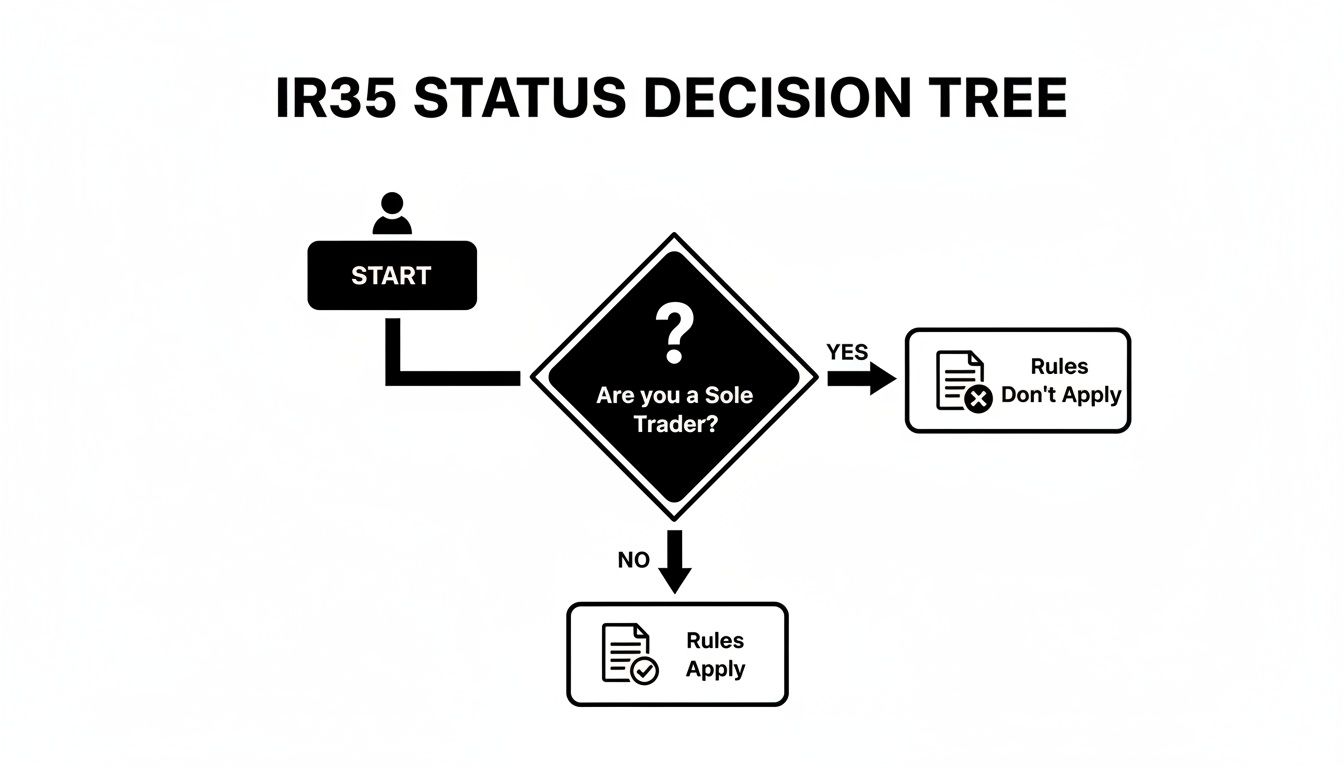
As you can see, the direct IR35 legislation might not apply to you as a sole trader, but those underlying status questions are just as critical. If you are ever in doubt about where you stand, it is crucial to get clarity. You can learn more about what it means to be inside or outside IR35 in our detailed guide.
Sole Trader vs Limited Company: The Tax Risk Showdown
Choosing how to set up your business is one of the biggest calls you will make as a contractor. It is not just about a trading name; it completely changes how you manage your taxes, liabilities, and personal risk. The difference between being a sole trader and a limited company director becomes crystal clear when HMRC comes knocking.
The IR35 off-payroll working rules were created specifically to look at contractors who work through an intermediary, usually their own limited company. This is key, because it created a situation where the responsibility for getting your employment status right can actually shift away from you.
For contracts with medium and large-sized businesses, the client is now the one who has to assess your IR35 status. If they get it wrong, HMRC will generally chase them for the missing tax and National Insurance, not your company. It’s a valuable layer of protection.
How Things Look for Sole Traders
For a sole trader, the story is completely different. The risk is personal and direct.
When you are a sole trader, there is no legal go-between. You are the business. That crucial legal and financial separation you get with a limited company just is not there.
This means the buck stops with you when it comes to paying the right tax and National Insurance. If HMRC decides one of your contracts makes you an 'employee for tax purposes', the financial fallout lands squarely on your shoulders. There’s no client liability to shield your personal bank account from a massive, unexpected tax demand.
Let's walk through two scenarios to see how this plays out in the real world.
Scenario One: The Limited Company Contractor
Picture Alex, an IT contractor working through 'Alex IT Solutions Ltd'. His client decides the contract is outside IR35. A year down the line, HMRC investigates and successfully argues that the client got it wrong, the role should have been inside IR35 all along.
- Who is Liable? Because the client made the status determination, they are on the hook for the unpaid PAYE tax and National Insurance.
- The Impact on Alex: While it is a huge headache for the client, Alex's company and his personal finances are generally safe from the tax bill (as long as no fraud was involved). The financial blow is absorbed by the client.
Scenario Two: The Sole Trader
Now think about Ben, a freelance graphic designer who operates as a sole trader. He spends a year working for a client and invoices them each month. HMRC looks into the arrangement and reclassifies him as an employee for that period.
- Who is Liable? In this situation, Ben is personally liable. The rules that shift the blame to the client do not apply here.
- The Impact on Ben: He’s now facing a bill for back-paid income tax, plus both employee's and employer's National Insurance. On top of that, there could be interest and penalties. This is his personal debt, putting his savings, his house, and other assets on the line.
The core difference is stark: a limited company acts as a financial firewall between you and tax liability under the off-payroll rules. As a sole trader, you are standing right in the firing line.
The stakes are high. In its first 15 years, HMRC launched 14,000 investigations where IR35 was the main issue, bringing in over £12.1 million for the government. An incorrect status determination can slash your net income by up to 25%, a figure that pushes many contractors to find a safer way to work.
Getting your business structure right is the best defence you have. For a deeper dive, check out our guide on choosing the right type of business structure for your contracting career.
The Real Cost of Getting Your Employment Status Wrong

Getting your employment status wrong is not just a bit of admin hassle; it can set off a financial bombshell. If HMRC looks into how you work and decides you’re an 'employee for tax purposes' instead of a self-employed sole trader, the fallout can be serious and costly.
The biggest hit, unsurprisingly, is to your wallet. HMRC will come knocking for the tax and National Insurance Contributions (NICs) they believe you should have paid all along. And this is not just about paying what you thought you owed, it creates a much bigger debt.
Suddenly, you could be on the hook for a bill that includes:
- Back-paid PAYE Income Tax: All the money you earned from that contract could be re-calculated as if it were a salary, with tax due at standard PAYE rates.
- Employee's National Insurance: You will owe the Class 1 NICs you would have paid as a regular employee on those earnings.
- Employer's National Insurance: This is often the real gut punch. The liability for employer's NICs also lands on you, adding a hefty percentage on top of everything else.
- Interest and Penalties: HMRC will add interest to the unpaid tax. If they decide you were careless, they can also slap on some painful penalties, making the final bill even bigger.
This is not just a scare story. It's a real risk that can turn a great contract into a financial disaster, putting your personal assets on the line.
A Real-World Example
Let's make this crystal clear with a quick case study. Meet Sarah, a freelance project manager working as a sole trader. For two years, she works exclusively for one client, earning £50,000 a year. She files her Self Assessment returns diligently, but her day-to-day working practices look a lot like an employee's.
HMRC opens an investigation and determines she was, for tax purposes, an employee for both years.
This reclassification means that instead of paying tax and Class 2/4 NICs on her profits, her entire £100,000 in earnings over two years is now subject to PAYE rules. The financial fallout is immediate and substantial.
Here’s how the costs could stack up:
- Income Tax: The income tax she owes might be similar to what she paid via Self Assessment, but it is calculated differently.
- Employee's NICs: She now owes thousands in Class 1 employee contributions that were never paid.
- Employer's NICs: Here’s the crucial part. She is now also liable for the employer's NICs on her £100,000 earnings, which could easily be over £12,000.
- Total Bill: When you add potential interest and penalties into the mix, Sarah could be facing a tax bill of £15,000 to £20,000, maybe more, all due right now.
This example shows just how quickly the costs can spiral, especially once employer's National Insurance is added to the bill. The point is not to cause alarm, but to give you a clear-eyed view of what’s at stake. Being proactive about compliance is not just about ticking boxes; it is about protecting your financial future.
Getting a handle on your potential tax liability is the first step. You can use our IR35 take-home pay calculator to see how a different employment status might affect your income.
How to Protect Yourself and Stay Compliant

Knowing the risks of being misclassified as an employee is one thing, but actively protecting yourself is another game entirely. To build a sustainable contracting career, you need to navigate your compliance options with confidence.
Fortunately, there are a few well-trodden paths you can take to manage your risk and keep HMRC happy. The right choice for you will come down to the nature of your contracts, your appetite for risk, and just how much admin you’re willing to take on.
Let's walk through the three main routes contractors typically take: joining an umbrella company, setting up your own limited company, or continuing as a sole trader but with much stronger armour in place.
The Umbrella Company Route for Total Compliance
For many contractors, an umbrella company is the simplest, most straightforward solution. If you’re working on projects that sit in that tricky grey area or are likely to be seen as employment, an umbrella effectively takes the entire employment status headache off your plate.
It’s a simple switch: you become an employee of the umbrella company. They, in turn, contract with your end client or the agency. This one change simplifies everything.
Here’s how it works in practice:
- No More Status Worries: You’re an employee of the umbrella, so any questions about ‘disguised employment’ are completely off the table. All your earnings are processed through PAYE.
- All Tax Handled for You: Just like a permanent employee, the umbrella company calculates and deducts your income tax and National Insurance contributions at source.
- Statutory Rights: As an employee, you get access to statutory benefits like sick pay, holiday pay, and a workplace pension.
- Minimal Admin: You just submit your timesheets. The umbrella company handles all the invoicing and payroll, freeing up a huge amount of your time.
When the off-payroll working rules landed in 2021, it caused what many called a 'flight to safety'. We saw a lot of sole traders move over to umbrella companies to secure their compliance. Recent data shows a 4% drop in sole traders in the last year alone and an 11% fall since 2019, which reflects this shift towards more secure working setups. You can discover more insights about the shifting landscape of self-employment.
Setting Up a Limited Company
Another popular option is to incorporate your business by setting up a private limited company. This creates a completely separate legal entity from you personally, which is great for protecting your assets and opening up more tax planning opportunities.
But, and it is a big but, this path comes with its own heavy set of responsibilities. As a director of a limited company, you’re now operating through an intermediary. That means the IR35 rules apply directly to your contracts.
While this structure can be incredibly tax-efficient for contracts genuinely outside IR35, it also means you (or your client) are on the hook for making the correct status determination. Get that 'outside IR35' decision wrong, and you could be facing a hefty tax bill.
A limited company provides a protective barrier for your personal assets and can offer greater financial flexibility. However, it also places you squarely within the scope of IR35 legislation, demanding careful and continuous status assessments for every contract.
Continuing as a Sole Trader with Stronger Safeguards
If you're committed to operating as a sole trader and you’re confident your contracts are a true reflection of self-employment, then the key is to build an undeniable case for your status. You have to operate and present yourself as a proper business at all times.
This goes way beyond just having a contract. It’s about proving your independence through your actions and your paperwork.
Here is a checklist of best practices for any dedicated sole trader:
- Get Contracts Professionally Reviewed: Never sign anything without an expert review. You need to ensure the contract includes clauses that scream self-employment, like a clear right of substitution and a lack of mutuality of obligation.
- Maintain Professional Indemnity Insurance: Holding business insurance is a massive indicator that you’re shouldering the financial risks of a genuine business.
- Keep Meticulous Records: Organise every shred of evidence that proves you run a business. This includes all your invoices, records of business expenses, and marketing materials like a professional website or business cards.
- Work with Multiple Clients: One of the most powerful arguments for being in business on your own account is showing that you do not rely on a single income stream.
By taking these proactive steps, you can massively reduce the risk of HMRC ever misclassifying you. It transforms your sole trader status from a potential liability into a well-defended, robust business structure.
Your Practical Compliance Checklist
Navigating the murky waters of employment status can feel like a headache waiting to happen, but with a clear plan, you can manage the risk and keep your business on solid ground. We have boiled it all down into a practical checklist to help you cement your self-employed status and get on with your work, confidently.
Your goal here is simple: build an undeniable case that you are genuinely in business for yourself. This is not just about what your contract says; it’s about proving it through your day-to-day actions and keeping a solid paper trail.
Your Action Plan
Here are the key areas to focus on to protect your position as a self-employed professional.
Review All Client Contracts: It is time to get forensic. Scrutinise every agreement for clauses that could even hint at employment. Pay close attention to the big three tests:
- Control: Does the contract give you proper autonomy over how, when, and where you work? Or is the client dictating your every move?
- Substitution: Do you have a genuine, unrestricted right to send someone else to do the work in your place? This is a huge indicator of self-employment.
- Mutuality of Obligation (MOO): Does the contract make it clear there’s no expectation of ongoing work once the project is finished, and no obligation for them to offer it or for you to accept?
Organise Your Evidence: Do not wait for a brown envelope from HMRC to land on your doormat. Start gathering proof that you operate a real business, not just a one-person-band for a single client. This includes things like:
- A professional business website and a proper business email address (not your personal Gmail).
- Marketing materials, like business cards, or a strong professional profile on sites like LinkedIn.
- Proof that you’re working for multiple clients, either at the same time or one after the other.
- Records of your business expenses, for example software subscriptions, professional insurance, or training courses you’ve paid for yourself.
Assess Your Operating Structure: Take a step back and look at the bigger picture. Does your current setup actually reflect how you want to work? Are your contracts consistently showing strong signs of self-employment, or are they a bit borderline? Remember, a single, long-term contract with one client carries far more risk than a series of shorter projects with different clients.
Taking these steps transforms your status from a potential weakness into a well-defended business position. It’s all about being proactive, not reactive, and making sure the reality of how you work matches your self-employed label.
Ultimately, this checklist is designed to give you a clear path forward and put you back in control. Managing your IR35 sole trader risk is not a one-off task; it’s an ongoing part of good business practice.
If you’ve reviewed your situation and decided the umbrella company route offers the security and simplicity you need, we're here to help. At UmbrellaCompany.com, we can connect you with a reliable, accredited partner to ensure full compliance and give you complete peace of mind.
Frequently Asked Questions
We know the rules around employment status can feel like a maze. To help you find your way, we have tackled some of the most common questions sole traders have about IR35 and staying compliant.
Can I Work Inside IR35 as a Sole Trader?
The short answer is, technically, no. The IR35 legislation (often called the off-payroll working rules) was created specifically for contractors who operate through an intermediary, like their own limited company. As a sole trader, you contract directly with your client, which puts you outside the direct scope of these rules.
But this is where things get tricky and the confusion often starts. If your working relationship with a client looks and feels like traditional employment, HMRC can reclassify you as an ‘employee for tax purposes’.
The end result is identical to being found ‘inside IR35’. Your client would have to deduct PAYE income tax and National Insurance from your payments before you get paid, which can seriously shrink your take-home pay. So, while you will not hear HMRC use the term IR35 sole trader, the financial hit of a negative status assessment is exactly the same.
Is an Umbrella Company a Safer Option than Being a Sole Trader?
For a lot of contractors, particularly those on longer-term projects with one main client, using an umbrella company is a much safer and simpler way to work. It takes any doubt or risk about your employment status completely off the table.
When you join a reputable, accredited umbrella company (look for FCSA or Professional Passport accreditation), you become their employee in the eyes of the law. They take care of everything.
- Guaranteed Compliance: All your earnings are processed through PAYE, ensuring your tax and National Insurance are paid correctly, every single time.
- No Risk of Investigation: The whole ‘disguised employee’ question becomes a non-issue because you are, officially, an employee of the umbrella.
- Peace of Mind: This approach gets rid of the looming threat of a huge, unexpected tax bill from HMRC landing on your doormat.
While being a sole trader is ideal for genuinely independent work with a mix of clients, an umbrella company offers a secure, compliant structure for roles that might otherwise fall into a grey area.
What Evidence Proves I am a Self-Employed Sole Trader?
Your best defence against being misclassified by HMRC is to build a rock-solid case for your self-employed status. It’s all about keeping meticulous records that prove you run a genuine business. The evidence needs to paint a clear picture of an independent professional, not a disguised employee.
Your paperwork is your shield. It has to show that you carry the financial risks and enjoy the operational freedoms of a real business owner, not just someone providing personal labour.
Here are the key bits of evidence you need to keep handy:
- Contracts with Key Clauses: Make sure your contracts explicitly state your right to send a substitute, confirm a lack of 'mutuality of obligation' (meaning no promise of ongoing work), and outline your control over how the project is delivered.
- Business Documentation: Keep every invoice, records of all your business expenses (things like professional insurance, software subscriptions, or equipment), and your business bank statements.
- Proof of Business Operations: Have a professional website, business cards, and evidence that you actively market your services to a range of potential clients.
This collection of documents proves you are in business on your own account, making it much tougher for HMRC to argue otherwise.
Figuring out your compliance options can be a headache, but you do not have to go it alone. At UmbrellaCompany.com, we specialise in helping contractors find the right way forward. Compare trusted, accredited umbrella companies today and get the peace of mind that comes with knowing you are fully compliant.


