


For UK contractors, one of the most important, and often overlooked, parts of the IR35 rules is the small company exemption. Understanding this rule helps you stay in control. Getting it wrong could lead to a nasty surprise from HMRC.
This guide explains what the exemption is, how to check if your client qualifies, and what your responsibilities are. The exemption is simple in principle: if your end client is a small business in the private sector, the responsibility for deciding your IR35 status stays with you, not them.
So, What Is The IR35 Small Company Exemption?
The off-payroll working rules, which we all know as IR35, were designed to ensure contractors working like employees pay similar tax and National Insurance. For medium and large businesses, the client must be the one to assess a contractor's IR35 status.
But for small businesses, there's a crucial difference.
The IR35 small company exemption creates an exception for them. It means your own limited company, often called a Personal Service Company (PSC), keeps the legal duty to figure out if your contract is inside or outside IR35. This is a massive deal, as it keeps you in the driver's seat of your own tax affairs.
Why This Exemption Is So Important for Contractors
Imagine if this rule did not exist. Every single client, from a tiny start-up to a massive corporation, would have to issue a Status Determination Statement (SDS) for every contractor they hire. Many smaller, risk-averse companies would likely play it safe and issue a blanket 'inside IR35' decision just to avoid any potential comeback from HMRC.
The exemption stops that from happening when you work with genuinely small clients. It puts the power back in your hands.
- You're in control: You are the one making the call on your IR35 status, based on the reality of how you work.
- Keeps your options open: It allows you to operate 'outside IR35' where it is correct to do so, giving you more flexibility in how you run your business finances.
- Helps small businesses hire you: Your clients are spared the headache and admin of IR35 assessments, making them more willing to bring in specialist contractors like you.
The bottom line for every contractor is this: the very first thing you need to do for any new contract is check your client's size. If you do not know who is responsible for the IR35 decision, you are flying blind.
What Counts as a 'Small' Company for IR35?
This is not just a gut feeling; the definition is pinned down in the Companies Act 2006. For your client to be considered 'small', they must meet at least two of these three criteria for their most recent financial year:
- Annual Turnover: No more than £10.2 million.
- Balance Sheet Total: No more than £5.1 million.
- Number of Employees: An average of 50 employees or fewer.
If your client ticks two or more of those boxes, the IR35 decision is officially your responsibility, not theirs. This is a good thing as it means you have control, but it also means you have to get it right. You can find out more about what that involves in our complete guide to [IR35 for contractors](https://umbrellacompany.com/ir-35-for- contractors/). Here at UmbrellaCompany.com, we provide the straight-talking advice you need to handle these rules like a pro.
How to Check if Your Client Qualifies
Before you even think about starting a new contract, you need to know your client's size. It’s the single biggest factor in deciding who is responsible for your IR35 status, and getting it wrong can be a costly mistake.
This is all about the IR35 small company exemption. The rules, laid out in section 382 of the Companies Act 2006, are thankfully quite clear. A company is considered 'small' if it meets at least two of these three conditions:
- Annual turnover is no more than £10.2 million
- Its balance sheet total is no more than £5.1 million
- It has fewer than 50 employees
Why does this matter so much? Because if your client is small, the responsibility for determining your IR35 status falls squarely on your shoulders. It keeps you in control, helping you avoid the dreaded blanket 'inside' decisions that can carve a 20-30% chunk out of your earnings.
This flowchart gives you a quick visual on how the decision process works based on your client's size.
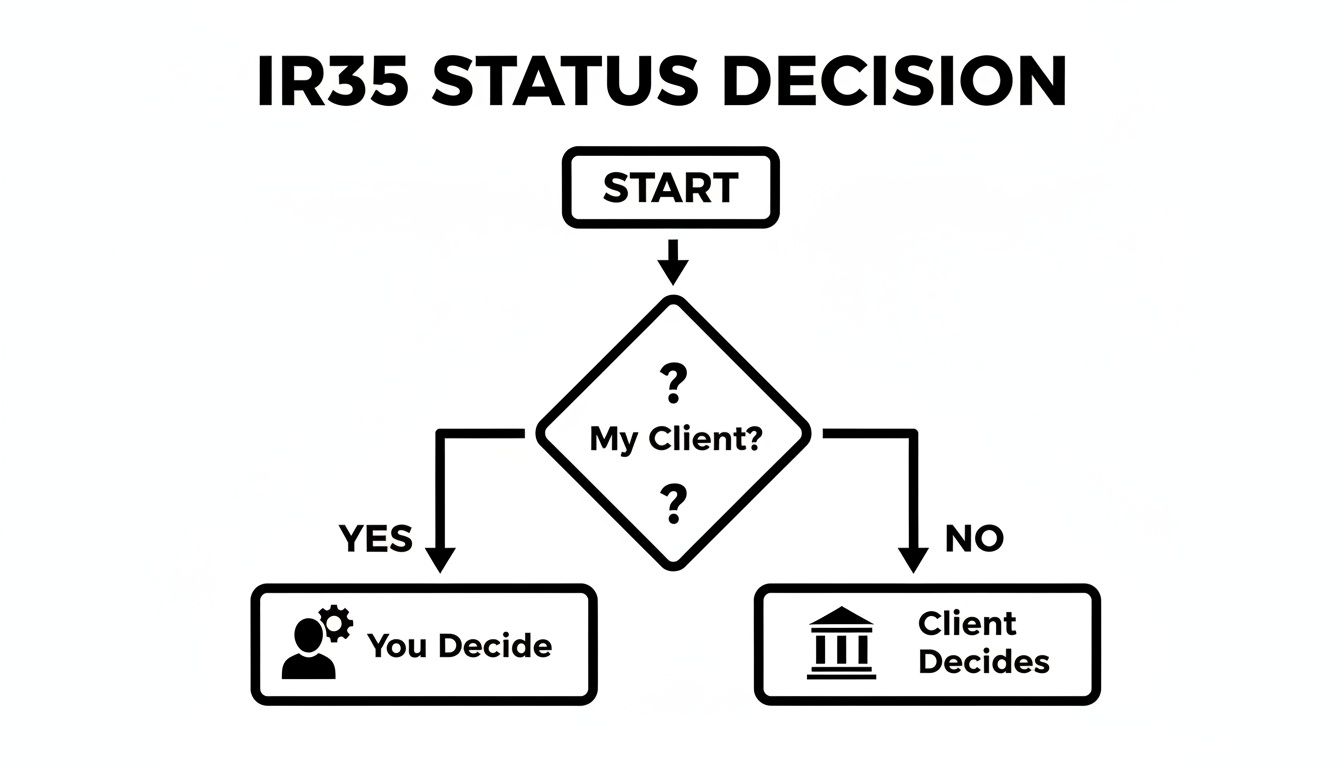
The message is simple: small client, your responsibility. This puts you firmly back in the driver's seat.
The Companies Act Small Company Test Criteria
To be certain, you need to check your client's figures against the official thresholds. A business qualifies for the small company exemption if it meets at least two of the following three criteria in its most recent financial year.
| Criterion | Threshold | Key Information |
|---|---|---|
| Annual Turnover | Not more than £10.2 million | Found in the Profit and Loss Account of the company's filed accounts. |
| Balance Sheet Total | Not more than £5.1 million | The total value of the company's assets, listed on the balance sheet. |
| Average Number of Employees | Fewer than 50 | Usually found in the notes accompanying the annual accounts. |
Checking these three simple figures gives you a definitive answer and peace of mind before you sign anything.
Using Companies House for Your Checks
The best and most reliable place to find this information is Companies House, the UK's official register of companies. It is free, public, and should be your first port of call for any new private sector client. Do not skip this step.
Here is a simple, step-by-step guide to get it done:
- Head over to the Companies House website: Just search for the official government service.
- Find your client: Pop in their full registered name or, even better, their company number if you have it.
- Click the 'Filing History' tab: This is where all their official documents live.
- Locate the latest accounts: You are looking for the most recent document labelled 'Full accounts'. They file these once a year.
- Examine the financials: Open up the PDF and scan for the balance sheet and the profit and loss account (which shows their turnover). Employee numbers are almost always tucked away in the notes section.
That's it. A few minutes of detective work is all it takes to know for sure where you stand.
Handling Complex Client Scenarios
While checking a single, standalone company is straightforward, things are not always so simple. You need to watch out for a few common edge cases that can catch contractors out.
Parent Companies and Groups: Is your client part of a bigger group? If so, you need to look at the numbers for the entire group, not just the individual company you are invoicing. All the turnover, assets, and employees of the parent company and its subsidiaries get added together. If those combined figures push them over the small company limits, the exemption is off the table.
Unincorporated Businesses: The off-payroll rules only apply to public authorities and medium or large organisations. Sole traders and partnerships are not classified as 'organisations' in the same way. The upshot? If your client is an unincorporated business, the IR35 decision is always your responsibility, no matter how much they turn over or how many people they employ. It helps to get your head around the different types of business structures to be clear on this.
Remember, the responsibility to check lies with you. Do not just take a client's word for it. Save a copy of their accounts as proof of your due diligence; it is crucial evidence if HMRC ever comes knocking.
By being proactive, you arm yourself with clarity. You will know from day one who holds the IR35 responsibility, allowing you to manage your contracts, stay compliant, and keep your business on solid ground.
Your Responsibilities When Working with a Small Company
When your client qualifies for the IR35 small company exemption, the whole dynamic changes. The legal duty to figure out the IR35 status of the engagement does not lie with them anymore, it lands squarely on your shoulders.
This means you, through your Personal Service Company (PSC), are back in the driver's seat. It is a world away from working with medium or large clients, where you are simply handed a Status Determination Statement (SDS) with little say in the matter. The exemption empowers you to make your own fair and accurate assessment based on how you actually work.

But with this freedom comes a critical responsibility: you have to get it right. A wrong call could leave you facing a hefty tax bill and penalties from HMRC down the line. So, carrying out a robust and diligent status assessment is not just a good idea; it is absolutely essential.
Conducting a Robust Self-Assessment
Making the right call on your IR35 status means looking far beyond the written contract. You need to get to grips with the genuine nature of your working relationship, digging into the key employment status tests that HMRC would use if they ever came knocking.
Over many years of case law, a few key pillars have emerged that are crucial for deciding whether a contract falls inside or outside IR35.
Your assessment should focus on three main areas:
- Control: Does your client dictate how, when, and where you do the work? A genuine contractor almost always keeps a high degree of control over their own work.
- Substitution: Do you have the genuine, unrestricted right to send someone else to do the work in your place? This is a powerful indicator that you are operating outside IR35.
- Mutuality of Obligation (MOO): Is your client obliged to offer you more work once the current project ends, and are you obliged to take it? In a true business-to-business relationship, no such obligation exists.
These are not the only factors, but they carry the most weight. Crucially, your day-to-day working practices must match up with your assessment. It is no good having a right of substitution clause in your contract if, in reality, you could never actually use it.
Tools and Professional Support
While the responsibility is yours, you do not have to go it alone. There are plenty of tools and services out there to give you clarity and peace of mind.
A good starting point is HMRC’s own Check Employment Status for Tax (CEST) tool. It asks a series of questions and gives an indication of your status. But be warned, the tool has well-known flaws, especially around Mutuality of Obligation, and HMRC will not stand by its result if they feel the information you entered was not accurate.
For complete confidence, nothing beats getting a professional contract review. An IR35 specialist can analyse both your contract and your working practices, giving you an expert opinion and solid advice to strengthen your position. It is a small investment that can save you from major financial headaches later on.
Ultimately, the IR35 small company exemption gives you the power to operate ‘outside IR35’ when your engagement is genuinely a business-to-business one. This allows you to manage your PSC’s finances far more efficiently than if you were classed as an employee for tax purposes. If you are not sure how being 'inside IR35' affects your finances, it is worth learning more about how PAYE for contractors works. We provide the resources to help you make informed decisions, ensuring you stay compliant while making the most of your contracting career.
A Contractor's Action Plan and Best Practices
Knowing the rules around the IR35 small company exemption is one thing, but having a solid, repeatable process is what will actually protect your business. It is not enough to just understand your responsibilities; you need a practical action plan for every new engagement to stay compliant and in control.
Think of it as your pre-flight checklist. By running through the same steps every time, you manage your risk effectively and build a clear record of due diligence.
Your Step-by-Step Checklist
Before you even think about signing a contract with a potential client in the private sector, you need to have a clear process. Following these steps does not just protect you; it shows HMRC you are taking your obligations seriously.
Here is what every contractor should do:
- Verify Your Client's Size First: This is your absolute first move. Head over to the free Companies House service and check their latest filed accounts. If they tick at least two of the three boxes for a small company, the IR35 decision-making power falls squarely on your shoulders.
- Document Your Findings: Do not just glance at the numbers and move on. Download or screenshot a copy of the accounts. Make a note of the date you checked, along with the figures for turnover, balance sheet total, and employee count. This is your proof.
- Conduct and Record Your IR35 Assessment: With a small client, it is up to you to determine the status. Run the engagement through the key status tests (Control, Substitution, Mutuality of Obligation) and make an honest assessment. The crucial part? Write down your reasoning and the evidence you have used to support your "outside IR35" decision.
- Ensure Your Contract and Working Practices Align: Your written agreement has to match the reality of how you work day-to-day. A contract that screams "outside IR35" is worthless if your actual working practices look like you are just another employee. You can get a feel for the right clauses by looking at a professional freelance contract template.
- Consider a Professional Review: For real peace of mind, especially on a high-value or long-term project, it is worth getting an expert to review your contract and working practices. That third-party validation can be a very strong line of defence if you ever need it.
Communicating with Potential Clients
Sometimes a client's status is not clear-cut, or they might not even be aware the exemption exists. How you handle this conversation is important. You want to be professional and helpful, positioning yourself as a knowledgeable expert, not an adversary.
If you have done your checks and believe they qualify as small, you could say something like: "As part of my own compliance process, I've looked at your latest accounts on Companies House. It looks like your business qualifies for the small company exemption, which means my limited company is responsible for the IR35 determination. I've already done an assessment and I’m confident the role falls outside IR35." This shows you are proactive and on top of your game.
When an Umbrella Company Is Still the Smart Choice
Just because the IR35 small company exemption applies, it does not automatically mean you have to use your Personal Service Company (PSC). There are plenty of good reasons why an umbrella company might still be the most practical choice.
You should think about using an umbrella company if:
- The Engagement is Clearly 'Inside IR35': If your own assessment points to the contract being inside IR35, an umbrella is the simplest, most compliant way to get paid. They will handle all the PAYE tax and National Insurance for you.
- You Prefer Simplicity and Low Admin: Let's be honest, running a PSC involves a lot of admin, such as filing accounts, managing insurance, and more. Many contractors find the 'show up and work' simplicity of being an umbrella employee a welcome relief.
- You're New to Contracting: If you are just starting out, an umbrella can be a great way to test the waters of contracting without the upfront cost and hassle of setting up and running your own limited company.
The exemption gives you a choice. It puts the power in your hands to decide not only your IR35 status but also the best way to structure your business for a given contract. The right move depends on the specific engagement and your personal appetite for risk and admin.
To make things clearer, let's compare what you need to do when working with a small, exempt client versus a larger one.
Contractor Action Plan Small Client vs. Large Client
This table breaks down how your responsibilities shift based on the size of your end client.
| Action Item | Working with a Small Client (Exempt) | Working with a Medium/Large Client (Not Exempt) |
|---|---|---|
| Who determines IR35 status? | You (your PSC is responsible). | The Client is responsible for making the determination. |
| What do you receive? | You will not receive a Status Determination Statement (SDS). | You must receive a Status Determination Statement (SDS) from the client. |
| Your primary action | Check their size, document it, then conduct and record your own thorough IR35 assessment. | Review the client's SDS. If you disagree, you have the right to challenge it through their formal dispute process. |
| If the role is 'Inside IR35' | You must process payment via a "deemed salary" through your PSC's payroll or choose to use an umbrella company. | The fee-payer (client or agency) must deduct tax and NICs at source before paying your company. |
| Key Risk | You are liable if HMRC successfully challenges your "outside IR35" assessment. | The client is liable, provided they have taken "reasonable care" in their assessment. |
Ultimately, your approach needs to be tailored. For small clients, the onus is on you to be the expert, carrying out your own due diligence. For larger clients, your role shifts to checking their work and ensuring you are paid correctly based on their decision.
The Future of the Small Company Exemption
The rules around IR35 are not set in stone. Like most tax legislation, they shift and adapt to the UK's economic climate. For any contractor wanting to plan their career effectively, understanding where the IR35 small company exemption is headed is absolutely vital.

The government has always kept this exemption in place for one simple reason: to shield small businesses from the heavy administrative burden of the off-payroll working rules. It means smaller firms can bring in specialist freelance talent without getting tangled up in complex compliance. It is a win-win for both sides.
Looking ahead, it seems this principle is about to get a serious boost.
Planned Increases to the Small Company Thresholds
Big changes are on the horizon, and they will directly affect which of your clients are caught by the off-payroll rules. The government is planning to increase the financial thresholds that define a 'small' company. In simple terms, this means more businesses will soon fit under the exemption's protective umbrella.
These adjustments are being made to account for inflation and to simplify reporting for more UK businesses. For contractors, this is brilliant news. It means some clients currently classed as 'medium' will soon be reclassified as 'small', pushing the responsibility for the IR35 assessment right back to your PSC.
Here are the key proposed changes:
- Annual Turnover: Set to increase from £10.2 million to a higher figure, likely around £15 million.
- Balance Sheet Total: Expected to rise from £5.1 million to a new level, possibly near £7.5 million.
- Number of Employees: This one is expected to stay put at 50 employees.
This is not just a minor tweak. These new thresholds could pull a significant number of businesses back into the exempt category. That opens up more opportunities for you to work with clients where you are the one who determines your IR35 status.
What This Means for Your Contracting Future
While the final date is still to be confirmed, these new thresholds are expected to kick in from April 2026. This is a genuinely positive development for the contracting community, set to classify many more UK clients as 'small' and pull them out of the main off-payroll rules.
The current rules are clear: a client is small if they meet two of the three criteria (£10.2m turnover, £5.1m balance sheet, <50 employees). Some estimates suggest the proposed increases could exempt an additional 15-20% of mid-tier firms. You can read a more detailed analysis of how these changes will affect contractors to get the full picture.
Staying on top of these upcoming changes is crucial for long-term planning. A client who is medium-sized today could easily become 'small' in 2026, which fundamentally changes how you engage with them and who is responsible for IR35.
We keep a close watch on legislative changes so you do not have to. By staying ahead of the curve, you can see these shifts coming, spot new opportunities, and make sure you are always prepared for whatever comes next. This evolving landscape simply reinforces how important it is to perform diligent client checks and robust status assessments.
Common Questions About the Exemption Answered
When you are dealing with the IR35 small company exemption, theory is one thing, but real-world contracting often throws up some tricky questions. Let's walk through some of the most common scenarios we see and get you some straight answers.
The goal here is to give you the confidence to handle these situations, stay compliant, and keep your focus on delivering great work for your clients.
What Happens if My Client Grows Mid-Contract?
This is a great question, and it is a situation that can easily catch contractors out. Let’s say you sign a 12-month contract with a client who is clearly a small business. But six months down the line, they land a huge new project or buy another company, and suddenly their turnover and staff numbers push them over the small company threshold.
What now?
The key thing to know is that a client's size is assessed for a full tax year. HMRC's rules state that the responsibility for the IR35 assessment only shifts to the client from the start of the next tax year after the one where they stopped being small.
Here is a quick example:
- You start a contract in June 2024. Your client is small, so you are responsible for IR35.
- In October 2024, they file their annual accounts, which show they now qualify as a medium-sized business.
- For the rest of this tax year (until 5th April 2025), nothing changes. The responsibility for determining IR35 status stays with you.
- From the beginning of the next tax year (6th April 2025), the responsibility moves to your client. At that point, they will be required to give you a Status Determination Statement (SDS).
Your Action Plan: It pays to be proactive. Keep half an eye on your client's Companies House page and do not be afraid to have a conversation with them if you think they might be getting close to the threshold. A little forward planning can save a lot of last-minute hassle.
Do the Rules Differ for Charities or Public Sector Bodies?
Yes, they do. The IR35 rules are not a one-size-fits-all solution, and it is crucial to know how they apply to different types of organisations.
Public Sector Organisations: This one is simple. The small company exemption does not apply to the public sector at all. If you work for a public authority, it is always their responsibility to determine your IR35 status, no matter how big or small they are. This has been the rule since 2017.
Charities: This can be a bit more complicated, as it depends entirely on the charity's legal structure.
- If the charity is set up as a company (like a company limited by guarantee), the normal small company test applies. You would check its turnover, balance sheet, and employee count just as you would for any other business.
- If the charity is unincorporated (for example, a trust), the rules do not class it as a medium or large "organisation". In that case, the responsibility for the IR35 decision always rests with you, the contractor.
Before starting work, always make sure you are clear on the legal structure of any third-sector client.
What Records Should I Keep as Proof?
Good paperwork is your best friend if HMRC ever comes knocking. Keeping organised records shows you have taken your obligations seriously and done your due diligence.
For every contract with a small client, your evidence file should contain:
- Proof of Client Size: A screenshot or PDF of the client’s latest accounts from Companies House. Make sure you date it so you can show when you checked.
- Your IR35 Assessment: A document explaining why you believe the contract is 'outside IR35'. Refer to the main status tests (Control, Substitution, Mutuality of Obligation) and how they apply to your specific working relationship.
- The Contract: A signed copy of your contract. Double-check that the clauses in it support your 'outside IR35' position.
- Proof of Working Practices: Any emails, project briefs, or other documents that show your autonomy. This is vital for proving that the reality of how you work matches what is written in the contract.
The best way to think about it is this: if you had to defend your decision to an HMRC inspector, what documents would you want in your hands? Get that file together from day one, not when a letter lands on your doormat.
Can I Still Use an Umbrella Company for an Outside IR35 Role?
Yes, absolutely. While running an 'outside IR35' contract through your own limited company (PSC) is often the most tax-efficient route, it is not the only way. Many contractors decide that the simplicity and security of an umbrella company is a better fit, even for a project with a small client.
There are a few solid reasons you might go down this path:
- Less Admin: Running a PSC involves a lot of work, for instance, accounts, tax returns, and insurance. An umbrella company takes care of all that for you.
- Employment Rights: When you work through an umbrella, you are their employee. This means you get statutory rights like sick pay, holiday pay, and a workplace pension.
- Peace of Mind: For some, the slightly lower take-home pay is a small price to pay for knowing all your tax and National Insurance is being handled correctly, with no risk of a future IR35 investigation.
The IR35 small company exemption gives you a choice. You can take on the responsibility of status determination yourself through a PSC, or you can opt for the straightforward, fully-employed model of a compliant umbrella company. The right decision is all about your personal preference and how much admin you are willing to take on.
At UmbrellaCompany.com, we specialise in helping contractors find the perfect compliant umbrella solution for their needs. Whether your contract is inside or outside IR35, our comparison portal makes it easy to choose a trusted provider. Find your ideal match today at https://umbrellacompany.com.


